

















Empresas Públicas de Medellín (EPM) has officially inaugurated the Tepuy photovoltaic solar park in La Dorada, Caldas, adding 83 megawatts of non-conventional renewable energy to Colombia’s National Interconnected System (SIN). The project, part of EPM’s broader strategy to support the country’s energy transition, required an investment of over 397 billion pesos and created approximately 1,800 jobs during its peak construction phase, with 52% of the workforce sourced from the local area.
The Tepuy solar park, EPM’s first large-scale photovoltaic project, covers 320 hectares near the village of Santa Helena. The facility includes 199,534 bifacial photovoltaic panels, installed on 2,290 solar trackers and connected to 320 inverters. The project also dedicates 60 hectares to environmental protection and conservation.
EPM General Manager John Maya Salazar noted that Tepuy’s 83 megawatts of power generation capacity is sufficient to supply energy to a city of about 400,000 inhabitants. The project aims to enhance Colombia’s power generation capabilities while contributing to climate change mitigation by reducing approximately 33,000 tons of CO2 emissions annually.
The construction of the Tepuy park adhered to environmental regulations set by the Regional Autonomous Corporation of Caldas (Corpocaldas). The project included comprehensive environmental management efforts, such as rescuing and relocating 1,669 wildlife specimens to a reserve area within the park and protecting 874 flora species, including bromeliads and orchids, with a 97% survival rate.
Additionally, EPM and the SENA Caldas regional office implemented a training program for over 300 local residents, equipping them with skills in the installation of solar panels and related equipment, thereby enhancing employment opportunities in the area.
The Tepuy solar park is expected to operate for 35 years, contributing to Colombia’s renewable energy supply and supporting the country’s sustainability goals. The project was partially financed by the French Development Agency (AFD).
Global aviation giant Emirates and Colombian airline Avianca recently launched a codeshare agreement that will allow customers to connect more easily across each others’ flight networks.
“Emirates customers flying on its network via Madrid, Barcelona, or London (Heathrow) can go directly to three points in Colombia and enjoy seamless connectivity, plus other travel benefits that offer more convenience,” said Emirates in a statement. “Codeshare flights will include Madrid to Bogotá, Medellín or Cali; Barcelona to Bogotá; and London to Bogotá.”
For its part, Avianca will place its code on routes operated by Emirates between Barcelona, Madrid or London (Heathrow) and Dubai.
“Customers of both airlines,” added Emirates, “will enjoy the convenience of smoother connectivity, a single booking on a single ticket with no hassle, while taking advantage of the advantage of securing competitive fares and a single checked baggage allowance to the final destination.”
The agreement comes just a few months after Avianca publicly opposed Emirates entry to the Colombian market.
Specifically, the Colombian carrier complained that “Emirates just wants to exploit mature markets” and threatened that hundreds of jobs would be put at risk.
Such claims did not sway the Andean nation’s regulators, which approved Emirates’ request for authorization to become a foreign operator to operate international regular public transport air services on international routes to and from Colombia, from Dubai and Bogotá, with a stopover in the city of Miami.
“The codeshare agreement will allow us to expand our reach and allow our customers to use our services and fly to additional popular points in Colombia,” said Adnan Kazim, deputy president and chief commercial officer at Emirates.
Barranquilla based Tecnoglass, Inc. (NASDAQ: TGLS), Colombia’s largest manufacturer of architectural glass, windows, and associated aluminum products serving the global residential and commercial end markets, has announced that its board of directors has declared a quarterly cash dividend of $0.11 per share, or $0.44 per share on an annualized basis, for the second quarter of 2024. The dividend will be paid on July 31, 2024, to shareholders of record as of the close of business on June 28, 2024.
Tecnoglass serves multi-family, single-family and commercial end markets, and is the second largest glass fabricator serving the U.S. With production facilities located in Barranquilla, Colombia, the company’s 2.7 million square foot, vertically integrated manufacturing complex serves over 1,000 global customers, with the U.S. accounting for more than 90% of revenues.
Tecnoglass’ tailored, high-end products are found on some of the world’s most distinctive properties, including One Thousand Museum (Miami), Paramount (Miami), Salesforce Tower (San Francisco), Via 57 West (NY), Hub50House (Boston), Aeropuerto Internacional El Dorado (Bogotá), One Plaza (Medellín), Pabellon de Cristal (Barranquilla).
Today in a civil trial taking place in Florida, a jury ruled in favor of 17 plaintiffs, victims of AUC (Autodefensas Unidos de Colombia) violence, ordering the Banana company Chiquita Brands International to pay up to $2 million USD for each of the deaths of eight relatives. In total the company was ordered to pay $38.3 million USD.
The ruling means that North American consumers of Chiquita Bananas were unwittingly funding a violent criminal mafia in Colombia.
The trial, which took place in West Palm Beach, Florida, started April 24. Chiquita was held liable for its total of $1.7 million dollar payments between 1997 to 2004 to the AUC, a violent right-wing criminal group that while first was organized as vigilantes against communist rebels such as the FARC and ELN, quickly devolved into narcotrafficking, extortion, sexual violence, and other crimes. In other legal actions, Chiquita was also found guilty of payments to communist guerillas as well.
In its defense, Chiquita claimed that it was obligated to pay the AUC what mounted to extortion in order to protect the company’s workers in Colombia, though the jury did not accept the excuse, as the payments simply served to expand the AUC in the Magdalena Medio and Urabá regions of Colombia, areas that still suffer from violence and crime today, often involving AUC descendant groups such as the Clan del Golfo Mafia.
Chiquita has already pleaded guilty in 2007 and fined $25 million USD by the US Justice Department, but as a criminal fine, that money did not reach Colombian victims. Chiquita actually sued the National Security Archive seeking to keep documentation of the company’s criminal activity secret and unpublished.
See also: The Chiquita Papers – Banana Giant’s Paramilitary Payoffs Detailed in Trove of Declassified Legal, Financial Documents
A new advisory board was convened to address the challenges and opportunities related to integrating ethnic talent into corporate value chains. The board aims to identify obstacles, analyze business practices that may hinder participation, and propose actions to improve the hiring, development, and retention of ethnic talent within the private sector.
The session included representatives from various companies, such as Pavco, Ingredion, and Bancolombia, alongside ethnic leaders who highlighted the importance of diversity, equity, and inclusion in business.
Luis Sevillano, director of the Ethnic Board Program of USAID and ACDI/VOCA, emphasized the economic impact of exclusion. “Understanding the cost of exclusion helps us recognize the economic implications for both the business sector and the country. This prompts a reflection: Isn’t it good business to capitalize on diversity and the opportunities that inclusion offers? Failing to do so could mean missing out on competitiveness,” said Sevillano.
Catalina Martínez, director of the ANDI Foundation, underscored the significance of the Advisory Board in fostering concrete actions. “This space is crucial for private sector representatives, encouraging them to highlight the importance of ethnic inclusion in business competitiveness and to share effective practices, inspiring others to join this initiative,” Martínez stated.
The project, titled Fostering the Inclusion of Ethnic Groups in Business Value Chains, is a collaboration between USAID’s Ethnic Board Program, ACDI/VOCA, and the ANDI Foundation. It seeks to raise awareness among companies and promote actions to adapt inclusion processes in value chains. The initiative is supported by nine partner organizations, including the Black Communities Process (PCN), National Indigenous Organization of Colombia (ONIC), and the Regional Indigenous Council of Cauca (CRIC).
The USAID and ACDI/VOCA Ethnic Board Program focuses on supporting the self-determined development of indigenous and Afro-Colombian communities by strengthening institutional capacity and promoting ethnic organizations. It also aims to increase access to socio-economic opportunities and enhance respect for ethnic heritage and cultural diversity.
The ANDI Foundation, since 2014, has led the Inclusive Competitiveness Strategy, which positions the private sector as a key player in creating a business environment that is not only competitive but also equitable and inclusive. The strategy emphasizes the need to diversify suppliers, reflect societal diversity within corporate staff, and leverage various groups to distribute products effectively.

The project, titled Fostering the Inclusion of Ethnic Groups in Business Value Chains, is a collaboration between USAID’s Ethnic Board Program, ACDI/VOCA, and the ANDI Foundation.
After successful bilateral talks between the US State Department and Colombian Foreign Minister Luis Gilberto Murillo, both sides announced new opportunities to work and study in the United States through either the H-2B visa program for seasonal or temporary non-agricultural workers, or through the Summer Work Travel and Camp Counselor Programs, which allow young people from around the world the chance to earn money and experience American culture working at fun places, like Cedar Point, Kings Island, Vail Resorts, Universal Destinations, Hershey Park, and hundreds of other destinations that hire extra staff during the busy summer vacation months.
Never fall for scammers who try to charge you to apply for jobs. Applying for jobs in the US is always FREE.
As first announced by our colleagues at EmpleoBilingue.com, Interested workers must hurry, because the application window has already opened! 20,000 visas are reserved for nationals of El Salvador, Guatemala, Honduras, Haiti, Colombia, Ecuador, and Costa Rica for the entirety of FY 2024. Citizens of other eligible countries may also apply under different allocations, see the table below for eligibility.
We reached out to our friends at the US State Department, and a US Embassy Bogotá spokesperson told us the following:
Every year, the United States welcomes thousands of foreign workers through the H-2B visa program to fill temporary, nonagricultural jobs in the United States. This year, in line with the Biden Administration’s commitment to expand lawful pathways as an alternative to irregular migration, the H-2B visa program includes a special allotment of 20,000 visas for workers from seven countries, including Colombia. H-2B visas are nonimmigrant visas that allow U.S. employers or agencies to temporarily employ foreign workers in the United States to fill urgent workforce demands. U.S. businesses in industries such as hospitality, tourism, landscaping, seafood processing, and more rely on seasonal and temporary workers in the H2-B program to help them meet demand. In order to apply for an H2-B visa, a U.S. employer or agency must petition for the workers they want to bring to the United States. Only foreign workers whose petitions have been approved by the Department of Homeland Security can apply for an H-2B visa. Because of this, anyone interested in applying for an H-2B visa must first search for U.S. companies seeking H-2B workers and contact the company to secure a job. One useful database of seasonal and temporary job openings is https://seasonaljobs.dol.gov/
In addition to the H2-B program, thousands of Colombian university students visit the United States every summer as part of the Summer Work Travel and Camp Counselor programs. Through these special exchanges, young Colombians work at U.S. summer camps all over the country or as seasonal or temporary employees for U.S.-based companies. On May 4, the U.S. Embassy opened its doors to 1,000 Colombian university students applying for J-1 visas to participate. For more information on how to apply for the summer work and travel program, please visit: https://j1visa.state.gov/programs/summer-work-travel#participants
Be sure to sign up to receive job alerts for bilingual opportunities at EmpleoBilingue.com
According to the US Citizenship and Immigration Service, effective Nov. 9, 2023, nationals from the following countries are eligible to participate in the H-2B program:
| Andorra | The Kingdom of Eswatini | Madagascar | Saint Lucia |
| Argentina | Fiji | Malta | San Marino |
| Australia | Finland | Mauritius | Serbia |
| Austria | France | Mexico | Singapore |
| Barbados | Germany | Monaco | Slovakia |
| Belgium | Greece | Mongolia | Slovenia |
| Bolivia | Grenada | Montenegro | Solomon Islands |
| Bosnia and Herzegovina | Guatemala | Mozambique | South Africa |
| Brazil | Haiti | Nauru | South Korea |
| Brunei | Honduras | The Netherlands | Spain |
| Bulgaria | Hungary | New Zealand | St. Vincent and the Grenadines |
| Canada | Iceland | Nicaragua | Sweden |
| Chile | Ireland | North Macedonia | Switzerland |
| Colombia | Israel | Norway | Taiwan* |
| Costa Rica | Italy | Panama | Thailand |
| Croatia | Jamaica | Papua New Guinea | Timor-Leste |
| Czech Republic | Japan | Peru | Turkey |
| Denmark | Kiribati | Philippines | Tuvalu |
| Dominican Republic | Latvia | Poland | Ukraine |
| Ecuador | Liechtenstein | Portugal | United Kingdom |
| El Salvador | Lithuania | Republic of Cyprus | Uruguay |
| Estonia | Luxembourg | Romania | Vanuatu |
Above photo: Cedar Point in Sandusky, Ohio (Photo: Loren Moss)
Feria de las 2 Ruedas 2024 (F2R) (2-Wheel Fair), the leading motorcycle event in Colombia, brought together a record 88,600 attendees in Medellín from May 2-5.
Click on the above image to play the video.
Participation in the 16th edition of the annual fair beat the previous high and included nearly 3,500 accredited members of the international business community from more than 40 countries, including most of Latin America, Japan, Australia, Saudi Arabia, Switzerland, India, Afghanistan, and more.
Of the 450 total exhibitors, 106 were international, including 12 first-time foreign exhibitors and a large presence of industry companies from Asia.
In terms of economic impact, F2R 2024 generated more than $20 million USD for the city, according to the Secretariat of Economic Development of Medellín, and helped facilitate upward of $60 million USD in sales, both between exhibitors in large-volume transactions and in sales to the general public who attended. More than 1,400 motorcycles were sold during the show, according to organizers.
Next year’s event is May 15-18, 2025
For more information go to https://www.feria2ruedas.com/en/visit…
See also:
Forgive the absence! I was attending BPRO’s CX Summit in Cartagena, and then I was off to Nairobi Kenya for the opening of CCI Global’s lovely new 5,000 seat contact center. But now I’m back, and there has been a lot going on!
Click on the above image to play the video.
Collective Mining keeps finding gold
First, some good news. Collective Mining (TSX: CNL, OTCQX: CNLMF, FSE: GG1), which is developing a gold mine down in the Caldas region in coffee country has five drill rigs operating at its Guayabales project, part of its 40 thousand meter drill program for this year. They are getting really encouraging results. This is the same team that developed Continental Gold and sold it to Zijin mining a few years ago for over a billion dollars. We published a more detailed update in Finance Colombia if you want to go over the numbers and assay results of this most recent update. I’m long on Continental because I believe in the team led by Ari Sussman.
Collective Mining Expands its Box Target Area with New High-Grade Samples; Drilling Continues
Petro threatens the private sector with “forced investments!”
President Gustavo Petro is once again terrifying investors, this time with an announcement that he plans to force private banks to loan money to projects and borrowers of his choosing. He said, and I translate:
“I promised that we were going to present the measures to the congress of the republic to reactivate the economy which will consist, and I say it once and for all, in projects of law that generate FORCED INVESTMENT in the private financial system of Colombia destined to small, medium and large industry of agriculture and tourism in Colombia to reactivate the country.”
This is what Petro’s opponents warned about, and at least when it comes to intent, they were right. The question now is whether Colombia’s institutionalism can withstand more of his adventures. Statements and plans like this destroy investor confidence and scare away capital, just like what is happening with Ecopetrol.
“…and I say it once and for all, in projects of law that generate FORCED INVESTMENT in the private financial system of Colombia” – President Gustavo Petro
General Motors To Close Colombia Manufacturing Operations
Speaking of scaring away capital, General Motors is closing its Colmotores car factory after almost 70 years in Colombia. Now two years ago, GM said it was going to invest 50 million dollars to upgrade the factory to produce new models! What has changed? By the way, the Minister of Labor has told GM that they have to keep the workers employed even though the factory is closing, so we will see how that works out.
Alvaro Uribe is formally charged with witness tampering & bribery
Former President Alvaro Uribe, who in recent years has seen his once stellar legacy tarnished by a litany of revelations, is now formally charged with witness tampering in a drama that goes back to 2012. See the AP article here. https://apnews.com/article/colombia-alvaro-uribe-charges-witness-tampering-bd11a922142d000db1fcac178a1a147e
Bilateral harmony between Colombia & US leads to results
In some good news Colombia hosted a US State Department delegation last month for high level talks which led to several announcements. Foreign Minister Luis Gilberto Murillo, who actually was a US Citizen for a while, has announced that Colombians can now access almost 20 thousand United States non-agricultural work visas, and more than 1,000 summer job visas. We will do a write up on this both on Finance Colombia and Empleobilingue, the only source on the web for bilingual talent.
Colombia is going to open five new consulates in Phoenix, Dallas, Denver, Charlotte and Seattle. There are already 9 thousand Colombians studying in the US on Student Visas, and there is a family unification program already in effect between the two countries which has 6,000 current authorizations by the State Department.
The mammoth UNGRD scandal that threatens Petro
There is an ongoing scandal in the Petro Administration where the government paid the equivalent of $12 million US dollars for a fleet of water tanker trucks to supply water to citizens of La Guajira, the desert region on the Atlantic Coast near the Venezuelan border. Now, no water got to the residents of La Guajira, the trucks sat idle on a Colombian military base. But the money paid to a contractor by Colombia’s UNGRD (National Unit of Disaster Risk Management) was “allegedly” used to bribe Senate President Iván Name and Andrés Calle in the house of representatives to unblock opposition to Petro’s reform bills. According to Colombia’s comptroller, the Controller General (Contraloria), each tanker truck was purchased from the dealer, Kenworth de la Montaña, in Medellín, for about 600 million pesos, but then sold to the government for $1.2 billion pesos. This way they could launder money out for political purposes.
Former Deputy Director of the UNGRD, Sneyder Pinilla “prendió el ventilador-started the fan” (Colombian saying, like “when the shit hits the fan”) and accused former director of the UNGRD, Olmedo Lopez of using the UNGRD money through this conspiracy to pay the bribes, covering it up with this tanker truck contract, and that the payments were made at the direction of Petro’s Minister of the Interior, Luís Fernando Velasco, and the Councilor for the Regions, Sandra Ortiz, who was actually the bag man, or “bag woman.”
Now Olmedo López and Sneyder Pinilla are testifying and want immunity with Colombia’s attorney general, because they say that the tanker scandal is just the tip of the iceberg in a case that for Colombia, may be larger than the Odebrecht scandal.
According to these two, a political machine was put in place inside the Petro administration that would launder 380 billion pesos, or almost $100 million US dollars of “marmalade” or UNGRD funds into the hands of legislators and bureaucrats to bribe for passage of Petro’s reforms, all of which have failed so far, and to finance last October’s local elections, where again, Petro’s party and allies lost badly. Lopez says the tanker truck scandal just got discovered but according to him there is a whole infrastructure inside Petro’s government operating with this modality to bribe legislators and fund campaigns.
Now the scary thing is that the company that sold the trucks, Impoamericana Roger SAS was sold to Elmer Celis in 2019, and right before the contract for the tankers was being finalized, Celis was assassinated. So this scandal now has deadly implications.
Sura wants out of the EPS health system
Grupo Sura, the insurance and asset management giant has told the Colombian government that it plans to withdraw from the national EPS health insurance scheme. They are supposed to be meeting with the company to negotiate what happens.
Colombia wants the gold from a Spanish Galleón, so do Bolivians
In 1708 the Spanish galleon San José was sunk by the British during the War of Spanish Succession. in the Caribbean sea off the coast of Cartagena. The shipwreck was found in 2015 in about 600 meters, or 328 fathoms, or 2,000 feet of water, and Colombia is claiming it as its own and using the military to fend off any would-be treasure hunters. Last month, Colombia announced that it was launching a research and recovery project, aiming to prioritize the historical value of the wreck. There are complications though. The ship was Spanish, so Spain would need to renounce any sovereignty over the wreck. Spain considers the ship a graveyard that should not be molested out of respect for the dead.
Down in landlocked Bolivia, the Chicha, Caranga and Killaka people have filed claims with UNESCO saying that their enslaved ancestors extracted the treasure onboard from mines in what is now Bolivia, and have a right to share in whatever wealth is in the shipwreck.
This is going to be an interesting case. There is a treaty, the 2001 Convention on the Protection of Underwater Cultural Heritage. Spain is a signatory, so is bound by the treaty, but Colombia never ratified or signed it, so is not bound by it.
Colombia has (finally) outlawed bullfighting
The Colombian house of representatives has outlawed bullfighting, a 500 year old tradition of bovine torture inherited from the Spanish. There are still people who defend bullfighting. The bill is in reconciliation with the senate, and then goes to President Petro, who is sure to sign it into law.
Mafia guerilla groups flourishing, expanding under Petro’s “Total Peace” fiasco
Reuters is reporting that it got access to a secret report showing that all the major criminal mafias in Colombia expanded in 2023, making a mockery of President Petro’s “Total Peace” initiative. Those criminal organizations would be the Clan del Golfo, ELN, and the two former FARC groups Estado Mayor and Segunda Marquetalia. Petro ran his campaign promising “Total Peace” but these groups, three of the four are avowed communist guerillas, and the Clan Del Golfo a descendant of paramilitaries, just keep getting bigger. When is Petro going to start?
Reuters also reported on illegal road building in the Amazon rainforest, in some cases by these same groups, that the government is supposed to be stopping. For example, Chiribiquete, nobody is even allowed to go in there but there are at least 12 illegal roads built, according to Reuters!
These mafias, in this case it looks like the Estado Mayor – former FARC, is building these roads to conduct illegal activities in nature preserves, and the government is unwilling to do anything, or at least, so far it is not combatting the activity.
So that’s it for this week.
Remember to practice critical thinking
Stay mentally and physically active,
And above all, be kind to yourself and others.
Collective Mining Ltd. (TSX: CNL, OTCQX: CNLMF, FSE: GG1), a Canada-based mining company with operations in Caldas, Colombia announced today that new high-grade assay results from surface outcrop samples have expanded the Box Target and that visual inspection of recently completed drill holes point to the potential for a large-scale system in the area at depth. The company has five drill rigs operating at the Guayabales Project as part of its fully funded 40,000 metres drill program for 2024. Drill rigs are currently operating at the Apollo, Box, Olympus and Trap targets. Drill cores from multiple holes are currently being assayed at ALS Laboratory in Lima, Peru with results expected in short order.
David Reading, Special Advisor to Collective commented: “Surface exploration work at the Box Target continues to confirm a very similar geological and geochemical footprint to the Apollo system. Visual observation from the three holes drilled in the northern portion of Box are promising and highlight multiple styles of mineralization, which are typical of the upper levels of a porphyry system and are proving useful in assisting our team to vector towards the center of the system. The discovery of brecciated porphyry outcrops in the south, some 400 metres higher in elevation, is also very encouraging and we hope to be drill testing that area soon. Reconnaissance exploration at Box is in its infancy, and to date, we have only drill tested a small portion of the total area at very shallow levels. The Box porphyry centre is only 1.5 kilometres west of the Apollo system and we believe that both systems form part of a much larger cluster of porphyry bodies.”
Highlights (see Table 1 and Figures 1-2)
- Further surface exploration work at Box has discovered new well mineralized, brecciated porphyry outcrops resulting in an expansion of the target area by 300 metres to the south. The Box target area now measures approximately 1.3 kilometers by 0.8 kilometers by 0.4 kilometers vertically and remains open in all directions and at depth (see Figure 1).
- In the south, two new outcrop areas of brecciated porphyry with overprinting CBM veins have been identified and host the same type of consistent high-grade gold and silver mineralization as the north zone with values up to 12.02 g/t gold equivalent (11.06 g/t gold, 106 g/t silver and 0.02% copper). See Table 1 for further details.
- Three reconnaissance drill holes have been completed to date in the northern portion of the Box target and highlight multiple mineralization styles including porphyry vein stockwork, brecciated porphyry and CBM vein systems. All styles of mineralization encountered are associated with sericite alteration typical of the upper portions of a porphyry system indicating that deeper drilling is required. Assays results expected in the near term.
- Two drill rigs are operating at Box with immediate plans to steepen the next drill holes in order test below the multiple mineralized outcrops. Additionally, new drill pads are being constructed in the central and southern areas of Box with drilling of these areas expected to commence shortly.
Table 1: New Rock Chip and Channel Sample Results from The Box Target
| Sample ID | Au (g/t) |
Ag (g/t) |
Cu (%) |
AuEq (g/t) |
Mineralization Style |
| R8928 | 11.06 | 106 | 0.02 | 12.02 | CBM Sheeted Veins |
| R8624 | 3.42 | 308 | 0.03 | 7.02 | Brecciated porphyry |
| R8343 | 2.58 | 238 | 0.02 | 5.38 | Brecciated porphyry |
| R8344 | 1.45 | 304 | 0.05 | 5.09 | Brecciated porphyry |
| R8439 | 1.76 | 229 | 0.01 | 4.44 | Porphyry Stockwork |
| R8517 | 2.49 | 110 | 0.13 | 3.90 | CBM Sheeted Veins |
| R8441 | 0.92 | 239 | 0.01 | 3.75 | Brecciated porphyry |
| R8345 | 2.19 | 128 | 0.01 | 3.67 | Brecciated porphyry |
| R8661 | 0.89 | 213 | 0.05 | 3.54 | Brecciated porphyry |
| R9050 | 2.84 | 28 | 0.00 | 3.09 | Brecciated porphyry |
| R8621 | 1.82 | 104 | 0.01 | 3.03 | Brecciated porphyry |
| R8430 | 2.09 | 71 | 0.02 | 2.93 | Porphyry Stockwork |
| R8628 | 2.00 | 79 | 0.02 | 2.91 | Brecciated porphyry |
| R8513 | 1.59 | 101 | 0.09 | 2.90 | Brecciated porphyry |
| R8689 | 1.53 | 100 | 0.02 | 2.70 | Porphyry Stockwork |
| R8432 | 1.77 | 73 | 0.01 | 2.61 | Porphyry Stockwork |
| R8690 | 0.99 | 119 | 0.01 | 2.41 | Porphyry Stockwork |
| R8622 | 2.33 | 10 | 0.01 | 2.39 | Brecciated porphyry |
| R8607 | 1.30 | 82 | 0.02 | 2.26 | Brecciated porphyry |
*AuEq (g/t) is calculated as follows: (Au (g/t) x 0.97) + (Ag (g/t) x 0.014 x 0.88) + (Cu (%) x 1.47 x 0.90) + (Mo (%) x 7.41 x 0.85) utilizing metal prices of Cu – US$3.95/lb, Ag – US$25/oz, Mo – US$ 20/lb, and Au – US$1,850/oz and recovery rates of 97% for Au, 88% for Ag, 85% for Mo, and 90% for Cu. Recovery rate assumptions for metals are based on metallurgical results announced on October 17, 2023, and April 11, 2024.
Figure 1: Plan View of The Box Target as Defined by Soil Anomalies, Rock Chip Samples and Surface Geology Mapping with New Assay Results
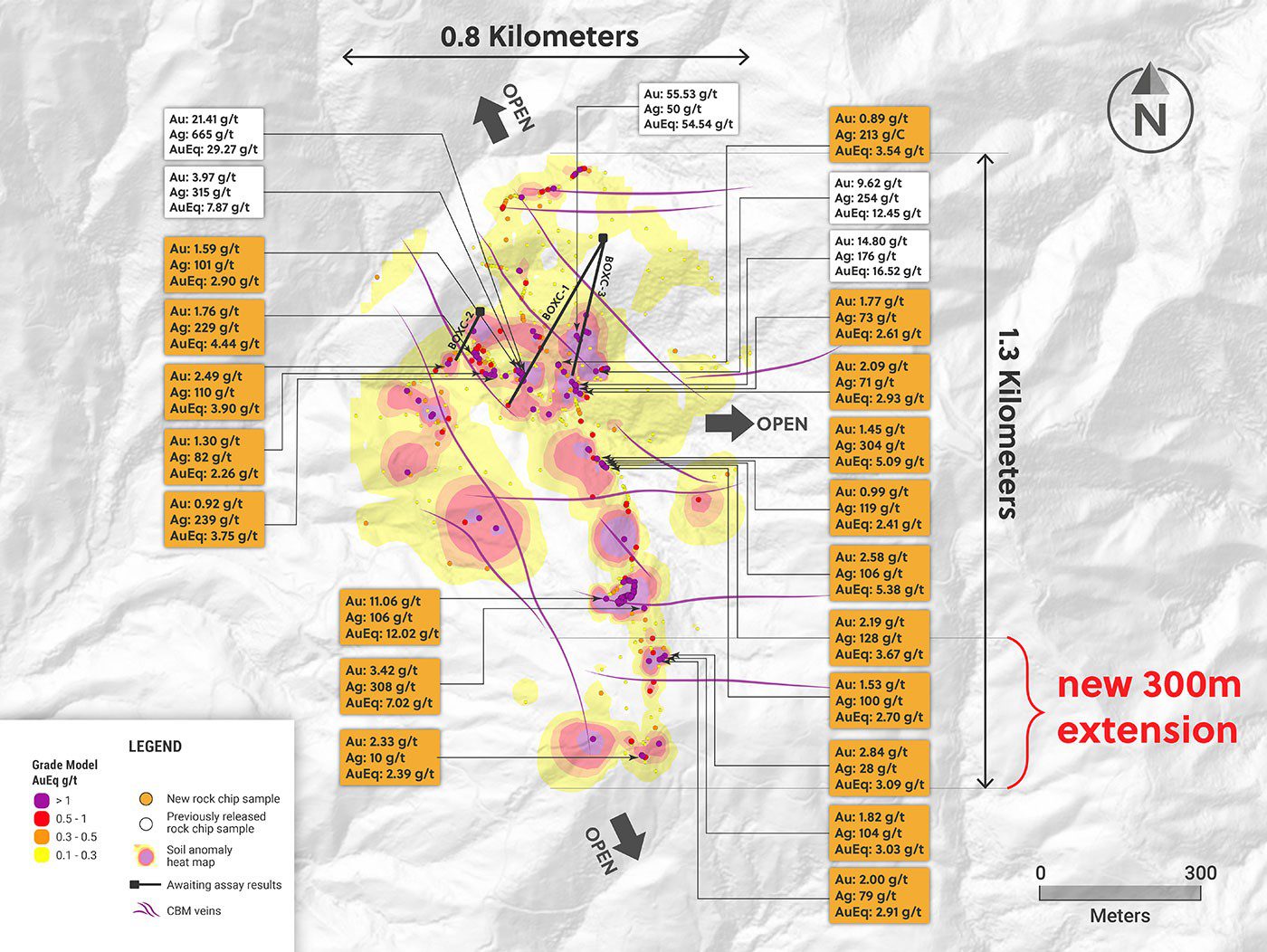
Plan View of The Box Target as Defined by Soil Anomalies, Rock Chip Samples and Surface Geology Mapping with New Assay Results
Figure 2: Plan View of the Guayabales Project Highlighting the Box Target Area
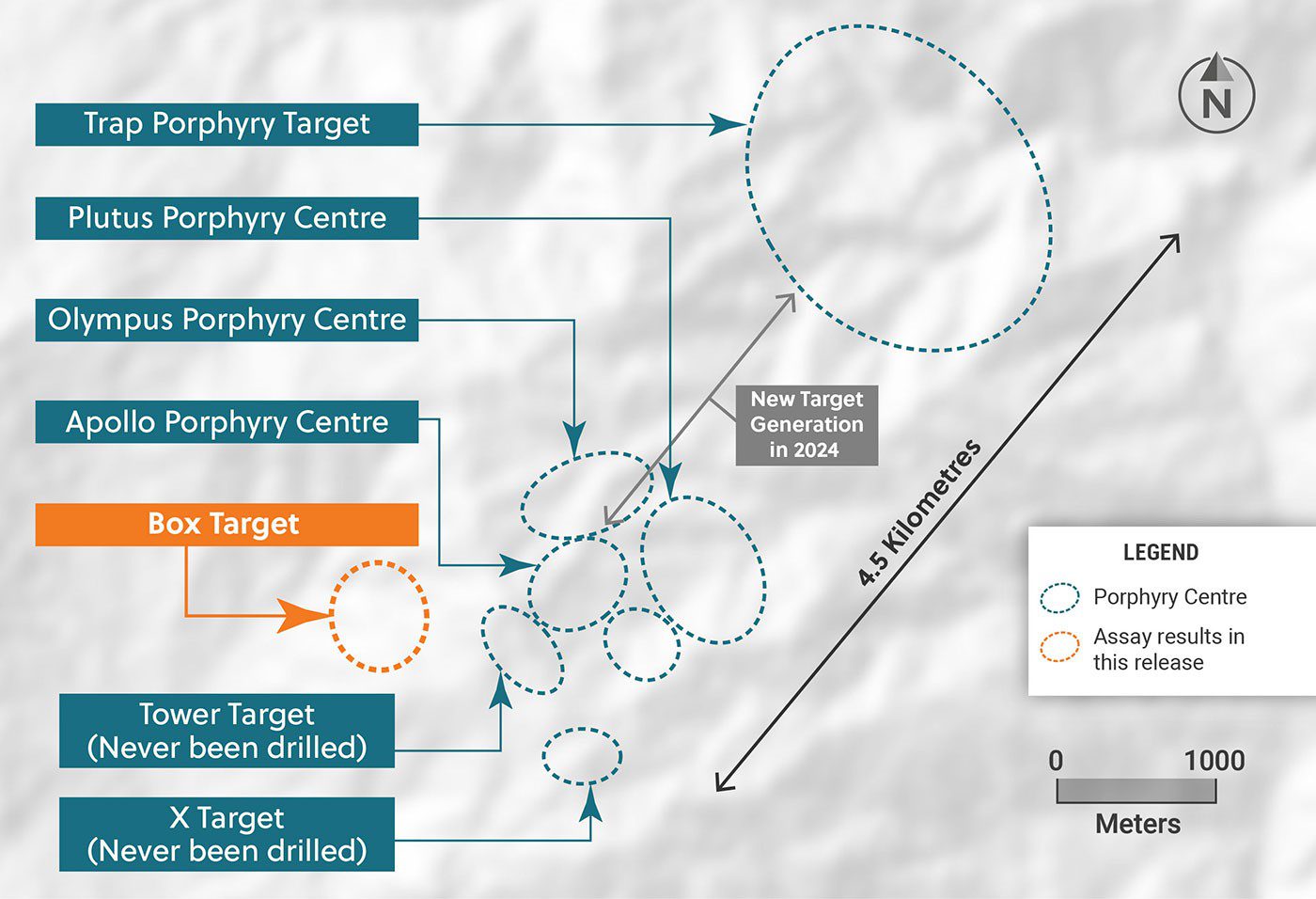
Plan View of the Guayabales Project Highlighting the Box Target Area
Rock, soils and core samples have been prepared and analyzed at ALS laboratory facilities in Medellin, Colombia and Lima, Peru. Blanks, duplicates, and certified reference standards are inserted into the sample stream to monitor laboratory performance. Crush rejects and pulps are kept and stored in a secured storage facility for future assay verification. No capping has been applied to sample composites. The Company utilizes a rigorous, industry-standard QA/QC program.
See also: Collective Mining and SENA’s Joint Training Initiative Has Helped More than 280 Women Join the Workforce
A proposed settlement has been reached in a class action lawsuit called Jane Doe, et al. v MasterCorp., Inc., Case No. 1:24-cv-00678 (E.D. Va.) (the “Settlement”). The Settlement is between Jane Doe, John Doe 1, and John Doe 2 (collectively “Plaintiffs”), on behalf of the proposed Settlement Class, and MasterCorp., Inc. (“MasterCorp” or “Defendant”). This Notice summarizes your rights and options. More details are available at www.ColombianHousekeeperSettlement.com.
Am I part of the Settlement Class?
You are a Settlement Class Member if:
- You are a Colombian National or of Colombian origin;
- You were paid by Perennial Pete, LLC or one of its affiliated entities or companies, including SM Cleaning Solutions Inc.; WD Cleaning Solutions Inc.; DM Cleaning Solutions Inc.; JM Cleaning Solutions Inc.; EV Cleaning Solutions Inc.; EM Cleaning Services and Solutions Inc.; SD Cleaning Services and Solutions Inc.; and
- You provided housekeeping services at resorts in the United States where MasterCorp was responsible for housekeeping between March 19, 2021 and May 15, 2024.
What is this lawsuit about?
Plaintiffs claim that MasterCorp subjected Settlement Class Members to unfair and unlawful practices. These included working Settlement Class Members for long hours without overtime pay, and immigration-related misconduct that made Settlement Class Members vulnerable. MasterCorp denies these claims. The Court has not decided who is right or wrong. The parties have agreed to the Settlement to avoid the risks, uncertainty, expense, and burden of litigation.
What does the Settlement provide?
Settlement Class Members who file a valid and timely claim will receive an equal share of the $4,950,000 USD Settlement Amount less attorneys’ fees and litigation costs, service awards, settlement administration costs, and any applicable taxes (“NET Settlement Amount”).
There are an estimated 205 Settlement Class Members. If all 205 file a claim, they will each receive 1/205 of the NET Settlement Amount. If fewer Class Members file a claim, payments will increase equally on a pro rata share, up to a maximum of 1/50 of the NET Settlement Amount. Any remaining funds will be distributed to St. Jude for undocumented-immigrant-related services.
How can I get a payment?
You must complete and submit a timely Claim Form online at www.ColombianHousekeeperSettlement.com or mailed postmarked by August 13, 2024 to: Colombian Housekeeper Settlement, c/o JND Legal Administration, PO Box 91308, Seattle WA 98111. If you do not submit a valid Claim Form by August 13, 2024, you will not receive a payment, but you will be bound by the Court’s judgment.
What are my other options?
1) Do nothing. Receive no payment. Be bound by the Court’s decision. Give up your right to sue or continue to sue MasterCorp for the claims in this case.
2) Exclude yourself (“Opt Out”). Remove yourself from the Settlement Class and receive no payment. This is the only option that allows you to keep your right to sue or continue to sue MasterCorp for the claims in this case.
3) Object. Tell the Court what you do not like about the Settlement. You will still be bound by the Settlement, and you may still file a claim.
The deadline to exclude yourself or object is August 13, 2024. For more details about your rights and options and how to exclude yourself or object, visit www.ColombianHousekeeperSettlement.com.
What happens next?
The Court will hold a Final Approval Hearing on September 20, 2024 to consider whether to give final approval to the Settlement and grant Class Counsel’s request for attorneys’ fees and litigation costs not to exceed one third of the Settlement Amount plus reasonable costs; service awards to Plaintiffs at a maximum amount of $7,500 in U.S. dollars each; as well as reimbursement for expenses incurred for settlement administration, including notice and taxes. The Court appointed Rachel Geman from Lieff, Cabraser, Heimann & Bernstein, LLP and Mark Hanna from Murphy Anderson PLLC as Class Counsel. You will not be charged for these lawyers. You do not need to attend the hearing, but you are welcome to attend at your own expense.
How do I get more information?
Visit www.ColombianHousekeeperSettlement.com or call 1-888-825-1238 (from U.S.) or 01-800-519-1529 (from Colombia).
 Empleobilingue.com

- Director/a de operaciones para hotel, restaurante y discoteca 1626320364.60 - Medellín, Medellin, Antioquia, Colombia
- Coordinador/a de calidad para La Unión 1626483143.1 - La Unión, Antioquia, Colombia
- Desarrollador fullstack - Bogotá, Bogota, Colombia
- Technical Analyst - Remote
- PIM Administrator - Ecommerce - Remote (Bogotá, Bogota, Colombia)
- Auxiliar de gestión humana y bienestar para Girardota 1626060072.28 - Girardota, Antioquia, Colombia
- Marketing Strategist
- Trainer Manager - Bogotá, Bogota, Colombia
- Tolemaida UH- 60 Inspector - Bogotá, Bogota, Colombia
- Virtual Assistant - Team Lead - Remote
Contact Us

