















Ecopetrol (NYSE: EC), Colombia’s state-owned oil company, announced a significant decrease in its second-quarter 2024 financial performance. The company’s net profit dropped by 17.4% to 4.22 trillion pesos ($1.08 billion), attributed to a decline in oil prices and lower production levels. Total revenue for the quarter also saw a reduction of 9.8% year-over-year, reflecting the challenging conditions in the global energy market.
The company reported an EBITDA margin of 44.8%, which, although robust, indicates the impact of external market pressures. Ecopetrol’s production averaged 698,000 barrels of oil equivalent per day, down from the previous quarter. This decline was influenced by operational challenges and a reduction in international oil prices, which affected the company’s revenue stream.
Internal Disputes Over Oslo Project Approval
In a related matter, controversy arose within the company regarding the approval of Project Oslo, including the CrownRock purchase, with Occidental Petroleum (NYSE: OXY), a key initiative intended to expand Ecopetrol’s portfolio and increase future production. Former board member Andrés Moreno publicly confirmed that the Oslo project had indeed been approved by the board, countering claims by Ricardo Roa (above right), the current Ecopetrol CEO and former campaign manager for Colombian President Gustavo Petro (above left),that suggested otherwise.

Occidental CEO Vicki Hollub In Bogotá, Colombia (photo: Loren Moss)
Moreno’s statements come amid ongoing debates within Ecopetrol about the direction of the company’s investments and its commitment to balancing profitability with environmental stewardship. The former board member emphasized that the decision to proceed with the Oslo project was made following thorough deliberations, considering both the potential benefits and risks involved.
Ecopetrol and Occidental had negotiated details of the deal for months, but in the final phase, Colombian President Gustavo Petro, who is anti-petroleum and especially anti-hydraulic fracturing, intervened to block the deal behind the scenes, leaving Ecopetrol’s board to face investor and public scrutiny.
“We worked on that deal from March until last week, and we thought we were done, but President Petro of Colombia did not approve it,” said Occidental CEO Vicki Hollub said in a conference call with investors. “He (President Petro) has made it very clear to the world that he is anti-oil, anti-gas, anti-fracking and anti-United States . And with those three attacks, he practically took Ecopetrol out of the agreement,” Hollub remarked.
Hollub did not hide her wrath, saying that “Unfortunately, there are others in the world like Petro. And there are some, in fact, in the United States like Petro, who believe that oil and gas should disappear and believe that we should no longer be an industry and that renewable energy will be all that is needed to move forward and help with the climate transition.”
The Oslo project, which would have boosted production and diversify Ecopetrol’s assets, has faced criticism over its potential environmental and financial risks. Some stakeholders have expressed concerns about the project’s alignment with the company’s long-term sustainability goals, especially in light of global shifts towards renewable energy.
Future Outlook
Ecopetrol’s management said that it remains committed to navigating the current market challenges while focusing on operational efficiency and strategic investments. The company plans to continue its exploration and production activities, with an emphasis on maintaining financial stability and enhancing shareholder value.
As Ecopetrol moves forward, it will need to address both the external economic pressures, lack of credibility and internal disagreements that have surfaced, particularly regarding major projects like Oslo. The outcome of these discussions and the company’s ability to adapt to changing market conditions will likely play a crucial role in shaping its future trajectory.
Nestled in the heart of Colombia’s Andes mountain range, approximately 75 miles south of Bogota, roughly 300 Soldiers from the U.S. and Colombian armies forged partnerships during the bilateral airborne infiltration exercise, Hydra III 2024 (HYDRA 24) July 28- August 1, 2024 in Fuerte Militar de Tolemaida, Colombia.
The U.S. Army South-led exercise, HYDRA 24, formerly known as Dynamic Force Employment, is an agreed-to-action between the partner nations and the third iteration of its kind.
Participating units included the 2nd Battalion, 508th Parachute Infantry Regiment, 2nd Brigade Combat Team, 82nd Airborne Division, Colombian Army Battalion of Counter Narcotics (BACN1), 7th Special Forces Group, the 1st Security Forces Assistance Brigade and support personnel from the ARSOUTH command.
“It is no secret that around the globe it is growing more important with each passing month and year that while we are experts in some aspects we have so much to learn from our partners around the world,” said U.S. Army Maj. Adam Amor, 2-508 operations officers and lead officer in charge of the 82nd Airborne Division paratroopers participating in HYDRA 24.
“The reality is in today’s battlefield partner force integration is the standard, it isn’t just a one-off opportunity and it is not just something we only do for training exercises but everywhere that we go around the globe we are going to be shoulder to shoulder with another partner nation.”
The exercise aimed to enhance the technical, procedural, and interoperability between Colombian and U.S. paratroopers and demonstrates the U.S. Army’s ability to rapidly and strategically employ forces in the U.S. Southern Command area of responsibility.
For many of the paratroopers, it was their first time integrating and interacting with a partner force.
“I was very impressed that everybody was able to expand and work out the language barriers to make the operations a success, in addition to some of our adhoc translators who stepped up to help integrate with our partners,” said Amor.
“We also learned that we have different methods of executing higher operations and battle tracking across the area, but our paratroopers could easily integrate with their partners even despite the language.”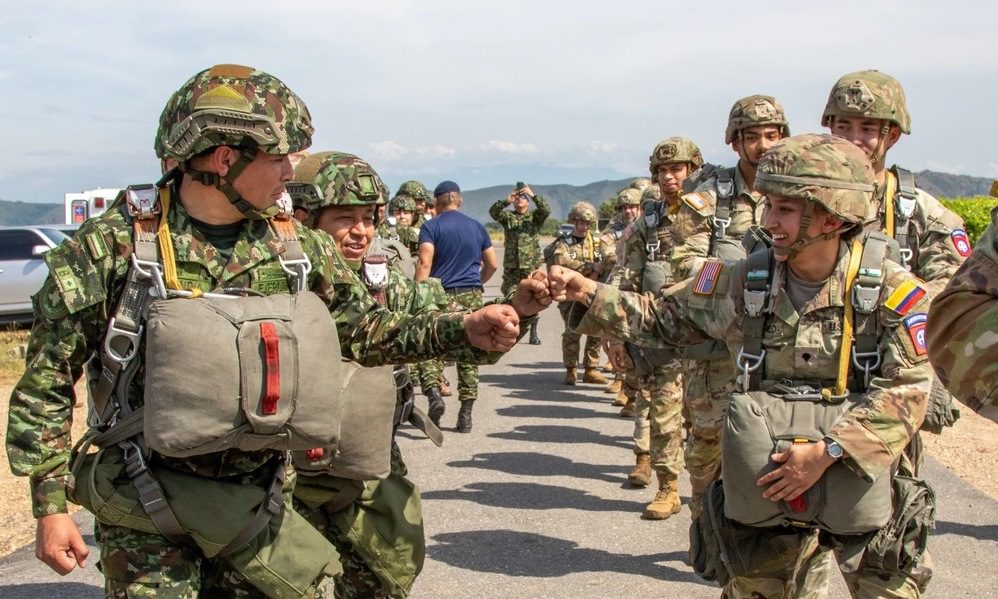
Amor stressed the importance of learning to synchronize planning efforts to facilitate battlefield operations anywhere in the world.
With a focus on pre-deployment operations, HYDRA 24 allowed U.S. Army Soldiers to enhance their agility in a new training domain alongside partner forces. This collaboration further improved interoperability and prepared them for success in competition, crisis, and conflict.
“The Colombian Counter Narcotics Battalion 1 has a specific mission and we also have a specific mission set with a global focus,” said Amor. “Because of this we were able to share lessons with airborne operations and learn how they execute operations that may be more localized using different types of aircraft and different types of jungle movements.”
Amor added that he was impressed with the initiative of the Colombian army’s company commanders and appreciated their hospitality and capabilities, which facilitated the exercise.
“The Colombian army is currently working on becoming interoperable with other armies worldwide. This exercise represents a significant step forward in that process.,” said Colombian Army Lt. Col. Bayardo Pena, senior observer and operations officer in charge for the Colombian Army.
“The U.S. Army has been supporting us for many years. The fact that we are conducting this exercise is going to strengthen and increase our partnership for the future.”
Pena stressed the importance of both armies being able to conduct the planning process, execution of the maneuver, understand each other’s doctrine, and execute an exercise.
“The U.S. Army has a world standard in terms of doctrine and it is going to help us standardize our processes too,” said Pena. “I am proud of our soldiers and how they conduct themselves with other armies like the U.S.”
The U.S.-Colombia partnership remains one of the most vibrant and mutually productive relationships in the Southern Hemisphere. SOUTHCOM and U.S. Army South bilateral exercises aim to demonstrate the U.S.’s commitment to the region and its citizens.
The exercise culminated in a distinguished visitor day, foreign airborne wing exchange ceremony and remarks from the U.S. Army South Commanding General, Brig. Gen. Phil Ryan.
“Today’s event goes beyond just tactical and operational interoperability, although that is crucial, what truly matters is the human connections formed between all of you,” said U.S. Army South Commanding General, Brig. Gen. Phil Ryan during the foreign wing exchange ceremony. “These bonds are key to safeguarding our shared values of democracy and human rights, and to preserving our way of life in the Western Hemisphere.
Prior to the exercise, the two armies synchronized tactics, techniques and procedures, medical and communication rehearsals to ensure seamless integration throughout the combined training exercise and the multinational airborne assault.
“Our goal is to enhance our interoperability so we can operate seamlessly together as one multinational force whenever needed,” said Ryan. “Embrace this shared experience and remember that, despite our different backgrounds and languages, we are united by your common identity as paratroopers–Defense and Fraternity!”
Above photo by Sgt. 1st Class Elvis Umanzor: Colombian army paratroopers from Battalion of Counter Narcotics (BACN1 and U.S. Army paratroopers from 2nd Battalion, 508th Parachute Infantry Regiment, 2nd Brigade Combat Team, 82nd Airborne Division, wish each other well before their final jump during HYDRA III 24 (HYDRA 24) at Fuerte Militar de Tolemaida, Colombia, Aug. 1, 2024. HYDRA 24 is a bi-lateral exercise between the U.S. and Colombian armies aimed at enhancing the technical, procedural, and human interoperability between the two airborne forces and demonstrating the ability to strategically employ forces in the U.S. Southern Command area of responsibility. (U.S. Army photo by Sgt. 1st Class Elvis Umanzor)
Article reprinted from the US Defense Visual Information Distribution Service.
Bayport Colombia, a company specializing in libranzas, a type of non-bank payroll loan, has secured a $30 million investment from Cerberus, a global leader in alternative investments. Bayport says that this transaction reflects continued international investor confidence in Colombia’s financial market and the financial stability of Bayport Colombia.
Lilian Perea (above photo), CEO of Bayport Colombia, stated, “Partnering with Cerberus underscores our commitment to financial inclusion in Colombia, as well as our financial strength and operational excellence. We remain dedicated to contributing to the socio-economic development of the country.”
Rob Milam, Managing Director at Cerberus, added, “We are pleased to continue providing innovative credit solutions to Bayport Colombia as they expand in the Colombian payroll loan market. This investment extends the partnership we began with Bayport in 2019.”
A subsidiary of South Africa based Bayport, the company has been operating in Colombia since 2011 and claims to have more than 68,000 payroll loan customers among its market focus of public employees and pensioners. In Colombia the company has a 1.1 trillion-peso loan portfolio and operates 17 offices across 15 cities. Globally, Bayport says it serves half a million borrowers in México, Colombia, Botswana, Ghana, Mozambique, South Africa, Tanzania, Uganda and Zambia.
Aris Mining Corporation (TSX: ARIS; NYSE-A: ARMN) provided an update on its ongoing 2024 exploration drilling program at the Segovia Operations in Colombia, which is currently 70% complete.
The exploration program has focused on extending and verifying the continuity of large-scale veins at depth and along strike. The results to date have identified potential new near-mine mineral resources, which may extend the life of the Segovia mine and provide additional feedstock for the ongoing expansion of the processing plant.
The drilling results disclosed include data from August 1, 2023, to April 1, 2024. These results are expected to be incorporated into updated mineral resource and reserve estimates, projected for release in the fourth quarter of 2024.
The Segovia vein system, comprising 80 identified veins and splays, extends between 1.5 and 2.8 kilometers along strike and between 2.0 and 2.7 kilometers down dip. The majority of the exploration is conducted from within existing underground infrastructure, targeting vein extensions that require lower development costs. Most drill holes intersect multiple veins due to the splays located in the footwall and hanging wall of the main veins, enhancing the efficiency of the exploration process.
Drilling at the historic Cristales operation, currently managed by a third-party contractor, has aimed to prove the extension of the Cristales vein at depth. The drill holes, located about 200 meters south of the historic mine workings, cover an area of approximately 250 by 200 meters. The results are expected to contribute to the identification of new high-grade inferred mineral resources. Highlights include:
- 0.32 m at 25.80 g/t Au in hole CR-ES-075
- 0.47 m at 7.48 g/t Au in hole CR-ES-080
- 0.31 m at 15.54 g/t Au in hole CR-ES-083
- 0.25 m at 137.78 g/t Au in hole CR-ES-086
Near-mine drill holes east of the El Silencio vein system confirmed the continuity of high-grade veins and extended the main vein down dip by another 500 meters. The drilling also identified new veins in the hanging wall and other veins with oblique orientations to the main structures. These new discoveries will be prioritized in upcoming drilling programs. Highlights include:
- 0.12 m at 45.19 g/t Au in hole ES-MH14
- 0.23 m at 55.22 g/t Au in hole ES-MH14-01
- 0.30 m at 61.50 g/t Au in hole ES-MH11-03
- 0.48 m at 61.82 g/t Au in hole ES-MH12-02
- 0.39 m at 28.34 g/t Au in hole ES-MH12-04
Infill and extension drilling northwest of El Silencio demonstrated the continuity of high-grade veins, leading to the discovery of additional new veins in the footwall and hanging wall. These discoveries have been added to the list of targets for future drilling. Highlights include:
- 0.25 m at 15.20 g/t Au in hole ES-IU-182
- 0.20 m at 65.70 g/t Au in hole ES-IU-183
- 0.26 m at 715.99 g/t Au and 0.13 m at 93.34 g/t Au in hole ES-IU-191
- 0.20 m at 56.14 g/t Au in hole ES-IU-195
- 0.49 m at 118.75 g/t Au in hole ES-IU-202
- 0.14 m at 99.87 g/t Au in hole ES-IU-208
Surface drilling targeting a shallower vein near existing operations confirmed vein continuity, prompting new mine development. These results, supported by updated geological interpretations, are expected to convert into high-grade mineral resources. Highlights include:
- 0.29 m at 536.75 g/t Au in hole MAN-ES-017A
- 0.39 m at 178.24 g/t Au in hole MAN-ES-020
- 0.19 m at 812.16 g/t Au in hole MAN-ES-021
Underground drill holes focused on the same high-grade vein target extended mineral resources and discovered new veins in the hanging wall and footwall. Highlights include:
- 0.40 m at 137.80 g/t Au in hole ES-EU-141
- 0.37 m at 15.37 g/t Au in hole ES-EU-145
- 0.28 m at 13.13 g/t Au in hole ES-EU-154
- 0.50 m at 26.93 g/t Au in hole ES-EU-158
At the Providencia mine, infill drilling tested the downdip extension of a high-grade vein, contributing to the short- and medium-term production plans. Highlights include:
- 0.28 m at 29.61 g/t Au in hole MAR-IU-034
- 0.29 m at 11.10 g/t Au in hole MAR-IU-041
- 0.16 m at 207.79 g/t Au in hole MAR-IU-052
Yesterday the White House published Presidential Determination # 2024-10 regarding continuation of US drug interdiction assistance to the government of Colombia. Under US law, the President must certify to Congress on a periodic basis that Colombia is collaborating in an appropriate fashion while protecting human rights.
The certification memorandum reads as follows:
Presidential Determination
No. 2024-10
MEMORANDUM FOR THE SECRETARY OF STATE
THE SECRETARY OF DEFENSE
SUBJECT: Continuation of U.S. Drug Interdiction Assistance to the Government of Colombia
By the authority vested in me as President by the Constitution and the laws of the United States, and pursuant to the authority vested in me by section 1012 of the National Defense Authorization Act for Fiscal Year 1995, as amended (22 U.S.C. 2291-4), I hereby certify, with respect to Colombia, that: (1) interdiction of aircraft reasonably suspected to be primarily engaged in illicit drug trafficking in that country’s airspace is necessary, because of the extraordinary threat posed by illicit drug trafficking to the national security of that country; and (2) Colombia has appropriate procedures in place to protect against innocent loss of life in the air and on the ground in connection with such interdiction, which includes effective means to identify and warn an aircraft before the use of force is directed against the aircraft.
The Secretary of State is authorized and directed to publish this determination in the Federal Register and to notify the Congress of this determination.
JOSEPH R. BIDEN JR.
When a week is spliced into two by an independence related holiday there is usually little to report but on this occasion there are a couple of themes worth commenting on.
July inflation from Departamento Administrativo Nacional de Estadística – DANE Colombia registered 0.20% (2023 0.50%) bringing us to a YTD reading of 4.32% (6.68%) and a 12 month figure of 6.86% (11.78%). That is pleasingly below the 6.96% predicted and with the exception of housing there was precious little to worry about. That sector rose 0.45% MoM and contributed 70% of the inflation in the system. Food rose 0.21% and added in most of the balance. Amongst the other sectors surveyed there was little to make mention of but Restaurants/Hotels & Cigarettes and Alcohol also rose 0.33% & 0.22% respectively which means Colombians are still insistent on enjoying themselves.
I would normally speculate as to what the Banco de la República – Colombia might do at their next meeting but it’s not worth it. In August they don’t have a ‘decision’ meeting and by the time they meet in September we will have had the August inflation number. Remember if they are to get to Fedesarrollo‘s 8.50% analyst estimate they will need to cut by 75 bps average at the three remaining ‘decision’ meetings of 2024. Good luck with that.
Venezuela is still on many people’s minds but there has been little to report this week, mainly because Maduro has been cutting communications links. Yesterday he shut down ‘X’ due to Elon Musk’s comments. Colombia and many other countries have asked for human rights to be respected but that will likely fall on deaf ears – it’s an internal sovereign matter in the eyes of international law and there seems little to be done. My only surprise is to find people seemingly shocked at Maduro’s actions. He isn’t fighting for his presidency, he is in all likelihood fighting for his life.
Wednesday’s holiday marked the two year anniversary of Gustavo Petro in office and was marked according to the defense minister, during his periodical update on criminality in Colombia, by intelligence pointing to an assassination plot against Gustavo Petro. No further details were offered as to when or where this was planned but nonetheless concerning.
That is it for this morning however, you do not escape that lightly. Please keep a look out for ‘The Petro Prism’ my very brief look at the first two years of the current presidency.
Have a great end to the week
Roops
Above photo: The Puente de Boyacá or Boyacá Bridge over the Teatinos River commemorates the “Battle of Boyacá,”a key event in Colombia’s independence from Spain (photo: Loren Moss)
EPM (Empresas Públicas de Medellín) has been accepted as a member of the National Association of Foreign Trade (Analdex), following its accreditation as an Authorized Economic Operator by Colombia’s Directorate of National Taxes and Customs (DIAN).
Analdex, recognized as the leading trade and logistics industry association in Colombia, represents over 400 affiliates across the country. The organization focuses on promoting Colombia’s international trade by developing and implementing policies related to exports, imports, and logistics.
In a communication to EPM’s General Manager, John Maya Salazar, Analdex Executive President Javier Díaz Molina expressed optimism about the new partnership, stating, “We hope to work together for our sector and meet the requirements and expectations that have motivated EPM to be part of Analdex.”
EPM Vice President of Supplies and Shared Services, Humberto Iglesias Gómez, noted that the company plans to leverage Analdex’s experience and network to enhance its foreign trade operations. “We will carry out initiatives that allow us to take advantage of Analdex’s experience, generate relationships with its affiliates, and use best practices in our foreign trade activities,” said Iglesias.
Strategic Benefits
Joining Analdex provides EPM with access to strategic advice on international customs, exchange, and tax logistics. It also facilitates interactions with key industry bodies, including the National Joint Commission for Tax and Customs Management, the International Chamber of Commerce (ICC), and the Confederation of Authorized Economic Operators of Latin America (COEALAC).
Rodrigo Patiño Correa, Analdex’s regional manager for Antioquia, welcomed EPM’s membership, describing it as a significant vote of confidence. “We are motivated and pleased with EPM’s entry into our guild. We look forward to adding value to their activities and anticipate success in their future projects,” Patiño said.
EPM’s Foreign Trade Milestones
EPM has achieved several milestones in foreign trade, including the import of 280 containers of solar panels for its Tepuy photovoltaic project in La Dorada, Caldas, and the import of 90% of the electromechanical equipment for the Hidroituango plant from countries like China, Brazil, Germany, and Spain.
For its aqueduct modernization projects in the Aburrá Valley, EPM has imported over 500 containers of pipelines from Chile and Mexico. Additionally, in 2016, the company utilized Antonov cargo planes to transport 800 tons of supplies for the Guatapé hydroelectric plant repair (above photo) and, in 2023, for the Ituango project.
Future Engagement
EPM also plans to participate in Analdex’s business training and education programs, which have been in place since 2017. These programs aim to develop the skills needed to navigate the global market and maintain a secure and efficient international supply chain, ensuring the timely provision of services.
EPM’s commitment to an effective supply chain supports the growth and expansion of domestic public services, contributing to broader coverage and development in the regions where it operates.
Japan has been selected as the Guest Country for the 39th edition of the ANDICOM 2024 ICT Congress, set to take place from September 4th to 6th in Cartagena de Indias. This marks the second time Japan has received this distinction, following its previous participation in 2018. The event will provide a platform for showcasing Japan’s technological advancements and exploring bilateral business opportunities.
Japan, recognized for its innovation in technology, will present developments across various sectors, including artificial intelligence, robotics, 5G connectivity, smart cities, and disaster management. These innovations will be featured during ANDICOM 2024, an event organized by CINTEL (Center for Research and Development in Information and Communication Technologies).
In a recent visit to Japan, CINTEL executives, along with Ángela Durán, Colombia’s Minister Plenipotentiary in Japan, met with Yoshida Hitoshi, Japan’s Vice Minister of International Affairs at the Ministry of Internal Affairs and Communications. Discussions focused on the technological and knowledge exchange facilitated by the congress and how CINTEL promotes ICT adoption and business innovation in Latin America.
Japan’s participation in ANDICOM 2024 is expected to enhance collaboration between Colombian and Japanese entities, as well as with other global participants. The Japanese Pavilion at the event will feature companies such as NEC, Nihon Dengyo Kosaku, Ai Trax, Terumo, Furukawa Electric, Fujikura, Sumitomo Electric Industries, Nippon Koei, Hitachi Vantara, OREX SAI, and Global Plan.
Key Areas of Japanese Technological Focus:
- Artificial Intelligence (AI): Investment in research and development in machine learning, natural language processing, and computer vision.
- Robotics: Japan continues to lead globally in robotics, with ongoing advancements in collaborative robots.
- Biotechnology: Focus on personalized medicine, agriculture, and new material development.
- Information and Communication Technologies (ICT): Development of new ICT technologies, including 5G and the Internet of Things (IoT).
- Energy: Research and development in renewable energy and fusion energy.
- Space Science: Investment in space exploration and technology development.
- Marine Sciences: Research aimed at understanding and sustainably utilizing ocean resources.
- Advanced Manufacturing: Investments to improve the competitiveness of Japan’s manufacturing industry.
For more information on Japan’s participation and other event details, visit the official ANDICOM website.
Peace negotiations with Colombia’s last true guerrilla insurgency are on the verge of collapse after the August 3 expiration of a ceasefire between the government and the ELN.
The bilateral ceasefire, in effect for the past year, ended after the National Liberation Army (Ejército de Liberación Nacional – ELN) rejected government offers to discuss a renewal.
The agreement was plagued by continued violence and hostilities, such as armed strikes and kidnappings, with both sides accusing each other of not upholding their end of the bargain.
“Just extending the ceasefire isn’t enough if it doesn’t come with new steps to protect civilians from attacks, hostilities, kidnappings, and threats,” said Otty Patiño, Colombian High Peace Commissioner.
Meanwhile, the ELN has accused the government of not negotiating in good faith.
“What’s the point of urging the ELN to sign new agreements if the previous ones haven’t been upheld?” asked the group’s commander, Eliecer Erlinto Chamorro, alias “Antonio Garcia,” in a statement released on July 26.
SEE ALSO: From Total to Partial Peace: Colombia’s Talks With Crime Groups Fragment
The negotiations between the ELN and the government had advanced further than any other talks held under President Gustavo Petro’s Total Peace (Paz Total) plan, which has sought demobilization agreements with criminal and armed groups across Colombia.
But the expiration of the ceasefire adds to a series of recent setbacks, including the ELN’s refusal to stop kidnappings and deepening internal divisions, and could lead the guerrillas to abandon the negotiating table completely.
Ceasefire Violations
While the ceasefire agreement primarily prohibits offensive military operations between the parties, it also includes other conditions, such as banning the ELN from “taking hostages,” widely understood to mean kidnapping.
The ELN has violated the agreement at least 39 times over the past year, according to the Colombian think tank, the Conflict Analysis Resource Center (Centro de Recursos para el Análisis de Conflictos – CERAC). These violations include five deaths, three injuries, and at least 52 kidnappings.
One of the most notable incidents occurred less than three months after the ceasefire took effect, in October 2023, when ELN members kidnapped the parents of Colombian football star Luis Díaz. After international attention pushed the group to release them, the ELN announced that it would cease kidnappings for ransom — a key part of their criminal operations.
Despite the ELN’s violations, negotiators agreed to extend the ceasefire on February 5 for another six months.
But internal divisions on the ELN side soon became apparent, leading to larger problems for the negotiations.
On February 20, the ELN delegation declared a crisis in the peace negotiations, angered over the government’s “regional dialogue” with the Comuneros del Sur, a dissident ELN faction in Nariño that had started parallel negotiations with the government without the consent of the guerrilla group’s top leaders.
Over the next few months, the ELN temporarily suspended its participation in the talks and reneged on its promise to cease kidnappings, citing the government’s “lack of will” in establishing a donor fund to provide alternative financing, which the group claimed left them reliant on kidnapping. The government, however, argued that the fund could not be established while negotiations were stalled, creating a catch-22 situation.
Willingness for Peace
For weeks leading up to August 3, the government’s negotiation team had warned that time was running out to renew the ceasefire with the ELN, and continuously asked the guerrilla group to resume the peace talks.
At the same time, key officials were critical of the ELN’s willingness to negotiate, especially on the issue of kidnapping, an issue that has derailed negotiations in the past. Patiño stressed that the Colombian government would not sign agreements with the ELN if the group continued the practice.
The government has also questioned the group’s desire for peace.
“After years of dialogue, the ELN still has not answered whether it is willing to transition to peace or if, on the contrary, it sees this process as an opportunity to strengthen themselves militarily,” said the press release.
Some experts agree that the ELN seems to have taken advantage of the negotiations with no intention of ever laying down arms. The group advanced negotiation items that benefited its political cause, without moving forward on demobilization, Jorge Mantilla, a political scientist who studies Colombia’s armed conflict and security, told InSight Crime.
“The ELN has been aiming to buy time from the very start of the negotiations,” Mantilla said
What Does This Mean for the ELN?
The end of the ceasefire between the Colombian government and the ELN has dealt a potentially mortal blow to an already fragile negotiation.
As the ELN has refused to continue negotiations with the government, the process with the group’s dissident Comuneros del Sur Front has moved forward. So far, this is the only ELN front to have split from the Central Command.
If the parallel peace talks succeed, it could encourage other factions to split from the ELN and seek peace with the government, especially among fronts under pressure from belligerent rivals.
The main concern is the Western War Front (Frente de Guerra Occidental – FGOC) in Chocó, which has been fighting a losing battle with the Gaitanist Self-Defense Forces of Colombia (Autodefensas Gaitanistas de Colombia – AGC) since 2018 for control over drug trafficking routes and illegal mining. In this area, the lapse of the ceasefire and an eventual return to military operations against the ELN could push the FGOC to the same decision as the Comuneros del Sur.
In other areas, however, the ELN has taken advantage of the ceasefire to solidify its control. The ELN continues to be a dominant criminal group along large stretches of the Colombia-Venezuela border, increasing its control over rural communities. The lapse of the ceasefire could lead to increased violence in these areas as the group retaliates against the Colombian government and continues its territorial disputes with other criminal actors.
The ELN also has a presence in Venezuela and close ties to the government of President Nicolás Maduro, who claimed victory in recent elections despite irregularities in vote counting.
The Eastern War Front (Frente de Guerra Oriental – FGO) and the Northeastern War Front (Frente de Guerra Nororiental) on the border between Colombia and Venezuela are key to the Maduro regime’s criminal balancing act. Since at least 2016, the ELN has expanded along the border with Venezuela with the approval of the Venezuelan political and military forces, and has adopted an increasingly paramilitary role, defending the interests of the Maduro government. Should Maduro cling to power, these fronts would be less likely to make a deal with the Colombian government.
This article, written by and , was originally published by InSight Crime, a Medellín-based foundation dedicated to the investigation and analysis of crime and security in Colombia and Latin America.
 Empleobilingue.com

- Director/a de operaciones para hotel, restaurante y discoteca 1626320364.60 - Medellín, Medellin, Antioquia, Colombia
- Coordinador/a de calidad para La Unión 1626483143.1 - La Unión, Antioquia, Colombia
- Desarrollador fullstack - Bogotá, Bogota, Colombia
- Technical Analyst - Remote
- PIM Administrator - Ecommerce - Remote (Bogotá, Bogota, Colombia)
- Auxiliar de gestión humana y bienestar para Girardota 1626060072.28 - Girardota, Antioquia, Colombia
- Marketing Strategist
- Trainer Manager - Bogotá, Bogota, Colombia
- Tolemaida UH- 60 Inspector - Bogotá, Bogota, Colombia
- Virtual Assistant - Team Lead - Remote
Contact Us

