

















In an initiative led by Colombia’s Ministry of Commerce, Industry, and Tourism, iNNpulsa Colombia has launched the latest round of its Minicadenas Locales program to provide funding and resources to 180 small businesses in Colombia’s conflict-affected regions. With a budget of over 6 billion pesos, the program aims to support rural micro, small, and medium enterprises (MiPymes) led by victims of forced displacement, providing capital for formalization, materials, and machinery.
Beneficiaries will receive productive capital to formalize and obtain supplies and machinery, and will be able to access commercial spaces and advice on different topics.
Targeting 96 municipalities across 12 departments, including Antioquia, Santander, and La Guajira, the initiative is focused on agricultural, livestock, fishing, and forestry sectors. It will connect entrepreneurs with local businesses for potential partnerships and offer tailored technical advice covering topics like financial inclusion, fair trade, and leadership.
This effort aligns with the government’s regional development and reintegration objectives through targeted support in areas prioritized under the Programs of Territorial Development Approach (PDET) and Areas Most Affected by the Conflict (ZOMAC). Participants, listed in the Registry of Victims (RUV), are not required to hold a formal business license to apply.
For more information on application criteria, visit iNNpulsa Colombia’s official site.
Digital payroll startup Symplifica, focusing on formalizing and enhancing conditions for domestic workers, has been named the winner of the ninth edition of Boston Consulting Group’s (BCG) Social Impact Consulting Program, held in partnership with Acumen Latam Impact Ventures (ALIVE). The program offers pro bono consulting to selected ventures, aimed at enhancing their strategy and impact.
Symplifica, chosen from five finalist ventures, will work with BCG consultants to refine its growth strategy and expand its reach. Symplifica’s platform facilitates efficient payroll management and ensures legal compliance, helping domestic employees secure entitled benefits. BCG’s impact initiative, running since 2013, has supported over 40 social enterprises in Colombia.
Santiago Álvarez, ALIVE’s Co-Founder and Managing Partner, emphasized the importance of social impact ventures like Symplifica for building a more inclusive economy.
Colombian utility company Empresas Públicas de Medellín (EPM) and Klik Energy, a digital platform for demand response, announced a partnership aimed at stabilizing Colombia’s energy system. This collaboration introduces tools for large-scale consumers to monitor and adjust energy use through a web platform, potentially contributing an additional 13 GWh daily.
Targeting customers consuming over 55,000 kWh, the platform enables management of production chain energy points, providing options such as “voluntary disconnection” and “demand response.” These measures, regulated by Colombia’s Law 1715 of 2014, allow participants to receive compensation for reducing consumption during high-demand periods. EPM’s CEO, John Maya Salazar, emphasized the role of the partnership in responding to industry energy demands, while Klik CEO Esteban Quintana highlighted the platform’s role in reducing energy use and supporting system reliability.
The alliance’s initial phase involves selected EPM companies, targeting daily reductions of around 1.5 GWh, with plans for expansion across EPM’s subsidiaries. The partnership offers large-scale consumers a chance to contribute to energy system stability amid current shortages while benefiting from financial incentives.
Toronto-based Quimbaya Gold Inc. (CSE: QIM, OTCQB: QIMGF, FSE: K05) has released an update on its technical evaluation of the Tahami South Vein Systems, a key gold exploration area in the Segovia mining district in Colombia. Initial assessments have focused on delineating structural vein systems and identifying mineralization trends.
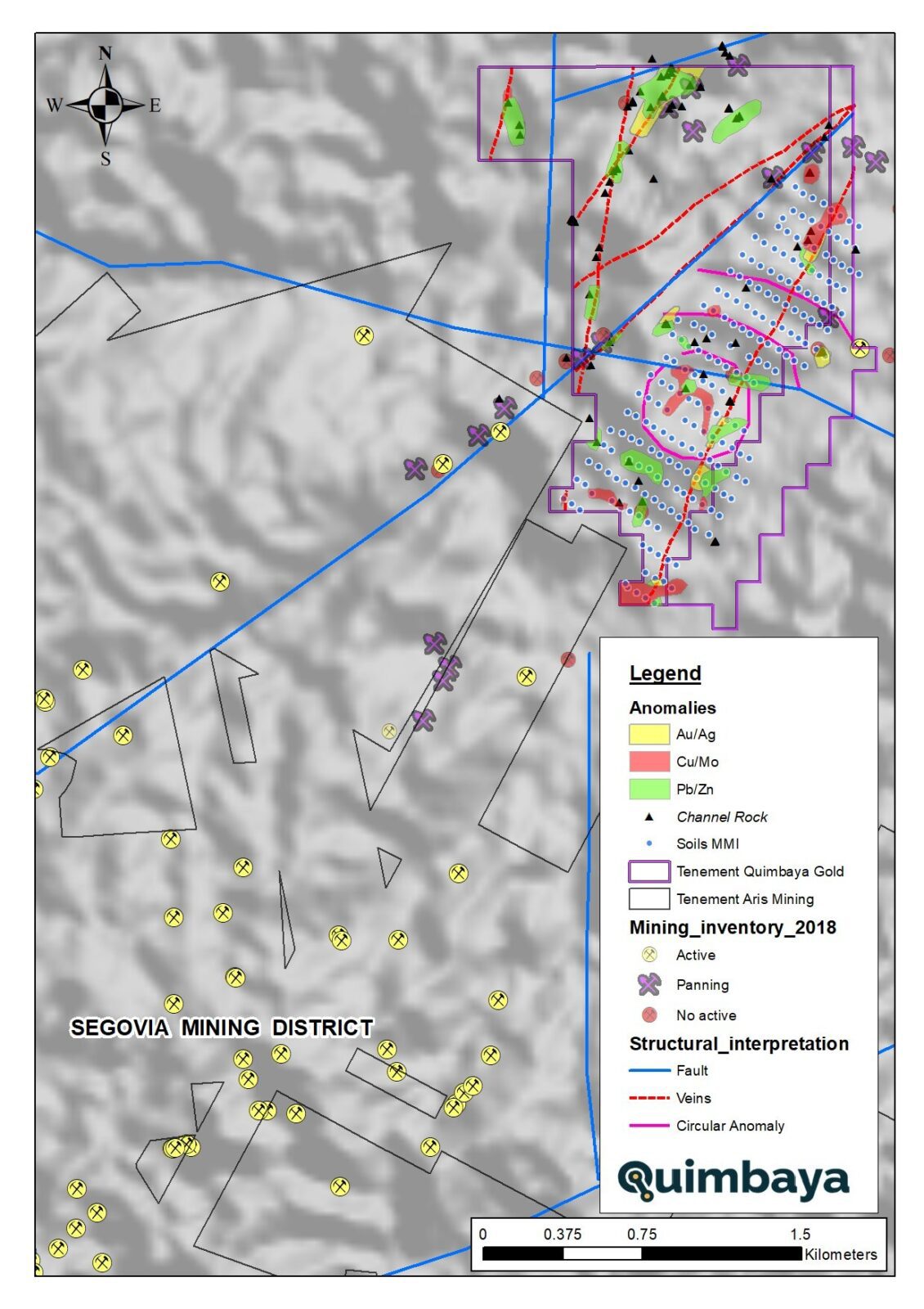
Figure 2. Mobile Metal Ion (MMI) soil sampling, channel rock sampling, anomalies of Au/Ag, Pb/Zn, Cu/Mo and structural interpretation on the Tahami South Vein Systems. (CNW Group/Quimbaya Gold Inc.)
The company recently began a LiDAR survey covering 800 hectares, generating detailed data to support geological mapping. A soil sampling program conducted over 2 kilometers has so far collected 220 samples, targeting areas of gold, silver, copper, and other metals. In addition, 135 rock samples were taken to enhance understanding of geochemical compositions in the region. Geophysical analyses, including magnetometry and structural interpretation, also contribute to understanding the Segovia gold belt’s mineral profile.
The company’s 2024 exploration strategy includes geological mapping, trench sampling, and further soil and rock analyses. This stage will also assess placer deposits in the surrounding creek areas of La Cianurada and San Nicolas, both of which drain into Segovia’s major mining operations.
Additionally, Quimbaya’s new Technical Advisory Board includes industry experts Dr. Stewart Redwood, Nicolas Lopez, Ricardo Sierra, and Terence Ortslan, tasked with guiding the company’s projects in Colombia.
For more technical details, see Quimbaya Gold’s official statement.
Toronto-based mining company Collective Mining Ltd. (NYSE: CNL, TSX: CNL) has announced the discovery of a high-grade gold zone, called the Ramp Zone, within its Apollo system, part of the Guayabales Project in Caldas, Colombia.
The discovery, revealed in drill hole APC99-D5, highlights a 57.65-meter section averaging 8.18 grams per ton (g/t) of gold equivalent, including a 18.85-meter interval at 20.21 g/t. This new zone, located about 1,000 meters below the surface, marks a significant deep-seated mineralization in an area close to a planned tunnel that may later connect the site to mining infrastructure, pending future project developments.
The Ramp Zone, similar in some geological aspects to Aris Mining’s nearby Marmato Deeps deposit, includes veins bearing bismuth, tellurium, and copper, which are characteristic of Reduced Intrusion-Related Gold Systems. The proximity to the Marmato Deeps and its specific mineral composition suggests a robust potential for extending the resource base in the Apollo project area.
Collective Mining currently has five active drill rigs within the Guayabales Project as part of its 2024 exploration program, which aims to complete 40,000 meters of drilling. Expansion plans include additional drilling in the Ramp Zone and surrounding areas, with assay results expected by late 2024.
For more technical details, see the company’s official press release.
Above image: Plan View of the High-Grade Ramp Zone Discovery (CNW Group/Collective Mining Ltd.)
Colombia’s real manufacturing production grew by 2% in July 2024 compared to the same month last year, according to the latest Monthly Manufacturing Survey with Territorial Focus released by the National Administrative Department of Statistics (DANE). The survey captures monthly shifts in the manufacturing sector across production, sales, and employment variables.
Out of the 39 industrial activities surveyed, 22 reported positive growth in real production. The strongest increases were seen in the basic iron and steel industries (41.5%), rubber products manufacturing (39.7%), and the production of other types of transportation equipment (30.4%).
Lorenzo Castillo Barvo, acting Vice Minister of Business Development, attributed these results to the national government’s economic recovery program, which emphasizes reindustrialization. Castillo stated that manufacturing is a key sector in the transition to a more sustainable economy driven by science, technology, and knowledge.
Despite these improvements, year-to-date manufacturing production remains down by 2.9%. However, July’s 2% growth marks the most significant recovery in the past 12 months. Industrial sales also grew by 0.7% in July, the second-highest monthly gain over the past year. Employment in the sector, while down 0.9% from last year, saw its smallest decline in 12 months.
The Ministry of Commerce, Industry, and Tourism says that it has continued to invest in initiatives aimed at strengthening the country’s business landscape to foster greater economic opportunities, particularly for the manufacturing sector.
Regional Performance
Of the 14 departments included in the survey, 10 recorded positive production growth. Córdoba led with a 36.5% increase in production and a 9.6% rise in sales in July. Risaralda and Valle del Cauca also showed notable growth, with production increases of 10.1% and 4.3%, respectively.
Among metropolitan areas, Valle de Aburrá (Metropolitan Medellín) contributed the most to the annual increase in real production, registering a 1.7% rise.
The manufacturing sector’s July gains reflect ongoing efforts to stabilize and stimulate industrial production across regions, though the overall year-to-date results remain mixed.
Avianca has launched ticket sales for new direct routes connecting Quibdó and Arauca with Bogotá, set to commence in December 2024. The routes will operate using Airbus A320 aircraft, providing a total of 1,440 seats weekly between Bogotá and Arauca from December 9, and 1,080 seats weekly between Bogotá and Quibdó from December 10.
Flights to Arauca, via Santiago Pérez Quiroz Airport, will run four times weekly, while connections to Quibdó, via El Caraño Airport, will operate three times per week. These routes aim to strengthen regional connectivity, and Avianca’s CEO, Frederico Pedreira, highlighted the airline’s intent to support regions needing robust transportation access. This expansion adds to Avianca’s 40 domestic routes, making it one of only a few air carriers with year-round service to various regions, from San Andrés to Leticia.
Aligned with Avianca’s social strategy, the new routes facilitate access to essential services, including healthcare. Through partnerships, Avianca supports social organizations in delivering medical and humanitarian aid to remote areas, benefiting vulnerable communities in places like Chocó and Arauca.
Flight schedules for these routes are subject to government approval, and tickets are available via Avianca’s website, mobile app, sales points, and travel agencies.
Arajet, a low-cost airline based in the Dominican Republic, is set to begin direct flights connecting Bogotá, Medellín, and Cartagena to Punta Cana starting October 27. In anticipation of these routes, Arajet announced a “Hot Promo” offering up to 50% discounts on fares, applicable until October 21.
The new routes from Colombia to Punta Cana, a prominent Caribbean tourist hub, will connect travelers to North American destinations like Toronto, Montreal, Mexico City, and Cancún through Arajet’s network. Arajet’s CEO, Victor Pacheco Méndez, noted Colombia’s high demand for flights, emphasizing the promotion as a gesture of appreciation to Colombian travelers.
Tickets under this promotion cover travel from October 2024 to June 2025 across multiple fare packages, with limited seat availability. For further details, visit Arajet.
Soma Gold Corp. (TSXV: SOMA) has announced preliminary exploration results from its Colossa Mine, located within the Machuca Project in Antioquia, Colombia. Sampling across multiple mine levels yielded gold assays, with a notable high of 1.0m @ 29.83 g/t Au, including 0.45m @ 66.28 g/t Au.
The Colossa Mine, a small-scale artisanal operation previously exploited in the 1800s, lies within a mineralized trend along the Otú Fault, covering multiple historical mines across a 1.8 km corridor. Soma says that its ongoing exploration indicates high-potential gold zones, further evidenced by stream sediment results and recent channel samples.
The Colossa Mine’s quartz veins, positioned in a unique orientation relative to the Otú Fault, resemble the configuration of veins at Aris Mining’s El Silencio mine in Segovia, raising expectations of further vein extensions. Soma Gold has scheduled an initial 500-meter diamond drill program in late 2024 to further explore these zones.
Since 2023, all Soma exploration samples have been processed by ALS Lima for standardized fire-assay and ICP-MS analysis due to lab improvements at Soma’s Operadora mine lab. Soma’s properties in Antioquia now cover over 56 km of the Otú Fault, including other significant mines along the district’s mineralized trend.
Soma Gold Corp. holds mining interests in Antioquia, Colombia, and Para State, Brazil. The company’s El Bagre Mill is currently operational, with funds from production directed toward regional exploration efforts.
Above photo: Stream sediment samples collected in the vicinity of the Colossa Mine. (CNW Group/Soma Gold Corp.)
Outcrop Silver & Gold Corporation (TSXV: OCG, OTCQX: OCGSF, DE: MRG) provided an update on its exploration activities at the Santa Ana project in Colombia, focusing on results from the Jimenez vein target. Drilling has revealed wide, high-grade silver intercepts and confirmed potential for parallel veins, extending known mineralization and resource potential at Santa Ana.
The current drilling program at Jimenez has yielded intercepts up to 1,288 grams per tonne (g/t) of silver equivalent (AgEq) over narrower high-grade zones. New exploration results have confirmed the continuity of the Jimenez vein system over a 500-meter strike and 200 meters down dip. The drilling data also unveiled an adjacent vein—Jimenez North—which presents additional potential for mineral expansion. Drilling highlights include a 0.32-meter intercept at 1,288 g/t AgEq and a 0.30-meter intercept at 789 g/t AgEq.
Figure 1 (above): Plan view of the Jimenez vein system showing the drill holes reported in this release (Table 1), drilling and channel samples previously reported and reported in this release (Table 2). Silver equivalent (AgEq) was calculated using the prices, recovery and grades of each element using the formula given in the silver equivalent note. (CNW Group/Outcrop Silver & Gold Corporation)
Jimenez Vein and Structural Complexity
The Jimenez vein system, composed of parallel and subparallel veins, exhibits a complex structure typical of high-grade silver-bearing systems. Historical workings and adits, likely from colonial-era mining, indicate longstanding exploration of these silver-rich zones. The Jimenez target area is characterized by quartz veins and silver sulfide (argentite) mineralization, consistent with other high-grade ore shoots identified throughout the Santa Ana project.
The following are key results from recent drilling:
| Hole ID | Interval (m) | Au (g/t) | Ag (g/t) | AgEq (g/t) | Vein |
|---|---|---|---|---|---|
| DH393 | 0.30 | 0.99 | 81 | 155 | Vein |
| DH396 | 0.30 | 2.37 | 266 | 444 | Vein |
| DH398 | 0.61 | 0.43 | 89 | 121 | Jimenez North |
| DH401 | 2.04 | 0.30 | 122 | 145 | Jimenez North |
| DH401 | 3.58 | 0.22 | 115 | 131 | Jimenez |
| DH403 | 0.30 | 1.17 | 543 | 630 | Jimenez North |
These results support the high-grade and continuity potential for the Jimenez vein system, reinforcing Outcrop Silver’s plan to pursue further drilling along both depth and strike extensions.
Ongoing Exploration and Development Plans
Outcrop Silver is advancing additional exploration targets within Santa Ana, including the La Ye and Los Mangos veins, using two rigs to continue expanding known zones and to delineate new high-grade silver resources. The 2024 drill campaign at Santa Ana is directed at enhancing Outcrop’s mineral resource base, which, as per a 2023 technical report by AMC Mining Consultants, currently stands at an indicated 24.2 million ounces of silver equivalent at 614 g/t and an inferred 13.5 million ounces at 435 g/t.

Figure 2. Geological cross-section showing the Jimenez vein target and non-outcropping veins. Silver equivalent (AgEq) was calculated using the prices, recovery and grades of each element using the formula given in the silver equivalent note (CNW Group/Outcrop Silver & Gold Corporation)
Santa Ana covers approximately 27,000 hectares in Colombia’s Mariquita District, one of the country’s largest historic silver-producing regions. Outcrop’s 2024 campaign targets nearly 30 kilometers of mineralized trend at Santa Ana, aiming to expand the project’s estimated seven major vein systems, which include Santa Ana, La Porfia, El Dorado, Paraiso, Las Maras, Los Naranjos, and La Isabela. The ongoing efforts are part of Outcrop Silver’s broader strategy to elevate Santa Ana into a significant silver asset.
Exploration Oversight and Methodology
Samples from HQ-NTW core drilling are processed at Actlabs and ALS in Medellin, Colombia, with subsequent ICP-multi-elemental analysis in Mexico. Adhering to QA/QC protocols, three control samples are inserted for every twenty drill samples to monitor assay accuracy. Results indicate consistency and no material issues, according to the company’s QA/QC standards. All data is verified by Edwin Naranjo Sierra, MSc, a Qualified Person under Canada’s National Instrument 43-101, who oversees technical aspects of the Santa Ana project.
Outcrop Silver’s Corporate Position
Outcrop Silver continues to focus on advancing the Santa Ana project toward becoming a high-grade silver producer with significant exploration upside. The company states that it aims to add value through disciplined expansion of resources and responsible operational practices in Colombia, which include community engagement and adherence to local environmental guidelines.
For additional information on Outcrop Silver & Gold, the company’s latest drill results, and ongoing exploration activities, please visit the Outcrop Silver & Gold Corporation website.
 Empleobilingue.com

- Director/a de operaciones para hotel, restaurante y discoteca 1626320364.60 - Medellín, Medellin, Antioquia, Colombia
- Coordinador/a de calidad para La Unión 1626483143.1 - La Unión, Antioquia, Colombia
- Desarrollador fullstack - Bogotá, Bogota, Colombia
- Technical Analyst - Remote
- PIM Administrator - Ecommerce - Remote (Bogotá, Bogota, Colombia)
- Auxiliar de gestión humana y bienestar para Girardota 1626060072.28 - Girardota, Antioquia, Colombia
- Marketing Strategist
- Trainer Manager - Bogotá, Bogota, Colombia
- Tolemaida UH- 60 Inspector - Bogotá, Bogota, Colombia
- Virtual Assistant - Team Lead - Remote
Contact Us

