

















Just one day after Colombian state-controlled petroleum company Ecopetrol S.A. (BVC: ECOPETROL; NYSE: EC) and Occidental Petroleum Corp (NYSE: OXY) announced the continuation of their joint venture in the Permian Basin oil zone located in the US state of Texas, Colombia’s President Gustavo Petro (above, left) ordered Ecopetrol to cancel the agreement.
Though Ecopetrol is listed on the New York Stock Exchange, the Colombian government controls almost 90% of the shares, and the board of directors is dominated by Petro appointees. Gustavo Petro has held an anti-petroleum and anti-mining stance, and is completely opposed to hydraulic fracturing (fracking) technology in the oil and gas industry.
Referring to the joint venture, Petro said during a televised cabinet meeting, “I want that operation to be sold and to invest the money in clean energies…We are against fracking because fracking is the death of nature and the death of humanity.”
With Petro opposed to drilling in Colombia, Ecopetrol’s Texas operations made up over 11% of the company’s production in 2024. Under Petro’s governance, Colombia has gone from being a net exporter to a net importer of natural gas. Last October, Ecopetrol suspended plans to drill its Komodo-1 well in the Caribbean due to Petro’s opposition. Ecopetrol is led by Ricardo Roa (above, right), appointed as Ecopetrol’s CEO after running Petro’s presidential campaign.
Medellín-based utility Empresas Públicas de Medellín (EPM) projected during the 2024 Oil & Gas Congress that retail natural gas prices are predicted to rise 100% during 2025 due to the resulting scarcity.
See also: Petro Administration Announces Natural Gas Rationing in Colombia Despite Abundant Hydrocarbon Resources
Above photo: Colombian President Gustavo Petro (l) with campaign manager & now Ecopetrol CEO Ricardo Roa (resolution enhanced photo: ANH)
The Pan American Health Organization (PAHO) has issued an epidemiological alert regarding yellow fever in the Americas due to the recent increase in confirmed human cases in several countries in the region and a change in the geographic distribution of the disease.
This increase has been observed over the last months of 2024 and the first weeks of 2025. In total, 61 cases of yellow fever were confirmed in 2024, with 30 resulting in death. This number exceeds the 58 reported cases of yellow fever, including 28 deaths, between 2022 and 2023 in Bolivia, Brazil, Colombia, and Peru. In January of this year, 17 additional cases were reported, with seven deaths.
While in 2024, cases were mainly concentrated in the Amazon region of Bolivia, Brazil, Colombia, Guyana, and Peru, in 2025, the disease has begun to spread to areas outside this zone, particularly to the state of São Paulo, Brazil, and the department of Tolima, Colombia. Peru has also reported a fatal case. PAHO warns that other countries could also be affected.
Yellow fever is a serious viral disease that can be fatal, especially in its more severe form. This increase in cases highlights the urgent need to intensify efforts to prevent the spread of the virus, strengthen clinical management (with an emphasis on early detection and treatment of severe cases), and improve epidemiological surveillance in high-risk areas.
PAHO reminds that vaccination remains one of the most effective tools for preventing and controlling yellow fever. In 2024, most of the cases reported were in people who had not been vaccinated. In this regard, PAHO urges countries to continue strengthening their vaccination programs and to take appropriate measures to inform and protect travelers heading to high-risk areas.
Given the changes in the patterns of virus transmission, PAHO stresses the need to maintain active surveillance, particularly in areas near affected zones, to detect any suspected cases early and ensure timely isolation and treatment.
Key recommendations:
- Enhanced surveillance: Rapidly detect any suspected cases, even in areas not traditionally affected.
- Universal vaccination: Ensure that at least 95% of people in high-risk areas are vaccinated.
- Laboratory diagnosis: Conduct virological diagnostics via PCR during the first 7 to 10 days of illness, or ELISA IgM in the convalescent phase, with careful interpretation due to cross-reactivity in areas with other circulating flaviviruses.
- Clinical management: Strengthen early detection and specialized monitoring of severe patients as a key measure to save lives.
- Preparedness for outbreaks: Review and update the national and subnational vaccine inventory to plan a rapid emergency response.
Since 1970, yellow fever has reemerged as a public health threat in the Americas. The disease is endemic in 13 countries and territories in the region, causing outbreaks and deaths. In 2014, the virus spread beyond the Amazon basin. Some attribute this spread to changes in the interaction between monkeys, mosquitoes, and humans.
In response to escalating violence in Colombia’s Catatumbo region near the Venezuelan border, Colombian President Gustavo Petro has declared a state of internal commotion (state of emergency), enabling the government to issue decrees aimed at addressing the crisis, while bypassing the legislature. The initial decrees focus on agricultural support and include provisions for expedited expropriation of properties, a measure that has sparked significant debate.
Fighting primarily between leftist guerilla groups ELN and FARC Dissidents in the Catatumbo region of Norte de Santander, a Colombian political department in the country’s northeast, has displaced an estimated 50,000 civilians fleeing the area, creating a domestic refugee crisis, and making a mockery of Petro’s campaign promise of “Total Peace” that the president would achieve by negotiating with the rebel groups.
Catatumbo is an important agricultural region producing palm oil, onions, tomatoes, cucumbers and beans, along with cattle and other produce.
The government has issued three decrees under the state of internal commotion, primarily targeting agricultural assistance in the affected areas. One of the decrees permits expropriation by administrative means to facilitate the return and stabilization of individuals displaced by the conflict, as well as the reintegration of former combatants. This approach is intended to expedite processes that are typically prolonged under normal legal frameworks.
The inclusion of expedited expropriation has elicited criticism from various political figures. Representative Katherine Miranda expressed concerns that the government is bypassing legislative procedures to implement expropriation measures, potentially infringing on property rights and due process. She emphasized that this could undermine judicial oversight and leave citizens without adequate legal recourse.
Senator Paloma Valencia told newspaper La República that “One cannot declare internal commotion for situations that were predictable and avoidable. We alerted the government about what was happening, the growth in guerillas, in his first year and a half.”
Former Colombian Finance Minister José Manuel Restrepo also added that “these measures worry the country because they reactivate a conversation that the Congress already took and rejected, which was the possibility of express appropriation in the agriculture sector. This is a complete error.”
In contrast, Senator Iván Cepeda defended the decrees, asserting that they are necessary to address the humanitarian crisis in Catatumbo. He argued that the measures are justified to ensure the safety and well-being of the affected populations.
According to Article 213 of Colombia’s Constitution, the president can declare a state of internal commotion in cases of severe disruption to public order that threaten institutional stability, state security, or citizen coexistence, and when such issues cannot be addressed through ordinary authorities. This declaration grants the government temporary powers to issue decrees aimed at restoring order, which may include measures like expropriation.
The crisis, in the third year of Petro’s presidency, appears to show his “Total Peace” initiative has failed, as the rebel groups are stronger and more active than any time in the past decade. Furthermore, to calm fears from the business and investment communities in Colombia, Petro, a former leftist guerilla himself, promised that there would be no forced expropriation during his presidential term.
The government’s decrees aim to provide immediate relief and support to the affected communities, but the inclusion of expedited expropriation measures has raised concerns about potential overreach and the protection of property rights. As the situation develops, the balance between effective crisis management and adherence to constitutional safeguards remains a focal point of public discourse.
Colombian state-controlled petroleum company Ecopetrol S.A. (BVC: ECOPETROL; NYSE: EC) announced yesterday in a statement that its subsidiary Ecopetrol Permian LLC and Occidental Petroleum Corp (NYSE: OXY), have reached an agreement to extend the development plan of its Rodeo Midland Basin LLC joint venture, located in the Permian Basin petroleum deposits in the US state of Texas. The joint venture was established in July of 2019.
Breaking news update:
Colombian President Moves To Block Ecopetrol Occidental Permian Basin Joint Venture
This agreement includes a drilling plan for 34 wells between April 2025 and June 2026, in addition to those being executed under the current development plan for the first months of 2025.
The agreement also maintains the possibility of signing a new extension of the Development Plan in the future, subject to the macroeconomic environment, industry situation, and partners’ interests. Furthermore, the two companies will keep active an independent contract for the development of the Delaware sub-basin, will remain in force until 2027.
After five years of operations, Ecopetrol Permian and Occidental have achieved positive operational and financial results in the Permian Basin, reflected in the growth of production and its contribution to the Ecopetrol Group’s results.
Ecopetrol Permian’s 2025 Plan for Midland and Delaware sub-basins will include the drilling of approximately 91 development wells, with an estimated investment of $885 million USD and an average annual production of approximately 90,000 barrels of oil equivalent per day (net to Ecopetrol Permian). This plan aligns with the Ecopetrol Group’s strategy, capital discipline, and the diversification of its portfolio.
Permian is recognized as one of the basins with the largest hydrocarbon reserves and one of the most productive in the world, with robust infrastructure for the development of oil projects.
Headline Photo credit: ARMBRUSTERBIZ / Pixabay
Colombia has a lot to show the world and the potential to make tourism a great money-spinner for the country. However, current achievements in the segment are minuscule compared to the country’s potential.
Colombia offers a wide range of experiences, from sun-soaked Caribbean beaches to the lush Amazon rainforest, which could make it a tourism powerhouse in the region. Sadly, constraints related to infrastructure, safety, and global promotion stand in the way of achieving sustained growth.
Tourism in Colombia’s Economy
Tourism needs to be more than a leisure activity; it could become another economic engine for Colombia. It can become the sector that rapidly creates jobs, supports local businesses, and attracts foreign investment. According to Colombia’s Ministry of Commerce, Industry and Tourism (MinCIT), international tourism has generated billions in revenue in recent years, contributing to the country’s economy.
Growth of Tourism: A Statistical Perspective
The following tourist data illustrates the sector’s resilience and challenges:
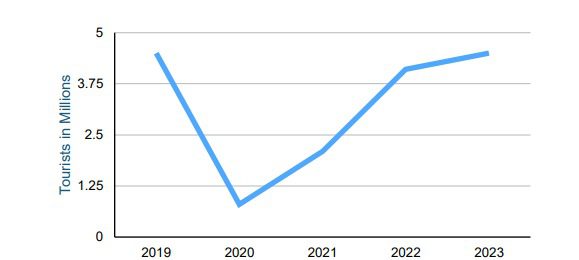
Data Source: Ministry of Commerce, Industry and Tourism and ProColombia.
Colombia’s tourism sector remains underdeveloped compared to its regional peers. In 2019, the country welcomed 4.5 million international visitors, dwarfed by neighboring countries like Mexico and Brazil. The pandemic multiplied the challenges, causing a significant drop in 2020. The recovery has been remarkable in 2023, with a return to pre-pandemic levels. There is a need for more ambitious targets and plans to unlock tourism’s full potential.
Key Destinations and Their Untapped Potential
Colombia’s diverse landscapes and rich cultural heritage should make it a magnet for travelers. Iconic destinations include:
- Bogotá and Medellín — These urban centers blend tradition with modernity, offering world-class museums, innovative urban design, and dynamic nightlife. Still, issues like traffic congestion and urban sprawl need to be addressed.
- Cartagena — Known for its UNESCO-protected colonial architecture and vibrant Caribbean culture, Cartagena remains a favorite for history and beach enthusiasts alike. However, overcrowding and insufficient infrastructure have limited its growth.
- Eje Cafetero (Coffee Region) — While popular for its coffee culture, the region lacks comprehensive tourist facilities to cater to international visitors.
- The Amazon and Pacific Coast — The Amazon offers unique ecotourism opportunities, but accessibility remains a challenge. The Pacific Coast, known for whale watching, suffers from underdeveloped infrastructure.
These destinations have immense potential to drive tourism growth, but unlocking it requires targeted investments and sustained support of governmental policy.
While Colombia has made substantial progress in improving security, particularly in tourist-heavy areas, lingering perceptions of crime deter many potential visitors.
Infrastructure: A Major Hurdle
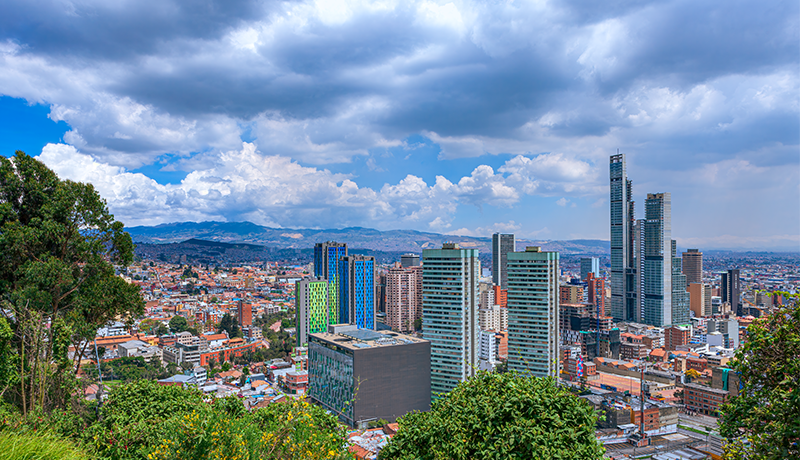
Bogotá City. Photo credit: Mano Chandra Dhas.
Colombia’s infrastructure lags behind the demands of a competitive tourism industry. Modern international airports in major cities, such as El Dorado in Bogotá, have improved global connectivity, but regional access remains a significant barrier.
- Transport Links — Many promising tourist destinations lack sufficient transport options, limiting their accessibility and growth potential. Upgrading regional airports, roads, and public transportation is crucial to the development of tourism.
- Hospitality Sector — High-quality accommodations and services are unevenly distributed across the country. Investments in luxury and eco-friendly lodgings can enhance Colombia’s appeal to affluent international tourists.
Safety Concerns and Their Impact
Safety remains a crucial factor in attracting international tourists. While Colombia has made substantial progress in improving security, particularly in tourist-heavy areas, lingering perceptions of crime deter many potential visitors.
Theft in public places continues to be a negative when potential tourists read about them. Increased police presence and specialized tourist police units have enhanced safety in key areas, but more efforts are needed to address rural and underdeveloped regions.
Emergency response systems and multilingual support remain underdeveloped, making it harder to reassure tourists.
Consistent and transparent communication about safety improvements is essential to change outdated perceptions.
Marketing Colombia: A Global Opportunity
Effective promotion is critical to attracting international tourists. While the Colombia Tourism Promotion Board has made strides in reshaping global perceptions, more robust and coordinated efforts are needed.
- Digital Marketing — Highlighting Colombia’s natural beauty, cultural richness, and warm hospitality through targeted campaigns can reach wider audiences.
- International Partnerships — Collaborating with global travel companies and participating in major tourism fairs in targeted markets will strengthen Colombia’s presence in competitive markets.
- Local Business Support — Training and resources for local entrepreneurs will ensure high-quality services and sustainable growth.
Tourism’s Economic Impact and Future Potential
Tourism’s influence extends beyond direct visitor spending. The sector stimulates job creation across various industries, from hospitality and transportation to artisanal crafts and cultural experiences. Local communities benefit from increased business opportunities, while the influx of foreign currency bolsters Colombia’s economic resilience.
Despite its contributions, tourism accounts for a smaller percentage of Colombia’s GDP. Colombia needs a long-term strategy emphasizing sustainable practices, diversified offerings, and inclusive growth. With a clear roadmap and consistent investments, the country will significantly increase its share of global tourism.
Headline image: Plaza Mayor Villa de Leyva. Photo credit: Mano Chandra Dhas.
The governments of Colombia and the United States have formalized an interpretative note concerning Chapter 10 of their existing Free Trade Agreement (FTA), in effect since May 2012. This development occurred during a bilateral meeting between Colombia’s Minister of Commerce, Industry, and Tourism, Luis Carlos Reyes Hernández, and the US Trade Representative Katherine Tai. The session concluded with the signing of Decision 9 by the Free Trade Commission, providing clarification on specific aspects of the investment chapter.
The interpretative note serves to elucidate the proper understanding of Chapter 10, which addresses investment-related matters, particularly investor-state disputes. Notably, the note does not alter the original text of the FTA, thereby maintaining existing protections.
Minister Reyes emphasized the significance of this clarification for investor expectations, state commitments, and the resolution of disputes by national judges, authorities, and international arbitrators. He stated, “This clarification is important for the expectations of investors, the commitments of the States, and for the resolution of disputes by national judges and authorities and international arbitrators.”
Minister Reyes clarified that the declaration does not undermine incentives for foreign investment
The note aims to clarify the protection commitments each state assumes, addressing ambiguities within the agreement that could lead to frivolous claims or abuses by investors seeking undue advantage. It reaffirms each country’s right to enact new regulations in the legitimate pursuit of public policy objectives, such as environmental protection.
Additionally, the document stipulates that investments not complying with the host country’s internal regulations will not receive protection, thereby excluding illicit investments. It underscores the sovereignty of national judges and authorities by explicitly stating that investment tribunals are not appellate bodies for domestic decisions and cannot review the substance of rulings issued by national judges and authorities.
The note also reiterates that investors bear the burden of proving their claims, which must be based on objective and concrete evidence rather than mere expectations or potential future or hypothetical damages.
Furthermore, it clarifies non-discrimination rules for foreign investments, specifying that differential treatment does not inherently constitute discrimination and that investors will not be subjected to discriminatory treatment based on nationality. It also affirms that investors cannot selectively choose protections from the portfolio of investment treaties each party has signed.
Minister Reyes clarified that the declaration does not undermine incentives for foreign investment but reinforces them for investments that benefit both investors and Colombian society.
This interpretative note aligns with directives from recent US administrations regarding investor-state dispute resolution, which have historically received bipartisan support. It also corresponds with Colombia’s Constitutional Court rulings stipulating that investment agreements must conform to the constitutional order.
Moreover, the note aligns with discussions in multilateral forums, such as the Organization for Economic Co-operation and Development (OECD) and the United Nations, in which Colombia has actively participated.
The United States remains Colombia’s principal source of foreign investment. As of the third quarter of 2024, according to the balance of payments data from the Banco de la República, foreign capital from the US in Colombia amounted to $4.163 billion, representing approximately 42% of the total. The US is also Colombia’s main trading partner, accounting for 29% of the country’s total exports and 31.6% of non-mining energy goods exports. It contributes to about 26% of total goods imports.
Headline Image: Colombia’s Minister of Commerce, Industry, and Tourism, Luis Carlos Reyes Hernández. Photo credit: Mincit.gov.co
Collective Mining Ltd. (NYSE: CNL, TSX: CNL) has commenced a drilling program at its San Antonio Project in Caldas, Colombia. The initiative plans for a minimum of 2,500 meters of drilling to assess three identified gold-copper porphyry targets within a 2.5-kilometer mineralized corridor.
Currently, the company operates five drill rigs as part of its 60,000-meter drill program for 2025. Two additional rigs are scheduled to begin operations in late January and February.
In 2021, initial drilling at the Pound target yielded significant mineralization, with holes SAC-08 and SAC-06 intercepting over 700 meters from the surface. Recent mapping and sampling have expanded the surface footprint of the altered system to 650 by 550 meters. The company suggests that prior drilling may have identified the pyrite halo of a copper-gold porphyry system, with stronger mineralization potentially nearby.
New soil anomalies have been identified at the Real and Euro targets, covering surface areas of 400 by 250 meters. The Real target, located 400 meters northwest of Pound, features multiple gold and copper mineralized porphyry clasts within breccia bodies. The Euro target, one kilometer south of Pound, is characterized by coherent soil anomalies for gold, copper, and molybdenum, suggesting the presence of a porphyry system.
Collective Mining holds options to acquire 100% interests in two projects in Caldas, Colombia, including the San Antonio Project and the Guayabales Project, which hosts the Apollo system. The company is listed on both the NYSE and TSX under the trading symbol “CNL.”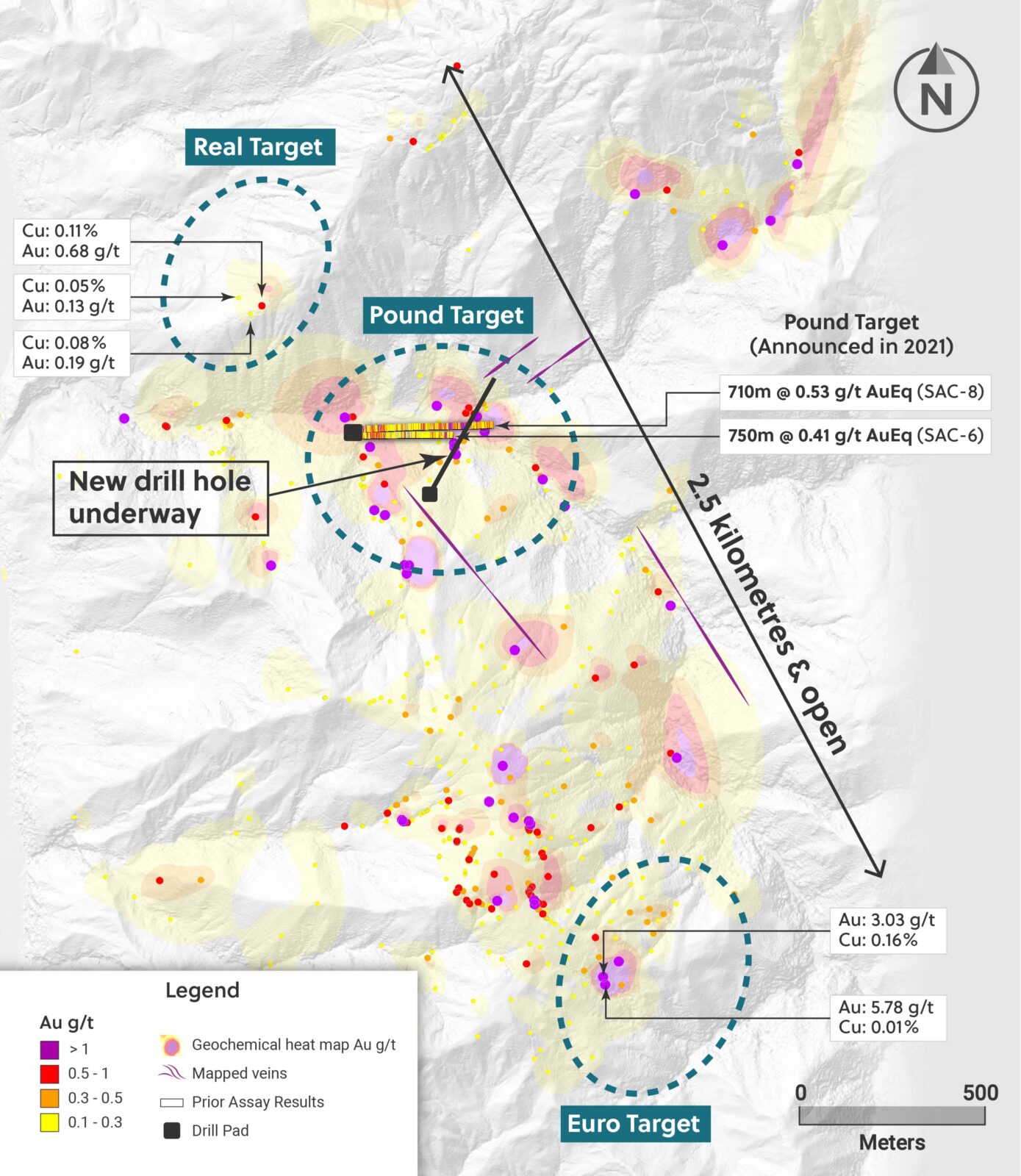
Headline image: Collective Mining Ltd’s San Antonio Project. Photo credit: Collective Mining Ltd.
The Banco de la República – Colombia will sit down, and the committee is behind the curve in terms of lowering rates when compared to the collapse in inflation, we can expect some caution. The consensus is a 25bps cut to 9.25% however could we see no move?
The rationale or excuse is the uncertain fiscal situation as the authorities struggle to balance the books, and also this week’s developments with the USA. It’s a tough call as the fiscal situation has been a constant for the past year and the fact that the Peso closed Thursday at $4170, its strongest in several months, suggests fears related to Donald Trump, shared by half the world, are overstated.
For the Central Bank, this will be the last meeting before two governors are replaced by Petro’s picks – the February meeting will arguably draw a lot of attention for that reason.
Petro’s perceived belligerence at the beginning of the week when dealing with the treatment of returning Colombian migrants, is now being viewed as a reasonable humanitarian request. It will hopefully embolden other Latam countries to demand the same basic respect from the USA.
November imports from Departamento Administrativo Nacional de Estadística – DANE Colombia rose 13.7% to $5.8bn, more evidence of a recovering economy however with exports still struggling somewhat, the YTD deficit now stands at $9.9bn, higher even than the $9.1bn for the first 11 months of 2023. Exports at least are being helped by coffee, with new record high prices this week.
Catatumbo remains a mess on the Venezuelan border and the government is still struggling to wrangle control back from the ELN and FARC, who are fighting over this lucrative cocaine route.
About it for this Friday, have a wonderful day.
Regards.
Roops.
Never miss Rupert’s latest commentary.
Follow him now on LinkedIn to see What Jumps Out.
Headline Image: Coffee beans from Don Elias finca in Salento, Colombia. (Credit: Jared Wade)
United States Attorney Roger B. Handberg announced that Jorge Hernan Gonzalez-Ortiz (50, Colombia) and Carlos Andres Aldana-Gil (43, Colombia) have pleaded guilty to conspiracy to import cocaine into the United States. Each faces a maximum penalty of life in federal prison. A sentencing date has not yet been scheduled.
According to the plea agreements and other court documents, from 2016 until 2023, Gonzalez-Ortiz established and led a drug trafficking organization in Colombia responsible for transporting cocaine via commercial airplanes. Conspirators loaded the commercial aircraft with cocaine disguised in boxes of fruit at Alfonso Bonilla Aragón International Airport in Cali, Colombia, and intended for Gustavo Rojas Pinilla International Airport in San Andrés Island, Colombia. With the assistance of corrupt Colombian police officers, the conspirators unloaded the cocaine. Then, they smuggled it by boat to Nicaragua, Honduras, Mexico, and the United States.
From 2016 until 2023, Gonzalez-Ortiz’s organization smuggled cocaine onto at least 27 commercial flights in Cali, totaling at least 43,000 kilograms.
From 2021 to 2023, Aldana-Gil worked on behalf of Gonzalez-Ortiz for all logistical aspects of the smuggling operation from Cali. He received truckloads of cocaine from other conspirators, transported the drugs to the airport, and paid an airport security supervisor to divert security cameras away from the airport’s external gates. He also hired and paid the conspirators responsible for altering the cargo manifests, as well as the luggage cart drivers who loaded the drugs onto commercial aircraft. On July 29, 2023, one of the organization’s cocaine shipments was interdicted by the Colombian National Police after it was offloaded from a commercial aircraft in San Andrés Island.
This prosecution is part of an Organized Crime Drug Enforcement Task Forces (OCDETF) Strike Force Initiative, which provides for the establishment of permanent multi-agency task force teams that work side-by-side in the same location. This co-located model enables agents from different agencies to collaborate on intelligence-driven, multi-jurisdictional operations to disrupt and dismantle the most significant drug traffickers, money launderers, gangs, and transnational criminal organizations.
The specific mission of the OCDETF Panama Express Strike Force is to disrupt and dismantle Transnational Criminal Organizations involved in large-scale drug trafficking, money laundering, and related activities. The OCDETF Panama Express Strike Force comprises agents and officers from the Coast Guard Investigative Service, Drug Enforcement Administration (DEA), Federal Bureau of Investigation (FBI), and Homeland Security Investigations, and the prosecution is being led by the Office of the United States Attorney for the Middle District of Florida.
Valuable assistance was provided by the Department of Justice’s Office of International Affairs, the Colombian National Police’s Dirreccion de Antinarcotics (DIRAN), and the Colombian Equipo de Trabajo Investigativo Control Aeronaves (ETICA). This case is being prosecuted by Assistant United States Attorney David J. Pardo.
Photo credit: Office of the United States Attorney for the Middle District of Florida.
The Office of the Attorney General of Colombia has charged Canadian citizen Raymond Arthur JR Cornish with the crimes of simple kidnapping, torture, and theft. He is accused of involvement in the kidnapping and torture of a woman who provided housekeeping services at an apartment rented through Airbnb in Medellín, Antioquia.
The incident occurred on November 23, 2023, in El Poblado neighborhood. According to the investigation, the woman was allegedly detained against her will by Cornish and another man, who were staying in the property. She was repeatedly assaulted to force her to disclose information about the location of a ring and money that they accused her of stealing.
According to Bogotá daily El Tiempo, the CCTV footage from the building shows the moment in which the woman is grabbed and forced into the apartment. Due to injuries the woman suffered at the hands of the men, the 42-year-old victim received a 15-day medical disability certificate after seeking medical attention. Following a judge’s decision, the Canadian was retained briefly in a Colombian jail but released.
She was repeatedly assaulted to force her to disclose information about the location of a ring and money that they accused her of stealing.
In January 2025, Cornish was finally apprehended in a coordinated operation while dining at a restaurant in the El Poblado neighborhood and pled not guilty to the charges against him. Following preliminary hearings, he was placed under preventive detention in a Medellín facility, where “he will have to face Colombian justice for the alleged crimes of aggravated kidnapping, torture and aggravated qualified theft. The supervisory judge decided to impose a security measure or deprivation of liberty in a penitentiary establishment,” Commander of the Fourth Brigade, Brigade General Jorge Ricardo Hernández Vargas, explained.
Manuel Villa Mejía, Secretary of Security and Coexistence, provided further details about the case. “Through the coordinated efforts of the Mayors’ Offices of Medellín, the military GAULA (Groups of Unified Action for Personal Freedom) of Antioquia, our National Army’s Fourth Brigade, and the CTI (Technical Investigation Corps), the arrest of Raymond Arthur JR Cornish, a 34-year-old Canadian citizen, was achieved through a judicial order.”
“We welcome everyone who visits within the framework of responsible tourism. However, those who come here to commit crimes are not welcome. The authorities have definitively returned to the city’s streets to deliver results and protect the freedom and safety.” Mejia added.
Headline Photo: Raymond Arthur JR Cornish, a 34-year-old Canadian citizen captured in Medellín (Photo: Office of the Attorney General of Colombia)
 Empleobilingue.com

- Director/a de operaciones para hotel, restaurante y discoteca 1626320364.60 - Medellín, Medellin, Antioquia, Colombia
- Coordinador/a de calidad para La Unión 1626483143.1 - La Unión, Antioquia, Colombia
- Desarrollador fullstack - Bogotá, Bogota, Colombia
- Technical Analyst - Remote
- PIM Administrator - Ecommerce - Remote (Bogotá, Bogota, Colombia)
- Auxiliar de gestión humana y bienestar para Girardota 1626060072.28 - Girardota, Antioquia, Colombia
- Marketing Strategist
- Trainer Manager - Bogotá, Bogota, Colombia
- Tolemaida UH- 60 Inspector - Bogotá, Bogota, Colombia
- Virtual Assistant - Team Lead - Remote
Contact Us

