

















We all remember when our parents were out of town, and we took advantage to invite friends over and always, somehow, red wine or a cigarette butt ended up on the carpet. Then there was the anxious wait to see what the parents would say and for how long you would be grounded. Well, in Colombia’s case, it was the Labor Reform Referendum that fell on the rug, and father Gustavo Petro is on the way home; that said, such is the need; he is visiting Pope Leo XIV in Rome on the way home for some spiritual guidance.
After the 49-47 vote there were immediate demands for a revote or for those who weren’t in the chamber, allegedly the hostile head of senate switched up the order of the day, to be allowed to vote. Petro called on his supporters to take to the streets once again. Whatever side you are on, it’s a total embarrassment, but there again Colombian politicians don’t have much shame.
The ANDI – Asociación Nacional de Empresarios de Colombia after years of simply bitching and moaning about any reform that might lower their members profits by 0.000001% have suggested looking for middle ground and even publically agreeing to some proposals. This feeds into an attempt to revive the Labor Reform itself in congress, ironically by some who were opposed to it. Quite clearly, both the corporate lobbyists in congress & the ANDI are getting nervous and are trying to find the cheapest way out of the current impasse.
Lots of headlines about the New Silk Road and even more speculation about the impact on both Chinese trade and relations with Washington. In reality, few know. China already has $100s of millions invested in Colombia, a lot of it in loans, but it remains to be seen what comes next. As for the US of A? Well, DT (Donald Trump) has spent so much time backing down and performing the dog with no bite trick, perhaps it isn’t as much of a worry as some think.
We will have the import data for March from the Departamento Administrativo Nacional de Estadística – DANE Colombia. Whilst exports were more robust than recently, driven by agriculture, domestic demand remains strong and another lumpy size deficit is likely to be reported.
About it from the tropical island of Mucura in the Caribbean…..check it out.
Have a great week.
Roops.
Never miss Rupert’s latest commentary.
Follow him now on LinkedIn to see What Jumps Out.
Photo credit: Gustavo Petro/X.
Addictions in the upper echelons of Colombian politics have recently been making headlines. At the end of April, former Foreign Minister Álvaro Leyva publicly accused President Gustavo Petro of drug addiction in an unprecedented moment in Colombia’s political history. The allegations came in the form of a lengthy letter addressed to Petro but also shared on Leyva’s social media, sparking political divisions and making headlines. Just days after the letter’s publication, Armando Benedetti, the recently appointed Minister of the Interior, stepped into the spotlight by openly admitting to his own struggles with drug and alcohol addiction in extended interviews with two national outlets.
“The memories I still have fresh of certain episodes—of which I was a direct witness—continue to cause me unease and dismay,” wrote Leyva in his letter, who served as the eldest member of Petro’s original cabinet as Foreign Minister. He was referencing a state visit to France in June 2023, where Petro allegedly “disappeared for two days,” delaying the delegation’s return.
Leyva added, “It was in Paris where I was able to confirm that you had a problem with drug addiction. But what could I do? Surely, I was not up to the task. I should have reached out, helped, intervened. I carry the regret of not having tried to lend a hand. The truth is, you never recovered. That is the reality.”
While the accusations were met with skepticism by Petro’s allies, the President himself responded on X, but without naming Leyva directly. “Now it’s a sin to be with my family. Because several of my children and my mother live abroad, and because of the persecution we suffer, I have very few opportunities to see them,” he wrote hours later. The following day, during a public appearance, Petro mocked the allegations: “Being a drug addict is not a sin, Mr. Oligarch. Most of your children are addicted—if not to drugs, then to money. It’s a treatable disease, but never blame that illness on a revolutionary who has spent his entire life trying to make his dream revolution come true,” he said in a speech lasting more than an hour.
Leyva, now 82, began Petro’s administration in 2022 as a key figure in the President’s peace-building agenda. Under his leadership, Colombia reestablished diplomatic relations with Venezuela and Cuba, making them key guarantors in peace talks with the ELN and FARC dissident groups. However, in 2023, Leyva was accused of unlawfully annulling a tender process for the issuance of passports—a decision that ultimately led to a ten-year public service ban imposed in November 2024. The ruling found that Leyva had canceled the bidding process despite the company Thomas Greg & Sons (TGS) meeting all legal requirements.
Days later, Armando Benedetti publicly admitted to his own addiction struggles. In two extensive interviews with online magazine Cambio and national daily El Tiempo, Benedetti revealed he had been addicted to cocaine and alcohol and had undergone rehabilitation in Mexico. “Last October, I spent 35 days in a rehabilitation center in Mazatlán, Mexico, and there I overcame the emotional instabilities that lead one to use drugs. And that helps free oneself from many of the situations that lead to use. Based on that, with rehabilitation, you become more spiritual. You understand that you have to ask for help and that you can’t get out of there alone,” he told El Tiempo.
“Sometimes it’s hard to accept. I don’t want to be a drug addict. But I am. It’s a disease, and I wish I was not (…), 90 % of my problems are due to arrogance,” he told Cambio. However, he firmly denied Leyva’s claims about Petro.
Benedetti is currently under judicial investigation for gender-based violence, illicit enrichment, and alleged physical aggression—charges filed in 2023 by current Foreign Minister Laura Sarabia, after leaked audio revealed him using offensive language against her during a past dispute.
These two revelations have reignited debate over personal conduct in public office and the boundaries between political loyalty, accountability, and privacy. But it has also raised concerns about the health of those whom have the Colombian government in their hands.
Headline photo: Armando Benedetti, Minister of the Interior of Colombia since February (Photo: Ministerio del Interior)
Government intervention in the Colombian electricity distribution company Air-E has increased accumulated balances, raising concerns about potential credit profile weakening across the energy chain, including generation, transmission, and distribution companies. According to Fitch Ratings, the intervention has introduced uncertainty regarding Air-E’s capacity to meet its financial obligations, which totaled approximately $2 trillion COP ($470 million USD) as of April 2025. A significant portion of this amount is owed to thermal generators.
A government directive prohibiting penalizing Air-E for payment delays by limiting supply compounds the situation. Several rated entities hold significant exposure to Air-E. TermoCandelaria Power S.A. (BB/Positive) has an outstanding balance of around $102 million USD with Air-E, with over half of this incurred since the intervention. Fitch anticipates a reduction in TermoCandelaria’s exposure as normalized hydrology conditions are expected to shift the company back to primarily out-of-merit generation.
Interconexion Electrica S.A. E.S.P. (BBB/Negative) and Grupo Energia Bogotá S.A. E.S.P. (BBB/Negative) also face exposure, with provisions made post-intervention of close to $40 million USD and $12 million USD, respectively, predominantly within their transmission operations. Air-E owes Empresas Publicas de Medellín E.S.P. (BB+/Negative) approximately $38 million USD, of which around $7 million USD is owed to its distribution subsidiary, Afinia. While Fitch does not foresee immediate liquidity concerns for these companies due to their strong cash flow generation, prolonged payment delays could exert pressure on future working capital requirements.
Air-E, which serves roughly 1.2 million users in Colombia’s Caribbean region, accounts for 11.5% of the nation’s total energy demand. The Superintendencia de Servicios Publicos intervened in the company in September 2024, citing financial instability stemming from high energy losses, low collection rates, and considerable exposure to the energy spot market amidst rising prices.
Photo credit: dimitrisvetsikas1969 from Pixabay.
Colombia’s Center for Research and Development in Information and Communications Technologies (CINTEL) has announced the 40th iteration of ANDICOM, its annual technology and business congress. The event is scheduled to take place in Cartagena de Indias at the Complejo Las Américas.
The congress is set to begin with a pre-congress session on September 2, followed by the main congress from September 3 to 5, 2025.
ANDICOM is an established event within the technology and business sectors in Colombia and Latin America. Organized by CINTEL, the congress aims to convene industry leaders to analyze trends impacting the digital landscape in the region and review technological evolution over the past decades.
CINTEL, founded in 1991, focuses on applied research projects in digital technologies. The organization states its role in promoting digital transformation across various sectors in Colombia.
Manuel Martínez Niño, Executive Director of CINTEL, commented on the upcoming event, noting its history and CINTEL’s stated commitment to digital development in Colombia and the region. He added that the event will facilitate the strengthening of alliances and the projection of the digital future.
The academic agenda for ANDICOM 2025 is structured around four themes:
September 2 (Pre-Congress): Applied Tech Trends in Business
September 3: Digital Transformation and Evolution
September 4: Connectivity and the Future of ICT
September 5: Digital Economy: Challenges and Innovations
ANDICOM 2025 is expected to cover topics such as artificial intelligence, data, cybersecurity, 5G connectivity, sustainability, and digital inclusion. A commercial exhibition will feature technology companies showcasing strategies and case studies. The event also includes networking opportunities to connect public, private, and academic participants.
Registration for ANDICOM 2025 is open. The event’s official website has further information and registration details.
Photo credit: ANDICOM.
The most recent survey conducted by the polling firms Guarumo and Ecoanalítica has revealed that Alejandro Char, the mayor of Barranquilla, holds the highest approval rating among mayors of Colombia’s capital cities. According to the poll, Char enjoys 85.4% approval rate, with only 10.6% of respondents disapproving of his administration.
This impressive public support comes despite Char’s current judicial investigations.
On January 22, the Office of the Attorney General of Colombia questioned him in relation to an ongoing probe into alleged misconduct in public office and falsification of public documents. The investigation arises from four controversial appointments made during his current term, which began in 2024.
A formal complaint was filed in June 2024 by a citizen, José Raúl Rodríguez Jiménez, who alleges that Char violated public employment regulations by appointing former city council members to key roles in his administration immediately after they lost reelection bids. The appointees include Elania Redondo Peña (Barranquilla’s Secretary of Human Resource Management), Andrés Felipe Rengifo Lemus (Head of Citizen Participation Office), Juan Carlos Ospino Acuña (Secretary of Culture and Heritage of Barranquilla), and Richard Manuel Fernández Barraza (Head of Port Affairs).
According to the complaint, these appointments went against rules requiring a one-year period for former council members before assuming public office, unless they have also resigned from their political parties.
The complaint, as reported by the local daily El Espectador, highlights that “Char ignored, despite the team of advisors that work in his cabinet, the ‘Disqualification and Incompatibility Regime for Public Officials’. It states that city council members, upon leaving office or ceasing to be public servants, must wait 12 months to be able to hold public office and, likewise, must resign from their respective parties.” The newspaper reported that it had access to the official document outlining the allegations.
Char is also in the news due to his past ties to the construction sector. Between 2002 and 2005, his company, Alejandro Char & Cía., developed a series of residential complexes in the Campo Alegre neighborhood, an area long identified as geologically unstable. Despite warnings as early as 1997 from Ingeominas, the city amended its urban development plan to allow the projects to proceed. Years later, more than 400 families were affected by serious structural damage to their homes, forcing the city to spend over 55 billion pesos on rental subsidies and hillside stabilization. Some of the buildings were evacuated in 2011 due to the risk of collapse.
In response to the ongoing investigations into this matter, Jaime Berdugo was appointed as ‘alcalde ad hoc’ (interim mayor) of Barranquilla on April 15, 2025, by Interior Minister Armando Benedetti. Berdugo, a lawyer and former employee of entities linked to contractor Euclides Torres, a political figure with ties to the Char administration, has been tasked with overseeing the city’s handling of claims related to the damaged housing projects. His role includes evaluating legal and administrative actions connected to Alejandro Char & Cía.’s developments, including the projects Ciudad del Sol II, Terragona, Barcelona, Parque 100, and Parque 98.
As a very experienced politician, Char has served three terms as mayor and ran as a presidential pre-candidate in 2022. Legal controversies have been common alongside his political career so it is not a surprise that this time, despite the legal pressures, Char’s popularity among Barranquilla’s residents remains strong.
Headline photo: Alejandro Char, mayor of Barranquilla (X / @AlejandroChar)
The week began with the Bogotá campus of the Universidad Nacional de Colombia hosting an encampment by the Indigenous “Minga,” which arrived over the weekend in anticipation of the May 1st International Workers’ Day protests. Although this was a coordinated action agreed upon with local and national authorities—intended as a humanitarian effort that would not interfere with academic life—the situation is more complicated than what was forecasted, as far more people arrived than initially anticipated, and they are taking control of key areas of the campus.
In Colombia, a “Minga” is a mass convocation of indigenous tribes who travel to meet en masse.
While many members of Colombia’s Indigenous groups support parts of Colombian President Gustavo Petro’s struggling legislative agenda, minga leaders are also pressing for the government to fulfill previously agreed-upon commitments concerning various aspects, including the implementation of peace agreements, investments in health and education within their communities, and guarantees for their territorial autonomy.
Although university authorities, including Rector Leopoldo Múnera, had coordinated with the national government to accommodate the Minga at the bandshell within the campus for this week, they had initially spoken of about 4,000 participants, but the number has now exceeded 10,000 people. Moreover, several academic buildings, including those for Engineering, Science and Technology, Mathematics, and the Julio Garavito building, were unexpectedly occupied due to bad weather (“extreme weather conditions,” according to the university’s press release).
Students were not allowed to access these buildings and several classes had to be cancelled. To ensure academic continuity, the university authorities set the implementation of online classes during this exceptional situation. “The priority has been to ensure mutual respect and maintain an environment of peaceful coexistence,” Munera stated as per the press release. Even the León de Greiff auditorium is reportedly closed, preventing the Bogotá Philharmonic Orchestra from rehearsing. The situation is worrying, especially considering that this semester only began a month ago, following a three-month delay caused by a student strike.
Jhoe Sauca, a senior advisor from the Regional Indigenous Council of Cauca (CRIC), told El Tiempo that internal discussions are ongoing and that they are working with the Indigenous Guard to prevent further incidents at campus entrances since Minga members are controlling access in and out of some of these buildings, as reported by Prof. Diego Torres through various posts on X.
Local authorities have emphasized on the coordination efforts they are working on to ensure the situation does not escalate with the arrival of the remaining attendants. On Sunday, April 27, Gustavo Quintero Ardila, Secretary of Government for Bogotá, acknowledged the continuous arrival of Indigenous groups from across the country and confirmed that part of the delegation had already settled within the premises of the Universidad Nacional and the city administration has designated Parque Tercer Milenio as an additional space to accommodate those still arriving. “We continue to provide ongoing support to the various stakeholders and work collaboratively to ensure the Minga’s arrival and continued presence in Bogotá proceeds as smoothly as possible,” Quintero mentioned via X.
Estas declaraciones de la administración de la @UNALOficial en @lasillavacia no son precisas. Abro hilo con videos y fotografías que yo mismo tomé el día de hoy, o que le fueron cedidas y autorizadas para publicar. 🧵👇
“Rector de la Unal dice que Minga no bloquea actividades…
— Diego A. Torres G. (@DiegoTorres_Fis) April 29, 2025
Headline photo: The Minga at the Plaza ‘Che’ (Central Square) of the university (@ValenVolandoVa / X)
The Medellín Mayor’s Office, through its Book Events division, has announced that over 11 international writers will participate in the 19th annual Book and Culture Festival, scheduled from September 12th to 21st. This literary and cultural gathering is recognized as one of the most prominent in Latin America.
Authors, editors, booksellers, comic artists, poets, and literary critics will meet with numerous attendees to exchange ideas and insights during the 10-day event. This free-admission event will take place at the Joaquín Antonio Uribe Botanical Garden and the northern district of the city.
“Writers from five countries have confirmed their presence, all of whom will bring their voices, stories, and reflections on the contemporary world to the city. Furthermore, we continue to strengthen our cultural relationship with Mexico, which this year stands out as the country with the most confirmed authors, addressing narratives that explore feminisms, social issues, and environmental challenges,” confirmed the Secretary of Citizen Culture, Santiago Silva Jaramillo.
The invited international publishing house is Periférica (Spain), an independent publisher that has focused on disseminating Latin American literature globally for nearly two decades. Its founder, Paca Flores, will lead the delegation to Medellín, accompanied by already confirmed authors: poet and translator Munir Hachemi (Spain), writer and essayist Diamela Eltit (Chile), and writer Juan Cárdenas (Colombia). Additionally, Jorge Carrión, a Spanish author, critic, and essayist known for his deep reflections on the complex relationships between literature and technology, will also join us from Spain.
From Mexico, the confirmed writers to date include: Brenda Navarro, writer and editor; Fabio Morábito, poet, short story writer, and novelist; Dahlia de la Cerda, author and feminist activist; Sebastián Tonda, business consultant and writer; and Luis Felipe Fabre, poet and essayist.
Cuban writer Elaine Vilar will present her work and discuss her experience as a narrator and playwright. From the southern part of the continent, other voices enriching the literary landscape with their diversity will visit the Festival: Cecilia Fanti (Argentina), author, editor, and independent bookseller; Diamela Eltit (Chile), a renowned writer and teacher; and Begoña Ugalde (Chile), who will share her journey between poetry and short stories.
The field of comics and graphic novels, currently booming within the publishing world, will feature the presence of two award-winning artists: Ian Debiase (Argentina), an illustrator and graphic novelist, and Ana Galváñ (Spain), a recognized illustrator and comic author. They will be joined by prominent figures in children’s and young adult literature such as Ana Garralón (Spain) and Manuel Peña Muñoz (Chile).
The public is invited to read or rediscover the works of the authors participating in the Book and Culture Festival. Additionally, they are encouraged to explore the work of other writers who will be announced in the coming months and will be part of this literary and cultural celebration.
Photo credit: Fiesta del Libro y la Cultura/Facebook.
Ecopetrol S.A. (BVC: ECOPETROL; NYSE: EC) has announced that the Ministry of Finance and Public Credit (“MHCP”) authorized the company to execute a loan agreement of up to $500 million USD with Banco Santander, S.A., through Resolution 0910 dated April 25, 2025. The term of the loan will be five years, payable at maturity, and the interest rate will be indexed to the SOFR rate.
The funds from this operation are intended to be allocated to non-investment expenses, as per the resolution issued by the MHCP and the company’s 2025 financing plan, and help reach the Gross Debt/EBITDA target for the year.
To obtain the MHCP authorization, the company complied with all required internal procedures and approvals. The MHCP reviewed and authorized the terms of the draft agreement, which will be governed by the laws of the State of New York.
Photo credit: Ecopetrol/Flickr.
The recent COVID-19 pandemic highlighted the fact that at the time, Colombia was unable to produce vaccines and antivirals, but had to count on other countries and multinational organizations to see that its citizens had access to vaccines. However, the country’s first vaccine development and production laboratory, VaxThera, has been built just minutes away from Medellín’s José Maria Córdova international airport located in the suburb of Rionegro. Backed by Colombian insurance giant Grupo Sura, and led by University of Wisconsin professor Jorge Osorio, who was born and raised in Medellín, the cutting edge facility promises to not only supply Colombia, but to export life saving vaccines throughout The Americas and the world. Osorio took Finance Colombia’s Executive Editor Loren Moss on a tour of the brand new facilities as it awaited a green light from INVIMA (Colombia’s medical and food certification authority), and readied for production.
Click on the image above to view the video.
Finance Colombia: But here, of course, in Medellín… Medellín is, as you know, kind of like a combination of the Silicon Valley of Colombia, and now with the biotech that you’re doing, it’s almost like Boston as well. It’s amazing to see something like this, not just Colombian operated, but Colombian owned, as part of SURA.
Jorge Osorio: We are very proud of it, you know, we’re very proud, and it’s kind of my dream come true. I left Colombia when I was very young, 22 years old. I didn’t know a word of English. I grew up in a very humble family, you know, a low-income family. But through education, I was able to make it through, and I ended up in Wisconsin, without even knowing where Wisconsin was. I went with short sleeves, you know? But I went in the summer, so it was great, because the summer is so nice, you know. As the weather gets colder and colder, I was like, “Oh my god, what am I doing here?”
Finance Colombia: By September, it’s all changing.
Jorge Osorio: I know, I know. The first November I was there, we had three feet of snow. It was up to here, so it was crazy. It was crazy. So then, little by little, you know, I learned English, and loved school, did my master’s, my PhD in Wisconsin, and I worked in the industry in the US. I started my own company in the US. My mom, all these things are inspired by mothers, you know, mothers play a major role in us. My mother told me one day, “Son, you haven’t done anything with your life.” After having my master’s, my PhD, and being a professor in one of the top universities in the US, my mom said, “You haven’t done anything with your life. People in Colombia are dying of dengue, and you haven’t done anything. Do something, do something for dengue, try to figure that out.” So what a challenge. So I started studying dengue, and with a friend of mine, created a company to make a vaccine, and I did it. It was successful.
Click on the above image to watch the full video and tour.
So that was like my moment of pride, and that vaccine is now in the hands of the people. Our company, Takeda, bought the vaccine, bought the company, and everything, and now that’s being used to prevent dengue. So at the same time, I said, “I need to do something for my own country, you know, my homeland. I’ve done this company somewhere else, and I need to do something.” So COVID came, you know.
And when COVID came, SURA said, “We need to do something.” Because what has happened is that we’re going to continue having these problems, you know, these outbreaks, these things are going to continue happening in general. But we were like one of the last countries… well, LATAM was one of the last regions to get vaccines.
Finance Colombia: Most people here who could, I mean, even I flew to Miami to get my vaccine, and then people were waiting on different ones, and the country was dependent on the mercy… And every other country is going to take care of their people first, and then send what’s left over down here.
Jorge Osorio: So we got vaccines from Sinovac, we got a few things there, but SURA said, “We need to do something ourselves, we need to do something.” So I came to meet with them, and that was my dream. I said, You know, I want to do something for my homeland.” And this is it.
So I decided, I want this to be inspired, to make people feel good to come to work here, and so the design of the buildings, I took a lot of a role in that as well. The design of the gardens, everything, the facilities inside, everything I did, I did a lot myself.
Finance Colombia: It’s amazing. So from Wisconsin, back home. And so you already sort of answered a couple of the questions that I have, which was why, not just why Colombia, not that there’s any bad reasons, but it’s interesting because there has not been, not just in Colombia, but in Latin America generally, not a large industry in producing high-level biologics.
I mean, some companies do things like produce vitamins, and some contract manufacturing, but not like the vaccines, which is a much higher tech than just saying, “I’m going to produce a generic, I’m going to produce a vitamin supplement,” or something like that.
Jorge Osorio: So yeah, because look, the whole region is 650 million. LATAM. That’s pretty large, isn’t it? And there are only four countries that make vaccines: Mexico, Cuba, Brazil, and Argentina, and they don’t make enough for everyone. So there’s a need to do this. There’s a need to produce something that will provide more vaccines for the region. At the same time, my dream is that… Tropical diseases affect people around the planet. It’s not just Colombia, or Venezuela, or the region, but mosquito-borne diseases, dengue, for example, affects people in Africa, in Europe, Spain, and Italy are having cases of that as well, and Asia as well.

Primary filling facility (photos © Loren Moss)
So I think what I would like to see happening is that we export science and technology from Colombia. We put our brains to work, and we export science and technology to help folks in other parts of the world, and we can control diseases in that way. We can export our knowledge and our scientists. I’m very proud of the scientists that we have, you know, people that we have.
Finance Colombia: The talent, and not just Colombian talent, but global talent. You have a quality control guy coming from India… And so that makes Colombia, and specifically Antioquia, kind of like a global hub.
Jorge Osorio: So what I want to see here, and we can even walk, and you can see. Because I’d like you to see what my dream is. You know, if you come to this area, it’s mostly.. You find these parking areas for cars that are near the airport, right? We can change the whole concept here by creating what you just said, a biotech hub.
That this whole area here, I dream that there’s going to be more buildings coming, hospitals, because we need some other supplies to make the vaccines. We need someone to make the caps, the glasses, and the enzymes. So I think we could have some other players that will come here and say, “Hey, you know, I want to be part of this.” And this could be a new hub for biotech. That’s how it started, actually in India.
If you go to a place like Hyderabad, if you’ve been there, but the hub for biotechnology there it’s called the Genome Valley. And that Genome Valley started about 30 years ago with one single company. Today, it’s amazing. And that’s what I want to see happening here: that we build more and more industry, and we invite more people to come to join this effort.
Finance Colombia: And people don’t realize that that brings not just the jobs, but the talent and the know-how that establishes you as the center for this.
Jorge Osorio: Exactly. And, you know, I think I’ve been seeing the Colombian folks that have come back, they wanted something like this to happen. They have said, you know, like you just met the plant director, Juan Fernando. He’s like, “Oh, you know, this was a dream of my life to be able to come back, but the opportunity was never there.” So I think we want to provide that, but also for the young people who are here in Colombia to feel that there’s an opportunity.
Finance Colombia: You don’t have to leave. There’s an opportunity here. A lot of times, there’s a brain drain.
Jorge Osorio: Exactly. Right. So we want to create the talent that we have. We want to stimulate the young people to say, “Hey, you know, I can do something as well for my country. I can come here, learn about technology, and new things to produce vaccines.” What I also like to have is innovation, okay? And what I have done is bring technology that has been used, for example, in mRNA vaccines. We can now make mRNA vaccines here.
Finance Colombia: Messenger RNA.
Jorge Osorio: Like the vaccine that COVID, that Pfizer made, that was, you know, like saved the world, basically, the vaccine that was made in 11 months. We can make that here. And we can do that. So I think I’d like to have the concept of health independence, you know, that we can do health sovereignty for the region. And that our country can also… and our region, because I think more about LATAM. I’m very proud of being a Latino.
You know, we can say, you know, here we are. We can take care of things. We can do it ourselves. We can drive the economy. Change the economy of the region. You know, I think we can do that because when we export science and technology, we can change that.
Finance Colombia: A knowledge economy. It’s not good when all the laborers are local and all of the managers are from somewhere else.
Jorge Osorio: Yeah. That happens in some places. Some companies do that. You know, and I’m very proud also of the training. What we want to do is that the opportunity that I have, which someone gave me a scholarship in Wisconsin, and I can do it for a hundred people. I can do it for more people. So we are sending people to Wisconsin. It’s a good education, you know, and I want them to have that opportunity to educate themselves, to experience what it’s like to be out of their comfort zone, and to understand that they can do good things. They can do even better things than I have done. So I’m proud. We are training people now. And not just science, you know. They are getting into business development, education, accounting, all that.
Finance Colombia: Accounting, engineering, management, right.
Jorge Osorio: All that. Right. So I think that’s what we love to see happening. To change this area.

Laboratory building (photos © Loren Moss)
Finance Colombia: This is such a modern plant. It’s brand new. I remember when they announced it, we did an article about four years ago, I believe it was, you know, covering it. And I remember thinking, “Okay, well, you know, it’s a concept. Let’s see.”
Jorge Osorio: “Let’s see what happens.”
Finance Colombia: And it wasn’t that I didn’t believe it, but, you know, I live very close to here. And when I saw the construction begin on the site, I was like, “Oh, this is real. This is coming.”
Jorge Osorio: This is real.
Finance Colombia: You know, and here it is.
Jorge Osorio: And also, one very important thing is the Colombian talent: the engineers, the architects, who took the concept, we had the best advisors from India and other places that have built manufacturing facilities all over the world. We took that concept and we have to translate that to the local language here because nobody here has made a facility like this before. And it’s not so simple.
If I walk you through this building and you will see the level of complexity that is on every level there. It’s amazing to be able to connect the air, the energy, and all the water supplies. It’s amazing. So, to me, I’m also proud to say this was built by local companies, you know, that did that work. But we brought the best technology and equipment from around the world. This is what makes me very proud of it, that we have done that.
So, you can see that in three and a half years, this is what we have, you know, and I think it’s really…We have had visitors from all over the world now, different companies that have said, you know, like you said, “Oh, I don’t know. I don’t know if those guys are going to come up with anything.” But look at it now.
Finance Colombia: When you saw SURA behind it, you know, SURA is a multinational. It’s Colombian, based in Medellín. It’s a company that already has assets and operations, and they, you know, they go far beyond everything from health insurance to car insurance to all different types of asset management and things like that. So, certainly that backing, I would imagine, gives you the financial stability.
Jorge Osorio: It does. That’s why I made that major commitment, because for a long time I wanted to do this, but people will say: “you know, I’ll give you $500,000.” This takes more than that, you know. So, when I first started this project, I told SURA, well, this is going to cost probably $100 million. In the first year, you’re going to cost maybe about $15 million. Say, okay, what are you waiting for to get started?
So, you need to have that muscle behind, that group that tells you, you’re not going to run short of this. And that’s where I think the private sector in our economy plays a major role. This would have never happened with government funds. I’ll be honest with you. I wish I were wrong there, but you need that private muscle, insurance that says, “Hey, you know, here I’m supporting you and, you know, just keep going, keep going.”
Finance Colombia: The patience, not just the capital, but I mean, it’s kind of sad when we look at it. There are cases. I was in Cartagena, and I was in La Guajira recently, and I saw unfinished hospitals. And there’s a case right now up on the Atlantic coast, and they gave the guy the deposit to start building the hospital, and he ran off, and he’s in Miami somewhere or something like that.
Jorge Osorio: That’s crazy. That’s crazy. So, you know, I think what we have here is also my name, my credibility. I put my name on this, and I want to deliver. I want to deliver to SURA but also to my people, to my commitment that I have.
Finance Colombia: Oh, it’s helping untold millions. Something you talked about earlier that I’m also curious about, you mentioned the work that you’ve done with dengue. And dengue, I remember my first time in Nicaragua, which was before, it was back in the 90s, and there was a dengue outbreak, and I remember being in a restaurant and looking over and people like falling out, you know, and I’m sitting there, but dengue is a very technically difficult disease to create a vaccine for because the vaccine is very, very harsh, and they won’t just give it, that’s why prevention is such a cure. It’s like, look, better not to get bitten by the mosquito.
And so, that’s challenging. And so, I wonder, you know, we’re up here kind of in the mountains at 7,000 feet, but we have things like dengue and yellow fever. In tropical… I’m sure that there are some, you know, I’m not a medical person. If we go down to the Amazon, there are some things that we have parasites and things.
Jorge Osorio: We have oropouche, we have malaria, we have chikungunya, we have many, many things that are tropical diseases. But also, some of those problems, big companies don’t want to put the resources into because they are so local.
Finance Colombia: Orphan diseases. Exactly.
Jorge Osorio: We call them orphan diseases, tropical diseases. So, my goal is also to create vaccines for these types of diseases that affect our population. And now that we see climate change and we see all these issues, we see that the mosquitoes are in Florida and Texas, and all these areas there. So, it won’t be a surprise in the future if we have a major outbreak in the US or something.
Finance Colombia: Then they start paying attention.
Jorge Osorio: Then they will.
Finance Colombia: But it’s important to be able to have the capacity here so that, you know, aside from the research and things like that, if you said we need to produce something, that’s not necessarily getting enough attention, you’re not beholden to some laboratory or some charity somewhere to do it.
Jorge Osorio: That we can make the decisions ourselves. That we can have that independence to say, yes, we want to do this, or we can do this. So, I feel that is also what makes us feel proud of it. You know, we can focus on our diseases, our tropical diseases, but they can also have an impact. I was asked recently, for example, one of the vaccines that I’m working on could have a significant impact in Africa. And we could do… It’s hard to believe that, but it’s going to be true. We will do a technology transfer from here, from Colombia to Africa.
Finance Colombia: Oh, yeah?
Jorge Osorio: That makes me very proud, too.
Finance Colombia: Exactly. Because Colombia is now a donor country, whereas 50 years ago, it was a recipient country.
Jorge Osorio: Exactly. So, we can change a few things, but we can also be more involved in this global partnership that we can be part of this network. And we are now part of this network that is also making vaccines and biologicals for all over the world. I think that’s what we wanted to do.
Finance Colombia: That’s great. It’s got to be a, I know it’s a source of pride for you, but also for Paisas, for Antioquia, for Medellín, Rionegro, of course, and then for all of Colombia. And like you mentioned, for Latin America, it’s great to see Colombia taking a leadership role. We hear about Brazil doing things and Mexico doing things, but now Colombia is part of that top tier.
Jorge Osorio: Totally. I feel that that’s what makes us proud. And this is not just an Antioquia or Rionegro project, it’s a nationwide project. And I see more of a regional project, of the entire region. I was in Rio last week as part of this global vaccine research network, and it’s the partnerships that we are doing with people from companies in Brazil, companies in Argentina. You mentioned Mexico, Nicaragua, all those countries, and Cuba as well. And we partner with them. We want to work together with them. So, I think I see this is how we can work together and show that Colombia is going to be on the map. It’s going to be on the map of biotechnology, which I’d like to see happening.
Finance Colombia: Absolutely. It’s so amazing what you’re doing here. I’d love to see if you could kind of give us a tour and show us the cool stuff.
Jorge Osorio: So, let’s, I want to show you what my dream is. Ok?
We’re gonna go there but I want you to see this area here. Because we just walked by, you know, without appreciating this. Look at this. This spiral.
Finance Colombia: It’s almost like…It reminds me of the helix of DNA.
Jorge Osorio: Exactly. That’s what it is. It was made for that purpose. To have that there. We brought that in. The colors are the colors of the company. The Vaxthera colors. Which is…we’re very proud of that, you know. And here is the result. So this here is the filling facility, we are going to go into. I want to walk you through some of the areas where people work here at the facilities.
Finance Colombia: Okay. So is this like the laboratory part? Or the production part?
Jorge Osorio: So here is where we bring…You’re gonna see the Rolls-Royce of equipment. Which is very exciting. This equipment took about three years to build. Two and a half years. It was built in Germany. Bausch. Custom-made for us. With a lot of sacrifice and pain from us. Because we have to deal with them here and there. Bring the equipment here. And make it work here. So it takes a while.
Paul: So since we are at the final stage of the construction of the facility. We still have some activities going on inside. But we implemented some measures to minimize the contamination.
Finance Colombia: Right. And the idea is to begin production in April?
Jorge Osorio: So we are going through the process of certification. What’s called certification. And so the team here is preparing what’s called the dossier for the regulatory packaging for INVIMA to come and inspect us.
Finance Colombia: And INVIMA, it’s like the FDA.

Pressure gauges are part of an integrated building management system to prevent contamination. (photos © Loren Moss)
Jorge Osorio: Exactly. The Colombian FDA. So that’s what’s gonna happen.
Paul: So, over here we have some offices, some storage rooms. The raw materials and the consumables that we’re going to use for the manufacturing process are the access to those materials. So it’s a material airlock. So they come directly from the warehouse, and then from here we’re going to sanitize them, and then we’re going to move them into the manufacturing suite. Let’s talk about these guys, pressure gauges. So our facility works with a cascade effect. So that means that the pressure in the grade A area is higher, the highest.
So when you open a door, basically when we’re transitioning from a dirty room to a clean room, the air from the clean room is coming out into the dirty room and not the opposite. It’s like a balloon when you inflate a balloon. So you are creating pressure inside, and then if you release the air, that air is coming out. That’s the principle of the clean rooms. Right. So that’s why it’s very important to have contingencies for power. So that’s constantly monitored by the building management system. So it’s 24/7 that we monitor temperature, pressure, and humidity. So all these devices are connected to a building management system. And in real time, we can check on the computer all those conditions.
Along the way, you can see some storage rooms, some change rooms. Here in particular, we have what we call a disinfection chamber. A fumigation box. So basically, in here, all those materials that we bring from the warehouse, we are going to disinfect them using hydrogen peroxide. So any material that we want to transfer into the aseptic areas, they must be disinfected with the peroxide.
Finance Colombia: So this is one line of production, and then you’ll have multiple lines of production similar to this?
Jorge Osorio: Eventually. This is for now. We’ll have other ones in the future that will be a different technique that will be like, you know, you have seen those pre-filled syringes, we will have something like that as well.
Finance Colombia: Life-saving. Amazing. Wow.
Jorge Osorio: The water tanks that supply water for the company are based right there, so it’s a very special building, and you can see that from there all the gases and lines are piped to all the different buildings, so that comes here to this, this is the filling facility. Then we have another building, which is like the social building, where people go for lunch, and we go we will go there if you like too. You will see nice areas because I also believe that our workers need to have a nice environment to do well.
Finance Colombia: I mean look at the care that you put into the facilities and making it attractive, and an attractive place to work.
Jorge Osorio: I’ll show you that one, it’s also it’s called the potency lab, so we have about six buildings, so that’s the potency lab that for every vaccine we need to test to make sure the vaccine really meets the standards, the requirements that you need to do, so it’s a nice facility that we have, we can walk through it if you like.
They do a few things here, okay, offices, pharmaceutical chemistry, you know, and then inside there, there is the facilities where they do all the potency testing of the vaccine, of the work, yeah, okay, so that would be inside behind there.
Finance Colombia: Wow, amazing, this is so great to see a modern… not just a facility here, but like I said, it’s just as impressive because it’s domestic. You know, it’s one thing if I don’t know, let’s say Pfizer, yes, puts a Pfizer says, “we’re going to put a factory in Colombia.” That’s great, but this is Colombian.
Jorge Osorio: It’s all made in Colombia, you know, this is what we’re doing.
Finance Colombia: When it’s fully staffed, how many people will you have?
Jorge Osorio: Likely more than 500. At this point, we have about 150 employees, and this is the plant facility, but we have a research lab in Medellín. We are making a lot of progress in a lot of things, very soon, probably, so number one: we’re moving the facility into the Invima regulatory package, so INVIMA is going to come to visit; we had a major announcement with the government, we announced about a month ago that Vaxthera, the Ministry of Health, and the National Institute of Health, signed an agreement to build capacity locally for the next 10 years. So we’re working together, Vaxthera will help the Institute of National Health to make vaccines as well, okay, because we cannot make all the vaccines ourselves. And it’s good to have partners, and to have them as partners of the government, it would be good for all of us.

One of the vaccine packaging lines deep in the heart of the facility. (photos © Loren Moss)
Finance Colombia: I mean, not just for Colombia, because when you increase capacity, then you’re able to help your neighbors. And not just that, but the whole licensing agreement… because when you guys develop the intellectual property, then you can go and license it, not just to other Colombian organizations, but around the world.
Jorge Osorio: That’s what we’re doing, you got it right. We got, last year, our first patent, for a vaccine that would protect against different variants of COVID, and that vaccine, now, it will also protect against Mpox; Mpox is a virus that is affecting people in Africa. So it’s going to be amazing that we will support some African countries, you know, to develop that vaccine, because we have made it here. We are going to make shingles here, too.
I’m so happy with SURA, because when we had this discussion with SURA, there were some people here in Colombia that were skeptical, saying, “Those guys are not going to do it, you know, they’re never going to be able to do this, or also, where are you going to find the people to do this.”
Finance Colombia: So you’re proving them wrong.
Jorge Osorio: Exactly right, so I’m very happy with that. We have all this space to grow. So take a look, we have all this space, okay? And we have access, we bought the land, this is from our neighbors, we bought them from a family, and that family is very proud of doing this. The owner of the land said, “I want my land to belong to this dream of having the facility here, to do something good.” We have areas here to grow, that we can build, in addition to what we can do here, we have space that we can build more, and there’s even a space behind there.
Finance Colombia: This is only phase one. You have all this space to grow.
Jorge Osorio: It’s going to be nice. And you see, we have the airport right next door, so many vaccines that we can make here.
Finance Colombia: You can ship them instantly anywhere in the world.
Jorge Osorio: Yeah, it’s gonna be nice. And I’m also hosting a scientific event, I’m part of a scientific network, which I want you to know that it’s called PanDengue, from April 21st to the 24th, and there are going to be scientists from all over the Americas coming here.
Finance Colombia: Oh great.
Jorge Osorio: And we’re going to keep hosting events here; there are going to be scientists from Europe, from Africa coming here as well. And I want to make the case, you know, why this could be a good investment, you know, because some people might be afraid of investing in LATAM. We expect next year to have vaccines with the label Vaxthera. Next year, and hopefully, the government will approve them, and we should be in good shape, so this also makes me proud.
Finance Colombia: And like I said, it’s just so impressive to see this happening right here, you know, 15 minutes from where I live, and even more so, it’s not like some big company from Europe or the US, or China, or China said, “We’re going to put a factory in Colombia,” which is good, you know, that’s great, that’s fine, but no, but this is Colombian, and that’s what’s so cool.
In a world where change waits for no-one, traditional models of philanthropy have fallen short and inequality remains an open wound in Latin America but new initiatives are emerging that dare to build something different. In Colombia, One Inversión Social has not only dreamed of a new path, it is walking it.
In 2024, this organization consolidated its commitment to a social investment model that combines purpose, strategy, and sustainability, connecting donors with revolutionary leaders who run organizations and social enterprises that respond to Colombia’s most important challenges, aimed at reducing inequality and poverty, improving quality of life, and protecting natural resources.
A model born out of urgency, but also of hope
Colombia is one of the most biodiverse countries per square meter on the planet, rich in a variety of plants, birds, and ecosystems. However, it is one of the most unequal: 39% of its population lives in poverty, and 12% in extreme poverty. In this context, more than 200,000 social organizations struggle to survive, and more than 80% do not survive more than two years of operation due to the lack of sustainable models, the absence of monitoring systems, the high dependence on donations, and weak teamwork.

Barista School students. Photo credit: One Inversión Social.
With your help, we can break this cycle. Donate here today to learn more and to help strengthen the delicate social fabric of Colombia.
Faced with this reality, ONE is committed to a different form of philanthropy, moving from the traditional to the strategic, that is, developing a model that goes beyond the donation. Through its BeOne methodology, ONE offers patient capital, strategic accompaniment, capacity building, access to networks, and collective leadership.
During 2024, ONE allocated a total of $472,807 USD in patient capital and $70,926 USD in strategic capital backed by more than 400 hours of direct accompaniment.
Some of the stories that make the impact visible:
1. Coffee, education, and life projects
In Medellín, the One Forest project, in partnership with the Juguemos en el Bosque Foundation, has converted a tuk-tuk into a Mobile Barista School to train young people in situations of vulnerability or poverty. By 2024, 44 young people had graduated, 65% had access to jobs, and their income had increased by 550%.

The tuk-tuk was converted into a Mobile Barista School. Photo credit: One Inversión Social.
Imagine what we can achieve together. Every contribution you donate sows opportunities like this. Support here!
“With a cup of coffee as a symbol of hope, we show that when opportunities come along, lives really can be transformed.” – Lucas Velilla, director of Juguemos en el Bosque Foundation.
2. Light for the nights of La Guajira
In areas where electricity is a luxury, the Casa Grata project, in partnership with Tierra Grata, installed more than 886 solar systems, benefiting 4,000 users and generating a reduction of 733 tons of CO₂ (carbon dioxide equivalent from the use of clean energy).
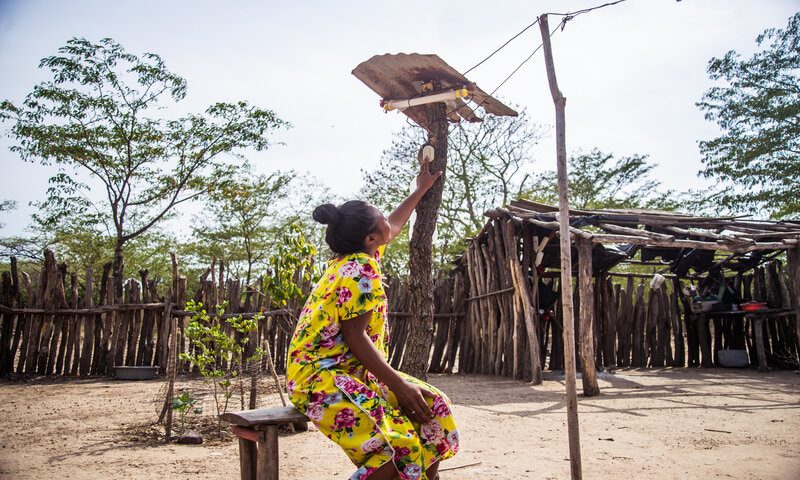
The installation of more than 886 solar systems, benefiting 4,000 users. Photo credit: One Inversión Social.
One was a real and tangible driver of transformation. Beyond the investment, it gave us the strength to grow and bring dignity to thousands of homes where not only light is the protagonist, but also security, opportunities, employment, study, and well-being.’ – Jennifer Colpas, Co-founder of Tierra Grata.
3. Ballet FROM and FOR everyone
With the Ballet Metropolitano de Medellín, ONE supported the democratization of dance, reaching audiences that had never entered a theatre or seen ballet. The working conditions of the artists were improved, new jobs were created, and works such as BOTERO were brought to more than 4,300 people.

Ballet Metropolitano de Medellín. Photo credit: One Inversión Social.
“The financial and strategic capital provided to our organization represented an increase in quality and outreach indicators; we reached more people with their contribution. But, beyond this support, the value that we highlight today is the trust that allows us to believe in and create new possibilities for the professionalization of ballet in the country through dance.” – Juliana Acosta, director of the Ballet Metropolitano de Medellín.
Are you passionate about art with social impact? Donate and help democratize culture. DONATE NOW.
4. La Pascasia
In the heart of Medellín, La Pascasia has become a cultural meeting point. In 2024 more than 30,000 people attended its events with a strong component of cultural democratization with 569 artists benefiting.

La Pascasia is a cultural meeting point hosting events benefiting over 569 artists. Photo credit: One Inversión Social.
‘Thanks to ONE, we were able to expand our programming, open more days, offer more subsidized tickets, and improve remuneration to artists compared to 2023. Thus, art became more accessible. – Jaime Suárez, Administrative Manager of La Pascasia.
5. Strengthening businesses to strengthen communities
With the 4Impact program, in alliance with Créame Incubadora de Empresas, 172 companies were supported to improve their capacities and connect them to value chains. The result: more jobs, more income, and a stronger entrepreneurial ecosystem.
‘They didn’t just add resources: they added purpose. That made the difference”. – Juan Manuel Higuita, director of Créame.
A better future is possible if we do it together

The 4Impact program. Photo credit: One Inversión Social.
ONE has shown that it is not necessary to wait for a political or economic miracle to transform the harsh reality that Colombia is living. With well-thought-out decisions, well-invested resources, and added to the conviction that a better country is possible, a more dignified life for countless Colombians is possible. In 2025, they will continue to seek strategic allies who share that vision both in Colombia and beyond. ONE is more than an organization: it is a community determined to be part of the solution.
‘The road ahead may present challenges, but I am convinced that together, we have the vision, passion, and determination to overcome them. Every investment we make, every partnership we forge, and every life we transform brings us closer to our goal of creating a more equitable and sustainable Colombia – Mónica Gil, CEO of One Social Investment.
You, too, can be part of this transformative community. Join ONE with a significant donation. Make it here!
Photos courtesy: One Inversión Social.
 Empleobilingue.com

- Director/a de operaciones para hotel, restaurante y discoteca 1626320364.60 - Medellín, Medellin, Antioquia, Colombia
- Coordinador/a de calidad para La Unión 1626483143.1 - La Unión, Antioquia, Colombia
- Desarrollador fullstack - Bogotá, Bogota, Colombia
- Technical Analyst - Remote
- PIM Administrator - Ecommerce - Remote (Bogotá, Bogota, Colombia)
- Auxiliar de gestión humana y bienestar para Girardota 1626060072.28 - Girardota, Antioquia, Colombia
- Marketing Strategist
- Trainer Manager - Bogotá, Bogota, Colombia
- Tolemaida UH- 60 Inspector - Bogotá, Bogota, Colombia
- Virtual Assistant - Team Lead - Remote
Contact Us

