

















In a historic verdict, former Colombian President Álvaro Uribe Vélez has been found guilty of procedural fraud, bribery, and bribery in a criminal proceeding. The decision, delivered by Judge Sandra Liliana Heredia of Bogotá’s 44th Criminal Court, marks the first criminal conviction of a former head of state in the nation’s history.
In her comprehensive, first-instance ruling, Judge Heredia systematically validated the arguments presented by the Fiscalía General de la Nación (Attorney General’s Office) while dismantling the defense’s counterarguments for each of the charges. The case centered on a years-long investigation into whether Uribe and his associates manipulated witnesses to discredit accusations linking him to the formation of right-wing paramilitary groups.
“The accused (Uribe) knew of the plan,” Judge Heredia stated definitively, concluding that the charge of bribing a witness in a criminal proceeding in the case of former paramilitary Juan Guillermo Monsalve was proven “beyond all doubt.”
Before delivering her verdict, the judge called for respect for the judicial process, affirming the decision was based strictly on law. She acknowledged the “gallantry and cordiality” of the former president throughout the trial. “This is not a trial against the political history of Colombia, it is not revenge, it is not an act of opposition,” Judge Heredia insisted. “It is an act of justice and only of justice.”
The ruling is a first-instance decision and is subject to a multi-stage appeals process.
Systematic Rejection of Defense Arguments
Judge Heredia dedicated significant time to explaining her legal reasoning, particularly regarding key evidence challenged by Uribe’s defense team, led by attorney Jaime Granados.
A central defense argument was that wiretapped conversations between Uribe and his then-lawyer, Diego Cadena, should be inadmissible due to attorney-client privilege. The judge firmly rejected this, stating that professional privilege cannot shield criminal activity. “The practice of law would have been denatured as a means to hide conduct,” she declared, adding that “professional secrecy cannot become a barrier to detecting punishable acts.”
Similarly, the court validated crucial recordings made by witness Juan Guillermo Monsalve on a spy watch, which captured conversations with Cadena. The defense had hired an expert who questioned the integrity of the files. However, the judge found that any technical questions were “not sufficient to deny the identity between the original file, the one delivered to the Court, and the one presented in the oral trial.” She gave full credibility to the testimonies of Monsalve and his ex-partner, Deyanira Gómez, who helped secure the recordings.
Genesis of the Case: An Investigation That Backfired
The complex legal saga began not with an investigation into Uribe, but with one he initiated. On September 17, 2014, Senator Iván Cepeda held a debate in the Senate of the Republic on the history of paramilitarism in Antioquia. During the debate, he presented testimony from former paramilitaries linking Uribe and his brother, Santiago, to the founding of the Bloque Metro of the Autodefensas Unidas de Colombia (AUC).
In response, Uribe filed a complaint with the Corte Suprema de Justicia (Supreme Court of Justice)—the high court for members of congress—accusing Cepeda of manipulating those same witnesses. However, after investigating, the Supreme Court found inconsistencies in Uribe’s claims. On February 16, 2018, it took the dramatic step of closing the case against Cepeda and opening a formal investigation into former President Uribe for witness tampering, setting the current trial in motion.
Next Steps: Sentencing and Appeals
With the guilty verdict delivered, Judge Heredia has scheduled a hearing in August to read the full sentence, which will detail the length of the prison term and the complete reasoning behind the conviction.
Following the August sentencing, the legal process will continue. “Once that sentence is read, all parties are given the opportunity to file an appeal,” explained lawyer Santiago Trespalacios to El Colombiano. “When the appeal is filed, there are five days to support it, and then the decision goes to the Superior Tribunal of Bogotá.”
A three-magistrate panel at the tribunal would then review the case and rule on the appeal. If that second-instance decision is challenged, the case could ultimately return to the Supreme Court of Justice for a final judgment.
Uribe’s lead counsel, Jaime Granados, has noted that the nature of the crimes could allow for alternatives to prison. “We are certainly talking about a scenario where, due to the very nature of the offenses, they admit house arrest,” he stated.
Randi Zuckerberg was recently in Medellín, Colombia as a keynote speaker during the 2025 WOBI event, which brings ideas and inspiration from some of the world’s greatest business minds. The global event rotates between major business hubs and capitals throughout the world, connecting thought leadership with local audiences from the business community, government, and academia.
Best known for her time heading marketing at her brother’s company Meta (Facebook), Zuckerberg brought her passion for “Leadership in The Age of AI” and how artificial intelligence can support leaders in decision making but also encouraging women and girls to get involved in technology, and specifically AI. She spoke about how so many time she found herself the only woman in the room where important decisions were being made at a corporate level.
After Zuckerberg’s conversation with Loren Moss, executive editor of Finance Colombia, Zuckerberg answered questions from the local press corps with Moss moderating and serving as interpreter for the questions from local journalists attending the event.
Finance Colombia: We’re here with Randi Zuckerberg. First, welcome. And is this your first time in Medellín?
Randi Zuckerberg: First time in Medellín, but not my first time in Colombia. I’ve gotten to travel extensively around the country, but I’m delighted to be here.
Finance Colombia: Wonderful. Hopefully, you’ve had time to see the city, and what are your impressions?
Randi Zuckerberg: I have. Well, I got to tour all around yesterday, and I love a city that has a bit of a deep history that makes you think. But what I’m inspired by is how the city has taken a bit of a darker history and is transforming into an art and technology hub of the world. I think it is a model that a lot of other cities should be looking at.
Finance Colombia: Impressive. If you could just, in a couple of sentences, recap the message that you gave today–or that you’re giving today in your presentation later.
Randi Zuckerberg: Yes, I’m talking about leadership in the age of AI, and I’m going to be reflecting on my experience on the front lines of social media, and using that as a way to structure how people can think about being in this next new era of innovation with AI.
“I will eat this table if there are not more women in AI than there were in Web 2!”—Randi Zuckerberg
Something I’m very passionate about is talking about women in technology, and when I was on the front lines of Web 2.0 and social media, I was one of the few women in the room. And now that it’s 20 years later, and we’re on the dawn of a new era of innovation, it would break my heart if that happened again, and things didn’t change. So I feel passionate about mentoring women to be entrepreneurs, about getting more younger girls into technology, and especially making sure that women in universities around the world have the opportunity to study technology in the same way. So yeah, I will eat this table if there are not more women in AI than there were in Web 2.0.
Finance Colombia: How can AI be used as a tool to empower women?
Randi Zuckerberg: I think there are so many ways that AI can be used to empower. First of all, I think it levels the playing field, because AI can now do things like writing basic code, designing, so you can be anywhere in the world, and even if you grew up in an area where maybe girls don’t have the same access to education, you now have the tools to launch a successful business, and be an entrepreneur, and be on the same playing field as people across the world that had the best education and the best resources, and I think AI is going to just open a world of creativity.
Local journalist: One question for the old people who are going to embrace the changes with technology.
Randi Zuckerberg: I think that hopefully we’ll live in a world where wisdom and experience are honored and celebrated side by side with innovation and tech knowledge. I think if you’re just looking into the future, you’re missing a lot of valuable things about an organization, and a culture, and an industry. Likewise, though, we have to make sure that people who grew up without tech as a first language are partnered with a mentor who can bring them up to speed and help them upskill themselves. So I think I’m excited about a workforce where those two live side by side.
Colombia’s Vice President Francia Marquez has been on the outs with her running mate and current Colombian President Gustavo Petro for some time. While it was common knowledge that Marquez had strained relations with Petro and his administration, after three years, the animosity spilled out into the public. Specifically, Francia Marquez, who was elected as vice president alongside Gustavo Petro, and who brought an estimated 850,000 additional votes to the Petro presidential campaign.
Though Petro has cycled through ministers, Francia Marquez was popularly elected and cannot be removed from office by the President, though he can, and has removed her responsibilities, such as her appointment to the newly created “Ministry of Equality.”
“We are wanted in the photo but not in decision making. We are wanted as a symbol, but not as a people with a voice.”
In an emotional speech on July 25th, Marquez “canto la tabla” as is said in Spanish, in other words, give someone a “severe talking to” as she denounced what she says is the mendacity, hypocrisy, and bigotry of Petro and his administration.
“We are wanted in the photo but not in decision making. We are wanted as a symbol, but not as a people with a voice. We are wanted to be obedient and if we do not obey, then comes punishment, political violence, cancellation and public dehumanization,” said Marquez, in Spanish, giving a speech in Cali, near her home turf of the Colombian Cauca department.
The vice president spoke at an international women’s event called “Juntas por la Restauración de Nuestra Dignidad” (Together for the Restoration of Our Dignity) held at the Universidad Libre, or Free University of Cali. Marquez stated that she has held her tongue for a long time, but she had to speak in her defense after political rivals close to Petro have called her arrogant and a traitor.
“…But I soon went from being the political phenomenon, the heroine, to being the traitor. Because in this country, when a woman rises, suspicion follows her. The system does not ask about her abilities, but rather whether she is in the place she deserves. If she steps outside the assigned margin, then she is arrogant, disloyal, clumsy, incapable and dangerous.”
Marques also referred to the controversy surrounding her time leading the Ministry of Equality, where she has been denounced for a perceived lack of execution in setting up the new ministry or executing against its mandate.
“From the campaign until today, I have experienced many episodes of delegitimization, sabotage and exclusion. I will tell you just a few. I was given the mission of creating an institution with no structure, no resources, no support. They told me ‘do it yourself.’ And when I argued that three vice ministries were too many, they demanded [I appoint] five. And I did it despite the systematic blockade. They accuse me of not executing, when they never gave me the instrument to do so.” In this case, Marquez is referring to the President’s inner circle wanting her to appoint vice ministers of their choice as sinecures, irrespective of need or capability.
Gustavo Petro, with the appointment of Francia Marquez as his running mate, tried to position himself as a racial progressive in Colombia, a country with a complex social fabric that struggles to overcome classism, regionalism, and political polarization, along with ethnicity. However, his treatment of Marquez along with many bigoted statements he has made during his term, arguably have exposed him as disingenuous at best, and one could make the case, racist.
“No one who is black can tell me!”
President Petro insisted upon the appointment of porn stars Alejandra Umaña (Amaranta Hank) and Juan Carlos Florián to political positions, which Marquez opposed on the grounds of their lack of qualification. Petro angrily responded in a televised ministerial meeting saying “No one who is black can tell me that a porn actor who created the sex workers’ union should be excluded,” not explaining why a black person would be excluded from having an opinion on the topic, as opposed to anyone else.
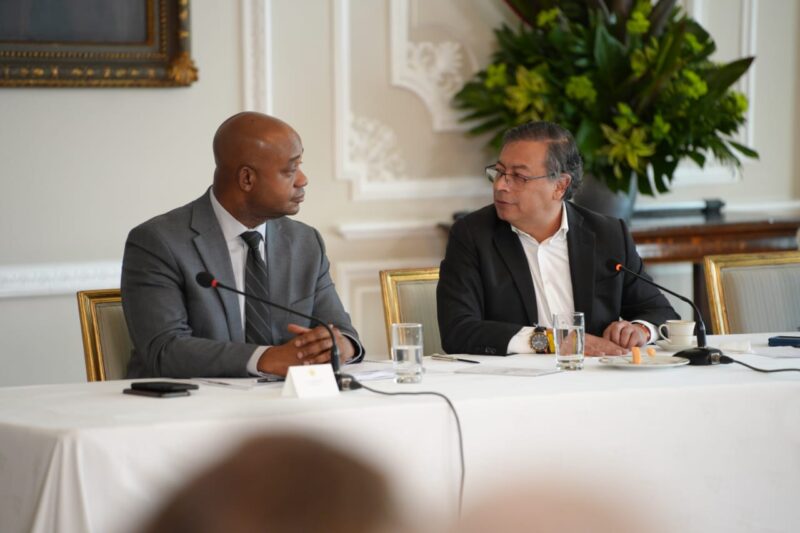
Then Foreign Minister Murillo (left) with Petro in better days between the two, earlier this year.
Petro’s former foreign minister says comments are “unacceptable”
The bigoted statement drew a rebuke from Petro’s former foreign minister, former ambassador to the US, and former governor of Chocó, Luís Gilberto Murillo, who said: “Do not say that ‘I don’t accept that a black tells me such and such a thing,’ because that racializes the discourse in Colombia, and even worse when it comes from the presidency of Colombia. It’s unacceptable, because we need to advance this inclusive nation.”
Petro, along with his penchant for calling people who disagree with him “neonazis,” has also made racist comments against people with a white phenotype such as US President Trump and French President Emmanuel Macrón. Facing Macrón in a conference earlier this month, Petro said “It’s easier to win votes with a lie and a fetish, saying that life will be better if we expel those who don’t have the same skin color, language, or religion…”to which Macrón shot back: “I never lecture someone from the South, and it’s a little strange to be lectured by someone from the South, just because they come from the South!”
French President Emmanuel Macrón Rebukes Petro in Spain
Petro seems to fancy himself an orator and leader of what some call the “Global South” but no one seems willing to follow him. In his own country, support hovers around 26-30% according to recent polls, and his frequent verbal gaffes are constant fodder for jokes and internet memes. Winning his election by a tight mandate against an ailing outsider candidate who died a few months later, Petro constantly refers to his “popular mandate” as if he has the support of the Colombian populace.
By appointing Francia Marquez, an Afrocolombian lawyer and community activist as his running mate, Petro, a leftist ex-guerilla, sought to define himself as progressive and inclusive. However, three years into his presidency, he and his political clique openly despise Marquez, excluding her from public events and important meetings. During the opening of this summer’s congressional session, she was excluded from the presidential entourage and had to make her own arrangements, as is her constitutional right, to attend the legislative session. Marquez is a nationally elected official, and as such, she does not owe fealty to the president and has the right to dissent. Still, Petro’s attitude towards her and others destroys whatever credibility he claims as a feminist and inclusive crusader for human rights.
The first semester of training at Ciudadela Digital Medellín successfully concluded with strong public response. This strategy, led by the Mayor’s Office of Medellín through Sapiencia, aims to promote fourth industrial revolution skills. A total of 47,859 people enrolled in free online English and digital skills courses.
The offering was delivered in three sessions during the semester. The first course had 17,008 enrollments, the second 1,512, exclusively for the public in five district departments, and the third, recently completed, had 29,339 participants, exceeding enrollment expectations in each of them.
“These results demonstrate citizens’ interest in accessing relevant, free, and high-quality training. From the Mayor’s Office of Medellín, through Sapiencia, we continue to open doors so that more people can prepare and take advantage of the opportunities that today’s job market demands,” said Carolina Rendón Arenas, deputy director of post-secondary education management at Sapiencia.
Of the 15 courses offered, the most in-demand were Basic and Intermediate English with 14,173 enrollments; Intermediate and Advanced Excel (8,972); Preparing Businesses for Digital Marketing (3,736); Data Science and Engineering (2,589); Business Intelligence (BI) (2,544); Create Your Own AI (2,468).
Digital Tools and Office Automation (1,827), among others.
Medellín’s Ciudadela Digital (Digital Citadel) will open its next call for applications on August 4 at noon. Three additional free training offerings are planned for the second half of the year. Sapiencia’s goal is to benefit more than 100,000 people throughout the four years with training in digital skills, bilingualism, and creative and cultural industries.
Photo credit: City of Medellín.
A specialty court in Colombia has sentenced seven former executives of the multinational fruit company Chiquita Brands International (NYSE: CQB) to more than 11 years in prison for their role in financing the United Self-Defense Forces of Colombia (AUC), a paramilitary group designated as a terrorist organization by the United States and the European Union. The ruling marks a significant development in a long-running legal battle seeking to hold the company accountable for its actions during a violent period in Colombia’s history.
The 6th Criminal Court of the Specialized Circuit of Antioquia found the former executives guilty of aggravated conspiracy to commit a crime. In addition to the 11-year, 3-month prison sentence, the court imposed a fine of $13.879 billion COP and ordered the immediate capture of the convicted individuals. The judge denied the defendants the possibility of house arrest or a conditional suspension of their sentences.
This decision follows a landmark ruling in the United States where a federal jury found Chiquita Brands liable for financing the AUC. In that case, the company was ordered to pay $38.3 million in damages to the victims’ families. Chiquita had argued that the payments, which totaled over $1.7 million between 1997 and 2004, were made under duress to protect its employees from the paramilitary group. However, lawyers for the victims contended that the company had entered into a “pact with the devil” and was complicit in the AUC’s crimes.
The Colombian court’s decision referenced the declassified documents and journalistic investigations that brought the payments to light. The judge was critical of the Colombian Prosecutor’s Office, describing its initial investigation as “submissive, superficial, and lacking in rigor.”
The United Self-Defense Forces of Colombia (AUC) was a far-right paramilitary and drug trafficking organization that operated in Colombia from 1997 to 2006. The group was responsible for numerous massacres, assassinations, and other human rights abuses in its fight against leftist guerrilla groups like the FARC and ELN. The AUC was known for its brutality and its deep ties to drug trafficking and certain sectors of the Colombian economic and political elite.
The conviction of the Chiquita executives is a significant step in the ongoing efforts to achieve justice for the victims of paramilitary violence in Colombia and to establish corporate accountability for human rights abuses.
Chiquita bananas (Credit: Mike Mozart)
Agroexpo 2025 marked a milestone in the modernization of Colombian agriculture with the arrival of robotic technologies designed to completely transform cattle milking. Intelligent robots and total automation are today the protagonists of a fair that connects innovation with tradition, and that offers concrete answers to the challenges of efficiency, animal welfare, and sustainability in the field.
DIMAP brings the first double milking robot to Colombia
The Colombian company DIMAP, with 23 years of experience in dairy technology, presented the first double milking robot installed in the country, manufactured in Holland and adapted to local needs.
This technology allows two cows to be milked at the same time with a single robotic arm, completely automating the stages of the process: trimming, cleaning, placement, and removal of teat shields. Everything is done from the back of the animal, which decreases stress, improves efficiency, and allows for a more rational use of space in milking parlors.
“This robot integrates sensors, control screens, and intuitive interfaces that allow you to visualize key data such as daily production, animal health, and herd performance. Our proposal goes beyond the team: we provide technical support and continuous monitoring to ensure that the investment has a real impact on the producer,” highlighted the DIMAP team.
GEA: Smart milking with machine vision and real-time analytics
From Germany, the multinational GEA arrived with a robot that takes automated milking to another level: artificial vision technology, health sensors, and a real-time analysis platform that carries out the milking, feeding, disinfection, and monitoring of each cow without human intervention.
The system detects signs such as lameness, weight loss, reproductive status, and more, integrating all the data into a central software that allows efficient and preventive management of the herd.
“Precision, animal comfort, and time optimization make this technology a strategic investment for the Colombian producer. Our model includes complete advice: from diagnosis to post-installation optimization,” explained GEA spokespeople.
Ordecol launches the first 100% Colombian portable milking robot
National innovation also shone at Agroexpo 2025 with Industria Ordecol, which presents a portable milking robot, ideal for all types of farms, especially those with limited resources or in remote rural areas.
This robot works with electric or gasoline motors and has digital and proportional meters to make the process more efficient. In addition, it introduces an innovative digital component: an app that allows QR codes to be scanned on cattle’s earmuffs to access the animal’s production, health, and activity history.
“Our differential is to be a solution designed by and for the Colombian countryside. We add technology, practicality, and technical support to accompany the farmer at every step,” said the Ordecol team.
With these innovations, Agroexpo 2025 remained a key platform to make the future of Colombian agriculture visible, where robotics and artificial intelligence are no longer a distant promise, but tools within the reach of the producer.
Automated milking, intelligent data collection, and a focus on animal welfare become pillars for the sustainability of the dairy sector in Colombia.
Photo credit: Agroexpo.
The Santafé Shopping Center in Medellín has unveiled the 15th edition of the world’s largest living flower carpet, featuring a 14-meter-tall hot air balloon sculpture, as a prelude to the city’s upcoming Flower Festival, which begins August 1.
“We have this grand, majestic, and emblematic flower carpet, the largest living carpet in both Colombia and the world, which will be on display for 48 days in the Medellín plaza,” María Fernanda Bertel, general manager of Santafé Shopping Center, told EFE.
The plaza housing the carpet spans 1,000 square meters, with 800 square meters covered by 25,000 plants, including more than 200,000 petunias and marigolds. All the flowers used in the installation come from various nurseries in eastern Antioquia, the department of which Medellín is the capital.
What began fifteen years ago as a tribute to the region’s silletera tradition—by showcasing “the city’s largest silleta”—has become a major tourist attraction during the Flower Festival, according to Bertel.
Silletas are wooden frames that were once used by local farmers to carry loads on their backs. Bertel noted that the 2024 edition of the flower carpet attracted 2.8 million visitors, including locals, Colombians from other regions, and international tourists. This year, organizers hope to surpass that figure.
Economically, the “flower season” is the second most important of the year for the shopping center’s co-owners, after December. The exhibition coincides with major citywide events such as Colombiamoda in late July and the Flower Festival in early August. According to Bertel, the season accounts for between 27% and 30% of the annual sales for the center’s business partners.
This year’s artistic theme, The Journey of the Flowers, invites visitors to Santafé to “become adventurers” and explore figures that adorned previous editions of the carpet—such as a seahorse, parrots, hummingbirds, and butterflies—now displayed throughout the shopping center, Bertel said.
For the first time, visitors can also view the flower carpet from its center and at a height of 2.8 meters by stepping into the basket of the hot air balloon that forms part of the installation.
Although the Flower Festival runs from August 1 to 10, the floral installation at Santafé Shopping Center will remain open to the public until August 31.
Above Photograph of a carpet made with flowers in Medellín (Colombia). The Santafé Shopping Centre in Medellín presented its 15th edition of the world’s largest carpet made with live flowers. EFE/STR
Colombia’s civil aviation authority, Aerocivil, has suspended the licenses of several air traffic controllers and launched a formal investigation after Colombian media outlet RCN reported that an air traffic controller at Bogotá’s El Dorado International Airport (BOG), one of the busiest international hub airports in Latin America, allowed his teenage son to take over operations, placing the lives of thousands of passengers at risk. Worse, the controller’s supervisor was complicit in the very bad idea, alleged to have taken place on July 21. The incident has prompted a multi-agency response to determine the full extent of the security breach and any potential criminal liability.
“Under no circumstances may anyone outside the air traffic control services be permitted to manipulate the control communications equipment.” – Aerocivil
According to a statement from Aerocivil, the agency took immediate action following the incident. Through Resolution 1923, issued on July 25, the aeronautical licenses of the air traffic controllers directly involved have been temporarily suspended pending the outcome of the investigation.
In addition to the suspensions, the Office of Internal Disciplinary Control has opened a case (2025/178) into five other officials who may have been connected to the event. The aviation authority has also announced its intention to refer the findings of its internal investigation to the Attorney General’s Office of Colombia to determine whether the acts warrant criminal charges against the controllers.
Video shows the teen providing runway coordinates, directions, landing authorizations & other weather information to airline pilots.
In its public statements, Aerocivil tried to reassure the public, saying that while the incident represents a “serious violation of air safety regulations,” established security protocols were activated, and at no point were active flight operations compromised. The authority emphasized that the actions of the individuals under investigation do not reflect the standards of the majority of its air traffic control professionals.
El Dorado International Airport is operated by Operadora Aeroportuaria Internacional (OPAIN S.A.), a private consortium. The airport is a critical hub for passenger and cargo traffic in Latin America. OPAIN has not yet issued a public statement on the matter.
Video provided by RCN
An interesting few days, but there again, when isn’t it in Colombia?
US relations are again making headlines with support for the country (Plan Colombia) reportedly set to drop by 50% from $410 million USD to $206 million USD. Whilst a blow, in reality, Colombia shouldn’t need to rely on the US for such funds – time to grow up. This week, we also had the Republican extremists referring to Gustavo Petro (and others in the government) as habitual drug users and again making inferences regarding the assassination attempt on Miguel Uribe – all pretty pathetic. It’s hard to take Donald Trump or his cronies seriously when they have threatened any country that deals with Venezuela – he has now reportedly permitted Chevron to resume oil exploration. The New Silk Road seems ever more appealing.
The May trade data from Departamento Administrativo Nacional de Estadística – DANE Colombia hit the headlines with a troubling $1.4 billion USD deficit, only adding to concerns over the fiscal situation amongst the press. There is, of course, real pressure to improve the situation, and the government needs to look at the spending situation; however, much of the cause of the problem is an economy that is growing at a healthy pace. Lower inflation and interest rates are driving domestic demand, retail sales, and confidence, which saw imports rise 10.8% in May as locals continue to buy consumer durables from overseas – the main country of origin is at the other end of that Silk Road.
This surge in imports has been accompanied by weak export data. It is noteworthy that Petro has again expressed the need for Colombia to wean itself off its oil & coal dependence and focus more on agriculture. The former two categories are struggling with international sales, whilst the latter is booming. An uncomfortable truth for the elite & the commodity sector.
Another element of the economic recovery is record low unemployment; however, this appears to be an inconvenient truth to the press (Portafolio), preferring to highlight that Colombia has the 3rd worst labor situation in the OECD – OCDE. A particularly lazy piece of journalism, considering the makeup of the 19 other countries in the survey. Yes, there is too much informality, but even Bancolombia this week pointed out that the labor reform should help that situation.
Finally, good news on poverty. The DANE reported a drop in the national number from 34.6% to 31.8%. That is still a disgrace given the natural resources that Colombia enjoys, but considering the sky-high GINI coefficient not a surprise. The good news is that they are record low numbers – but work to do !!
Elsewhere, there has been no advancement in the various reform processes, and the countries’ politicians continue to take cheap shots at one another.
Have a fabulous Friday.
Regards.
Rupert.
Never miss Rupert’s latest commentary.
Follow him now on LinkedIn to see What Jumps Out.
Presidential candidate and Senator Miguel Uribe Turbay with his wife, Maria Claudia Tarazona. (source: social media)
Board-certified pediatric spine surgeon and researcher Dr. Jaime A. Gomez has joined the Nicklaus Children’s Orthopedics, Sports Medicine, and Spine Institute. According to US News & World Report, Dr. Gomez brings his extensive expertise in the operative and nonoperative treatment of scoliosis and other complex spinal conditions in children and adolescents to one of the best-known children’s orthopedic programs in the nation.
His specialty includes using growth-friendly surgical techniques for young children and less invasive approaches such as scoliosis casting, bracing, and complex spinal deformity corrections. An active researcher, Dr. Gomez focuses on clinical outcomes in pediatric orthopedics and scoliosis. He has contributed to more than 50 peer-reviewed publications and book chapters, presented his research at national and international conferences, and participated in numerous medical-surgical trips to the Dominican Republic with World Spine Outreach and the Butterfly Foundation.
“It is an honor to join the world-renowned team of specialty physicians at Nicklaus Children’s Orthopedics, Sports Medicine and Spine Institute,” says Dr. Jaime A. Gomez. “I’m looking forward to joining and collaborating with pioneers in the field whose innovations have shaped the advanced surgical techniques we use today to treat the most complex spinal conditions,” Gomez added.

Lead Pediatric Spine Surgeon and Researcher, Dr. Jaime A. Gomez, Joins Nicklaus Children’s Hospital. Photo credit: Nicklaus Children’s Hospital.
Dr. Gomez earned his medical degree from Pontificia Universidad Javeriana in Bogotá, Colombia, followed by an orthopedic surgical residency at Columbia University‘s New York Presbyterian Hospital. He later pursued a pediatric orthopedic fellowship at Harvard Medical School/Boston Children’s Hospital, followed by a spine surgery fellowship at New York University‘s Hospital for Joint Diseases.
“Nicklaus Children’s continues to be a national leader in treating spinal disorders in children,” says Dr. Stephen George, medical director of surgical service and pediatric spinal surgeon at Nicklaus Children’s. “With Dr. Gomez’s years of expertise and research in scoliosis treatments, we’re looking forward to continuing the legacy within the institute,” George added.
Before joining Nicklaus Children’s, Dr. Gomez was director of Spinal Deformity, Pediatric Spine Surgery, and Pediatric Orthopedic Education and Research at Montefiore Einstein in New York City. He also held the position of associate professor of Orthopedic Surgery and Pediatrics.
Dr. Gomez is employed by Nicklaus Children’s Pediatric Specialists, the multi-specialty medical group practice of Nicklaus Children’s Health System. He is bilingual in English and Spanish.
Lead Pediatric Spine Surgeon and Researcher, Dr. Jaime A. Gomez, joins Nicklaus Children’s Hospital. Photo and video credit: Nicklaus Children’s Hospital.
 Empleobilingue.com

- Director/a de operaciones para hotel, restaurante y discoteca 1626320364.60 - Medellín, Medellin, Antioquia, Colombia
- Coordinador/a de calidad para La Unión 1626483143.1 - La Unión, Antioquia, Colombia
- Desarrollador fullstack - Bogotá, Bogota, Colombia
- Technical Analyst - Remote
- PIM Administrator - Ecommerce - Remote (Bogotá, Bogota, Colombia)
- Auxiliar de gestión humana y bienestar para Girardota 1626060072.28 - Girardota, Antioquia, Colombia
- Marketing Strategist
- Trainer Manager - Bogotá, Bogota, Colombia
- Tolemaida UH- 60 Inspector - Bogotá, Bogota, Colombia
- Virtual Assistant - Team Lead - Remote
Contact Us

