

















Collective Mining Ltd. (NYSE: CNL, TSX: CNL) has issued a robust public statement to reject a short-seller report published by Morpheus Research. The report, titled Morpheus Research Report: Collective Mining, alleges that the Canadian-based company is conducting illegal and restricted activities at its flagship Apollo gold deposit in the Department of Caldas, a claim the company’s management has categorically denied. The report also highlights the past of the company’s executive chairman, Ari Sussman, a move that the company has decried as a misrepresentation of facts.
The timing of the report, released by a firm that stands to profit from a decline in Collective Mining’s stock price, raises questions about its objectivity. Short sellers like Morpheus Research make money by borrowing shares of a company’s stock, selling them, and then repurchasing them later at a lower price to return to the lender, pocketing the difference. This practice, while legal, has long been a source of ethical controversy. Critics argue that short sellers may disseminate negative or even misleading information to intentionally drive down a company’s share price, profiting at the expense of other investors. While this can sometimes expose legitimate issues within a company, it can also create market volatility and lead to undue financial losses for long-term shareholders.
Dubious Claims and Collective’s Rebuttal
Morpheus Research’s report claims that a significant portion of Collective Mining’s exploration and drilling for the Apollo system has been conducted on untitled land and within environmentally protected riparian buffer zones. Citing an investigation using satellite imagery and data from the Agencia Nacional de Minería (ANM), the report alleges that some drill pads were built entirely outside the company’s officially granted mining titles.
Collective Mining’s response, however, offers a detailed and technical refutation. The company’s press release clarifies that small, incomplete cells or gaps between titles are a common administrative issue in Colombia’s mining sector. Ari Sussman, executive chairman, commented, “Having operated in Colombia for almost 20 years, the issue related to incomplete cells and gaps within or next to titles is nothing new and affects much of the mining industry. We faced a similar situation while operating at Continental Gold, which was successfully resolved.”
The Collective’s statement asserts that these incomplete cells, which resulted from the conversion of old claim shapes into square cells, cannot be staked by any third party. The company had already requested that the Colombian authorities integrate these cells into its title, and the authorities confirmed this would happen once their software is updated.
On the matter of environmental claims, Omar Ossma, president of Collective Mining, stated:
“As a Colombian national and lawyer with more than 20 years of experience in the mining and energy industry, I take great pride in ensuring that our Company operates with full respect for Colombian law, institutions, and communities.” He added that the allegations “are without legal merit and reflect a misunderstanding, or misrepresentation, of Colombia’s mining framework,” Ossma explained that drilling outside mining title boundaries is permissible under the Colombian Mining Code to meet technical requirements, such as understanding a deposit’s geometry and assessing geotechnical factors. Collective also confirmed that the Apollo system does not overlap with any areas excluded from mining and that it has obtained special permits from environmental authorities for drilling within water drainage buffer zones where necessary.
Management’s Track Record and Reputational Context
The Morpheus report also brought up a controversial incident from Mr. Sussman’s past at Colossus Minerals, a company that faced corruption allegations and later filed for creditor protection in Brazil. While this information is not directly relevant to Collective’s operations, the company’s defense hinges on the strong reputation and track record of its management team, a key point for investors.
The core of this reputation stems from their previous work at Continental Gold Inc., which was ultimately sold to China’s Zijin Mining Group (SEHK: 2899, SSE: 601899) for approximately $2 billion USD. As previously noted by Finance Colombia, that deal showcased the team’s ability to develop a significant mining asset from exploration to operation. The sale of Continental Gold to Zijin Mining for a premium demonstrated the management’s capacity to create substantial shareholder value in Colombia’s mining sector, a fact that both the company and the editorial opinion of this publication view as highly relevant.
Collective Mining is continuing its exploration program at its Guayabales and San Antonio projects, with 10 rigs currently in operation as part of a fully funded 70,000-meter drill program for 2025. The company’s management and insiders own a significant 44.5% of the outstanding shares, aligning their interests directly with those of shareholders.
See also: Collective Mining Applauded By Local Town For Social Outreach Efforts
Tecnoglass, Inc. (NYSE: TGLS), a prominent manufacturer of architectural glass and aluminum products, has reported record financial results for the second quarter of 2025. The company announced revenues of $255.5 million, a 16.3% increase year-over-year, driven by organic growth in its single-family and multifamily residential business segments. The results come as the company navigates a complex economic environment and continues its strategic expansion in the United States, including the recent acquisition of Continental Glass Systems.

Plano, Texas. Photo credit: Tecnoglass.
Detailed Financial Performance Analysis
Tecnoglass’ second-quarter financial statements indicate a company in a strong financial position. A closer examination of the results provides insights for the institutional investor.
Income Statement Analysis:
Revenue Growth: The 16.3% increase in total revenue to $255.5 million USD was primarily driven by a 17.8% growth in the multifamily/commercial sector and a 14.5% increase in the single-family residential sector. The company attributes this to market share gains, geographic expansion, and a broader product offering. A portion of the single-family residential growth is attributed to customers accelerating orders in anticipation of price increases related to US tariffs. The impact of foreign currency exchange was a modest adverse effect of $0.5 million.
Profitability Metrics: The gross margin expanded by 400 basis points to 44.7% from 40.8% in the prior-year quarter. This improvement reflects better pricing, stable raw material costs, operating leverage, and increased vertical integration. Operating expenses increased to $53.1 million USD from $38.4 million USD in Q2 2024, primarily due to higher selling expenses, including $5.9 million in aluminum tariffs paid in April. As a percentage of revenue, operating expenses were 20.8%, up from 17.5%. The company notes that price adjustments implemented in May began to offset these incremental expenses by late June.
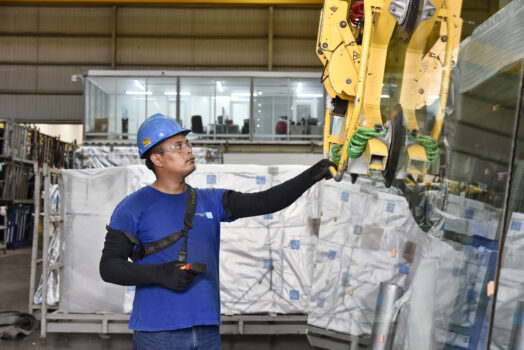
Photo credit: Tecnoglass.
Net Income and Earnings Per Share: Net income for the quarter was $44.1 million USD, or $0.94 USD per diluted share, compared to $35.0 million USD, or $0.75 USD per diluted share, in the same period last year. Adjusted net income, a non-GAAP measure that excludes items like non-cash foreign currency exchange gains and losses, was $48.5 million USD, or $1.03 USDper diluted share.
Adjusted EBITDA: Adjusted EBITDA, another non-GAAP measure, increased by 24.5% to $79.8 million USD, representing 31.2% of total revenues. This was driven by higher revenues and gross margin improvement, which more than offset the aforementioned increase in operating expenses. The Adjusted EBITDA calculation for the quarter includes a $0.5 million USD contribution from the joint venture with Saint-Gobain.
Balance Sheet and Cash Flow:
Strong Liquidity: The company ended the quarter with a solid liquidity position of approximately $310 million USD, consisting of $137.9 million USD in cash and cash equivalents and $170.0 million available under its committed revolving credit facilities. The total debt stood at $109.2 million USD.

Cook County Central Campus Health Center, Chicago. Photo credit: Tecnoglass.
Cash Flow from Operations: Cash generated by operating activities was $17.9 million USD for the quarter. This figure was impacted by the seasonal timing of tax payments.
Capital Expenditures (Capex): Capex for the quarter was $32.5 million USD, which included scheduled payments for previous investments and $15.1 million USD for the acquisition of Continental Glass assets classified as property, plant, and equipment.
Shareholder Returns: The company returned $7.0 million to shareholders through dividends during the quarter and has approximately $76.5 million remaining under its current share repurchase program.
Project Backlog: The company’s project backlog grew to a record $1.2 billion USD, a 17.2% year-over-year increase, providing visibility into projects for the next two years.
US Market Expansion and Operational Strategy
Tecnoglass is actively pursuing an expansion strategy within the United States market. The acquisition of assets from Continental Glass Systems for approximately $30 million USD is a key part of this strategy, adding manufacturing capabilities and a project backlog in the southeastern US.

Santiago Giraldo. Photo credit: Tecnoglass.
The company is also set to open a new showroom on the West Coast to introduce its “Legacy” aluminum product line, aimed at supporting its geographic expansion. Furthermore, a feasibility study is underway for a new automated manufacturing plant in the United States, with two potential sites identified in Florida. This facility is intended to address expected growth beyond current installed capacity and to improve delivery times and supply chain efficiencies.
Navigating US Trade Policy
The company has acknowledged the impact of US tariffs on aluminum, which contributed to higher operating expenses. In response, Tecnoglass has adjusted its supply chains and implemented price increases to mitigate the financial impact. This reflects a proactive approach to managing the risks associated with evolving trade policies.

Christian Daes (right). Photo credit: Tecnoglass.
Environmental, Social, and Governance (ESG) Initiatives
Tecnoglass has integrated ESG principles into its corporate strategy. The company has a stated goal of carbon neutrality and has invested in sustainability initiatives, including a large-scale solar panel installation and a natural gas cogeneration project. A significant portion of the company’s revenues is from “green revenues” generated by its energy-efficient products.
Through the Tecnoglass ESWindows Foundation, the company is also engaged in social initiatives in its home base of Barranquilla, Colombia, focusing on community development. Tecnoglass has also received recognition for its corporate governance practices.
In summary, Tecnoglass’ second-quarter results demonstrate solid financial performance and a clear strategy for growth in the US market. The company’s detailed financial reporting provides a transparent view of its operations and its approach to managing both opportunities and challenges in the current economic and political environment.
In a significant escalation of diplomatic tensions, the government of Peru has issued a formal protest against statements made by Colombian President Gustavo Petro, who accused the neighboring country of occupying Colombian territory in the Amazon in violation of historical treaties. The dispute centers on the sovereignty of newly formed river islands, particularly Isla Santa Rosa, and unfolds against a backdrop of already fragile relations between the two administrations.
On Tuesday, President Petro alleged via the social media platform X that Peru had illegally claimed land belonging to Colombia. “Again, the government of Peru has taken over territory that belongs to Colombia and has violated the Rio de Janeiro Protocol,” Petro stated. “Islands have appeared that are north of the current deepest line, and the Government of Peru has just appropriated them by law and placed the capital of a municipality on land that, by the treaty, should belong to Colombia.”
Petro’s comments refer to the Peruvian Congress’s recent creation of the Santa Rosa de Loreto district, establishing its capital on Isla Santa Rosa. The Colombian president affirmed that his government “will use, first of all, diplomatic steps to defend national sovereignty.” He also announced the relocation of Colombia’s Battle of Boyacá commemoration to Leticia, the capital of its Amazonas department, as a direct response to the dispute.

Colombia’s President Gustavo Petro (left) has expressed an ideological affinity for disgraced Peruvian President Pedro Castillo (right).
The Peruvian Ministry of Foreign Affairs swiftly responded, expressing “its most firm and energetic protest” and rejecting Colombia’s claims. In a formal statement, the ministry asserted that the new district’s territory “is under the sovereignty and jurisdiction of our country, by the international political limits established” in the 1922 Boundary and Fluvial Navigation Treaty between Peru and Colombia and the subsequent work of the Joint Boundary Demarcation Commission.
Peruvian Congressman Alejandro Muñante of the Renovación Popular party suggested Petro’s motives were political. He urged his country’s foreign minister to “cut off any hidden intention of Mr. Petro to want to divert the focus of attention from the many problems his country has towards a conflict that he has invented.” Muñante added, “Mr. Petro has a not-so-peaceful background; he was a former guerrilla, he still considers himself a communist militant, so we are not talking about a person who is objective.”
In Colombia, opposition Senator and presidential pre-candidate Maria Fernanda Cabal criticized the Petro administration’s handling of the issue. “Don’t be irresponsible! You are mediocre people who understand nothing of what is happening in the country,” she posted on X. “They attack Peru, but allow the genocidal Maduro regime to take over Catatumbo. This is not resolved with threats.”
As both nations trade official communiqués and public statements, the call from academic experts to reactivate the binational border commission remains the most cited path toward a de-escalation of the conflict.
A History of Strained Relations Between Petro & Boluarte
This territorial flare-up is the latest in a series of diplomatic clashes between the governments of Gustavo Petro and Peruvian President Dina Boluarte. Relations soured significantly after the December 7, 2022, impeachment and arrest of former Peruvian President Pedro Castillo following his attempted “self-coup.”
President Petro, an ally of Castillo, has repeatedly defended the ousted leader and questioned the legitimacy of Boluarte’s succession. The diplomatic fallout led to the mutual withdrawal of ambassadors. On February 18, 2023, the Peruvian Congress declared President Petro persona non grata with a vote of 72 in favor, 29 against, and 7 abstentions. The motion expressed rejection of Petro’s “offensive” statements against Peru’s National Police (PNP) regarding their response to social mobilizations that supported the ousted Castillo.
A nearly identical dispute over Isla Santa Rosa arose in July 2024. At the time, a Colombian foreign ministry official stated the island “would not belong to Peru and would be irregularly occupied.” Peru issued a formal protest, and the incident was considered closed after Colombia offered a satisfactory response. The current escalation indicates the underlying issue was never resolved.
Dueling Interpretations of Treaties and Geography
The border between Colombia and Peru was largely defined by the Salomón-Lozano Treaty of March 24, 1922. “The river’s course was divided between the two States not by the middle, but by the best navigable channel, the deepest one,” explains Walter Arévalo, a professor of International Law at the Universidad del Rosario in Colombia. This principle is known as the thalweg.
According to historian Felipe Arias Escobar of the Pontificia Universidad Javeriana, the treaty was initially met with opposition in both nations, leading to the Colombia-Peru War of 1932. The conflict concluded with the signing of the Rio de Janeiro Protocol in 1934, which ratified the 1922 treaty. “It is a conflict in the service of nationalism that at the time served to strengthen national identity,” Arias Escobar notes.
The core of the conflict lies in differing interpretations of historical agreements and the dynamic geography of the Amazon River.
Colombia’s Position
The Colombian Foreign Ministry presented a more nuanced position than President Petro’s direct accusation of illegal occupation. The ministry stated that Isla Santa Rosa is a formation that emerged in the Amazon River after the only official allocation of islands between the two countries in 1929.
Rafael Orozco, Director of the Americas for the Colombian Foreign Ministry, clarified the stance: “For the island ‘Santa Rosa’ and others that have arisen after 1929, an allocation process must be carried out by common agreement between the Foreign Ministries.”
The Colombian government announced it has presented formal protest notes to Peru, requesting the reactivation of the Permanent Joint Commission for the Inspection of the Colombo-Peruvian Border (COMPERIF) “so that, based on an allocation methodology, a decision can be made on the sovereignty of the islands that have emerged in the course of the Amazon River after 1929.” The ministry’s statement emphasized, “For years, Colombia has maintained the need for binational work to be carried out for the allocation of islands and has reiterated the position that the ‘Isla de Santa Rosa’ has not been assigned to Peru.”

Castillo’s failed self-coup led to Dina Boluarte being recognized as Peru’s 1st female vice-president.
Peru’s Position
Peru counters that the island is not a new formation requiring allocation. Peruvian Foreign Minister Elmer Schialer stated that any claim of a border dispute is “a completely mistaken position from a legal, geographical, technical, and historical point of view.”
Schialer argues that Isla Santa Rosa was originally part of Isla Chinería, which was assigned to Peru in the 1929 demarcation. “One of the islands assigned to Peru was Chinería, and, around the 1950s, the river split off a part that was later called Santa Rosa Island. It was not born nor did it emerge, but was part of Chinería,” Schialer explained. He added that the channel that separated it later dried up, reintegrating it with the larger island. “Not only was Santa Rosa Peruvian, but it continues to be Peruvian.”
The Peruvian Foreign Ministry’s communiqué echoed this, stating, “The town of Santa Rosa is an integral part of the Peruvian island of Chinería, assigned to Peru in 1929.” Schialer stressed that Peru has developed infrastructure on the island since the 1970s, including a school and government offices, “without the Colombians ever saying anything.” He concluded, “Santa Rosa is Peruvian, just as Leticia is Colombian… We should not ask a friendly nation what we can or cannot do in our territory.”
The Shifting River and the Fate of Leticia
Compounding the sovereignty dispute is a pressing environmental issue threatening Colombia’s primary Amazon port. Sedimentation, deforestation, and climate change are causing the main channel of the Amazon River to shift away from Leticia and towards Peruvian territory.
A study by the Faculty of Mines at the Universidad Nacional de Colombia warned that Colombia is at risk of losing its most significant fluvial connection. “A model developed by the National Navy anticipated several years ago that, by 2030, the Amazon River could cease to pass in front of Leticia for most of the year… Today, the model is a reality,” the study concluded. Professor Lilian Posada García, involved in the research, warned, “If immediate action is not taken, Leticia will cease to be a riverside city. The implications go beyond the symbolic; they are cultural, economic, and territorial.”
President Petro directly linked this environmental threat to the current dispute, expressing fear that Peru’s actions could “make Leticia disappear as an Amazonian port, taking away its commercial life.”
Experts like Santiago Duque, a limnology professor at the Universidad Nacional de Colombia, emphasize the river’s dynamic nature. “When the treaty was signed, opposite Leticia, there were only two islands… a border between Colombia and Peru is a living, changing border, which both countries must review from time to time.” He added, “It is time for the countries to sit down to review the new geographical situation and make decisions. There are more than seven new islands, including Santa Rosa.”
Headline image: Aerial view of Leticia, Colombia, Tabatinga, Brazil, and Santa Rosa Peru, on the Amazon River. Satellite image by Google Earth.
The Republic of Colombia, through its Ministerio de Hacienda y Crédito Público (Ministry of Finance and Public Credit), has announced a cash offer to purchase a selection of its outstanding US dollar-denominated global bonds. The government is targeting ten series of bonds with maturities ranging from 2030 to 2061.
The offer, detailed in an official document dated August 4, 2025, allows registered holders and beneficial owners of these bonds to tender them for purchase. The maximum amount of bonds to be purchased will be determined by Colombia at its discretion.
The purchase price for each series of bonds is a fixed amount per $1,000 USD of principal, as specified in the offer. In addition to the purchase price, investors whose bonds are accepted will receive accrued and unpaid interest up to, but not including, the settlement date.
The specific bonds included in the offer are as follows:
- 3.000% Global Bonds due 2030
- 3.125% Global Bonds due 2031
- 3.250% Global Bonds due 2032
- 6.125% Global Bonds due 2041
- 4.125% Global Bonds due 2042
- 5.625% Global Bonds due 2044
- 5.000% Global Bonds due 2045
- 5.200% Global Bonds due 2049
- 4.125% Global Bonds due 2051
- 3.875% Global Bonds due 2061
Should the total value of tendered bonds of a particular series exceed the maximum purchase price set by the government for that series, a proration factor will be applied. The offer is not contingent on a minimum participation level for any of the bond series.
The tender offer commenced at approximately 8:00 a.m. New York time on Monday, August 4, 2025, and is scheduled to expire at 5:00 p.m. New York City time on Friday, August 8, 2025, unless extended. The settlement date for the accepted tenders is expected to be Thursday, August 14, 2025.
Colombia has stated its intention to announce key details of the tender results at or around 8:00 a.m. New York City time on Monday, August 11, 2025. This announcement is expected to include the maximum purchase price for each series, the aggregate principal amount of tenders accepted for each series, and any applicable proration.
Bondholders wishing to participate must submit their tenders through a direct participant in either The Depository Trust Company (DTC), Euroclear Bank SA/NV, or Clearstream Banking, S.A. The government has not provided a letter of transmittal or guaranteed delivery procedures for this offer.
Citigroup Global Markets Inc. (NYSE: C) is acting as the dealer manager for the offer. Global Bondholder Services Corporation is serving as the tender and information agent. Documentation for the offer can be obtained from Global Bondholder Services Corporation’s website or by contacting them directly. Questions regarding the offer can be directed to the dealer manager.
US Dollars. Photo credit: Mano Chandra Dhas.
During the first half of 2025, the Agency for Cooperation and Investment of Medellín and the Metropolitan Area – ACI Medellín – managed 18 foreign direct investment projects for a total of $168.11 million USD, with a projection of more than 8,100 jobs. This investment comes from countries such as the United States, France, the United Kingdom, Brazil, China, and Puerto Rico. It is mainly concentrated in sectors such as technology services, trade, energy, manufacturing, and the creative economy.
This balance was presented during the Medellín 2025 Investment Roundtable, a meeting led by ACI Medellín and the Medellín Chamber of Commerce for Antioquia, with the support of ProColombia, Ruta N, ANDI del Futuro, and the Government of Antioquia. In this space, 27 local and regional companies held one-on-one meetings with national and international investment funds in search of capital that allows them to grow, innovate, and consolidate their expansion. Beyond attracting new companies, this strategy strengthens the brownfield model by connecting companies already established in the territory with sources of financing to scale their operations and generate a sustainable impact.

The city has reported 18 new foreign direct investment projects and more than 8,000 jobs projected in 2025. Photo credit: ACI Medellín.
In the most recent Investment Roundtable organized by ACI Medellín and the Medellín Chamber of Commerce for Antioquia, 27 businessmen and 19 investors participated, generating 127 business appointments. As a result of this connection exercise.
“The results of this semester ratify that Medellín is a reliable partner for investment and cooperation. We managed more than USD 168 million and nearly 8,000 jobs, connecting international capital and development finance with high-impact public and private projects in our region. From ACI Medellín, we are carrying out a determined work of global positioning so that the city continues to be on the map of international investment. Cases such as those of Accenture, Recurly, or Health Prime, and projects such as Primavera Norte, which received technical assistance from the C40 program, are proof that internationalization transforms territories, strengthens trust among all actors in society, and is reflected in a better quality of life for our people. Our commitment is clear: to work in an articulated way so that Medellín is increasingly competitive, generates sustainable social development, and multiplies opportunities for those who inhabit it,” said Cristina Zambrano, executive director of ICA Medellín.
Ruta N, a strategic ally of ACI Medellín, has been key in strengthening the city’s science, technology, and innovation ecosystem. In coordination with ProColombia and the ACI, it facilitated the establishment of 10 new companies in the STi sector from the United States, Ukraine, Argentina, Chile, and Colombia, consolidating Medellín as a competitive destination for technology-based companies.

At the Investment Roundtable, more than 27 local and regional companies met with 19 national and international investors to raise capital to boost their growth. Photo credit: Loren Moss.
Through the Medellín Venture Capital program, Ruta N builds local and foreign investment capacities, mapping and attracting more than 200 regional funds interested in investing in the city, training more than 100 new venture capital investors, structuring new investment vehicles, and creating an active investment community with angel investors. Family offices, corporates, and funds. In addition, Ruta N, in alliance with Bancoldex, has invested $3.2 million USD in an investment fund in the city, which in total will make around $10 million USD available to 30 FinTech startups in the region.
Ruta N, in addition to supporting investment rounds with the ACI, also promotes the connection between investors and startups through Startia, the brain of the city’s entrepreneurship ecosystem, with more than 350 technology-based ventures mapped and more than 300 investors, where effective connections can be generated organically. From an international point of view, Ruta N has great allies such as the Royal Academy of Engineering and the government of the United Kingdom, with which in 2025 it allocated £200,000 GBP to the training and scaling of entrepreneurs in the city.
ACI Medellín also highlighted key advances in international cooperation. In this first half of the year alone, Medellín managed $2.58 million USD in technical and financial cooperation, with projects that address issues such as financial education with a gender approach, circular economy, data for public management, and strategies to combat hunger. The city was also selected for international programs such as the City Data Alliance and Bloomberg Philanthropies’ Mayors Challenge 2025.
Photo credit: ACI Medellín.
Despite ongoing governmental efforts, deforestation in Colombia remains a persistent issue. The Ministry of Environment and Sustainable Development and the Institute of Hydrology, Meteorology and Environmental Studies (IDEAM) announced on July 31 that 113,608 (208,700 acres) hectares of forest were lost in 2024. This figure is equivalent to nearly three times the size of the city of Medellín, with the Amazon region experiencing the most significant impact.
Minister of Environment Lena Estrada Añokazi acknowledged the gravity of the situation during the press conference, stating that the government’s efforts “are not sufficient because deforestation persists.” She highlighted the particular concern for the Colombian Amazon, citing its fragility and the vulnerability of its populations.
While the official data from the IDEAM’s Forest and Carbon Monitoring System (SMByC) reported the loss of 113,608 hectares, international platforms such as Global Forest Watch have cited a higher figure of 213,031 hectares for the same period. This significant discrepancy has prompted a defense of the government’s methodology.
Minister Estrada Añokazi addressed the disparity directly, emphasizing that the official data is based on a methodology specifically adapted to Colombian territories and ecological conditions. “The real figures for deforestation are these, the ones we are presenting today, and not from any other source with an external measurement,” she stated. “We must trust our Colombian work, our product, our institutions, and our teams that make an enormous effort to perfect this monitoring system,” she added.
Ederson Cabrera, the coordinator of the SMByC, explained that the difference stems from distinct definitions and methodologies. The SMByC’s system generates official data for Colombia by adhering to the country’s specific legal definitions of “forest” and “deforestation.” In contrast, international platforms monitor “tree cover loss,” a broader metric that includes the removal of trees outside natural forests, such as in urban areas or agricultural plots, which are not classified as deforestation under Colombian law.
“That is why the tree cover loss figures are often higher,” Cabrera explained. “They include all possible changes that occur in the planet’s forests. In contrast, our figures are more precise and restricted to the natural forests of Colombia.” He also noted that international platforms sometimes focus solely on “primary forest loss,” a measure that can yield lower figures than those from IDEAM, as the Colombian entity includes all types of natural forests in its assessment.
The 2024 report, based on satellite imagery, regional authority information, and quality control processes, identified several key drivers of deforestation. These include land grabbing for cattle ranching, unsustainable practices in extensive livestock farming, unplanned transportation infrastructure, illicit crop cultivation, illegal logging, illegal mining, and the expansion of the agricultural frontier into restricted zones.
The report also detailed deforestation within the country’s protected areas. The Parques Nacionales Naturales (National Natural Parks) experienced a loss of 10,127 hectares, concentrated primarily in the Amazonian parks of Tinigua (3,684 hectares), Sierra de la Macarena (3,361 hectares), and Serranía de Chiribiquete (2,102 hectares).
Despite the persistent challenge, the report indicates a cumulative reduction in deforestation of 39% between 2022 and 2024 compared to the 2021 baseline of 174,103 hectares. This result exceeds the National Development Plan’s goal of a 20% reduction. Furthermore, the country has recorded three consecutive years of a sustained downward trend in deforestation. The 2022-2024 period saw a cumulative deforestation figure of 316,381 hectares, a lower total than in preceding government terms.
IDEAM director Ghisliane Echeverry attributed these results to the “Comprehensive Deforestation Containment Plan,” which involves collaboration with communities, criminal investigations, institutional strengthening, and the deployment of public forces. The minister called for a broader societal commitment to preserving the Amazon’s ecosystems, stating, “I call on all of society to start forming committees for life.”
Rainforest on Colombia’s Pacific Coast of Chocó. Photo credit: Loren Moss.
Within the framework of the World Day Against Trafficking in Persons, Avianca, in coordination with the Attorney General’s Office and the Renacer Foundation, reaffirms its commitment to the fight against this crime that violates human rights.
“Human trafficking, by its nature and characteristics, requires a multi-stakeholder response that transcends borders. That is why, together with Avianca and the Attorney General’s Office, we transform each flight into a platform for prevention, detection, and reporting: today, thousands of passengers travel informed, crews have clear protocol, and authorities receive timely alerts. This alliance confirms that when the State, private enterprise, and civil society join capacities, protective environments are strengthened, indifference is broken, and victims find real networks of protection,” said Luz Stella Cárdenas, director of Fundación Renacer.
Between 2022 and 2025, according to figures from the Ministry of the Interior, 1,157 cases of trafficking have been identified in Colombia, with 90% of the victims being women and girls. Given this, since 2023, the agreement between these three actors has established a collaborative work model to prevent, identify, and act in the face of possible cases in the airline’s operations.
In this framework, Avianca has made progress on two fronts to strengthen the prevention of human trafficking:
- Training for more than 1,600 Avianca employees: prevention training, warning signs, and activation of service routes. In 2024, more than 1,100 employees were trained, and more than 500 additional employees joined in 2025.
- More than 130,000 cards with key information were distributed on aircraft. Located in seat pockets, they include awareness messages, warning signs about human trafficking, and reporting hotlines for each country where the airline operates.

This alliance, consolidated in 2023, seeks to strengthen the prevention, detection, and reporting of possible cases of human trafficking in the airline’s operations. Photo credit: Avianca.
“Human trafficking is a silent crime that moves in everyday contexts. For this reason, at Avianca we are committed to acting with our allies to prevent, combat and expose it on all possible fronts: training our people, informing our passengers and working with the authorities to generate safer environments where synergies between the public and private sectors can benefit those who need it most,” said Felipe Andrés Gómez Vivas, Avianca’s vice president of corporate affairs and sustainability.
“In the framework of the commemoration of the World Day Against Trafficking in Persons, we highlight the commitment of the Attorney General’s Office, particularly in the city of Cartagena, in the fight against this crime that disproportionately affects children, adolescents, and women. We reaffirm the importance of a joint effort between the public sector, the private sector, and civil society to move towards a country free of exploitation and violence,” said Martha Andrea Romero Reyes, coordinator of the Special Unit for the Investigation of Prioritized Crimes Committed against Children and Adolescents.
Between January and May 2025, Colombia consolidated an agricultural trade surplus of $2.489 million USD, representing an increase of 145.2% compared to the same period of the previous year. This figure reflects the strength of the agri-food sector in its exports, compared to a moderate increase in imports.
This surplus means that, in terms of value, Colombian agricultural and agro-industrial exports far exceeded foreign purchases, strengthening the country’s position in international food trade and reaffirming the role of agriculture as a strategic engine for the economy.
“The strengthening of our agricultural trade balance is a positive sign of a good moment for the Colombian countryside. Exporting more than we import in value means that our products are in international demand, generate foreign exchange, and support the economic sustainability of the sector. From planning, this information allows us to guide strategic decisions and consolidate our food security,” said Dora Inés Rey, director of the Rural Agricultural Planning Unit (UPRA).
In May 2025, imports of agricultural and agro-industrial products reached a value of $911 million USD, representing a growth of 10.1% compared to the same month of the previous year. This behavior was mainly driven by the increase in foreign purchases of coffee by $26.9 million USD (500.3%), corn by $19.5 million USD (14.2%), and pork by $17.6 million USD (50.6%).
In terms of volume, imports from the sector totalled 1,423,741 tonnes, with an increase of 0.2% compared to May 2024. The largest variations were recorded in corn, with an additional 79,854 tons (13.7%); waste from the starch industry, with 22,544 tonnes (87.5%); and soybean cake, with 16,811 tons (11.7%).
Between January and May 2025, imports accumulated a value of $4.229 million USD, an increase of 7% compared to the same period in 2024. The increase was explained by higher purchases of corn ($86.1 million USD, 12.7%), soybean oil ($77.5 million USD, 63.2%), and pork ($44.7 million USD, 25.9%). In volume, the total entered in these five months was 6,908,012 tons, with a growth of 4.8%, highlighting increases in corn (309,601 tons), soybean cake (86,498 tons), and soybeans (63,419 tons).
“These results reflect the dynamics of trade relations in the Colombian agri-food sector, in a context of active domestic demand and consolidation of our exports. Monitoring these flows is key to making strategic planning decisions and strengthening the country’s food security,” Rey added.
Corn/Maize. Photo credit: Rural Agricultural Planning Unit – UPRA.
Medellín launched an international task force at José María Córdova Airport to strengthen immigration controls during the Flower Festival. This specialized unit is made up of elite groups from the National Police, such as the National Digital Analysis Group (GNAD), the Tourism Group (GUTUR), the Criminal Investigation Unit (UBIC), and the Interpol Medellín Office.

Medellín activates a special force to stop criminals trying to enter as tourists. Photo credit: Medellín Mayor’s Office.
Its main objective is to prevent the entry of undesirable individuals posing as foreign tourists, especially those designated as sexual predators.
The agency is supported by the US Homeland Security Investigations (HSI), which operates with technological tools such as the National Passenger Assessment System (ENMEC) and the Angel Watch program, designed to identify travelers with criminal records, especially for sexual offenses.
In turn, Colombian Immigration carries out permanent checks at the airport, and if risk profiles are identified, the foreigner will be denied entry, and alerts will be sent to authorities in the country of origin, ensuring coordinated and preventive action.
With this strategy, Medellín reaffirms its commitment as a safe, welcoming, and vigilant tourist destination. Authorities reiterate that the city welcomes with open arms those who come to enjoy the fair, but will act firmly against those who seek to violate its peace. With authority, technology, and international cooperation, the protection of the territory and the safety of local residents and visitors are strengthened.
Photo credit: Medellín Mayor’s Office.
The traditional Battle of Boyaca holiday marked the start of the last 12 months of Gustavo Petro’s administration. If the first 36 months were tough, they might yet be seen as the easiest. Petro, despite the chaos, has made progress on employment, labor rights, repatriation of land, and poverty, all priorities for him. He will also spend the next year presiding over healthy economic expansion. The black mark, beyond the chaotic nature of his stewardship, is the fiscal situation with a burgeoning deficit; however, that deficit didn’t suddenly appear since 2022, it has been stacking up for decades due to poor economic management – unsustainable fuel subsidies, which largely benefited the rich, would be the prime example. But what can be done?
Crucial social programs require money; however, there is no buy-in from Colombia’s elite. There is even push back on the GINI coefficient, which has been so damning of Colombia’s inequality – suddenly, perhaps it isn’t accurate or the best measurement in this country. That is bunkum. GINI has been accepted for years as a yardstick for inequality across the planet.
Petro’s reforms have been both well-intentioned and necessary, but he always bit off more than he could chew. Organizing Colombia in four presidential terms, let alone four years, would be a struggle. Ahead of the elections, getting much more done will be a struggle, especially with the imprisonment of Álvaro Uribe polarizing further congress. Yesterday’s demonstrations in favor of Uribe were as expected in size – large in right-wing Medellín and modest across the rest of the country. Even in Medellín, 10x as many turned out for the vintage car parade later in the day.
We have the July CPI data from Departamento Administrativo Nacional de Estadística – DANE Colombia, which at 4.8% won’t jump off the page – regardless, the Banco de la República – Colombia has no full meeting this month. This week we had June Exports (+2.6%), which recovered somewhat but are still sputtering as commodities struggle. No doubt, due to the economic recovery, they will be swamped by Imports and there will be another sizable deficit.
Have a great day.
Regards.
Roops.
Never miss Rupert’s latest commentary.
Follow him now on LinkedIn to see What Jumps Out.
Leticia, Amazonas, commemoration of the 206th anniversary of the Battle of Boyaca. Photo credit: Presidencia de la República de Colombia.
 Empleobilingue.com

- Director/a de operaciones para hotel, restaurante y discoteca 1626320364.60 - Medellín, Medellin, Antioquia, Colombia
- Coordinador/a de calidad para La Unión 1626483143.1 - La Unión, Antioquia, Colombia
- Desarrollador fullstack - Bogotá, Bogota, Colombia
- Technical Analyst - Remote
- PIM Administrator - Ecommerce - Remote (Bogotá, Bogota, Colombia)
- Auxiliar de gestión humana y bienestar para Girardota 1626060072.28 - Girardota, Antioquia, Colombia
- Marketing Strategist
- Trainer Manager - Bogotá, Bogota, Colombia
- Tolemaida UH- 60 Inspector - Bogotá, Bogota, Colombia
- Virtual Assistant - Team Lead - Remote
Contact Us

