

















Caldas represents 5.4% of Colombia’s non-mining and energy goods exports to the world, placing it seventh in the list of exporting regions.
Between January and June of this year, according to an analysis by the Ministry of Commerce, Industry, and Tourism based on DANE figures, Caldas reported exports of these products for $692.4 million USD, an increase of 47.3% compared to the same period in 2024, when these sales reached $469.9 million USD. This growth was the second-highest among the top nine departments in the non-mining basket.
Between January and June, Caldas exported coffee extract and essences for $112.1 million USD, an increase of 26.1% compared to the first half of 2024.
“From the trade, industry, and tourism sector, we will continue to make available all our institutional offerings so that entrepreneurs in the regions can continue advancing with dignity in strengthening and enhancing the competitiveness of the productive fabric and their export basket,” said the Minister of Trade, Industry, and Tourism, Diana Marcela Morales Rojas.
The driving force behind this growth was coffee, with global sales from Caldas totaling $422.9 million USD, an increase of 108.6% year-over-year.
Another driving force in exports, derived from the coffee bean, was coffee extracts and essences. These reached $112.1 million USD and grew 26.1% compared to the first six months of 2024. 60.4% of Caldas’ non-mining exports went to the United States, followed by Belgium, Germany, Mexico, and South Korea, among others.
Coffee beans. Photo credit: Pexels from Pixabay.
With the participation of the academic, governmental, business, and community sectors, EPM installed the Urabá Green Hydrogen Technical Roundtable, a space for dialogue and joint work to explore the challenges and possibilities of this clean energy source in the Antioquia subregion.
The roundtable arises as a response to the convergence of interests and purposes between EPM and representatives of local governments, academia, and the banana, cocoa, banana, palm and agricultural sectors in general, interested in exploring the potential for green hydrogen production in the Urabá region of Antioquia, from the use and transformation of the residual biomass generated by Urabá’s agribusiness.

EPM hired the University of Antioquia for the studies. Photo credit: EPM.
To this end, EPM signed a contract with the University of Antioquia to lead the studies to establish the potential of biomass from the main agro-industrial activities in the Urabá subregion for the production of green hydrogen and/or its derivatives, including actions such as:
- The constitution of a relationship plan with different actors in the agro-industrial sector of the Urabá region is needed for the socialization of the initiative.
- Technical visits in the area are carried out to characterize the biomass, thus determining the potential and viability of these to produce green hydrogen and/or its derivatives.
In September 2021, Colombia launched the 30-year Hydrogen Roadmap, contemplating that its implementation will require a significant public and private investment effort for the development of infrastructure, transport, and end-uses of multi-emission hydrogen.
Subsequently, the EPM Group drew up its 2022-2050 Roadmap for the production of green hydrogen that includes energy transition, digital transformation and circular economy, always thinking about the development and well-being of communities and strengthening the development of skills and innovation based on clean and renewable energies, which can be scalable to projects that allow the use of hydrogen locally and internationally.

The hydrogen would be produced from residual biomass from agribusiness. Photo credit: EPM.
Thus, in February 2024, the pilot for the production of green hydrogen (H2V) began at the Aguas Claras WWTP (biofactory), located in the municipality of Bello, north of the Aburrá Valley. The pilot, which is being carried out by EPM and Aguas Nacionales, a subsidiary of the EPM Group, allows the production of 1,800 kilograms of hydrogen per year and is in the process of expanding hydrogen production to up to 3,600 kg/year. The energy is already used for some internal processes of Aguas Claras.
Connected to the region
Since 2017, the EPM Group has been implementing the Urabá Territorial Integration Model (MIT), a technical agreement that strengthens the role of the EPM Group as a convergent actor in the region, aimed at participating and strengthening the various scenarios of inter-institutional articulation to team up for the well-being of its inhabitants and enhance the capacities installed in the area.

EPM and Aguas Nacionales advance in green hydrogen pilot in Aguas Claras. Photo credit: EPM.
Among the 13 interaction factors of MIT are: Climate change, energies, alliances and networks, socioeconomic leverage of the territory and provision of solutions, which is why this project represents an advance in the implementation of MIT Urabá.
Likewise, the project is aligned with territorial initiatives such as the Climate and Peace Plan 2040, a document built by more than 300 participants and 105 public, private, and civil society organizations, and which has the leadership of Corpourabá and Cordupaz for its implementation in the territory.
This space to build a team around hydrogen is also aligned with the management of the Social Innovation Platforms Table of the University-Business-State-Society Committee (CUEES) Urabá, led by EPM, and from which this type of initiative serves to add capacities, resources, and knowledge from academia, government, unions, and society, with the same purpose: the consolidation of a sustainable Urabá.
Photo credits: EPM.
From September 10-12, Plaza Mayor in Medellín will host the 17th edition of Expoagrofuturo, an event for the agricultural and food industries. The trade show, organized by Agrilink and Corferias, is an established platform for professionals, entrepreneurs, and public and private sector entities within the agribusiness ecosystem.
The 2025 event is set to feature more than 350 companies, trade associations, and producers, with a program that includes business matchmaking, specialized training, and networking. Expoagrofuturo is scheduled to run concurrently with the broader Week of the Agro, an initiative that coordinates multiple events and forums across the sector.
According to Doris Chingaté, project manager for Expoagrofuturo, the event connects industry professionals with emerging technologies, business models, and market trends.
Academic Agenda and Thematic Focus
A central component of the three-day event is its academic agenda, which will feature 75 specialized talks. This year’s program includes the sixth edition of the Summit of Asobiocol, an association for the Colombian bio-input sector.
The FIXA (Agrofuturo Innovation Forum), a key academic event within the trade show, will be held on September 10 and 11. It will host international speakers from Brazil, the United States, Mexico, Argentina, and Colombia. Confirmed speakers include:
- Jaime Elizondo (Mexico): A specialist in regenerative farming and the use of animals for soil regeneration.
- André Aguiar (Brazil): An agricultural engineer with a focus on production efficiency and sustainability.
- Alex Foessel (United States): A PhD in robotics from Carnegie Mellon University and an expert in applied agricultural innovation.
- Camilo Manrique (Colombia): An agribusiness entrepreneur leading sustainable palm oil and livestock production.
Attendees of the FIXA forum will receive an official certification from Universidad Zamorano of Honduras, a recognized agricultural education institution in Latin America.
Event Zones and Business Matchmaking
Expoagrofuturo will be organized into five thematic pavilions and specialized zones:
- Red Pavilion: A new area dedicated to the livestock sector, featuring auctions of genetics.
- Blue Pavilion: Focused on inputs and productivity, including seeds, fertilizers, bio-inputs, and plant genetics.
- White and Green Pavilion: This space will host international delegations and address topics related to irrigation, water management, biotechnology, and Agriculture 4.0.
- Yellow Pavilion: Divided into sections for Productive Territory (housing trade associations, government entities, and chambers of commerce) and Machinery and Technification (showcasing agricultural tools, machinery, and vehicles). A Livestock section will feature products for animal nutrition, genetics, and veterinary services.
- Experimental Zone: An interactive area with live demonstrations.
The event will also facilitate business and networking through two platforms. Agstar is designed for connecting with innovation leaders and will include a live podcast on mental health in the agricultural sector. Agromatch will serve as the business matchmaking forum, which this year will feature a second session supported by the Cámara de Comercio de Medellín, Comfama, and Procolombia, and will host more than 20 international buyers.
Expoagrofuturo. Photo credit: Corferias.
Aris Mining Corporation (TSX: ARIS) (NYSE American: ARMN) has announced its financial and operational results for the first half and second quarter ending June 30, 2025. The company also released its 2024 Sustainability Report, available for review on the Aris Mining website. All financial figures are reported in US dollars.
Q2 2025 Financial Performance
Aris Mining reported record revenue of $200.2 million USD, an increase of 30% from the previous quarter and 75% from the second quarter of 2024. The increase was attributed to higher gold prices and increased sales volumes.
The company’s cash balance increased to $310 million USD as of June 30, 2025, up from $240 million USD at the end of the first quarter. This resulted from cash flow from operations and proceeds from the exercise of ARIS.WT.A warrants. After the quarter’s end, the company received an additional $60.5 million USD from warrant exercises that expired on July 29, 2025. Total proceeds from these warrants amounted to $114.8 million USD, with a 98.7% exercise rate.
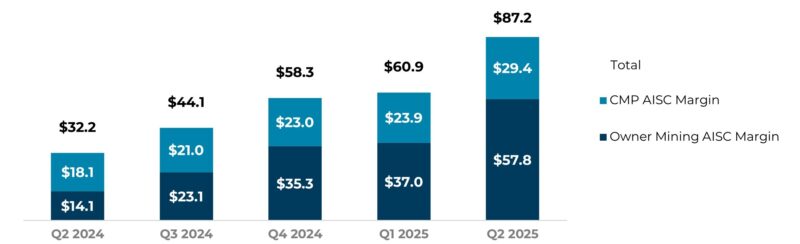
Figure 1: Strong AISC Margin Growth ($ million) – Segovia (CNW Group/Aris Mining Corporation)
Adjusted EBITDA reached $98.7 million USD, a 48% increase from the first quarter of 2025 and a nearly threefold increase from the same period in 2024. Over the trailing 12 months, Adjusted EBITDA was $264.0 million USD. The company invested $36.7 million USD in growth capital, with $23.6 million USD allocated to the Marmato Bulk Mining Zone and $6.9 million USD to the Segovia operations.
Adjusted net earnings were $47.8 million USD, or $0.27 USD per share, the highest since the company’s formation in September 2022. This represents an increase from $0.16 USD per share in Q1 2025 and $0.08 USD per share in Q2 2024. A non-cash loss of $45.5 million USD was recognized in Q2 2025 from fair value adjustments to the company’s warrant liability. This liability, valued at $40.8 million USD as of June 30, 2025, has been fully extinguished following the expiration of the warrants on July 29, 2025.
| Q2 2025 | Q1 2025 | Q2 2024 | |
|---|---|---|---|
| Gold production (oz) | 58,652 | 54,763 | 49,216 |
| Gold sold (oz) | 61,024 | 54,281 | 49,469 |
| Segovia – AISC, Owner Mining ($/oz sold) | $1,520 | $1,482 | $1,616 |
| Segovia – CMP AISC Margin (%) | 42% | 41% | 34% |
| Adjusted EBITDA ($M) | $98.7 | $66.6 | $36.1 |
| Adjusted net earnings ($M) | $47.8 | $27.2 | $12.7 |
| Adjusted earnings per share ($/share) | $0.27 | $0.16 | $0.08 |
Q2 2025 Operational Performance
Gold production for the quarter totaled 58,652 ounces, a 7% increase from the 54,763 ounces produced in Q1 2025. Production is anticipated to increase throughout the second half of 2025 following the commissioning of the second mill at the Segovia operations in June 2025.
The Marmato Narrow Vein Zone produced 7,125 ounces, consistent with Q1 2025 levels and a 29% increase over Q2 2024.
The Segovia Operations produced 51,527 ounces, supported by an average gold grade of 9.9 g/t and gold recoveries of 96.1%.
All-in Sustaining Cost (AISC) margin increased to $87.2 million USD, a 43% increase from Q1 2025. The trailing 12-month AISC margin reached $250.4 million USD.
Owner-operated Mining AISC was $1,520 USD per ounce sold, bringing the first-half 2025 average to $1,503 USD per ounce, which is within the company’s full-year guidance range of $1,450 USD to $1,600 USD.
Gold sourced from Contract Mining Partners (CMPs) delivered an AISC sales margin of 42%, contributing to a 41% margin for the first half of 2025, exceeding the full-year guidance range of 35% to 40%.
Total AISC increased to $1,681 USD per ounce sold, up from $1,570 USD in Q1 2025. This increase was attributed to higher gold prices, which raised costs associated with material purchased from CMPs, as well as royalties and social contributions linked to gold sales.
| Q2 2025 | Q1 2025 | Q2 2024 | |
|---|---|---|---|
| Average realized gold price ($/oz sold) | $3,303 | $2,855 | $2,313 |
| Tons milled (t) | 167,960 | 167,150 | 155,912 |
| Average gold grade processed (g/t) | 9.85 | 9.37 | 9.14 |
| Gold produced (oz) | 51,527 | 47,549 | 43,705 |
| AISC margin ($M) | 87.2 | 60.9 | 32.2 |
Growth and Expansion
The company’s operations generated $74.6 million USD in cash flow after sustaining capital and income taxes in Q2 2025. After accounting for expansion capital, Aris Mining generated a net cash flow of $37.9 million USD.
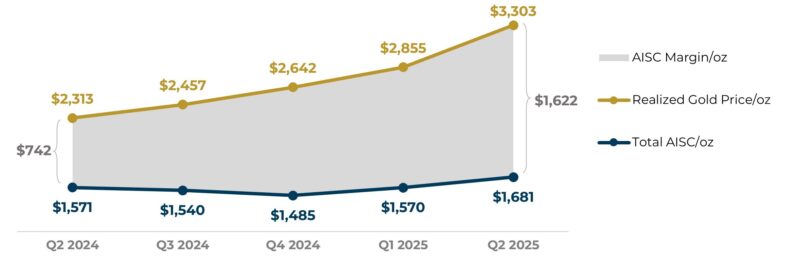
Figure 2: Total AISC and Realized Gold Price Trends ($/oz) – Segovia (CNW Group/Aris Mining Corporation)
Segovia Operations Commissioning of the second ball mill at Segovia in June 2025 is expected to increase gold production throughout the second half of the year. With ongoing underground development and increased mill feed from CMPs, the company maintains its guidance for annual production of 210,000 to 250,000 ounces this year and a target of 300,000 ounces for next year. A total of $6.9 million USD was invested in Q2 2025 to support the plant expansion, underground development, and exploration.
Marmato Bulk Mining Zone Construction of the Marmato Bulk Mining Zone is advancing. The project, which involves a porphyry-hosted gold-silver system, is being developed using bulk underground mining methods. Decline development is in progress to access the mineralized zones. Earthworks for the main substation have been completed, and earthworks for the carbon-in-pulp (CIP) plant platforms are nearing completion. The company invested $23.6 million USD in the project during Q2 2025. First ore and production ramp-up are projected for the second half of 2026.
Soto Norte Project: A new Pre-Feasibility Study (PFS) for the Soto Norte Project is currently underway and is expected to be completed in Q3 2025. This study includes a smaller-scale development plan and processing options intended to support local small-scale miners. Following the PFS, Aris Mining plans to submit the necessary studies to apply for an environmental license for the project’s development.
Toroparu Project: A new Preliminary Economic Assessment (PEA) for the Toroparu Project is in progress and is expected to be completed in Q3 2025. The PEA will evaluate updated development options following the March 2023 mineral resource update and subsequent infrastructure optimization studies.
Aris Mining in Segovia. Photo credit: Aris Mining Segovia/Facebook.
The balance of the first six months of the year for exports of non-mining and energy goods closed positively. The country sold $12.857.6 million USD to the world in this class of products (agro, agro-industrial, and industrial) for an increase of 21.7% compared to the same period in 2024.
This value also represented more than half, 52.7%, of everything that Colombia sold to the world in those six months.
“The behavior of what the country exported in the first six months of the year in products other than oil and coal, ratifies not only the behavior that non-mining exports have been registering for months, but also that step by step we are advancing in the transformation of the productive fabric and the diversification of the export basket. From the commerce, industry, and tourism sector, we continue to provide entrepreneurs in the regions with all the instruments and institutional offer to guarantee the sophistication and expansion of the offer,” said the Minister of Commerce, Industry, and Tourism, Diana Marcela Morales Rojas.
In volume, shipments also continue to increase. Between January and June, there were 5.1 million tons, for a growth of 9.6% compared to the first half of 2024. Within the non-mining basket, the exports that had the greatest weight in the period of analysis were those of the agricultural sector, which accounted for 43.7% ($5.615.9 million USD) and grew 36%.
Products such as coffee stand out, whose exports in the 6 months grew 81.3%; flowers, 9.9%; bananas, 6.2%; Hass avocado, 27.6%; Tahiti lemon, 15.7%, and gulupa, 23.3%, among others. The second most representative group of products of exports of non-mining goods in the period was industry, which participated with 40.8% ($5.252 million USD) of this basket and a growth of 5%.
Exports of aluminum doors, windows, and their frames stood out, among others, with an increase of 9.5%; insecticides, 18.8%; electrical transformers, 12.9%; medicines, 9.3%; and beauty preparations, 3.7%. Products from the agribusiness sector, which accounted for 15.5% ($1.989.7 million USD) of the non-mining energy export basket, registered an increase in sales of 37%.
Products such as palm oil, whose exports grew 64.1%; coffee extracts and essences with an increase of 45.7%; sugar, 14.3%; cocoa and its derivatives, 87.3%, and bakery products, 8.7%, among others, boosted the sector’s performance.
90.4% of exports of non-mining energy products were made from nine Colombian regions: Antioquia, from where they grew 25.9%; Bogotá, which increased 16.5%; Cundinamarca, 16.5%; Valle del Cauca, 14.8%; Atlántico, 6.6%; Bolívar, 9%; Caldas, 47.3%; Magdalena, 45% and Huila.
The latter was the one that reported the highest increase, with 50%. Its non-mining foreign sales totaled $624.2 million USD in the first six months of the year, marked by coffee.
In June alone, the country exported $2.112.6 million USD in non-mining products, which represented an increase of 20.4%. In volume, 774,248 tons were shipped for an increase of 9.6%.
Avocados. Photo credit: JohnyVid from Pixabay.
Violence returned-Does it ever really go away?-to Colombia yesterday with a bombing in Cali that left multiple civilians dead and many more injured. This time the reported perpetrators are the dissident FARC – last time it was another group, but sadly again it is the sort of headlines that cripples the country.
Everyone wants to date the good-looking girl, and that young lady is called Miss Tourism. It has been picking up since COVID-19, and has been one of the big Gustavo Petro bets and has paid off. Last year, for the first time, Colombia (6.9 million) was the most visited country in South America – this year that number is set to grow another 4.3% to 7.2 million, and in reality, the country is just getting started. Tourism is threatening to bring more dollars into Colombia than oil in 2025.
No surprise then that a dozen presidential pre-candidates descended on the ANATO tourism forum in Medellín to sit on panels to give their views on a subject they know nothing about. Hours of delegates’ time were wasted on listening to the peacocks and peahens as they preened their feathers.
Another sector undergoing a boom is agriculture, where, coincidentally, Petro has also been concentrating his efforts. Coffee, flowers, and palm oil are all booming, but there are plenty of other products. Petro has tried to push ahead with the repatriation of lands stolen during the armed conflict, especially by the paramilitaries, but this is a slow process. One can only imagine what a bread basket (as opposed to basket case) Colombia would be if 1% of its population (Oxfam) didn’t control 81% of the land with little or no interest in farming or sharing it – the worst reading in Latam.
Elsewhere (say it quietly so as not to upset the elite), domestic demand is following confidence upwards with imports according to Departamento Administrativo Nacional de Estadística – DANE Colombia rising another 14.5% in June, driven by capital and consumer goods – the downside is that the growing economy added another $1.1 billion USD to the deficit.
The initial tax reform has been presented in conjunction with the budget – both will be a struggle to get through congress as the peacocks/peahens prepare themselves for the March elections. This will be a challenge for Ministerio de Hacienda Germán Ávila. What really sticks in the throat is ex-finance ministers such as Mauricio Cárdenas telling us how they would do it – they already had their chance, and failed.
There is much news, but just to mention that in this disaster of a country, which everyone should leave, the stock market continues to rage (+34% YTD) on improving volumes and more Colombians than ever before (80,000) traded the stock market in 1H2025, according to Asobolsa.
Just another of the inconvenient truths. One can only imagine that if Colombia is even half the ship was rowing in the same direction for just one day.
Have a great day.
Roops.
Never miss Rupert’s latest commentary.
Follow him now on LinkedIn to see What Jumps Out.
FARC dissidents arrested in Putumayo, Peru, during Operation Armageddon. Photo credit: Ministerio de Defensa del Perú/Wikipedia.
A single afternoon of terrorist massacres in Colombia’s Valle del Cauca and Antioquia departments has left at least 19 people dead and dozens injured, exposing the emptiness of President Gustavo Petro’s controversial “Paz Total” (Total Peace) policy. The coordinated assaults, attributed to FARC dissidents, underscore the escalating power of illegal armed groups and their deep-rooted control over vast swaths of the country, fueled by a booming cocaine trade that now surpasses levels seen during the era of Pablo Escobar.
In the southern city of Cali, a truck bomb detonated outside the Marco Fidel Suárez Air Force Base on Thursday afternoon, killing at least six civilians and injuring more than 70 others. The powerful explosion, which occurred at approximately 2:50 PM, ripped through a bustling commercial area, leaving a trail of destruction. Eyewitnesses described a scene of chaos and horror, with victims strewn across the street and buildings reduced to rubble.
Hours earlier, in the rural northern municipality (in Colombia, a “municipality” is somewhat equivalent to a county) of Amalfi, Antioquia, a helicopter carrying police officers engaged in coca crop eradication was taken down by an explosive-laden drone. The attack, which claimed the lives of 12 police officers and a civilian, was a chilling demonstration of the evolving tactics and military capacity of the armed groups operating in the region.
The attacks have been widely condemned by national and local officials, who have called for a decisive response to the growing wave of violence. President Gustavo Petro, who campaigned on a promise of achieving “Total Peace” through negotiations with the country’s various armed factions, traveled to Cali to oversee the government’s response. In a statement on X (formerly Twitter), the president attributed the Cali bombing to the Carlos Patiño Front, a dissident faction of the former FARC guerrilla group, and described it as a “terrorist reaction” to recent military operations against them.
However, critics argue that the “Total Peace” policy, which has included ceasefires and negotiations with groups like the National Liberation Army (ELN), Segunda Marquetalia, and the powerful mafia organization, the Clan del Golfo (also known as the Urabeños), has emboldened these organizations, allowing them to expand their territorial control and illicit economies.
Andrés Julián Rendón, the governor of Antioquia, confirmed that the downed helicopter in his department was providing air support for a coca eradication mission. In a public statement, he lamented the loss of life. He called for a more forceful approach to combating the drug trade, which he identified as the primary driver of violence in the region.
Colombia’s President Gustavo Petro campaigned on a promise of “Total Peace” but guerilla groups are thriving during his term, showing no interest in ceasing crime or terrorism.
The mayor of Medellín, Federico Gutierrez, echoed these sentiments, expressing his condolences to the families of the victims and calling for national unity in the face of the growing security crisis. In a recent meeting with US senators, Gutierrez highlighted the interconnectedness of drug trafficking, terrorism, and corruption, and the need for a comprehensive strategy to address these challenges.
In Cali, Mayor Alejandro Eder announced a reward of up to $400 million COP (approximately $90,000 USD) for information leading to the capture of those responsible for the air base attack. “Cali is once again the victim of a narco-terrorist attack,” he declared, ordering the militarization of the city to restore order. Eder also confirmed the capture of two individuals believed to be members of the Jaime Martínez front of the FARC dissidents, who are now in the custody of the Fiscalía General de la Nación.
The acting governor of Valle del Cauca, Dilian Francisca Toro, has also been vocal in her condemnation of the violence, urging a united front against organized crime. “We must work together against this crime,” she stated in a recent interview, highlighting the need for greater coordination between local and national authorities.
The recent attacks have cast a long shadow over the Petro administration’s security policy. While the government has touted record cocaine seizures in 2025, with 601 tons confiscated so far, coca cultivation has also reached historic highs. This paradox suggests that while law enforcement efforts are having some success in interdicting drug shipments, they are failing to address the root of the problem: the relative impunity protecting the narco-mafias, who have enjoyed legitimacy under the Petro administration as negotiating partners. Rather than eradicating the criminal mafias, President Petro has treated them as diplomatic delegations that have come to negotiate as legitimate civil society actors.
The flourishing drug trade has provided a financial windfall for groups like the FARC dissidents and the ELN, allowing them to recruit (often forcibly) new members, acquire sophisticated weaponry such as attack drones, and challenge the authority of the state in a way not seen in years. The use of an explosive-laden drone to down a helicopter is a particularly ominous development, signaling a new level of technological sophistication among these groups.
As the country mourns the victims of these latest attacks, a difficult question hangs in the air: Will President Petro, a former guerrilla himself, abandon his soft-on-terrorism “Total Peace” policy and allow the country’s security forces to persecute these narco-criminals? Nothing in his record says “yes.” Colombia has less than a year until the next president is inaugurated. Colombia experimented with its first leftist president in modern history, who promised “total peace,” but as the mafia groups that plague Colomba are gaining power like it’s the 1980s, as political assassinations have returned to the case of presidential candidate Miguel Uribe Turbay, Colombians may turn back to a more hard-line leader who can promise eradication of narco-mafias and the cocaine they produce, while hopefully respecting human and civil rights better than some past administrations.

Cali attack. Photo from Twitter.
Video credit: infoLibre YouTube.
The Nordic country of Sweden has been in the news quite a bit recently in Colombia. Yes, Ikea has been establishing a presence in Bogotá and Medellín, and the Grupo Familia consumer packaged goods company is now part of Essity, but notably, Colombia has chosen to upgrade its 1970s era tactical fighters with Saab Gripen fighter jets manufactured in Sweden. The price tag has not been announced on the deal, but several years ago, the Colombian government had earmarked $678 million USD equivalent in the national budget for the aircraft acquisition. The deal value certainly now significantly exceeds this.
What many people may be unaware of though, is that the countries have a 150 year bilateral diplomatic history together. The countries’ ties go far beyond merely commercial ventures. A 19th century Swede even was appointed governor by the fledgeling government after Colombia gained independence from Spain. Sweden has several cultural, peace-building, civil society, and humanitarian initiatives both in Colombia and throughout the Andean region.
Ambassador Helena Storm made time in her busy schedule to speak with Loren Moss, the executive editor of Finance Colombia, where they discussed the bilateral relationship, Storm’s impressions of the country over her time here, and the potential for deepening ties between the two countries.
Finance Colombia: I’m here with Helena Storm, Her Excellency, the Ambassador of Sweden in Colombia. First, I want to thank you very much for making time for us. I know that the life of an Ambassador or any diplomat is very busy. And so it’s an honor to speak to you here briefly. So first of all, thank you.
Helena Storm: Well, thank you very much for inviting me, Loren.
Finance Colombia: I want to talk about Colombia and Sweden having a 150-year-old bilateral relationship. It’s not often the noisiest relationship. You know, like a lot of countries in the news and things like that, for sometimes good reasons, sometimes bad reasons. But of course, Sweden has a strong global reputation for quiet diplomacy and things like that. But tell me, what are the ties that bind Sweden and Colombia? And are there notable examples of collaboration or cooperation going back over the years?
Helena Storm: Yes. Well, as you pointed out, Sweden and Colombia have very good bilateral relations. And last year, we celebrated 150 years of bilateral relations. I mean, that’s 150 years of formal bilateral relations, formal diplomatic relations. Before that, we had relations with Colombia. People-to-people relations and even contacts between the two governments go beyond. Already from the liberation of the country, Sweden was here, and we were present. We had a count, a Swedish count fighting with Simon Bolivar to liberate the country. He was then appointed the first governor of Mompox by Simón Bolívar.
At this time, we had several important Swedish families migrating to Colombia, one of them very well-known, and they’ve been active in many areas of Colombian society. It’s the Familia De Greiff. So we have this tradition of people-to-people relations. And since I would say maybe three, four decades now, we have been very engaged in this Colombian peace process.
In all the formal attempts that have been executed, negotiating between different groups and the Colombian government, Sweden has been present, supporting these talks in different ways. So, a durable peace in Colombia has been part of the main kind of activities that we’ve had over the last decades in Colombia.
Yes, so it’s a strong relation. And we also celebrated the 150th anniversary with the visit of President Gustavo Petro to Stockholm, where we signed a joint declaration of bilateral partnership between Sweden and Colombia. And I would say this partnership kind of sets a new scene for our relations.
Finance Colombia: Absolutely. If I’m not mistaken, there is even a street in Medellín named after De Greiff. I never made the connection until just now, so every day you learn something, as they say. And speaking of President Gustavo Petro’s visit to Stockholm, I want to congratulate you guys. I’m from the US, and Lockheed Martin was there. But that’s an impressive accomplishment. You guys beat out lots of different competitors, all of them worthy. Of course, all of us are partners with Sweden and with the EU. And we’re all allies.
But first, congratulations to Sweden and Saab on winning the deal to replace Colombia’s fighters, which are from the early 70s, the tactical fighter fleet. And so, how long have you guys been working on that deal? And how big is that deal? People don’t realize outside of aviation that there’s the price of purchasing the hardware, the aircraft, but there are long-term service contracts that go on for decades after; it is a whole program. So maybe if you could elaborate on that, and obviously, that’s a commercial deal, but the way that these things work, it’s a hand-in-hand thing with the government, and everyone is working together. So I’m sure that occupied a lot of your time in the past few years.
Helena Storm: Well, thank you for that comment. And obviously, we are very happy and proud of the fact that Colombia chose the Swedish company Saab to replace their fighter fleet. And these kinds of decisions are long-term; they take a long time to make. So I think we have been discussing this with the Colombian government, and Saab has been offering a solution from their company since Santos’ time in government. I think that’s when they started to look at the replacement of this fleet. And this is normal. This is how long these kinds of acquisitions take. And, as you say, we have a great respect for our competitors, the other countries and companies that were also putting in offers. We are very proud that they chose Saab.
And as you pointed out, this is a long-term relationship for us. We are not looking for clients, we are looking for associates, allies, and friends. And with this kind of agreement, we have the opportunity to reinforce all three of these aspects with Colombia. And so right now we are in the process of identifying the details of this agreement.
Finance Colombia: That’s good to hear. And so also, I understand that part of the package… And Sweden has always been, as have your other Nordic neighbors, really involved in social efforts across the globe and have been leaders in that. And I understand that part of this package, you know… fighters are necessary in the real world. But there’s also, you know, we always have that perennial conflict of guns or butter, as they say. But I understand that part of this package includes a significant investment and efforts by Sweden in Colombia’s Atlantic region, which is a region that suffered a lot of neglect and a lack of investment, and things like that. And I don’t remember the details. Maybe you can fill us in. What’s that social part of the commitment that you guys have agreed to?
“Colombia is such a rich country in culture, history, and nature. I mean, it’s just amazing.” – Helena Storm
Helena Storm: Well, as you said, these kinds of acquisitions are accompanied by an offset program. And the offset program is an agreement to transfer technology and transfer knowledge, so we can multiply, actually, the investments in Colombia. And it’s up to the Colombian government and the Colombian society to identify in which areas, in which sectors, they would like the investments when it comes to technology, and the transfer of knowledge and technology.
And as I said, we are in the process of identifying this part of the offset program, it’s as you call it, direct and partly indirect. And the indirect part, that’s what you are referring to, I guess, when it comes to the social investments. And this is right now being identified and discussed between the Colombian Ministry of Defense and the company Saab.
Finance Colombia: Great. Besides aviation, besides, obviously, Saab, besides the Gripens, what are the primary bilateral trade links between Colombia and Sweden? Has there already been a significant amount of ongoing import and export between the two countries in terms of what Sweden buys from Colombia, and then what products does Sweden export to Colombia? Maybe if you can speak to the trade that has already existed.
Helena Storm: Yes, of course. Well, we have had trade between our nations for over a century. And today, the exports from Colombia to Sweden mainly consist of fruits, flowers, and coffee. And the exports from Sweden to Colombia mainly consist of different pharma products, technology in general, and vehicles and auto parts. And we are trying to increase now, together with the Colombian side, the export possibilities from Colombia to Sweden. We just had a delegation of 20 Colombian companies to look at export possibilities in Sweden.
I went with them and we visited various actors in Sweden in the first week of June. And this was an initiative by my colleague, the Colombian ambassador in Stockholm. We are working very much hand in hand to increase the Colombian exports to Sweden. The numbers are not showing the reality, because when it comes to the trade, much of the trade goes via another European before it comes to Sweden, or before it exits Sweden, which in the statistics does not show Swedish imports from Colombia, or Swedish exports to Colombia. So, the numbers, that’s why I don’t go into numbers, but there has been a significant interest from Swedish companies to increase their presence in Colombia. We have, give and take, 100 Swedish brands and companies in Colombia.
They generate more than 25,000 direct jobs. We’ve also had big investments since I came here. One investment was the company Essity acquiring El Grupo Familia. We have had the inauguration of three IKEA stores in Colombia.
Finance Colombia: Thank you. Thank you, by the way! Thank you. A big fan, of course.
Helena Storm: Yes, thank you very much. No, but it’s an important commitment. We also have the company Zelestra, which is owned by a Swedish investment fund that has invested $300 million USD in two solar parks. And they are now discussing another investment in La Guajira. They have investment plans for several hundred million dollars more until 2027. That’s in the renewable energy sector. We also have other Swedish companies here, a big multinational that every year invests in Colombia to strengthen their position here and strengthen innovation policies that they have here.
I was recently in Rionegro to inaugurate a redistribution center, the second biggest in the world, which the company Essity has just built and inaugurated in Rionegro. That’s also a big investment of at least 35 million dollars. We also invest in the waste-to-energy sector, where we are also taking part from the government side, where we, for example, have financed feasibility studies to increase the possibility of investing in this sector for Swedish companies.
Finance Colombia: That’s impressive. I know about your Rionegro facility. It’s just a few minutes away from where I live here in Rionegro. Yeah, you know, lovely area. I can tell you, it’s kind of funny. So many times before, when I would travel to Miami, just back to the US, whether it’s on business or whatever, and stopping at the big IKEA there near the airport, and carefully weighing my luggage and being sad because things were too heavy to bring back. I remember just writing the article several years ago when we first heard that IKEA was going to open its first store in Bogotá, and now in Envigado. And just aside from being a journalist, just personally excited. And so really very happy for you all.
You know, I know that is a company of national pride, but then even for us as consumers, so happy about that. Renewable energy is a big area, as well as the strategic investments that you’ve made in companies like the paper companies, like Familia, which makes consumer packaged goods and things like that.
Beyond commerce, are there bilateral cultural or social initiatives to strengthen the people-to-people ties between the two countries? I know sometimes I’ll talk to people and, you know, it’s a little bit different in English compared to Spanish, but I found people get tripped up pronouncing in Spanish, of course, Sweden, with Switzerland, and things like that. It’s like, no, you know, it’s a quiet country because they don’t make bad news. You know, it’s one of those countries that are, and I know you guys are proud of this, quietly doing good things and have a great reputation.
But tell me about some of the people-to-people ties that you have and the bilateral initiatives that you guys have on an ongoing basis with Colombia.
Helena Storm: Well, thank you. We have in our embassy here in Bogotá two strategies for development cooperation, one bilateral for Colombia and one regional for the whole Latin American region. We manage both of these strategies from the embassy in Colombia. By the way, the Swiss embassy in Colombia is the second biggest in the region after Washington. So it kind of shows how we prioritize Colombia in our bilateral relations. And these two development cooperation strategies have priorities. For the Colombia strategy, our priorities are climate change and environment, peace building, and the third priority is democracy, human rights, and gender equality. And these are kind of the three main focuses for our work when it comes to development cooperation.
And we have several initiatives that also foster these people-to-people relations, and are also working very much hand-in-hand with the private sector to kind of use the Swedish development cooperation as an engine for economic growth. We have several programs for that. I won’t go into detail here, but I could if you want to.
We also work with education, vocational training for youth, and women, within these programs. And regionally, one program that I want to highlight is our mining program, which promotes sustainable mining in the region. And the Colombian chapter of that program was inaugurated or launched a couple of months ago, in May.
So it’s a recent addition to our efforts when it comes to sustainable mining. And in all our programs, we try to always have a gender equality perspective, because Sweden is a country where we highlight the importance of gender equality in all sectors in everything that we do. So gender equality is one of these priorities that we’ve been working on for the last five years that I’ve been here, and also before. But we’ve had numerous activities with exhibitions in the parliament, the Colombian Congress. We will inaugurate one very soon with the mayor’s office in Bogota, where we also highlight the men’s role when it comes to gender equality.
Another area where we have strengthened our bilateral relations recently is the cultural area. Sweden has, since I came, been twice a partner country for FILBo 2021 and 2022. We were also the invited country for the EuroCine Festival 2024. We’ve financed several documentaries that show the civil society’s engagement in peacebuilding and the role in the conflict, in the Colombian conflict. We’ve done that with various of our partners. ICTJ, which is the International Center for Transitional Justice, has been one of the partners, and UN Women another.
We have also strengthened our cooperation through the Philharmonic Orchestra of Bogotá, where we have a Swedish head director, musical director. And this orchestra went to Sweden during my five years here. I think it was 2023 or 2022. They traveled the whole orchestra to Sweden to showcase the quality of a Latin American Philharmonic Orchestra. And that was a very successful visit. So we are now planning a new visit to the Nordics for this orchestra in 2026. Unfortunately, after I’ve left, but yeah, maybe it will take place in the Autumn of 2025.
But anyway, these are very important areas of people-to-people relations that we’ve been working on. We’ve also brought Swedish artists here, singers, groups. One example that I want to highlight is Jon Henrik Fjällgren, who came and performed during COP16. And he is part of the Swedish native population, the Sami. But he was adopted from Colombia from an indigenous community in Colombia. So he has a double indigenous identity. He was born as an indigenous baby here in Colombia and then adopted by a Sami family in Sweden. And he has been reconnecting with his Colombian roots. And he is a very famous artist in Sweden, and he won our version of Sweden’s Got Talent. So it’s also been very emotional, I would say, the two visits that he made to Colombia during my five years. And to see how he had been fostering also a rapprochement between our indigenous groups, and how we can engage in further dialogue with them and foster further respect for their traditions and cultures.
Finance Colombia: You bring up an interesting point. A lot of times, I know growing up in the US, and I’m from the Midwest, where we do have a significant Nordic population. But it’s easy to forget how integral it is to society. I don’t even know why, but for some reason, we tend to remember the neighbors in Finland, that they have a significant indigenous population. But of course, Sweden does as well. I don’t know why we unfortunately tend to forget that. But that sounds like an amazing, not just collaboration, but just a story, just life history. And that brings me to ask, like you mentioned, your posting is mature here, and I’m sure that you’ll move on soon.
But during your time as ambassador, what accomplishments and activities are you most proud of? Not when you look at your resume or when you talk to the foreign minister, but when you talk to friends and family, what are you most proud of about the things that you were able to touch during your time here in Colombia?
Helena Storm: Oh, that’s a very difficult question. But I’m very proud of the footprint that Sweden has left in Colombia. I’m very proud of the association many or the majority of the Colombians have when I travel in the territories, because as an ambassador, I’ve prioritized traveling in Colombia, and to visit the territories, not only working from Bogotá. Colombia is not Bogotá. Colombia is an extremely diverse country. And most of the people that I meet in the territories associate Sweden with support for peacebuilding, conflict resolution, human rights, and gender equality. And I think we have been able during these five years to increase that footprint in Colombia. And I think that’s what I’m most proud of.
And also, obviously, the 150 years of bilateral relations were a unique moment to show that we were the first country to support the first verification mission that came to Colombia to support the peace process in 2004, I think it was, with the establishment of MAPP/OEA, the Organization of American States Verification Mission in Colombia. Sweden was the first country to support financially and politically that they came to Colombia. We created MOE with the actual director of MOE now. MOE is the observation of the electoral organization in Colombia. I would say it’s an organization; it’s an NGO in that sense. It’s not a governmental organization, but it is the organization with the most respect from all parties when it comes to reliability in election monitoring.
We also have supported the territorialization or the expansion of La Defensoría, which is kind of the Ombudsman office in Colombia that was introduced in the 1991 Constitution. Ombudsman is a Swedish word. So the whole idea of the Ombudsman’s office is a Swedish invention, so to speak. And I think the Defensoría is maybe the Colombian institution, the government institution with the most presence in the territories all over Colombia. And as we know, much of the conflict that still occurs here in Colombia occurs due to the lack of official representation, the presence of official institutions around the territory. So that’s another example of how we’ve been working very long term to try to contribute to peacebuilding.
Finance Colombia: I understand. And you’ve been very generous with your time. I’m grateful. Last question for you. What will you miss most about your time? You may come back to visit, but I mean, your time here living in Colombia, what will you miss most about it? And maybe, not so much politically, but you know, really speaking as people, what can the people in the two countries maybe learn from each other?
Helena Storm: Well, that’s a super difficult question because there’s so much that I will miss. Colombia is such a rich country in culture, history, and nature. I mean, it’s just amazing. So obviously, all of that, the strength of the Colombian civil society, I think I’ve never experienced such resilience and strength from civil society. But actually, it’s funny that you say that, because this weekend, I was doing kind of my last errands in Bogotá, and I was panicking a bit, because I said, “Oh, my God, I have to fit now all the Colombian artesanía,” as you say it here, “that I can fit in my suitcase.” Since I came, I’ve been buying handcrafted things from all the territories, and I always wear Colombian artesanía.
Today, I’m wearing an earring from Choco, made by a women’s organization in Choco. And you know, this is one small example of how you can create conditions to sustain yourself economically and empower women economically around the world, just a small example. But I have a huge collection of these, and I was like, “How will I be able to maintain this collection when I travel back to Sweden?” So that’s one of the things I will miss to travel around the territories, talking to different people, women in these territories, trying to make a living, trying to change, trying to construct a future for themselves and their communities.
And I think that kind of resumes what I will… You know, something that I’ve noted during these five years it’s the talent of the Colombian people and the talent of the workforce. It’s also one of the explanations why we have such an interest from Swedish companies to come here and establish here, the talent of the Colombian people. And I think when it comes to learning things from each other, I think Swedes maybe should learn to be a little bit more relaxed, not to plan everything, and that things may turn out great, even though you don’t have 100% control over every step and every detail. And maybe Colombians can learn to have a little bit more structure and a planning horizon.
Finance Colombia: Ambassador, thank you so much for your time. It’s been an honor to speak with you. Best of luck on your future postings and the rest of your career. I’ll certainly endeavor to stay in touch. We appreciate it. And I want to make sure that your staff knows that we want to do a better job of covering Sweden’s activity here in Colombia.
Sometimes, as journalists, we can be lazy and write about what the US is doing, or what Spain is doing, or what happened next door in Venezuela. But we want to be sure, because we know that there are so many countries like Sweden that, aside from trade and commerce, are doing good works and contributing not just to Colombia, but to the region. And we want to make sure to communicate those things that you all are doing. And again, thank you. I’m tremendously grateful.
Helena Storm: Thank you so much. Thank you.
Every year, thousands of professionals fly into Medellín for meetings, conferences, and corporate visits. They land at José María Córdova International Airport, check into hotels in El Poblado, attend back-to-back meetings, and often leave as quickly as they got into meeting rooms.
But what if they stayed just one night longer?
That extra 24 hours could open their eyes to a city that is not only a rising economic center of activity, but also a living example of urban transformation. Medellín is no longer a city you pass through — it’s a city you learn from.
A City Rebuilt with Purpose
We all know that in the early 1990s, Medellín made headlines for all the wrong reasons. It was a city affected by violence, drug trafficking, and fear. But today, it stands as one of Latin America’s most inspiring turnaround stories.
Over the past two decades, Medellín has become a model of urban renewal and smart public investment. Public and private sectors have worked together to rebuild the economy, improve infrastructure, and create inclusive spaces. The result is a city that now attracts international business, top talent, and a growing number of visitors.

Colorful staircase in Medellín. Photo credit: Andres Miranda from Pexels.com.
One of the strongest symbols of this change is Ruta N, in the city’s innovation district. This tech-driven ecosystem has brought in over 400 companies from more than 30 countries, from startups to multinationals in clean energy, mobility, health, and advanced manufacturing.
Medellín is no longer just competing with Bogotá or Cali. It is positioning itself as a gateway to the Andean region and Pacific markets.
Infrastructure That Drives Inclusion
Unlike many cities, Medellín’s infrastructure does more than move people — it connects lives and economies. The Metrocable, an aerial cable car system, links poor hillside neighborhoods to the city center. The Tranvía de Ayacucho and Bibliometro Line go beyond efficiency; they bridge historic gaps in access and opportunity.
Public libraries, sports complexes, and innovation hubs are placed strategically across all zones of the city, ensuring that economic growth is also social growth. Medellín calls this Social Urbanism, and it has become a model studied by city planners across the world.
Most importantly, this is not just theory. It’s a working city model. The Unidad Deportiva de Miraflores, for example, offers youth in high-risk areas a place for sports, learning, and leadership. It’s a real alternative to crime: a core part of Medellín’s development plan.
A Culture of Innovation That Extends Beyond the Boardroom
Innovation in Medellín is not limited to tech parks. It’s in the DNA of the city. It’s in Comuna 8, where grassroots initiatives have reshaped entire communities. It’s in Villa Hermosa, a district once affected by violence, now alive with urban gardens, murals, and micro-businesses.
It’s in the art of Comuna 13, where graffiti tells stories of pain, survival, and hope — and where visitors can walk alongside locals who helped drive the transformation.
Staying longer allows the business visitor to see this for themselves. Not through data, but through experiences that bring the numbers to life.
The Museo Casa de la Memoria: Learning From the Past
One of Medellín’s most powerful cultural spaces is the Museo Casa de la Memoria. Here, interactive exhibits share the stories of Colombia’s conflict and the human cost of the drug war. It is not a place of blame, but of understanding.
Business travelers often spend time trying to understand market risk, political context, and social trends. A visit here does that in one afternoon. It’s a direct look at how a country confronts its past while building a better future.
This museum is often the final stop on city tours that show both the historic scars and the healing now underway. It gives voice to the victims and gives visitors a deep respect for the city’s resilience.
Why One Extra Day Matters
Medellín is efficient, modern, and business-friendly. It has strong universities, a talented, growing bilingual workforce, and competitive operating costs. It has world-class hotels and modern meeting spaces.
The city also has something you can’t see on a spreadsheet — a spirit of reinvention.
When you stay longer, you see that Medellín is not just trying to look like other global cities. It’s building something different. Something that balances profit with purpose.
One extra day can be a strategy, not a luxury. It’s a way to understand clients better, build trust, explore new partnerships, and witness a city that’s leading by example.
Medellín: More Than a Business Trip
This is not about squeezing in a few tourist sites after hours. It’s about understanding the bigger picture of Colombia’s economic future. Medellín is playing a leading role: not just in innovation, but in inclusion. Not just in strategy, but in soul.
So the next time business brings you to Medellín, pause before booking the return flight. Let the city speak to you through its streets, its people, and its projects. In just 24 more hours, you might discover why Medellín is Latin America’s most quietly powerful success story.
Photo credit: César Gaviria/Pexels.com.
Grupo LATAM has implemented a new feature enabling passengers to share the location of their bags via Apple’s (NASDAQ: AAPL) “Find My” network. The integration is intended to improve efficiency in locating and recovering delayed baggage.
The functionality allows LATAM passengers using an AirTag or a compatible “Find My” accessory to securely and privately share an item’s location with the airline. The process is initiated by the passenger through the “Find My” app on their iPhone, iPad, or Mac.
According to a company statement, LATAM Airlines Group’s Vice President of Customers, Paulo Miranda, indicated that the airline transports over 40 million pieces of luggage annually. He noted that despite a loss rate approximately 50% below the industry average, delayed baggage remains a critical concern for customers.
In the event of a delayed bag, a passenger can generate a shareable link from the “Find My” app. This link can then be submitted to a delayed baggage report via SITA’s self-service website. SITA is a technology provider for the air transport industry.
Shawn Gregor, president of SITA Americas, stated that the company’s “Baggage IT Insights report” for 2024 showed a nearly 15% decrease in baggage incidence rates in Latin America and the Caribbean, which he attributed to investments in smart technology. Gregor added that with global air traffic growing, the company “welcomes LATAM’s initiative to implement this solution with AirTags and SITA WorldTracer.”
The location sharing feature automatically ends once a customer finds their bag or after seven days. The user can also manually stop sharing at any time. The process is end-to-end encrypted and anonymous, which means Apple and accessory manufacturers on the “Find My” network cannot view the location or other user data. The feature requires devices to be running iOS 18.2, iPadOS 18.2, or macOS 15.2 or later.
LATAM baggage. Photo credit: LATAM Airlines.
 Empleobilingue.com

- Director/a de operaciones para hotel, restaurante y discoteca 1626320364.60 - Medellín, Medellin, Antioquia, Colombia
- Coordinador/a de calidad para La Unión 1626483143.1 - La Unión, Antioquia, Colombia
- Desarrollador fullstack - Bogotá, Bogota, Colombia
- Technical Analyst - Remote
- PIM Administrator - Ecommerce - Remote (Bogotá, Bogota, Colombia)
- Auxiliar de gestión humana y bienestar para Girardota 1626060072.28 - Girardota, Antioquia, Colombia
- Marketing Strategist
- Trainer Manager - Bogotá, Bogota, Colombia
- Tolemaida UH- 60 Inspector - Bogotá, Bogota, Colombia
- Virtual Assistant - Team Lead - Remote
Contact Us

