

















Ministerio de Hacienda y Crédito Público Germán Ávila presented the tax reform this week, but before we delve in, there are two options on the ideological front. You either seek to improve Colombia’s appalling record on inequality, poverty, education, and social programs, or you prefer the status quo. The problem is that after years of corruption and mismanagement, the Colombian bank balance isn’t in any shape to write the checks needed to move the inequality needle – it needs to find extra resources. Please don’t fall into the trap that the local elite are trying to set by saying that somehow the GINI coefficient isn’t a fair reflection of Colombia’s brutal inequality.
Those resources are not coming from commodities. Despite oil production having increased since the days of Duque/Bayon, July exports from Departamento Administrativo Nacional de Estadística – DANE Colombia were again down 4.1% with commodities (-25%) and oil (17%) both lower.
There were some sensationalist headlines (Bloomberg around how much tax the rich will pay under the new reform however, it is far more nuanced than that. Consumption accounts for around 27% (of the $6 billion USD), but there are areas of pure common sense within that. Alcohol & tobacco are two areas proposed, as well as VAT on international tourists. Where the rich may get more nervous is that 24% of the reform is geared towards lowering evasion – Colombians are experts at hiding their funds overseas and/or hiring brilliant accountants. Other areas targeted are mining/energy (3%), gambling (6%), & fuel (10%).
It’s a many-headed snake, but just as Perseus took care of Medusa back in Greece, the Colombian Congress will take a sword to the tax reform, as well as the 2026 budget – much of the media debate will prove redundant. Let’s see what is left in a few weeks.
In terms of the overall fiscal picture, made worse every month by the above exports and booming domestic demand, plenty are saying that the key is to reduce government spending by 3-4%/GDP, which seems sensible. But is that in education, the fight against poverty, or perhaps by simply suspending some massive public infrastructure projects?. Whatever Gustavo Petro does, the ANDI – Asociación Nacional de Empresarios de Colombia and its peanut gallery members will still be moaning.
Was it a sailboat or a speedboat? Was it carrying drugs? Did the US act legally? Was it dispatched by Nicolás Maduro? Will Donald Trump continue to punch downwards until he finds a country that doesn’t bite back? Is Petro correct to speak of caution, given that Colombia shares a 4000 km land border with Venezuela? Simply a rabbit hole I’m going to avoid.
There was news elsewhere in brief.
The current account deficit widened to 2.5%/GDP in Q2.
Vehicle sales in August hit 21,285, up 29% YoY.
The Colombian birthrate fell again in 2024 by 13.7% – no extinction fear yet, but growth is slowing.
A lumpy Friday to say the least!
Regards.
Roops.
Never miss Rupert’s latest commentary.
Follow him now on LinkedIn to see What Jumps Out.
Roulette wheel. Photo credit: stux from Pixabay.
The Guyana Defence Force (GDF) has signed a Memorandum of Understanding (MoU) with the National Defense Ministry of the Republic of Colombia to enhance collaboration in aerial surveillance and regional security.
The agreement seeks to strengthen cooperation in monitoring and safeguarding airspace, focusing on countering illicit activities and improving situational awareness. Under the MoU, both countries will share expertise and build capacity to better detect and respond to threats.
Brigadier Omar Khan, MSS, Chief of Defence Staff, described the partnership as an important step in advancing Guyana’s defense agenda. He noted that the agreement will enhance the GDF’s ability to protect the nation’s sovereignty and contribute to a safer, more secure region.

Guyana Defence Force signs MoU with Colombia’s National Defense Ministry to boost aerial surveillance and regional security collaboration. Photo credit: Guyana Defence Force.
Commander of the Colombian Aerospace Force, General Luis Carlos Córdoba Avendaño, also emphasized the value of regional partnerships in addressing common challenges, highlighting the benefits of greater cooperation, information sharing, and coordination between the two nations.
The signing was witnessed by a high-level GDF delegation, including the Colonel General Staff, Colonel Kenlloyd Roberts, the Commandant of the Guyana National Reserve, Colonel Lorraine Foster, Adjutant General, Colonel Lloyd Souvenir, Inspector General Lieutenant Colonel Natasha Stanford, and Colonel Administration and Quartering, Commander Roger Nurse. Senior Officers of the Air Corps were also in attendance. Their attendance underscored Guyana’s commitment to strengthening defense capacity and regional partnerships.
The Colombian delegation included General Avendaño; Lieutenant Colonel Víctor Hugo Montes Castaño, Officer Air Liaison; and Colonel Miguel Andrés Gil Santacruz, Chief of the Office of International Affairs. Also present were the Ambassador of Colombia to Guyana, Graybern Livingston, and Ambassador George Talbot, Director of the Multilateral and Global Affairs Department, reflecting the strong diplomatic support behind the agreement.
This MoU is expected to pave the way for technical exchanges, training opportunities, and the use of advanced systems in support of surveillance and rapid-response operations. For the GDF, it marks a milestone in its modernization efforts and its continuing role in safeguarding national and regional security.
Photo credit: Guyana Defence Force.
A consortium of six global investment banks has initiated a cash tender offer for twelve series of US dollar-denominated global bonds issued by the Republic of Colombia. The move, announced on August 27, 2025, is directly linked to a series of total return swap (TRS) transactions, signaling a sophisticated liability management exercise by the Colombian government to optimize its debt profile.
The purchasing banks are Banco Bilbao Vizcaya Argentaria, S.A. (NYSE: BBVA, BME: BBVA), Banco Santander, S.A. (NYSE: SAN, BME: SAN), BNP Paribas Securities Corp., a subsidiary of BNP Paribas (EPA: BNP), Citigroup Global Markets Inc., a subsidiary of Citigroup Inc. (NYSE: C), Goldman Sachs & Co. LLC, a subsidiary of The Goldman Sachs Group, Inc. (NYSE: GS), and J.P. Morgan Securities plc, a subsidiary of JPMorgan Chase & Co. (NYSE: JPM).
The Tender Offer’s Framework
The offer targets a dozen outstanding series of Colombia’s global bonds with maturities spanning from 2027 to 2061. The purchasers will pay a fixed cash price for each series, plus any accrued and unpaid interest up to the settlement date.
While the offer is for a broad range of securities, the total amount to be paid for the tendered bonds, referred to as the “Maximum Purchase Price,” remains at the sole discretion of the purchasers. If the total value of tendered bonds for any given series exceeds the determined maximum, a proration factor will be applied. This structure provides the syndicate and, by extension, the Republic of Colombia, significant flexibility in managing the scale and scope of the buyback.
The specific bonds and their respective purchase prices per $1,000 of principal amount are detailed below:
| Existing Bonds | CUSIP / ISIN | Outstanding Principal Amount (as of Aug. 27, 2025) | Purchase Price (per US$1,000) |
|---|---|---|---|
| 3.875% Global Bonds due 2027 | 195325 DL6 / US195325DL65 | $1,740,144,000 | $996.25 |
| 4.500% Global Bonds due 2029 | 195325 DP7 / US195325DP79 | $2,000,000,000 | $980.00 |
| 3.000% Global Bonds due 2030 | 195325 DR3 / US195325DR36 | $1,542,968,000 | $901.25 |
| 3.125% Global Bonds due 2031 | 195325 DS1 / US195325DS19 | $2,539,952,000 | $866.25 |
| 3.250% Global Bonds due 2032 | 195325 DZ5 / US195325DZ51 | $2,000,000,000 | $836.25 |
| 6.125% Global Bonds due 2041 | 195325 BM6 / US195325BM66 | $2,500,000,000 | $875.00 |
| 4.125% Global Bonds due 2042 | 195325 EA9 / US195325EA91 | $514,546,000 | $700.00 |
| 5.625% Global Bonds due 2044 | 195325 BR5 / US195325BR53 | $2,500,000,000 | $805.00 |
| 5.000% Global Bonds due 2045 | 195325 CU7 / US195325CU73 | $3,670,948,000 | $737.50 |
| 5.200% Global Bonds due 2049 | 195325 DQ5 / US195325DQ52 | $2,168,483,000 | $738.75 |
| 4.125% Global Bonds due 2051 | 195325 DT9 / US195325DT91 | $1,035,726,000 | $645.00 |
| 3.875% Global Bonds due 2061 | 195325 DX0 / US195325DX04 | $751,835,000 | $601.25 |
Strategic Rationale and Total Return Swap Structure
The offer document explicitly states that the transaction’s primary purpose is for the purchasing banks to acquire the bonds to hedge potential obligations under total return swap (TRS) transactions expected to be executed with the Republic of Colombia.
This arrangement suggests that Colombia is entering into agreements with the banks where it will receive the total return (interest payments plus capital appreciation/depreciation) on its own debt, effectively neutralizing its exposure to those specific bonds. In return, Colombia would likely pay the banks a floating rate, such as SOFR, plus a spread. For the banks to hedge their position in this swap—where they are paying out the bonds’ total return—they must physically hold the underlying assets. This tender offer serves as the mechanism for the banks to acquire the necessary bonds from the market.
This structure allows the Ministry of Finance and Public Credit to synthetically manage its debt profile, potentially reducing interest rate risk or altering its maturity schedule without immediately retiring the debt from its balance sheet. At the maturity of the swaps, the banks are expected to deliver the bonds to the republic, at which point the debt would be formally extinguished.
Key Terms and Timeline for Investors
For bondholders considering the offer, the key dates are as follows:
- Expiration Time: The offer will expire at 5:00 p.m., New York City time, on Wednesday, September 3, 2025. This is also the deadline for withdrawing any tendered bonds.
- Announcement of Results: The purchasers expect to announce the aggregate principal amount of accepted bonds and any proration factors on Thursday, September 4, 2025.
- Settlement Date: The transaction is scheduled to settle on Monday, September 8, 2025.
Tenders must be submitted in principal amounts equal to the minimum authorized denominations, which is $200,000 for most series ($100,000 for the 6.125% bonds due 2041) and integral multiples of $1,000 in excess thereof. The process must be conducted through DTC, Euroclear, or Clearstream.
The offer’s primary condition is the successful execution of the TRS agreements between the purchasers and Colombia. It is important to note that the purchasing banks are severally, not jointly, liable. Each bank is only responsible for its own accepted portion of the tender.
The depositary and information agent for the offer is Global Bondholder Services Corporation.
US Dollars. Photo credit: Mano Chandra Dhas.
Frontera Energy Corporation (TSX: FEC) has released its second-quarter financial and operational results for 2025, while simultaneously announcing significant changes to the board of directors of its majority-owned joint venture partner, CGX Energy Inc. (TSXV: OYL). The disclosures come as CGX recorded a $56.4 million impairment on its Corentyne block assets in Guyana, signaling potential headwinds for the joint venture’s offshore exploration projects.
The second quarter saw Frontera generate $76.1 million in operating EBITDA, with an adjusted infrastructure EBITDA of $27.1 million. The company reported a total cash balance of $197.5 million at the end of the quarter, having reduced its upstream net debt by 30%. Over the past year, Frontera has returned over $144 million to shareholders through dividends and share buybacks and has also decreased the outstanding principal amount of its senior unsecured notes by more than 20%.
In Colombia, the company highlighted increased total production, attributing it to enhanced processing capacity at its SAARA project, new flow lines in heavy oil fields, a successful well intervention program, and new natural gas production from the VIM-1 block. Production costs saw a 10.3% quarter-over-quarter decrease, while transportation costs fell by 5.7%, which the company credits to higher domestic wellhead sales.
Concurrent with its financial reporting, Frontera announced a shake-up at the board of CGX Energy. Orlando Cabrales has been appointed as the new chairman of the board, with Alejandra Bonilla and René Burgos Díaz joining as new directors. These appointments follow the resignation of Dr. Suresh Narine as executive director and co-chairman and Gabriel de Alba’s decision to step down as a director.
Analysis of Frontera’s Financial Position
Frontera’s second-quarter results present a mixed but cautiously optimistic picture for investors. The reported operating EBITDA of $76.1 million, while substantial, should be viewed in the context of a volatile global oil market. The company’s ability to reduce upstream net debt by 30% and maintain a strong cash position of $197.5 million demonstrates a disciplined approach to capital management, a crucial factor in navigating fluctuating commodity prices. The return of over $144 million to shareholders in the last twelve months through dividends and share repurchases signals confidence from management in the company’s cash flow generation capabilities.
However, the significant impairment charge of $56.4 million on the Corentyne block in Guyana, booked by its joint venture CGX Energy, casts a shadow over Frontera’s growth prospects outside its core Colombian operations. This impairment, effectively writing down the value of the asset to zero, reflects the ongoing uncertainty surrounding the joint venture’s license with the Guyanese government. For investors, this development heightens the risk profile of Frontera’s Guyanese exploration efforts and places greater importance on the performance and stability of its Colombian production and infrastructure assets.
The company’s focus on operational efficiencies in Colombia, leading to a 10.3% decrease in production costs, is a positive indicator. This suggests that Frontera is actively working to control expenditures and maximize profitability from its existing assets. The 5.7% reduction in transportation costs, driven by higher domestic sales, also points to a strategic shift that could mitigate logistical expenses and improve margins. The standalone infrastructure business, generating $27.1 million in adjusted EBITDA, provides a stable and growing source of revenue, partially insulating the company from the volatility of the upstream oil and gas sector.
Looking ahead, Frontera has adjusted its capital expenditure guidance downwards by approximately $20 million, reflecting a more conservative spending approach in the current oil price environment. The revised Operating EBITDA guidance of $320 – $360 million at a $70/bbl Brent price, and adjusted infrastructure EBITDA guidance of $110 – $125 million, provide a clearer, albeit more cautious, outlook for the remainder of the year. For investors, the key takeaways are Frontera’s solid operational performance and disciplined financial management in its core Colombian business, contrasted with the significant geopolitical and operational risks associated with its Guyanese venture. The company’s ability to amicably resolve the Corentyne block license issue with the Government of Guyana will be a critical factor in unlocking future value.
CGX Energy Board Changes and Guyana Dispute
The changes to the CGX Energy board are a direct consequence of the challenges faced by the Frontera-CGX joint venture in Guyana. Frontera, as the majority shareholder of CGX and the primary financial backer of the joint venture, is asserting greater control over the strategic direction of the company in light of the ongoing dispute with the Guyanese government over the Corentyne block license. The appointment of Orlando Cabrales, Frontera’s CEO, as the new chairman of the CGX Board, along with the addition of Frontera’s General Counsel, Alejandra Bonilla, and CFO, René Burgos Díaz, solidifies Frontera’s influence over CGX’s governance and decision-making.
The root of the issue lies in the differing interpretations of the Corentyne block’s license validity. While the joint venture maintains that its license is in good standing, the Government of Guyana has expressed its view that the license expired in June 2024. This disagreement has led to a standstill in exploration and development activities, culminating in the $56.4 million impairment charge. The Guyanese government has indicated it may consider a meeting with the joint venture in October 2025 to discuss the matter, but there is no guarantee of a favorable outcome.
Frontera’s decision to install its own executives on the CGX board is a clear signal that it intends to take a more direct and assertive role in resolving this dispute. The new board will be tasked with navigating the complex legal and political landscape in Guyana to either reach a negotiated settlement or pursue legal action to protect the joint venture’s interests. The resignations of Dr. Suresh Narine and Gabriel de Alba represent a changing of the guard, likely intended to bring a fresh perspective and a more aggressive approach to the negotiations.
The likely outcome of this board overhaul will be a more unified and Frontera-driven strategy for the Guyanese assets. This could involve intensified negotiations with the Guyanese government, a more robust legal challenge, or a strategic decision to cut losses and exit the Corentyne block if a viable path forward cannot be found. For investors in both Frontera and CGX, the board changes are a pivotal development. A successful resolution could unlock significant value from the Corentyne block’s multi-billion-barrel potential. Conversely, a failure to resolve the dispute could result in a permanent loss of the investment and a significant blow to both companies’ long-term growth ambitions in the highly prospective Guyana-Suriname basin. The new leadership at CGX faces a critical test in the coming months, with the future of the company’s most promising asset hanging in the balance.
Aruchara-4 Drilling Rig (CNW Group/NG Energy International Corp.)
In a public-private partnership, AES Colombia, Soluna Energía S.A.S. E.S.P. (Soluna), and the Financiera de Desarrollo Nacional S.A. (FDN) have secured financing for a project to deliver solar energy to over 800 households in La Alta Guajira. The initiative, named Sol-Kai, aims to provide electricity access to more than 3,000 residents in the initial phase.
The project is slated for development within communities located in the area of influence of the Jemeiwaa Ka’l wind cluster, operated by AES Colombia (The AES Corporation, NYSE: AES) in the municipality of Uribia. The first stage will encompass the JK1 and JK2 wind farms, which have a total capacity of 259 MW.
FDN, a development bank, structured the project’s financing, approving a senior loan of $11.6 billion COP and a liquidity line of $1.12 billion COP. Additional funds for the project are being contributed by AES Colombia and Soluna as investors. These funds will be managed through a trust administered by Fiduciaria Bogotá S.A.
According to FDN President Francisco Lozano, the project’s financing is intended to address social gaps in La Guajira, a region where 31.4% of the population lacks access to electricity. The project aims to provide continuous 24/7 power, which could facilitate educational and productive activities for the beneficiary population.
The initiative aligns with AES Colombia’s sustainability strategy and contributes to Sustainable Development Goal 7: affordable and clean energy. Its objective is to supply clean energy to Wayuu indigenous communities in off-grid rural areas. Federico Echavarría, general manager of AES Colombia, stated that the project, which has been under structuring for several years, demonstrates the company’s commitment to renewable energy development and contributes to an energy transition.
The first phase of the project is projected to benefit 840 households, with the potential to expand to an additional 3,000 homes. The solar technology will enable residents to power appliances such as refrigerators, computers, and mobile phone chargers.
The project’s financing includes resources from a special line of the Climate Investment Funds (CIF) and the Inter-American Development Bank (IDB), which are being channeled through FDN. This marks the first disbursement from this line, which is designed to support projects with social and environmental impacts, particularly those promoting renewable energy for a just energy transition. The project is also noted as the first of its kind to be financed via a project finance structure, potentially setting a precedent for its replication in other Colombian communities without electricity access.
Soluna will be responsible for the operation and maintenance of the project, ensuring a sustainable service at a subsidized rate. The implemented scheme is designed to be affordable for the beneficiary population.
Pictured from left to right: Daniel Vallejo, CEO of Soluna, Federico Echavarría, CEO of AES Colombia, and Francisco Lozano, President of FDN. Photo credit FDN
Fitch Ratings has affirmed the long-term foreign and local currency Issuer Default Ratings (IDRs) of Promigas S.A. E.S.P. (BVC: PROMIGAS) at ‘BBB-‘ with a stable outlook. The credit rating agency also affirmed the ‘BBB-‘ rating on Promigas’s $520 million senior unsecured notes due in 2029, co-issued with Gases del Pacífico S.A.C. (Quavii). Furthermore, Fitch affirmed Promigas’s long- and short-term national ratings at ‘AAA(col)’ and ‘F1+(col)’, respectively, with a stable outlook. The national ratings for Promigas’s and its subsidiaries’ senior unsecured notes were also affirmed at ‘AAA(col)’.
The ratings are supported by Promigas’s strong business position in the natural gas transportation and distribution sectors in Colombia. These segments are regulated and function as natural monopolies, contributing to stable and predictable cash flows that mitigate re-contracting risk.
Fitch withdrew the ‘AAA(col)’ rating for the Surtidora de Gas del Caribe S.A. E.S.P. (Surtigas) local bond issuance of $330 billion COP from 2024 due to its expiration.
Key Rating Drivers
Solid Business Position
Promigas’s ratings reflect a low business risk profile, stemming from stable and predictable cash flow generation and a strong competitive position. Promigas is the second-largest natural gas transporter in Colombia, serving the Caribbean coast region. Its 3,290 kilometers of pipelines account for approximately 46% of the national network. The company is also a significant player in natural gas distribution, reaching about 38% of connected users nationwide through subsidiaries and non-controlled holdings.
Promigas’s 51% stake in Sociedad Portuaria El Cayao S.A. E.S.P. (SPEC), a liquefied natural gas (LNG) terminal, provides added flexibility to supply imported natural gas to thermoelectric plants along the coast, bolstering its capacity to meet demand fluctuations. The country ceiling applicable to Promigas is determined by Peru’s ‘A-‘ rating, as the EBITDA generated by its Peruvian subsidiaries and dividends from its 40% stake in Gas Natural de Lima y Callao S.A. (Cálidda) (BVL: CALIDDA) (IDR ‘BBB’ Stable Outlook) are sufficient to cover consolidated foreign currency interest payments.
Promigas’s cash flow is supported by operations diversified across natural gas transportation, distribution, and electric power distribution. The transportation segment, which accounts for 52.4% of consolidated EBITDA, is backed by medium-term take-or-pay contracts with capacity payments exceeding 80%, reducing volumetric risk. The gas distribution segment, contributing 30% of EBITDA, operates under a regulatory framework with low demand volatility and solid cash flows. Cash flow stability is further enhanced by dividends from non-controlled companies, which average $245 billion COP annually. The projected growth of the Peruvian market is expected to increase its share of gas distribution EBITDA from 21% to 47% over the next three years.
Recent regulatory changes aimed at increasing gas supply flexibility are credit-neutral for Promigas. The new framework allows for greater flexibility in supply contract renewal periods, facilitating shorter-term renewals, which affects transportation contract renewals in the sector. The impact on Promigas’s average contract duration remains limited, as the company maintains an average term of six years. Contractual conditions are stable, supported by Promigas’s role as critical infrastructure for the country’s gas import and transport, which supports contract renewal expectations.
Negative Free Cash Flow
Promigas’s free cash flow (FCF) is expected to remain negative in the short and medium term, continuing a five-year trend of structurally negative FCF. This is attributed to high working capital requirements in its financial services segment, high capital expenditures (capex), and consistent dividend distribution. Fluctuations in working capital, stemming from financing the non-bank financial services business and delays in subsidy payments, require significant cash resources and limit operating cash flow (OCF) available for investment. Promigas’s participation in strategic projects, such as pipeline bidirectionality, infrastructure expansion, and alternative pipeline enablement under the national supply plan, will maintain high investment requirements. Consolidated capex from 2025 to 2029 is projected at $5.6 trillion COP, with 61% allocated to transportation.
Fitch’s base case projects that gross leverage, unadjusted for financial services, will remain near 4.3x, and adjusted leverage at 4x in the coming years, leaving limited room relative to rating sensitivities. In 2024, unadjusted leverage reached 4.2x and adjusted leverage was 3.9x, supported by strong cash generation from thermoelectric demand. Fitch’s base case does not include the tariff modification planned for 2027.
To ensure comparability with other rated issuers, Fitch adjusts reported debt and EBITDA to reflect the operations of the financial services program Brilla and estimates a capital allocation for this segment, considering its risk profile. An increase in the delinquency of the loan portfolio managed by gas distributors has required additional debt resources, putting pressure on credit metrics.
Gases de Occidente S.A. E.S.P. (GDO) and Surtigas, both rated ‘AAA(col)’, have the highest independent national ratings and do not receive benefits from their parent company, Promigas. Their ratings are supported by strong business profiles, stable operational generation, low demand variability, and regulated tariffs. Fitch projects that GDO’s consolidated leverage will remain below 4x, with adjusted leverage around 2.5x. For Surtigas, leverage is expected to peak at 4.3x in 2025 due to higher working capital needs. Both companies maintain adequate liquidity, supported by available cash, predictable operations, and reliable market access.
Peer Analysis
Promigas maintains a credit profile consistent with its investment-grade rating. Its low business risk reflects its participation in regulated businesses and its strong position in the natural gas transportation and distribution sectors in Colombia.
Promigas’s ‘BBB-‘ IDRs are one notch below those of Transportadora de Gas Internacional S.A. E.S.P. (TGI) (BBB Negative Outlook) and Cálidda (BBB Stable Outlook). These companies benefit from more conservative capital structures and operate in countries with similar operational environments, such as Colombia and Peru.
Promigas’s credit profile is positioned between that of other operational holding companies in Colombia, such as Empresas Públicas de Medellín S.A. E.S.P. (EPM) (BB+ Negative Outlook) and Grupo Energía Bogotá S.A. E.S.P. (GEB) (BBB Negative Outlook). Promigas’s IDR is one notch below GEB’s due to its lower business and geographical diversification and structurally negative FCF generation, which results in higher leverage levels than GEB’s in the medium term.
The rating actions were based on a review conducted on August 21, 2025, with committee members Natalia O’Byrne (chair), Gustavo Mueller, and Adriana Eraso. The credit rating opinion provided by Fitch Ratings Colombia S.A. Sociedad Calificadora de Valores is a professional assessment and does not constitute a recommendation to buy, sell, or hold a security, nor does it guarantee the fulfillment of the rated entity’s obligations.
Promigas. Photo credit: Promigas/Facebook.
Colombia’s Registraduría Nacional del Estado Civil issued Resolution 9479, formally approving a citizen-led initiative for a national referendum titled “Colombia Bilingüe Consulta Popular de Origen Ciudadano”. The proposed initiative seeks to establish English as a second official language of instruction in public schools, aiming to foster skills and enhance the country’s global competitiveness. This move marks a significant step in a long-standing national conversation about bilingualism and education in Colombia.
What is the “Colombia Bilingüe” Initiative?
The “Colombia Bilingüe” initiative proposes making English a second official language of instruction in public schools. The goal is to create a public policy that promotes measurable academic outcomes, equality, social inclusion, and job opportunities for young people. Proponents argue that making English mandatory in key subjects like science and mathematics will develop comprehensive language skills—speaking, reading, understanding, and writing. This initiative is seen as an “expression of substantive equality” and a way to connect Colombian talent with global demand, strengthening the country’s competitiveness and enabling international participation.
The citizen committee that submitted the proposal to the Registraduría is comprised of four individuals: Juan Carlos Portilla Jaimes (who is also the designated spokesperson), Juan Manuel Ramirez Perez, Mario Fernando Camargo Lara, and Ricardo Felipe Quintero Lopez.
Registraduría’s Response
The Registraduría Delegada en lo Electoral, acting on behalf of the Registraduría Nacional del Estado Civil, received the request for the popular consultation on July 21, 2025. After a review, the Registraduría determined that the proposal, titled “Colombia Bilingüe Consulta Popular de Origen Ciudadano,” fulfilled the necessary legal requirements outlined in Statutory Law 1757 of 2015.
The official resolution, Resolution 9479, makes the following declarations:
- The popular consultation initiative meets all legal requirements.
- The promoting committee members are officially registered: Juan Carlos Portilla Jaimes, Juan Manuel Ramirez Perez, Mario Fernando Camargo Lara, and Ricardo Felipe Quintero Lopez.
- Juan Carlos Portilla Jaimes is officially recognized as the spokesperson for the initiative. As the spokesperson, he is responsible for all administrative, financial, and campaign activities related to the initiative.
- The initiative has been assigned the unique identifier CPOC-2025-05-005.
Historical Context of Bilingualism in Colombia
The push for bilingualism in Colombia is not a new development. Various policies and plans have been implemented over the years, primarily focusing on English as a key to global competitiveness and economic integration.
General Law of Education (Law 115 of 1994): This law allowed schools to teach one foreign language.
National Bilingual Program (PNB, 2004-2019): This program, initiated by the Ministry of Education, sought to develop English proficiency to help citizens participate in a globalized world. According to the Common European Framework of Reference for Languages (CEFR), the goal was for high school graduates to achieve a B1 proficiency level and for teachers to reach a B2 level.
“Colombia Bilingüe” (2014-2022): A subsequent policy that aimed to strengthen the PNB by improving the educational system’s coverage and quality. It also sought to incorporate intercultural understanding into language programs and recognized Colombia as a multilingual and multicultural nation, acknowledging indigenous and Creole languages.
Despite these past efforts, many scholars have criticized the policies for their lack of continuity, overemphasis on English, and failure to adequately address challenges such as teacher proficiency, funding, and disregard for other languages spoken in the country.
What Happens Next?
With the Registraduría’s approval, the promoting committee, led by spokesperson Juan Carlos Portilla Jaimes, is now authorized to move forward with the next phase of the process: collecting signatures. According to Article 7 of Statutory Law 1757 of 2015, the committee must gather signatures to support the initiative. The Registraduría will determine the specific number of required signatures based on a percentage of the total number of votes cast in the last presidential election. The initiative’s success will depend on its ability to garner sufficient public support to advance to a national referendum.
Registraduría Approves Citizen Initiative for “Colombia Bilingüe” National Referendum
from
Loren Moss
A new report from the Tax Foundation, an independent tax policy nonprofit, has ranked Colombia’s tax system as the least competitive among all 38 member countries of the Organization for Economic Co-operation and Development (OECD). The 2024 International Tax Competitiveness Index, which benchmarks tax systems on their neutrality and competitiveness, placed Colombia 38th overall for the second consecutive year.
The comprehensive report analyzes over 40 variables across five categories: corporate taxes, individual taxes, consumption taxes, property taxes, and cross-border tax rules. While Colombia has some bright spots in its tax code, significant weaknesses in corporate and property taxation drag down its overall score, making it the most challenging tax environment for businesses and investment within the OECD.
The Colombian government’s tax authority, the Dirección de Impuestos y Aduanas Nacionales (DIAN), is responsible for administering this complex system. The Tax Foundation’s report suggests that Colombia’s current tax structure may hinder economic growth and foreign investment.
Strengths of the Colombian Tax System
Despite its low overall ranking, the report highlights some positive aspects of Colombia’s tax policies:
- Low Burden on Average Workers: A worker earning the nation’s average wage faces the lowest tax burden in the OECD. This is a significant advantage for the country’s workforce and can help to stimulate consumer spending.
- Competitive Dividend and Capital Gains Taxes: Colombia taxes dividends and capital gains at relatively low rates of 15% and 20%, respectively. These rates are attractive to investors and can encourage capital formation.
- Average VAT Rate: The Value Added Tax (VAT) rate of 19 percent matches the OECD average and is applied without a minimum earnings threshold, creating a broad and relatively efficient consumption tax base.
Weaknesses of the Colombian Tax System
However, the report also identifies several critical weaknesses that contribute to Colombia’s poor ranking:
- High Corporate Income Tax: At 35 percent, Colombia’s corporate income tax rate is the highest in the OECD and significantly above the 23.9 percent average. This high rate can discourage business investment and make it difficult for Colombian companies to compete globally.
- Worldwide Corporate Tax System: Colombia is one of the few OECD countries that operates a worldwide corporate tax system, meaning it taxes the foreign profits of its multinational corporations. This is in contrast to the more common territorial system, which exempts foreign profits from domestic taxation. This can lead to double taxation and reduce the competitiveness of Colombian businesses abroad.
- Additional Taxes: Colombia levies a net wealth tax and a financial transactions tax. These taxes are considered to be some of the most distortive and harmful to economic growth, as they discourage savings and investment. The presence of these taxes further complicates the tax system and adds to the burden on individuals and businesses.
Colombia’s tax environment works to retard growth and investment opportunities in the country, and encourages taxpayers to seek complex tax shelters, often abroad. The country’s worsening fiscal deficit crisis also means that significant tax relief is probably not likely soon. While the country has some competitive features in its tax code, the significant drawbacks, particularly in corporate and property taxation, create a challenging environment for economic growth. Addressing these weaknesses will be crucial for improving Colombia’s competitiveness on the global stage.
DIAN team on the ground. Photo credit: DIAN Dirección de Impuestos y Aduanas Nacionales de Colombia/Facebook.
Collective Mining Ltd. (NYSE: CNL) (TSX: CNL) announced that recent drilling at its San Antonio Project’s Pound target has confirmed the presence of a high-grade porphyry system and expanded its known footprint. The results, particularly from drill holes SAC-18 and SAC-15, indicate a mineralized zone that remains open in multiple directions, with a newly identified strike length of at least 450 meters. The project is situated in the Caldas Department of Colombia, near the company’s flagship Guayabales Project.
Key Drill Intercepts from the Pound Target
Drilling at the Pound target has focused on defining a recently discovered porphyry system. Two of the latest holes, SAC-18 and SAC-15, were drilled from the same pad and successfully intersected significant mineralization.
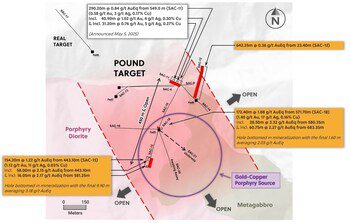
Figure 1: Plan View of the San Antonio Project Highlighting the Mineralized Corridor of the Pound Target and Significant Assay Results Announced Today and Previously (CNW Group/Collective Mining Ltd.)
Hole SAC-18: Drilled vertically 250 meters south of the discovery hole SAC-11, SAC-18 intersected multiple mineralized zones. The hole returned 172.40 meters at 1.88 g/t gold equivalent (AuEq), including a higher-grade section of 28.50 meters at 3.32 g/t AuEq and another section of 60.75 meters at 2.27 g/t AuEq. The hole was terminated prematurely due to rig limitations while still in strong mineralization, with the final 1.60 meters averaging 2.03 g/t AuEq. The company noted that this hole cut a late-stage porphyry-related sheeted vein system before entering the main gold-copper-silver-molybdenum porphyry system.
Hole SAC-15: Drilled to the south-southwest at a flatter angle from the same pad as SAC-18, this hole intersected a gold-rich zone of sheeted veinlets. Key results include 154.20 meters at 1.22 g/t AuEq, with higher-grade intervals of 58.00 meters at 2.15 g/t AuEq and 16.05 meters at 2.17 g/t AuEq. Similar to SAC-18, this hole was also stopped due to rig depth capacity, with the final 9.90 meters averaging 3.18 g/t AuEq.
Drill holes SAC-11, SAC-15, and SAC-18 have tested a north-to-south strike length of approximately 450 meters, with the system remaining open. To address the rig limitations that have prematurely ended several holes, the company has upgraded all rigs at the San Antonio Project. A higher-capacity rig is currently drilling hole SAC-21.

Figure 2: Cross-section along SAC-11, SAC-15, SAC-18, and SAC-21 showing the High MVI Anomaly Correlated with Au-Ag-Cu-Mo Porphyry Mineralization at the Pound Target (CNW Group/Collective Mining Ltd.)
Mineralization and Geological Context
Collective Mining’s geologists have identified three distinct, porphyry-related mineralized phases at the Pound target:
Phase 1: This phase is a large, 3-by-3-kilometer porphyry halo zone characterized by phyllic alteration. It hosts low-grade gold mineralization (0.2-0.5 g/t Au) and extends from the surface to a depth of at least 700 meters. This large zone covers the entire San Antonio project and includes multiple targets like Pound, COP, Euro, and their western extensions.
Phase 2: Described as a late-stage, gold and silver-rich sheeted veinlet system, this phase begins near the surface but shows more robust grades from 300 meters downhole. This mineralization is located in proximity to or in contact with the Phase 3 porphyry system.
Phase 3: This is the core gold-copper-silver-molybdenum porphyry system. It is characterized by potassic alteration and begins at approximately 400 meters below the surface. A notable feature of this phase is an unusually high gold-to-copper grade ratio, which can be as high as 4:1.
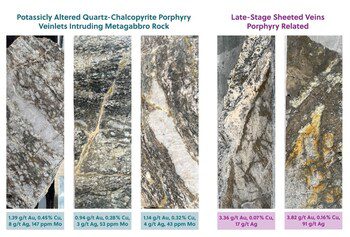
Figure 3: Drill Hole SAC-18 Split Core Highlighting the Gold-Copper-Silver-Molybdenum Porphyry Mineralization (Left) and the Late-Stage High-Grade Gold and Silver Sheeted Porphyry Veinlets (Right) Encountered from Drilling at the Pound Target (CNW Group/Collective Mining Ltd.)
Both Phase 2 and Phase 3 mineralized zones are found within the larger Phase 1 porphyry halo. The company is using Magnetic Vector Inversion (MVI) modeling of airborne geophysical data to help guide drilling. The current hole, SAC-21, is being directed toward a high MVI anomaly.
Project and Corporate Overview
Collective Mining’s drilling campaign for 2025 is fully funded with a target of 70,000 meters. The company is operating eleven drill rigs, with three dedicated to the San Antonio Project and eight at the Guayabales Project.
The San Antonio Project’s location, between 2 and 5 kilometers east-northeast of the Guayabales Project, offers the potential for shared infrastructure in the future. Executive Chairman Ari Sussman commented on the project’s scale and logistical advantages, noting its proximity to the Pan-American Highway and existing hydropower lines.
Collective Mining was founded by the team that developed and sold Continental Gold Inc. to Zijin Mining. The company’s Guayabales Project is anchored by the Apollo system, a large-scale, bulk-tonnage gold-silver-copper-tungsten system. The company’s current work at Apollo includes defining shallow mineralization and expanding high-grade zones. Collective is listed on both the NYSE and TSX under the ticker symbol “CNL”. The company’s ownership structure is heavily concentrated, with management, insiders, a strategic investor, and close associates holding a 44.5% stake.
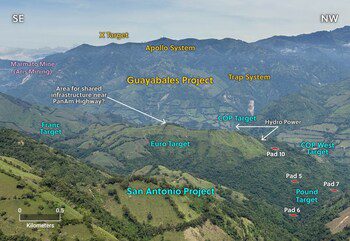
Figure 4: Image of the San Antonio Project and its Targets (foreground) and the Guayabales Project (background), highlighting the Potential for Shared Future Infrastructure. Note the Hydro Power and the Vastly Unpopulated Landscape (CNW Group/Collective Mining Ltd.)
David J. Reading, a qualified person under National Instrument 43-101 (“NI 43-101”), has reviewed and verified the technical information in this report. Sample analysis is conducted at SGS and Actlabs facilities in Colombia and Canada. The company utilizes a standard QA/QC program, and no capping has been applied to the reported grades. The gold equivalent (AuEq) calculations are based on specific metal prices and recovery rate assumptions.
Proposed modifications to Colombia’s electricity Reliability Charge (Cargo por Confiabilidad) have the potential to impact the operational cash flow of power generation companies (GenCos) and deter future investments, according to an analysis from Fitch Ratings. The report suggests these changes could heighten the risk of power shortages in the country.
The Colombian government is evaluating the elimination or reformation of the Reliability Charge, a mechanism that compensates power generators for the availability of their assets. This charge is a significant revenue source for GenCos, particularly those with a focus on thermal power. The proposed changes are aimed at reducing electricity costs for consumers.
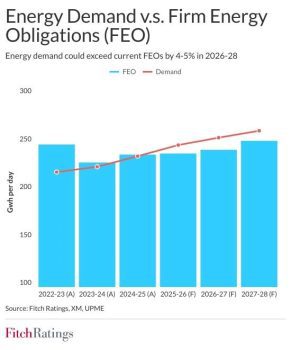
Energy Demand vs. Energy Obligations. Credit: Fitch Ratings.
Colombia’s energy matrix is highly dependent on hydroelectricity, which supplies between 60% and 70% of the nation’s power. The Reliability Charge was designed to encourage the expansion and diversification of the generation infrastructure by compensating GenCos for maintaining the capacity to fulfill Firm Energy Obligations (FEOs), which are assigned through auctions. The mechanism is intended to ensure a consistent energy supply, especially during periods of low rainfall, functioning similarly to capacity and power charges in other countries.
For Termocandelaria Power, which operates exclusively thermal generation assets, the Reliability Charge can constitute more than 20% of its total revenue and a larger portion of its operating cash flow. The company provides critical electricity capacity on Colombia’s Atlantic coast, which helps address demand peaks and energy volatility, mitigating shortfalls from hydroelectric plants and transmission constraints.
Other GenCos with more diversified portfolios and less reliance on thermal generation, such as Enel Colombia and Empresas Publicas de Medellin, receive an average of 10% to 15% of their total revenue from the charge. Isagen (BVC: ISG), which also has a diversified portfolio, is also in this group.
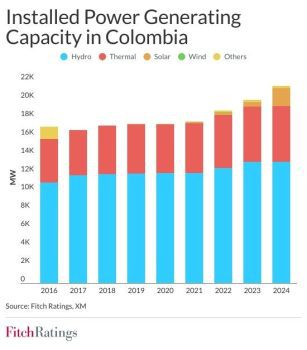
Installed Power Generating Capacity in Colombia. Credit Fitch Ratings.
The potential changes to the Reliability Charge come as the Colombian power sector faces increased stress. In recent years, electricity supply growth has not kept pace with demand, a trend attributed to environmental issues and conflicts with local communities. A drought in 2024 caused a spike in spot electricity prices, though FEOs were sufficient to cover the reduction in hydroelectric generation. However, a future drought could necessitate energy rationing.
Fitch estimates that from 2026 to 2028, energy demand could exceed current FEOs by 4% to 5%, following the last reconfiguration auction in May. Modifications to the Reliability Charge could exacerbate this shortfall by inhibiting GenCos’ capacity to fund capital expenditures.
Above photo: Turbine chamber at the Hidroituango hydroelectric dam. (Photo credit: EPM)
 Empleobilingue.com

- Director/a de operaciones para hotel, restaurante y discoteca 1626320364.60 - Medellín, Medellin, Antioquia, Colombia
- Coordinador/a de calidad para La Unión 1626483143.1 - La Unión, Antioquia, Colombia
- Desarrollador fullstack - Bogotá, Bogota, Colombia
- Technical Analyst - Remote
- PIM Administrator - Ecommerce - Remote (Bogotá, Bogota, Colombia)
- Auxiliar de gestión humana y bienestar para Girardota 1626060072.28 - Girardota, Antioquia, Colombia
- Marketing Strategist
- Trainer Manager - Bogotá, Bogota, Colombia
- Tolemaida UH- 60 Inspector - Bogotá, Bogota, Colombia
- Virtual Assistant - Team Lead - Remote
Contact Us

