

















On Friday, September 19, the Medellín civic security secretary announced that a 25-year-old armed thug was captured after robbing a North American tourist of diamond-studded gold chains and a Rolex watch valued at, according to the mayor’s office, over $120,000 USD. The assailant robbed the tourist using a blank-firing starter pistol.
The police were able to return the jewels to the victim, and the thug is in custody. Neither the victim nor the suspect has been named at the time of publication; however, the mayor’s office shared video and the accompanying photo with Finance Colombia.
Analysis
San Javier, also known as “Comuna 13” on the west side of Medellín, is a low-to-moderate income neighborhood known for its long history of gang and insurgent-related violence. Though the neighborhood is much safer than it was during the worst of Colombia’s violence, it is still controlled by street-level criminals who themselves are controlled by organized crime structures. Though considered safe for backpacker tourists on supervised and guided tours, it remains a low-income area where very few people earn an annual income of $10,000 USD. Walking around anywhere in Latin America, let alone an area where tens of thousands of people live in desperate circumstances, with over $100,000 USD worth of jewelry and watches, is just idiotic. It is difficult to sympathize with anyone possessing such profound stupidity. It is as if the “victim” (both of the thug and his own immense foolishness) donned a siren with a rotating beacon and a loudspeaker that said, “I am a clown! Rob me!
Having said this, there is no excuse for crime. Criminals rarely steal out of hunger, but out of avarice. Hopefully, this thief will be prosecuted and remain in custody, where he is unable to menace others.
Thug arrested in Medellín. Photo credit: City of Medellín.
A war of words has erupted between members of the European Parliament and the administration of Colombian President Gustavo Petro, following a parliamentary resolution expressing grave concern over rising political violence in the South American nation. As reported by the news outlet Infobae, European parliamentarians have accused the Colombian government of actions that indirectly favor criminal organizations, while President Petro has vehemently rejected the claims as baseless and misinformed.
The conflict centers on a resolution passed by the European Parliament on September 9, which highlighted an escalation in political violence in Colombia throughout 2025. The resolution condemned a series of violent acts, including the assassination of Senator and presidential pre-candidate Miguel Uribe Turbay, warning that such crimes are not isolated incidents but part of a wider pattern of intimidation that threatens democratic stability ahead of the 2026 elections.
Members of the European People’s Party (EPP), including Hermann Tertsch and Juan Ignacio Zoido, have voiced specific concerns. They allege that the Colombian executive branch is indirectly enabling groups such as the Clan del Golfo, FARC dissidents, and the Cartel de los Soles, a transnational criminal network allegedly operating out of Venezuela.
Speaking to Colombia’s W Radio, Tertsch asserted that these criminal organizations have expanded their operations during Petro’s tenure. “The international mafias could even be Gustavo Petro’s own interlocutors,” Tertsch stated, referencing alleged links between the government and criminal structures.
The parliamentarians cited recent high-profile attacks as evidence of the deteriorating security situation, including the murder of Senator Uribe Turbay, a car bomb attack in Cali, and the downing of a military helicopter in Antioquia that resulted in the deaths of 12 police officers. They argue these events are part of a coordinated strategy to destabilize Colombian institutions.
“The international mafias could even be Gustavo Petro’s own interlocutors,” Tertsch stated, referencing alleged links between the government and criminal structures.
Juan Ignacio Zoido, speaking to Blu Radio, clarified that the resolution is not a political judgment but a response to objective data. He reminded listeners of Petro’s campaign promise of “Total Peace,” contrasting it with the current security climate. “Armed violence is threatening the democratic stability of Colombia, by a man who had promised absolute peace but is achieving the highest rates of crime in the country,” Zoido declared. He added that the tone of speeches from the presidency contributes to social tension, indirectly facilitating the actions of criminal groups.
In response, President Gustavo Petro, during an official event in Timbío, Cauca, dismissed the European resolution as “senseless” (“una sinrazón”). He countered that the perpetrators behind Senator Uribe Turbay’s assassination were not domestic but rather an international mafia operating from Europe.
“It is not because of Petro’s speech that Senator Uribe Turbay was killed; he was killed by the mafia according to the evidence, and that mafia lives in Europe and not here in Colombia,” the president affirmed.
In a later, more extensive speech in Popayán, Petro directed a message to Europe, invoking historical grievances of colonialism and slavery and accusing the parliamentarians of hypocrisy. He asked the assembled crowd: “What does this town say to Europe? Is it the president who is denying democracy to Colombians, to Latin America, and to the world? What do the indigenous people of America say? Is President Petro anti-democratic?” He continued, “The anti-democrats are those who applaud those who drop bombs on babies… I ask the children and the youth of Europe, all of you, to rise.”
Despite the president’s rebuttal, the MEPs have stated their intention to continue monitoring the situation in Colombia closely, particularly as the 2026 election cycle approaches. Tertsch mentioned that parliamentary groups such as Patriots for Europe and the Spanish political party Vox, via its Foro Madrid initiative, will maintain rigorous oversight of the Colombian government.
Zoido rejected Petro’s characterization of the resolution’s supporters as far-right, insisting that a majority of the political parties that backed the measure are not. “What we want is for there to be a strong Colombia from a democratic point of view,” he said. “We have enough data to be concerned about the escalation of violence and insecurity in the country.”
The European Parliament’s resolution also calls for the protection of political candidates, human rights defenders, and members of the security forces, emphasizing that impunity for recent crimes only encourages further attacks.
European Parliament. Photo credit: Elekes Andor/Wikipedia.
Authorities in Medellín have arrested seven individuals allegedly involved in a criminal network that exploited children from the Embera Katío indigenous community for forced begging. The arrests are the culmination of a 10-month investigation into charges of human exploitation and criminal conspiracy.
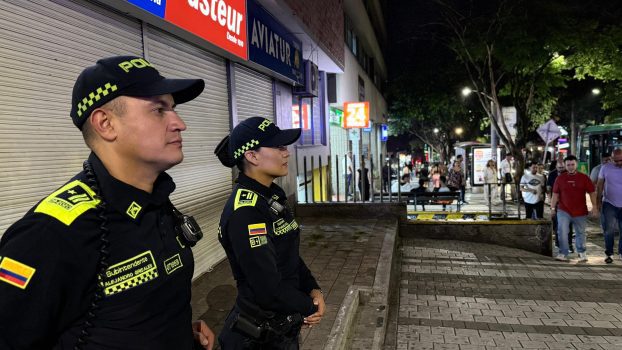
The Childhood and Adolescence Police documented over 900 cases of minors in recurring begging during the investigation. Photo credit: City of Medellín.
The operation, named ‘The Hidden Face of Charity,’ was carried out by Colombian authorities in the city’s Calle 10 area in Poblado and the neighborhoods of Carpinelo, Santa Cruz, and Boston. The detained individuals include both Colombian and Venezuelan nationals.
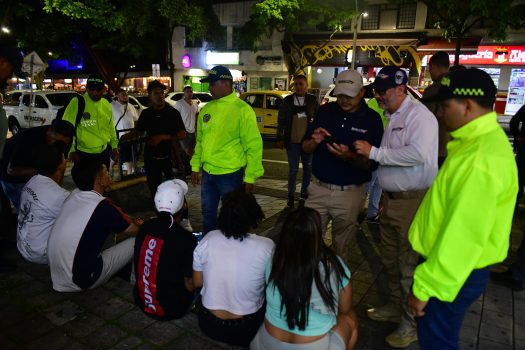
Authorities launched ‘The Hidden Face of Charity’ operation in Medellín’s Calle 10, Carpinelo, Santa Cruz, and Boston neighborhoods. Photo credit: City of Medellín.
According to a statement from Medellín’s Secretary of Security and Coexistence, the network allegedly used babies as young as one month old and children up to five years of age to solicit money and goods. The operation targeted high-traffic tourist areas, including Parque Lleras and Provenza in El Poblado, where members of the network would approach foreigners to ask for essential items such as milk, diapers, medicine, and food, in addition to cash.
“What they did was exploit girls and boys, even newborns, whom, in many cases, their own mothers handed over to women of Venezuelan nationality to be used in begging activities. They changed their clothes to simulate conditions of greater vulnerability and then approached them, especially tourists, generating pity to receive aid in diapers and milk, which were later sold in the city center,” said Mayor Federico “Fico” Gutiérrez. “None of those resources were actually intended for the children. It was all part of a network set up for economic gain, exploiting minors and deceiving those who, in good faith, believed they were helping.”
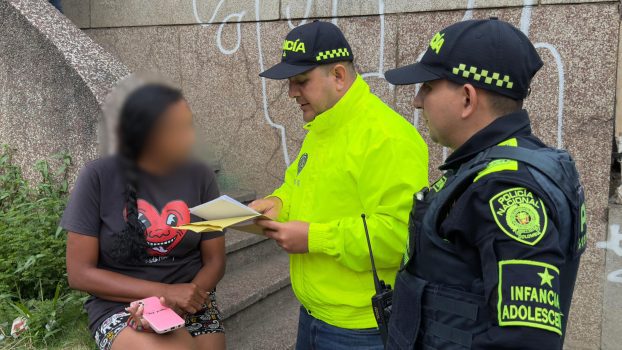
The operation targeted tourist spots in El Poblado where the network solicited milk, diapers, medicine, food, and cash from foreigners. Photo credit: City of Medellín.
The investigation, which was a joint effort involving the Fiscalía General de la Nación (Prosecutor General’s Office) and the National Police of Colombia, found that the donated and collected goods were later resold. The network’s activities generated an estimated $180 million Colombian COP (approximately $45,000 USD) per month in revenue from both cash and the resale of products.
The mayor explained that, according to the evidence gathered, it was found, for example, that foreigners bought a case of milk for $250,000 (about $60 USD) at a pharmacy, and the criminals resold it for a lower price elsewhere in the city. Indigenous people were given a commission for allowing their children to be used.
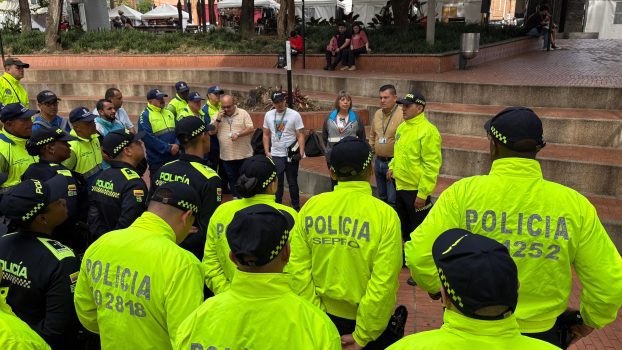
The investigation was a joint effort by Colombia’s Fiscalía General de la Nación and National Police. Photo credit: City of Medellín.
Investigators utilized undercover agents, telephone interceptions, and extensive surveillance to gather evidence against the suspects. During the investigation period, the city’s Childhood and Adolescence Police division documented over 900 cases involving the protection of minors found in recurrent begging situations, highlighting the scale of the problem.
Manuel Villa Mejía, the head of the Secretariat of Security and Coexistence for the Mayor’s Office of Medellín, affirmed the city’s commitment to protecting the rights of minors. He stated that the operation was a coordinated action with law enforcement to put an end to criminal practices that were affecting merchants, tourists, and the local community.
The seven captured individuals have been turned over to the Fiscalía General de la Nación to face judicial proceedings. Authorities have indicated that the investigation will continue in an effort to identify and apprehend other individuals connected to the exploitation ring and to ensure the restoration of rights for the affected children.
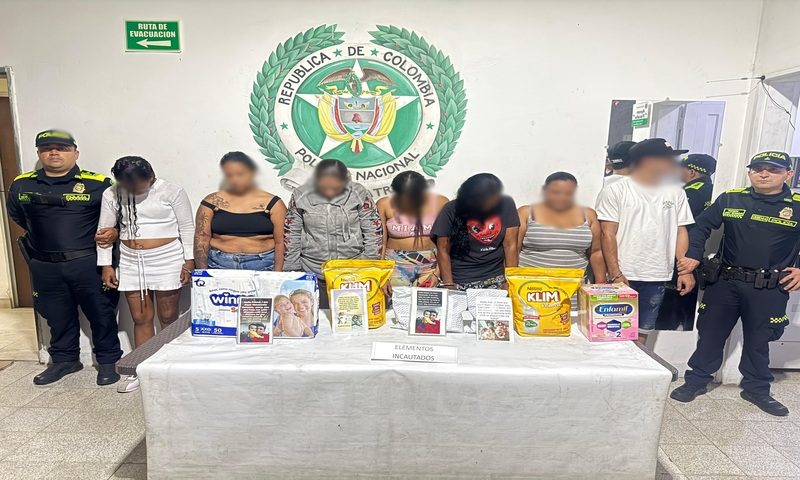
Seven arrested in Medellín for exploiting Embera Katío children in forced begging. Photo credit: City of Medellín.
The alleged killing of a guerrilla commander near the Colombia-Venezuela border suggests that a fragile criminal alliance that up until now had controlled criminal economies and strategic territory in the southern border region has fractured.
José Manuel Sierra Sabogal, alias “Zarco Aldinever,” second-in-command of the Second Marquetalia (Segunda Marquetalia), was allegedly killed in an August 5 ambush in the southern reaches of the Colombia-Venezuela border, according to a statement from the group. The Second Marquetalia is a dissident group of former fighters from the Revolutionary Armed Forces of Colombia (Fuerzas Armadas Revolucionarias de Colombia — FARC), also known as the ex-FARC Mafia.
The statement accused the National Liberation Army (Ejército de Liberación Nacional — ELN) of carrying out the attack using explosives and said it also claimed the lives of four other fighters. However, Colombian authorities have so far been unable to independently verify the claims.
*Sierra Sabogal’s death, which occurred during an ELN attack near the Colombia-Venezuela border, was confirmed on August 11 by Colombia’s Defense Minister, Pedro Sánchez.
The Second Marquetalia accused “Pedro Pablo” or “Copete,” commander of the José Daniel Pérez Carrero Front of the ELN’s Eastern War Front, of orchestrating the ambush. He allegedly invited high-ranking members of the Second Marquetalia to a meeting to lure them into the ambush.
“The ELN acted with malice and treachery. They carried out premeditated simultaneous attacks on other Second Marquetalia units located in the region,” the group said in the statement.
The killing is linked to a series of recent armed confrontations between the ELN and Second Marquetalia in the municipality of Maroa in Venezuela’s Amazonas state, which local sources began reporting to InSight Crime on August 3. The battles between both groups, according to those reports, took place along the border with the Colombian department of Guainia.
Colombian President Gustavo Petro confirmed the armed confrontation between the guerrilla groups. “The ELN has entered into war with the Second Marquetalia and their conflict extends into Venezuela, where they have already killed people,” the president said in a post on X.
SEE ALSO: Major Criminal Powers Dispute Key Corridors in Colombia
Before this fighting, both the ELN’s Eastern War Front and the dissident Acacio Medina Front, an ally of the Second Marquetalia, had maintained certain financial arrangements and territorial divisions along this part of the border. This allowed them each to manage the area and oversee illegal mining in Amazonas, as well as the drug trafficking routes that cut through this area.
Zarco Aldinever had been in the crosshairs of Colombian authorities. They accused him of being one of the main suspects behind the June shooting of Senator and presidential candidate Miguel Uribe Turbay in the capital city of Bogotá.
The breaking down of the guerrilla alliance in this strategic border region may lead to further military advances from the ELN and spark a new conflict with major implications for both Colombia and Venezuela.
After Hugo Chávez became Venezuela’s president in 1999, he welcomed many FARC commanders into the country who went on to establish operations in several border states. However, when President Nicolás Maduro rose to power in 2013, he established more favorable relations with the ELN. With the tacit support of his regime, the ELN began to expand its operations across the border, eventually displacing some of the dissident FARC factions still there.
The latest flare-up between the ELN and ex-FARC Mafia comes about eight months after the start of another conflict between the guerrilla groups. In January 2025, the ELN launched a violent assault on the ex-FARC’s 33rd Front in the contested Catatumbo region, which is one of the world’s top cocaine-producing areas.
SEE ALSO: Colombia’s Peace Efforts Spark Criminal Disputes and Divisions
With the ELN also controlling key territory on the Venezuelan side in the state of Zulia, this cemented the guerrilla group as the top armed actor on the northern part of the border, granting them access to drug trafficking routes leading to dispatch points in Venezuela.
The ELN’s latest confrontation with the Second Marquetalia in the south suggests this may be the next key battleground for control of the border.
Unlike prior fighting, this conflict may develop more on the Venezuelan side. That is largely because the ex-FARC Mafia’s Acacio Medina Front has more military capacity on that side and can rely on more than a decade of experience operating there. Illegal mining in Amazonas and the drug trafficking corridors near Brazil represent hugely important financial resources for both groups, making it unlikely that either will cede control without a fight.
There is also the risk that the confrontation could expand further north into Venezuela’s Apure state, which borders the Colombian departments of Arauca and Vichada. The Second Marquetalia maintains a strong presence there, particularly in the town of Elorza in the municipality of Rómulo Gallegos. This has long been the preferred place for ex-FARC commanders to operate, and they have taken over ranches and set up camps in the region.
The alleged killing of Zarco Aldinever would add him to a growing list of FARC dissidents killed in Venezuela. Other infamous commanders killed there include Miguel Botache Santanilla, alias “Gentil Duarte,” Seuxis Pausías Hernández Solarte, alias “Jesús Santrich,” Hernán Darío Velásquez Saldarriaga, alias “El Paisa,” and Henry Castellanos Garzón, alias “Romaña.” The Second Marquetalia’s top leader, Luciano Marín Arango, alias “Iván Márquez,” was also gravely injured in Venezuela.
This article, written by the Venezuela Investigative Unit, was originally published by InSight Crime, a Medellín-based foundation dedicated to the investigation and analysis of crime and security in Colombia and Latin America. It has been generously shared with Finance Colombia under a Creative Commons license.
In a joint operation conducted by Colombian authorities and the United States’ Homeland Security Investigations (HSI), a US citizen, Stephen Paul Mueller, was apprehended in Medellín on charges of commercial sexual exploitation of a minor under 18. This case, and a separate apprehension of a US fugitive, highlight the ongoing efforts of Colombian and international law enforcement to counter transnational crime.
According to a statement from the Policía Nacional de Colombia and Homeland Security Investigations, Mueller was detained upon his arrival in Medellín. He is alleged to have used social media to contact victims, offering them “gifts in exchange for sexual encounters in rented apartments.” A joint investigation revealed evidence of two instances of sexual exploitation involving minors over the last two years. Authorities also identified 33 prior entries into Colombia by Mueller.
¡𝗩𝗔𝗡 𝟭.𝟵𝟵𝟳 𝗣𝗘𝗗𝗢́𝗙𝗜𝗟𝗢𝗦 𝗖𝗔𝗣𝗧𝗨𝗥𝗔𝗗𝗢𝗦! En Medellín, en desarrollo de la ofensiva contra el multicrimen y el delito, la @PoliciaColombia, en coordinación con la @HSI_HQ de Estados Unidos, capturó al ciudadano estadounidense Sthepen Paul Mueller, por el delito… pic.twitter.com/reY9i2ERA8
— Mayor general Carlos Fernando Triana Beltrán (@DirectorPolicia) September 13, 2025
Major General Carlos Fernando Triana Beltrán, director of the Policía Nacional, stated, “Mueller was captured when traveling to the Antioquia capital, where he would contact victims through social networks, offering them gifts in exchange for sexual encounters in rented apartments.” The investigation was a collaborative effort between the Policía Nacional, HSI-Arizona, Migración Colombia, the SIJIN (Dirección de Investigación Criminal e INTERPOL), and the DIPRO (Dirección de Protección y Servicios Especiales).
Medellín’s mayor, Federico Gutiérrez, affirmed the city’s commitment to combating exploitation. “In the operation, technological material with key information for new actions against ESCNNA was seized. We will continue relentlessly in the defense of our boys and girls, with the support of national and international agencies,” he said. During the operation, a laptop, two USB drives, and a cell phone were confiscated.
In a separate but related development, a US fugitive named ‘M. Peck sought a “million-dollar robbery” in Las Vegas, and other outstanding charges in Miami were located in Medellín. The fugitive was identified through intelligence and surveillance operations.
The apprehension was the result of a coordinated effort involving Migración Colombia, the SIJIN of the Policía, and the US Marshals Service. The individual was located at a hotel in the El Poblado neighborhood. After being expelled from Colombia by Migración Colombia, the fugitive was taken into custody in Miami by the US Marshals.
🗞️#EsNoticia | @MigracionCol expulsó del país a un estadounidense requerido en su país por el delito de hurto. El individuo fue ubicado en un hotel del Poblado, en Medellín, gracias a un operativo conjunto con el CTI, la @PoliciaColombia y la agencia estadounidense US Marshals. pic.twitter.com/lYGgHqi42F
— Migración Colombia (@MigracionCol) September 11, 2025
This marks another instance of international cooperation, following a similar case on August 19, in which another fugitive wanted for homicide was expelled. The director of Migración Colombia expressed via X that the “individual was located…thanks to a joint operation with the CTI (Cuerpo Técnico de Investigación), the Policía Colombia, and the US agency US Marshals.”
Stephen Paul Mueller. Photo credit: Policía Nacional de Colombia.
In the end, the Donald Trump administration chose to put Colombia in school detention, or decertified it as an ally in the war on drugs. Whilst there was much hand-wringing before the decision, in the end, the consequences are likely to be minimal as Trump declared there would be no trade or security measures taken. The reason for that is simple: it’s an arbitrary political decision based on ideological differences – anyone doubting that, check out the Venezuelan situation.
The US may offer some minimal help with the Colombian war on drugs. Still, it is local soldiers and law enforcement officers, as well as civilians and human rights workers, who are killed daily, gunned down, or bombed by a plethora of armed gangs.
Gustavo Petro is right to state that cocaine is a demand-driven business and that the US, Europe, and other major narcotics markets are doing next to nothing. Sadly, the practicalities of legalizing cocaine are impossible, desirable as it is. Could Petro do more? Probably, but whilst cocaine planting and harvests have risen, it is seizures that have risen most.
Away from drugs….”It’s the economy, stupid.”
ISE (economic activity) for July rose 4.3% according to Departamento Administrativo Nacional de Estadística – DANE Colombia, well ahead of expectations and the highest reading of 2025. YTD, we stand at 2.7% – the comparative in 2024 was 1.44%. The main drivers were once again commerce (+6.69%) & the public sector (+7.04%). Surprisingly, agriculture (1.64%) is struggling.
The real sector data for the same month was again even stronger than analysts expected. Retail sales rose 17.9% with vehicles (+57% across various sectors), telephones/electronics (+56%) & other durable goods driving the gains.
Manufacturing production (5.8%) also rose more than expected, with 32/39 sectors gaining. This data point had been a drag until recently – now, not so much, which is very positive.
Surprisingly, this week, the politicians were (very) suspiciously quiet and there was little to no mention of the 2026 budget or tax reform – that won’t last.
That is about it for my last day in my 50s.
Take care.
Roops.
Never miss Rupert’s latest commentary.
Follow him now on LinkedIn to see What Jumps Out.
Cocaine bricks seized by the US Drug Enforcement Agency (DEA): Photo credit: DEA.
Colombian President Gustavo Petro returned recently from a much-criticized trade visit to Osaka Japan, where Colombia invested a reported $11 million USD to built and operate a pavilion during the Future Fair. While the event’s value and the investment prudency may be debatable, the President made some outrageous claims last week, defending the project. Via Twitter/X he stated:
“I’ve entered the Colombia pavilion at the Future Fair of Osaka, Japan. They criticized its cost, but you know what?
1.3 trillion (1,300,000 millones) people entered the stand, we sold 700 different classes of Colombian products, all in one: We sold 11 million dollars of avocados, in the negotiation round, in two days, we sold $35 million dollars.
The most famous dish of the whole fair turned out to be lechona [Colombian Lechona, distinct from the Lechón of the Greater Antilles, is a small Colombian pig cooked stuffed with rice and spices] 10 million tons of lechona was sold at the fair, with the longest lines. It is a better dish than the sandwich or hamburger, or the hot dog, for the modern times with the hurry of the big city.
I wanted to massively sell Wayúu tunics and the gentlemen from ANATO and FONTUR opposed it, but for acts of campaigns Uribista [in support of Alvaro Uribe] with public money, yes it works.”
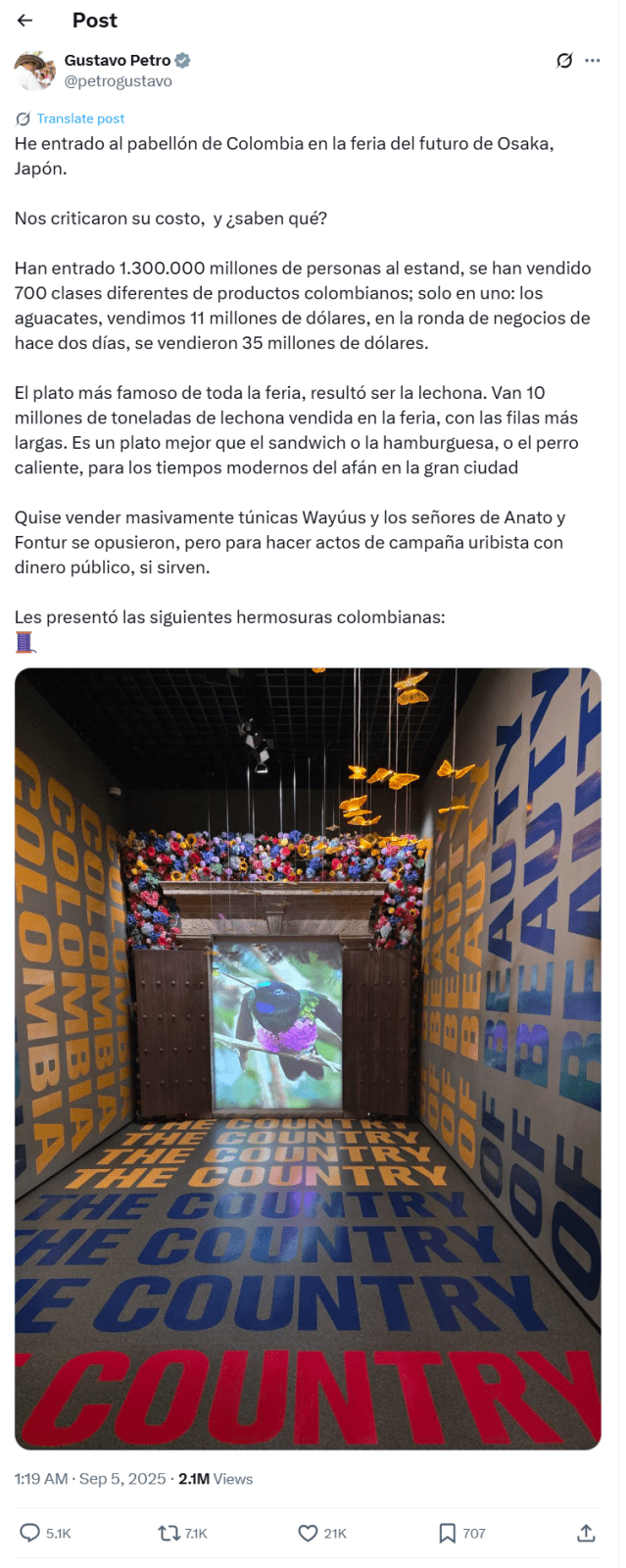 According to Gustavo Petro, more people than have existed in the history of planet Earth visited the Colombian exhibit in Osaka, Japan. There are approximately 120 million people in Japan, 8.2 billion people on planet Earth, but “1,300,000 millones” would be 1,300,000,000,000 or 1.3 trillion people (under US numeric conventions) Perhaps this is a typo, but even if he meant 1.3 million visitors to the Colombian pavilion, it would be a stretch. Last month, the entire event celebrated reaching a milestone of one million visitors.
Lechona (above photo), while delicious, is not popular enough, nor would there be enough food supply in the entire country of Japan to serve 10 million tons, which translates into roughly 22 billion pounds, or 10 billion kilograms. Even if the president made a typo and meant 10 million kilograms, at 125 grams per serving, that would mean 80 million plates of lechona were served, or 80 servings for each of the event’s confirmed one million visitors—not visitors to the Colombian pavilion, but visitors to the entire event.
Finally, while as a public agency indirectly under Petro’s control, FONTUR does have access to public funds, ANATO is the travel and tourism industry association, an organization made up of its members. So Petro’s complaint that they want to sell Wayúu products to benefit supporters of convicted former President Alvaro Uribe is perplexing, at best, and nonsensical at any rate.
Petro’s management of fiscal matters shows that mathematics is not necessarily his strongest talent, however these egregious statements go beyond errors or typos into the realm of absurdity.
He entrado al pabellón de Colombia en la feria del futuro de Osaka, Japón.
Nos criticaron su costo, y ¿saben qué?
Han entrado 1.300.000 millones de personas al estand, se han vendido 700 clases diferentes de productos colombianos; solo en uno: los aguacates, vendimos 11… pic.twitter.com/A8gJLMKyUu
— Gustavo Petro (@petrogustavo) September 5, 2025
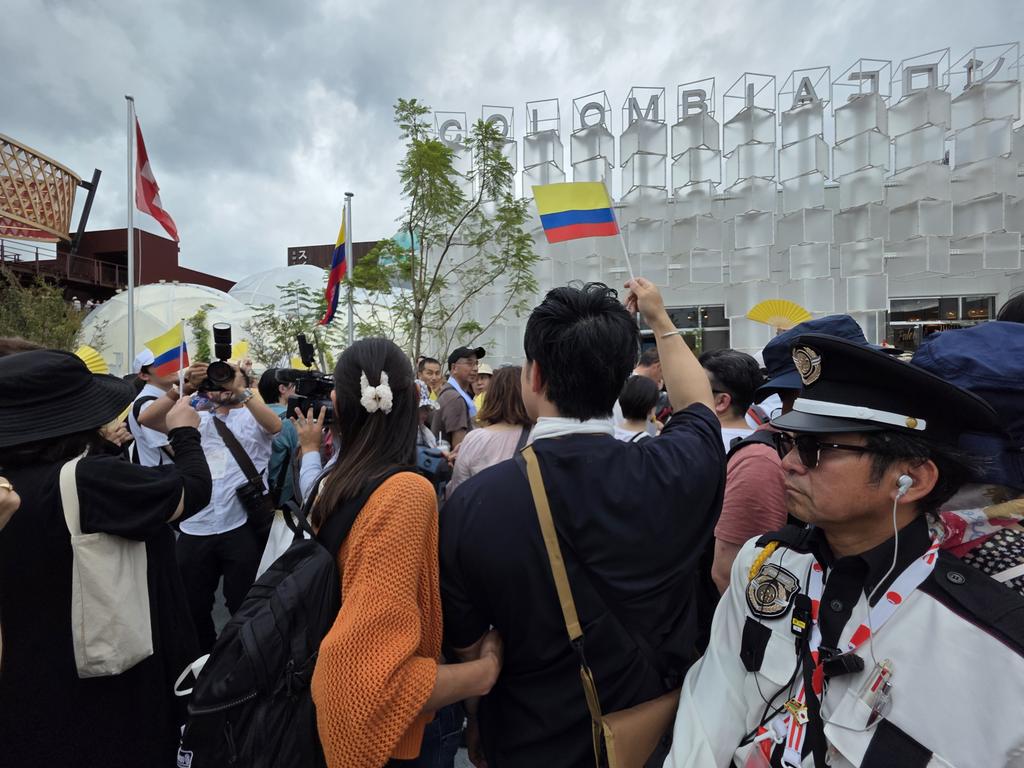
Visitors to the Colombia pavilion in Osaka, Japan (photo: MinCIT)
Headline image: Lechona (photo © Loren Moss)
An attack using explosives destroyed a high-voltage electrical tower belonging to Empresas Públicas de Medellín (EPM) in the La Asomadera sector of the city on the evening of Wednesday, September 10. Officials have labeled the incident a “terrorist act” and attributed it to the 36th Front of the FARC dissidents, allegedly in retaliation for a recent police operation.
Despite the tower’s collapse, EPM reported that there were no resulting power service interruptions in the city.
In the immediate aftermath, Medellín Mayor Federico “Fico” Gutiérrez stated that police were initially called to the area to investigate the presence of a flag alluding to the FARC’s 36th Front. After detonations were heard, the damage to the EPM tower was confirmed.
The mayor announced that the attack was believed to be a direct response to a successful operation by the National Police of Colombia in the municipality of Campamento, Antioquia, which resulted in the deaths of four members of the dissident group.
“This terrorist act is in response to the blow and takedown that the National Police dealt to this structure today in Campamento,” Gutiérrez stated. “We are going to continue putting a price on all terrorists. They will fall because they will fall. We are offering up to $200 million COP for information on the material and intellectual authors of the attack against the power tower.”
🚨🚨🚨A todos los terroristas les vamos a seguir poniendo precio. Caen porque caen. Ofrecemos hasta $200 millones de pesos para quien nos dé información de los responsables materiales e intelectuales de la afectación contra la torre de energía el día de hoy.
Colombia 🇨🇴 debe… pic.twitter.com/vR8MjDpDni— Fico Gutiérrez (@FicoGutierrez) September 11, 2025
The governor of Antioquia, Andrés Julián Rendón, echoed the mayor’s assessment and announced an extraordinary security council meeting. “This is the front of ‘Calarcá,’ the same criminal with whom Petro insists on negotiating ‘total peace,” Governor Rendón remarked, referencing the national government’s ongoing peace negotiation policies.
EPM technical teams were dispatched to the scene immediately, but were unable to begin repairs. The area first had to be secured by anti-explosives units from the National Army of Colombia and the National Police to ensure no other explosive devices remained.
Security Response and Investigation Developments
Two days after the attack, on Friday, September 12, authorities announced a significant reinforcement of security in Medellín with the arrival of 480 new members of the Public Forces. The contingent, presented at the Bomboná Battalion, includes 350 soldiers from units such as the PM4, Special Forces, and the Rapid Deployment Force, along with 130 specialized police officers from the Search Block, GOES (Special Operations Groups), Gaula (Anti-Extortion and Kidnapping Group), and intelligence and investigation units (Sipol, Sijín, Dijín).
Addressing the newly arrived forces, Mayor Gutiérrez defined their objective clearly. “The best way to protect ourselves and our citizens is by neutralizing the terrorist threat. That is the mission that has been entrusted to you as soldiers and police of the homeland,” he said, adding that the task is to completely dismantle the 36th Front of the FARC dissidents. “Medellín cannot be a den for criminals; we are going to continue fighting.”
The operational plan includes:
- 24-hour checkpoints on main roads and access points.
- Joint Army-Police patrols at major intersections.
- Combined patrols by GOES and Special Forces in peripheral areas.
- Raids to search for explosives and criminal group members.
Enhanced surveillance of strategic infrastructure using cameras and drones, supplemented by nocturnal air patrols with police and Colombian Air Force helicopters.
Authorities also updated the reward system, offering up to $50 million COP for information that prevents terrorist acts and up to $100 million COP for intelligence leading to the capture of the dissident leader in the department, known as alias ‘Primo Gay’.
Mayor Gutiérrez also reported a breakthrough in the investigation, announcing the capture of alias ‘el Sastre’ or ‘el Pío’ during a raid in the Manrique neighborhood. The individual is believed to be a logistics manager for the 36th Front. During the operation, authorities seized 19 flags identical to the one left at the tower site and communication equipment.
“These radios were not for communication,” Gutiérrez pointed out, “but to activate explosive charges.”
An attack using explosives destroyed a high-voltage electrical tower belonging to EPM. Photo credit: Es tendencia en Colombia/X.
Yesterday evening, September 15th, US President Donald Trump issued a determination to Congress, designating Colombia a “major drug transit or major illicit drug producing country” along with Afghanistan, The Bahamas, Belize, Bolivia, Burma, China, Costa Rica, the Dominican Republic, Ecuador, El Salvador, Guatemala, Haiti, Honduras, India, Jamaica, Laos, Mexico, Nicaragua, Pakistan, Panama, Peru, and Venezuela.
In a written statement, Trump said:
“In Colombia, coca cultivation and cocaine production have surged to all-time records under President Gustavo Petro, and his failed attempts to seek accommodations with narco-terrorist groups only exacerbated the crisis. Under President Petro’s leadership, coca cultivation and cocaine production have reached record highs while Colombia’s government failed to meet even its own vastly reduced coca eradication goals, undermining years of mutually beneficial cooperation between our two countries against narco-terrorists. For this reason, I have designated Colombia as having failed demonstrably to meet its drug control obligations. Colombia’s security institutions and municipal authorities continue to show skill and courage in confronting terrorist and criminal groups, and the United States values the service and sacrifice of their dedicated public servants across all levels of government. The failure of Colombia to meet its drug control obligations over the past year rests solely with its political leadership. I will consider changing this designation if Colombia’s government takes more aggressive action to eradicate coca and reduce cocaine production and trafficking, as well as hold those producing, trafficking, and benefiting from the production of cocaine responsible, including through improved cooperation with the United States to bring the leaders of Colombian criminal organizations to justice.”
The US State Department on social media directly blamed Gustavo Petro for the failures, but also noted that the US government issued a 1-year waiver, meaning bilateral cooperation, and almost half a billion USD in security and antinarcotics aid to Colombia will not end immediately. One year from now, Colombia will have a new president, as Petro’s term comes to an end August 7th, 2026.
The decertification puts half a billion dollars of US security aid to Colombia at risk. Mafia & insurgent groups have flourished during the government of Gustavo Petro.
“Under Petro’s misguided leadership, coca cultivation & cocaine production in Colombia has increased to historic levels…President Trump “has determined that the Colombian government failed to uphold its drug control obligations, but he has issued a waiver so critical US cooperation, including on counter-narcotics, can continue. Results matter – we must see progress and it must be soon!” the State Department tweeted.
Colombian President Gustavo Petro ran on a presidential campaign promising “total peace” and pledging programs that would replace coca production with other food crops, increasing Colombia’s agricultural exports. What has happened, however, is the reverse. Narco-insurgent groups such as FARC dissident mafias, communist rebels ELN, and the Clan del Golfo (Gulf Clan) mafia are all resurgent and taking over territory from government control. Over the weekend, narco-insurgents bombed an electrical tower in Medellin, and this just a few weeks after a massive truck bomb killed over 19 in Cali, Colombia’s third largest city. Under the Petro administration, cocaine production has surpassed levels seen during the days of the cartels and Pablo Escobar.
Petro, a former member of the M-19 guerilla group himself, has made statements defending cocaine, calling it “no worse than whisky,” and in April, his own former foreign minister Alvaro Leyva publicly accused him of being a drug addict.
“It was in Paris where I was able to confirm that you had a problem with drug addiction. But what could I do? Surely, I was not up to the task. I should have reached out, helped, intervened. I carry the regret of not having tried to lend a hand. The truth is, you never recovered. That is the reality,” said Leyva.
A defiant Gustavo Petro refused to accept any responsibility and said that the Trump administration’s decision demonstrates that US policy has failed.
Petro’s own Interior Minister, Armando Benedetti, is an admitted recovering drug addict.
Last night, a defiant Petro blamed the US and defended his administration’s efforts, saying that the move would end Colombia’s dependence on the United States, and cited the government’s recent cocaine seizures, without mentioning the skyrocketing production during his Council of Ministers meeting.
“You begin with a factual lie. Coca crop growth has occurred during (Iván) Duque’s administration, and with forced fumigation. It is U.S. policy that has failed. To reduce coca leaf cultivation, what is needed is not glyphosate dropped from airplanes, but a decrease in demand for cocaine, primarily from the U.S. and Europe,” said Petro in response to the US State Department statement.
Former Colombian President Ernesto Samper, whose administration also experienced decertification, and whose 1994 campaign was partially financed by the Cali Cartel drug lords, assured that decertification was “not the end of the world.” The former president added that “we must once again demand that consumer countries like the United States and many in Europe fulfill their commitment to reducing drug demand, precisely at a time when consumption of plant-based drugs has declined and the devastating effects of synthetic drugs like fentanyl and other narcotics we don’t produce are being felt.”
Samper stated that the decision to decertify Colombia in its fight against drugs “is illegal, political, and regressive.” He explained that it is “illegal because no country is authorized to impose unilateral sanctions on another country or its nationals. Only the United Nations can do so under established circumstances and in justified cases of necessity,” and it is political “because it has always been used to punish countries considered “enemies” of the United States. The worst right-wing dictatorships have benefited from the non-application of decertification, while our country, which has paid high human and institutional costs, is decertified every time the Colombian government appears as an “enemy” of the United States government.”
Paisa politicians blame Petro
Not all Colombian politicians are defending Petro. Medellín’s mayor Federico “Fico” Gutierrez, who returned from the US on his own diplomatic missive to meet with US officials in direct defiance of Petro’s orders not to go, issued a statement damning the Colombian President:
“Colombia is being decertified by the United States in the fight against drugs. It was to be expected. Petro sided with the worst criminals. They are the only ones who have won under this disastrous government. During our visit to Washington last week, our position was to ask that Colombia not be decertified. And if it were to happen, we asked that support for our public forces in the fight against drug trafficking not be withheld, nor that the trade on which millions of jobs depend in Medellín and throughout Colombia be affected. Indeed, our agenda in Washington was successful in defending Colombia. Although Colombia is decertified, it leaves the door open for support for our public forces and expressly highlights the recognition that the United States gives to our public forces and mayors: *“Colombia’s security institutions and municipal authorities continue to demonstrate skill and courage in confronting terrorist and criminal groups, and the United States values the service and sacrifice of its dedicated public servants at all levels of government.”* (see photo) In the midst of all this, we would have solutions as a country. But seeing Petro’s absurd statements, his intention is for Colombia to lose this opportunity and for us to be plunged into chaos. It is very evident that this is what he wants and has sought all along: to be left alone and remain in power. All the more reason we remain steadfast in the defense of Colombia and our people. We pull Colombia forward from the regions.” (below video)
Colombia es descertificada por Estados Unidos en la lucha contra las drogas. Era de esperarse. Petro se puso fue del lado de los peores criminales. Son los únicos que han ganado con este nefasto gobierno.
En nuestra visita a Washington de la semana pasada, nuestra posición fue… pic.twitter.com/2qEIBTpTGU— Fico Gutiérrez (@FicoGutierrez) September 16, 2025
The Governor of Antioquia, Andrés Julián Rendón, also had a scathing rebuke for his own president. Antioquia is the Colombian department where Medellín is capital and is home to much of Colombia’s economic activity. Rendón tweeted:
“Regarding the decertification of Colombia, the Government of @petrogustavo – It’s a snapshot of the failure of “total peace,” of temporizing with criminals, of dealing with them in a friendly way while they destroy the country and Colombians. – Now, the Petro government should stop playing the victim coming up with resentful, outdated, anti-US rhetoric. The President is reaping his own harvest of incompetence and failure: he sided with the criminals. The world and the US are paying him back. – Antioquia is the first victim: flooded in a sea of cocaine by a weak government that ties up soldiers and police to prevent action. The criminals win, and we Antioqueños lose. Drugs, drugs, and more drugs to poison our youth and to enrich and strengthen the criminals. – Aerial spraying was the most successful tool in the past: effective in eradication, it protected our soldiers and police. It must be reactivated. Tomorrow will be too late! It’s been proven: more cocaine seizures are not proof of greater effectiveness in the fight against drug trafficking; rather, they are the ultimate proof of a historic peak in production. We’ve gone back more than 20 years, but fortunately, this government has only months left. In Antioquia, despite intimidation and judicial persecution, we will continue working to defend the interests of my fellow citizens, adhering to the Constitution and appealing to the courage of soldiers and police. In our government, we understand peace as the rule of law, security, justice, and social opportunity. We will remain there, even if our lives and freedom are at risk.
Sobre la decertificación a Colombia, al Gobierno de @petrogustavo:
– Es una radiografía del fracaso de la paz total, de contemporizar con criminales, de tratarlos por las buenas mientras acaban con el país y los colombianos.
– Ahora que el Gobierno Petro no se haga la víctima… pic.twitter.com/OygRV29NER
— Andrés Julián (@AndresJRendonC) September 16, 2025
Business calls for cooler heads to prevail
Amcham Colombia, the binational Colombian-American chamber of commerce based in Bogotá and made up of both Colombian and US businesses involved in bilateral trade, issued a statement lamenting the decision, while also calling for the Colombian President to do more to save the relationship.
“AmCham Colombia firmly and respectfully calls on the National Government to urgently present and implement a roadmap with achievable and verifiable goals that demonstrate political will and substantial improvements in crop eradication, production and trafficking reduction, judicial cooperation, and the financial dismantling of criminal organizations. Only then can the country request reconsideration of the designation in the next cycle and maintain assistance within the national interest of the United States.
Respectfully, AmCham Colombia invites the United States Government to recognize the progress in interdiction and seizures and to consider announcing the resumption of spraying when appropriate and under the safeguards of the Constitutional Court, complemented by alternative development and a comprehensive state presence. These signals should contribute to avoiding measures that affect trade, tourism, and investment between the two countries.”
🇺🇲🇨🇴 #Descertificación con interés nacional@AmChamCol hace un llamado firme y respetuoso al Gobierno Nacional para presentar y ejecutar con urgencia una hoja de ruta con metas alcanzables y verificables que evidencie voluntad política y una mejora sustancial en: erradicación… pic.twitter.com/qDer8SKYFl
— Maria Claudia Lacouture (@mclacouture) September 16, 2025
Above image: Gustavo Petro during his council of ministers meeting where he defended his administration and blamed Trump for his country’s decertification. Photo credit: Ovidio González – Presidencyof The Republic
The sentencing of a minor for the fatal shooting of Colombian senator and presidential hopeful Miguel Uribe Turbay has underscored the government’s focus on a group of guerrillas as the alleged masterminds, but evidence remains thin.
The 15-year-old who shot Uribe on June 7 in Bogotá has been sentenced to seven years in a juvenile detention center for attempted homicide, the Attorney General’s Office reported on August 27.
The teenager pleaded guilty before Uribe died of his injuries on August 11, which prevented prosecutors from upgrading the charge to homicide, since Colombian law prohibits changes to charges once a formal accusation is filed against a minor. Five adults have also been arrested in connection with the case.
Authorities have suggested that the Second Marquetalia, a dissident faction of the demobilized Revolutionary Armed Forces of Colombia (Fuerzas Armadas Revolucionarias de Colombia – FARC), could have had a hand in Uribe’s killing, but have yet to present concrete evidence. National Police Director Carlos Fernando Triana first suggested a connection to the group in July, and Defense Minister Pedro Sánchez Suárez repeated the claim in August after Uribe’s death.
SEE ALSO: Colombia-Venezuela Border Killing Hints at Growing Guerrilla Conflict
The link to the group is vague, and via one of the five people arrested in connection with Uribe’s murder.
That’s Elder José Arteaga Hernández, alias “El Costeño,” who allegedly began working as a hired assassin after meeting a former FARC fighter known as “Daniel” in prison in 2019, according to police sources cited by Colombian newspaper El Espectador.
Daniel, once a member of the Teófilo Forero Mobile Column, an elite FARC unit behind some of the group’s most notorious attacks, has reportedly been helping rebuild the column within the Second Marquetalia in southern Huila and northern Caquetá, according to Colombian newspaper El Colombiano. Therefore, he would serve as a potential bridge between the Second Marquetalia and the Uribe assassination.
Two other suspects currently in custody also appear tied to Caquetá, where the Teófilo Forero Column is allegedly reorganizing. Katerine Andrea Martínez Martínez, alias “Gabriela,” who supplied the minor with the weapon to shoot Uribe, was arrested in Florencia in June, while Carlos Eduardo Mora González has faced an arms trafficking case before a Florencia court since 2024.
Nearly three months after the shooting of Turbay, investigators have yet to clarify who ordered the crime. The arrests point to a network of low- and mid-level operatives with ties to FARC dissident circles, but no clear political motive has emerged.
However, the available evidence suggests the focus on the Second Marquetalia may be misplaced. Once a feared rebel faction, the group is now among Colombia’s weakest armed organizations, having had its leadership decimated over the past five years.
Luciano Marín Arango, alias “Iván Márquez,” the group’s leader, was seriously injured in a 2022 attack, prompting repeated reports of his death. He resurfaced in 2024 through a video and later a public appearance, confirming he was alive, though widely believed to be in poor health.
Other senior figures have also been eliminated. Seuxis Pausías Hernández Solarte, alias “Jesús Santrich,” who co-founded the Second Marquetalia with Márquez after rejecting the 2016 peace deal, was killed in 2021. That same year, commanders Hernán Darío Velásquez, alias “El Paisa,” and Henry Castellanos Garzón, alias “Romaña,” were killed in Venezuela’s Apure state. Most recently, in August 2025, José Manuel Sierra Sabogal, alias “Zarco Aldinever,” one of Márquez’s key lieutenants, was also killed in Venezuela.
SEE ALSO: Who Was Behind the Attempted Hit on a Colombian Presidential Hopeful?
As well as these losses, the Second Marquetalia suffered a major rift in November 2024. The Border Command (Comandos de la Frontera – CDF) and the Pacific Guerrilla Coordinating Committee (Coordinadora Guerrillera del Pacífico – CGP), two of its most influential factions operating in Nariño and Putumayo, announced they were breaking away after disagreements over the group’s stance in peace talks with the government.
Given the group’s fragile internal state and mounting competition from rival criminal actors, authorities have yet to present evidence of any clear motive for the Second Marquetalia to order such an assassination.
Nonetheless, the lack of clarity about the attack underscores the risks heading into Colombia’s elections next year. Uribe’s assassination sets a precedent that could embolden other armed groups to use targeted political violence as leverage. With organized crime interests tied to the continuation of peace talks and possible judicial benefits stemming from negotiations, the next electoral cycle may see criminal actors intervening more directly in politics through violence.
This article, written by , was originally published by InSight Crime, a Medellín-based foundation dedicated to the investigation and analysis of crime and security in Colombia and Latin America. It has been generously shared with Finance Colombia under a Creative Commons license.
 Empleobilingue.com

- Director/a de operaciones para hotel, restaurante y discoteca 1626320364.60 - Medellín, Medellin, Antioquia, Colombia
- Coordinador/a de calidad para La Unión 1626483143.1 - La Unión, Antioquia, Colombia
- Desarrollador fullstack - Bogotá, Bogota, Colombia
- Technical Analyst - Remote
- PIM Administrator - Ecommerce - Remote (Bogotá, Bogota, Colombia)
- Auxiliar de gestión humana y bienestar para Girardota 1626060072.28 - Girardota, Antioquia, Colombia
- Marketing Strategist
- Trainer Manager - Bogotá, Bogota, Colombia
- Tolemaida UH- 60 Inspector - Bogotá, Bogota, Colombia
- Virtual Assistant - Team Lead - Remote
Contact Us

