















Innovative service models strengthen Bogotá’s tourism infrastructure.
Colombia’s economic landscape is undergoing a profound transformation, driven not only by institutional shifts but by the indomitable spirit of its local entrepreneurs. The story of Julio Jiménez, founder of American Visa Hotel, serves as a powerful testament to the social mobility and resilience defining the country’s modern business narrative. From selling empanadas as a child to managing a diverse portfolio of hospitality and logistics assets, Jiménez embodies the grit that is reshaping the nation’s service sector.
Click above to watch the video!
In this exclusive interview, Loren Moss of Finance Colombia sits down with Jiménez at his newest property, Destino. Their conversation covers a journey of hardship, recovery, and a radical commitment to social responsibility that challenges traditional corporate models. For the international investment community, Jiménez’s trajectory offers a window into the burgeoning mid-market hospitality segments that are being built on authentic local experience and a rigorous focus on consumer security.
This evolution is particularly evident in his recent move to professionalize the transportation industry at El Dorado International Airport. By integrating technology and hospitality standards into the taxi sector, Jiménez is working to eliminate the friction points that historically deter foreign business travelers. It is a narrative of redemption and professionalization that highlights why Colombia continues to maintain its competitive edge in the regional tourism market.
Finance Colombia: I’m here with Julio Jiménez, the founder of American Visa, and here we are in one of his American Visa hotels, ‘Destino.’ And it’s an interesting name that the company has but the most fascinating thing is your history. Tell me how you started in business. Very young, right?
Julio Jiménez: Yes, since I was 8 years old. I had a struggle, grieving when my father separated from my mother. Four brothers stayed practically in one room, in one bedroom. Five people: my mother, my four brothers; struggling a lot, because of the separation. And from there we started working, because since then I started doing business, since I was 8 years old.
Finance Colombia: Wow, and what was your first business?
Julio Jiménez: My first business was to tell the principal of the school where I studied that we didn’t have anything to eat, and she should let us sell some empanadas, we had empanadas for sale and I started selling empanadas in the Cooperative at the age of 8 years old.
Finance Colombia: And that was here in Bogotá?
Julio Jiménez: In Bogotá.
Finance Colombia: Okay, and after that you started to work at the airport, right?
Julio Jiménez: Well, the bad thing about the empanadas was that I stayed with the empanadas until I was 19 years old. I saw money; I didn’t study anymore. I wasn’t inclined to study, I left after 5th grade but I started selling empanadas at the age of 10, 12, 14 years old and I was able to develop my mind, because I had a stand of empanadas in a corner where I was serving 50 people at once.
Finance Colombia: Wow.
Julio Jiménez: Taxi drivers, regular people, would come to my empanadas stand where I had two soda cases, 300 empanadas, butter, dough and a lot of people talked to me at the same time and I didn’t write anything down. I had a mind where… I knew you ate beef, chicken, a Hawaiian and you ate, and you ate… So I talked to 50 people at once and I was able to develop my mind, a photographic memory, a unique memory. Math is adding and subtracting, just that: to add, subtract, divide and multiply, and I developed my mind. After being an empanadas vendor, at the age of 19, I got married. I started gambling, I got addicted to it. When as a child you see money, and you don’t have a guide, a guide on how to manage finances, how to save money well… Money has chased me all my life, the money, the business, but I’ve been a bad administrator. I fell into gambling since I was 12 years old. Problems with ludomania, addiction, ludomania is the game: casino, gambling.
Finance Colombia: Yes, yes.
Julio Jiménez: Only 3 years ago I recovered from gambling. But the issue here that I want to tell you about is that I had many struggles in my life: hardship, hardship and more hardship. But from hardship something good always comes out. The teachings of each mark, of each wound, of each blow. Then I became a taxi driver at 21 years old, and I drove taxis for 14 years. As a taxi driver, I understood and I knew that I was very good with numbers and with the auditory part, and so I had three radio phones in my taxi listening to where they asked for taxis.
Finance Colombia: Yes.
Julio Jiménez: One here, another here, and I went around all of Bogotá driving but also getting to know people and listening. I’ve been very good at listening. I’ve never read, now I’ve read the Bible, but I’ve never read. But I listened, I listened when people get upset, I listened when people have good energy, when people are positive, when they are negative. And all that I learned in my taxi. Until I saw the El Dorado airport. Because of the people I took to the airport. I’d get to the airport, they’d get off my taxi, but someone else would come and say, “Hey, take me to the hotel.” And the hotels I would take them to, 15 years ago… As a taxi driver, they asked me for hotels. I took them to hotels where they gave a commission to the taxi driver, a commission of, I don’t know, at that time it was 30,000 COP, it was 10 USD today. I’d get to the hotels, they gave me my commission, 2 or 3 a day. I wondered, “What do the people that stay at the airport do?” I dared to let go of my taxi, which was what I knew how to do. I know how to do 3 things in life: drive a taxi, sell empanadas and sell hotels. That’s my art, what I learned. I let go of my taxi and I started selling hotels at the airport. I went from a taxi driver, to getting out of it, asking for permission to a hotel at that time, 15 years ago, I said, “Give me a certificate and back me up so I can be at the airport with a sign-”
“When you dedicate yourself to serve, to help, to protect. That is the motto of the American Visa company.” — Julio Jiménez, Founder of American Visa Hotel.
Finance Colombia: ‘And I’ll get you customers.’
Julio Jiménez: Lorenzo you need a hotel, I have a hotel near the airport, I’ll take you, bring you back, give you food, the entire service. And I started, and like me there were already 200 people working in different shifts, it was a closed circle, that business has been there for 40 years, at the airport. It’s called informalism, being touts. Those that when you get off, “I have the Uber, I have the Uber.” In the whole world, even in China, there are airport touts. So I started selling hotels and it turns out that they are talking to the best speaker, because my God gave me a gift to know how to express myself, to know how to convince and I started selling hotels and I sold 15 rooms daily, when I started 15 years ago, and 15 rooms with 50 percent commissions…
Finance Colombia: That’s very profitable.
Julio Jiménez: Profitable, tempting, but there is also indiscipline, because 15 years ago I wasn’t very disciplined. I was still doing drugs, gambling, alcohol, women, treachery, learning. For me it was easy to earn 500 USD a day in commissions but it was also easy to spend them in one hour.
Finance Colombia: Easy come, easy go.
Julio Jiménez: Correct.
Finance Colombia: You still didn’t have discipline to save.
Julio Jiménez: No, I was paving the road, as I always say, I always had that hardship. The ludomania, addiction management, gambling management, emotions management. I was hospitalized for 4 months in a clinic 14 years ago for gambling management. I committed myself for 4 months in a clinic for addiction management because I got obsessed with gambling.
Finance Colombia: And how did you get over that eventually?
Julio Jiménez: Look, I spent 4 months with psychology, psychiatry in the clinic, here in Bogotá, my diagnosis wasn’t bipolar, it wasn’t schizophrenic but it was compulsive gambler, and that is the worst of all.
Finance Colombia: Addicted to dopamine.
Julio Jiménez: To dopamine, serotonin, endorphins. Everything, everything, everything, has to be like this. And the compulsive gambler risks everything, he does not lose, he plays everything. Unfortunately that was almost all of my life. Many pitfalls and many defeats, since very young the money came to my life and I didn’t know how to handle it, then I met the Lord when I met Jesus Christ… 3 years ago I fell to the feet of Jesus before the pandemic. 6 years ago I had a business opportunity, I left the airport when the pandemic came, I started with a small hotel of 12 rooms, the pandemic came and everything broke. When they reopen hotels, it takes me out of the airport. At the airport they did not want to see me because of a betrayal. I set up a business in the airport before the pandemic, a special transport business of white cars (formalized, legal transportation), and the people in the airport with whom I set up the business betrayed me, he remained because he was a lawyer and I had nothing. He ran things there, and they said, “Julio, don’t call us, we will call you.” They removed me from the airport. I went to the transport terminal.
Finance Colombia: In Salitre, yes.
Julio Jiménez: That’s where I worked as a tout. “Hotel, hotel!” It wasn’t the airport but it was a terminal. We start the travel agency American Visa Tours. It still exists. It is a long story, it would take two hours to tell it because it is already edited even for a book, they already made a script of how everything happened. Because the spiritual connection with God was very big because in the terminal when it was closed for the pandemic, the people were thrown outside. A group of foreigners, of Venezuelans, of Colombians, There was no transport, they’d get here and get tossed on the ground. I had a hotel with 12 empty rooms, so what did I do? I had three trucks like this, owed 8 months’ rent. But I wanted to start again.
During that learning lesson there were nights that I went out to hustle, I loaded people from Cúcuta, I arrived and I loaded people in the terminal, “Going to Cúcuta?” in my truck. I put 11 passengers and took them to Cúcuta. I did like 10 trips. And during that time while I offered that illegal transport to Cúcuta, because it had ended, they also asked me about hotels, so I packaged hotel and transport, so I could survive, but in that time I realized that people couldn’t pay. Not for the hotel, or transport, or food. Because they are like refugees, if it’s bad here, it’s worse in Venezuela. So what did we do, what did the Lord do through me? I have an empty hotel, I have a truck to take people, it’s raining, kids are getting wet, the grandparents, the pregnant women… Let’s help them. And on several occasions we opened the hotel doors, which was broke. And we gave them free nights and gifted them a chicken or something to eat.
There, my dear Lorenzo, Heaven’s doors opened, and American Visa started. With that act of faith, of love, I don’t know what happened, God simply made a blessing here because for the past 6 years American Visa, which was born in that hardship, has not stopped receiving blessings. Today we are a hotel chain with 8 hotels. A travel agency, three agencies we own, the restaurant chain the technology company. More than 7 companies.
Finance Colombia: These hotels are beautiful. I think it’s new, it’s like international class. We went, without knowing you, we went to eat in Camelia, your restaurant in route 40, yesterday. It’s good. I’m always here in Bogotá in an event in Corferias. I remember seeing your brand in front of the embassy because you have services, packages, everything included not only for holidays but people who come for business in the embassy, people who are in Corferias because everything here is close to Corferias. What is like, the market or what is the audience or the passengers you aim for? I’m not going to say strategy, but which travelers fit best with what you do?
Julio Jiménez: I learned as a taxi driver that a tourist requires a hotel. Requires a good restaurant and requires security. When the three things are given to a tourist, it turns into an ecosystem. Why not build the ecosystem? Transport, tourism accommodation, restaurants everything they need in one place. That’s what American Visa does. And everyone who arrives at the airport, well now with technology and social media and digital media many people are getting to know us. But my true business, where I started, it was airlines. When they lose a connecting flight, when they cancel a lot of flights, what they do is call American Visa. Because we have restaurants 24 hours, transport 24 hours and everything is ready to see you. From one to a thousand people a day.
Finance Colombia: It has happened to me many times in El Dorado, going back to Rionegro. It has happened to me.
Julio Jiménez: Now with this gigantic ecosystem, here we have over 500 rooms in Bogotá, not only for airlines but also to receive the international agencies that arrive in Bogotá. We receive them 24 hours, we have service in the airport 24 hours 365 days a year in which the first thing you do is to have kind face to greet you and take you to the hotel without cost because it is included in the package. We have a restaurant that works 24 hours so whenever you get there, you’ll find food. We have our agents, language, we have our employees who work here willing to give love.
Finance Colombia: And that is the last thing I wanted to talk to you about, that this moment is my first time to meet you but I have known… We are here recording the ANATO Vitrina Turística event, the most important tourism event in Colombia, and I met people from your American Visa team, and they all have a commitment that they show but apart from that I have heard stories or cases of employees with humble beginnings, a lady whose mother had cancer and she came to you for a loan, and you were like “It’s no trouble.” And when people talk well about you behind your back, that speaks volumes.
Julio Jiménez: Look, the social aspect, when God blesses us, I met the Lord 6 years ago, when we helped those people on the ground, when we gave them shelter and food. God opens the gates of Heaven and the door opens. That also opens my heart. I have a duty, for the 35 years that I spent gambling, to help, to serve and protect. Today my debt is not with the casino nor with their people but with the people who need help. God transformed all of my illness. Because I keep praying every day. I wake up at 3:30 AM to connect with the Lord and to plan my day and I go to bed at 10 or 11 PM planning what business we are going to do. If there is no business, there is no risk. When you fail, it is cowardice. But when you don’t fail you can know for certain that God has picked you up for good. He does not fail. You are the one who fails. If you don’t fail, there will be no failure.
Every business shines, every business prospers, if you put it in God’s hands. And how? With service. thinking that the person who you help, whether good or bad, a believer or not, is a human being, who needs an opportunity. And American Visa is dedicated today to opportunities it is the company of opportunities. We receive people who have been in jail, people who have made mistakes, those who do not know how to read, those who can’t write, those that have many titles and need to be trained because the ego is killing them. Because today the biggest disease in the world is the ego, and depression, anxiety, so here we are about receiving everyone, giving them a hug and finding the wound to heal the soul. When you heal the soul you connect with God.
Finance Colombia: And I believe that also when you come from humble beginnings, you know what’s it like to go hungry, it is different from someone who is born with a silver spoon in their mouth. It is different when you know what’s it like to ask for a chance. when you know how it is to sleep on the floor, like when you were helping them. And helping them without knowing what will happen later, and look at all of this. How many hotels do you have?
Julio Jiménez: Eight hotels. We own three buildings and rent five, we own the transport agencies, American Visa has absorbed the companies that today transport to the most important airport in Colombia, they are from American Visa, of the holding.
Finance Colombia: And that is important because, I’m sorry because I know it is part of your story, but the taxi drivers here in Bogotá have a bad reputation. I wouldn’t say I’m scared, but I look for white cars, because I don’t want to be scammed, to be overcharged because it’s Sunday, or because of a foreign accent, and I look for a reliable transport, reliable people. And if you offer that, how can a traveler get in touch with you? Do you have a website?
Julio Jiménez: Right now, we have just acquired the Taxi Imperial company, who manages the airport. Taxi Imperial.
Finance Colombia: I know them, yes.
Julio Jiménez: American Visa at this moment has strategies… today is February 26, 2026. I ask you that you count 6 months. Give me 6 months my dear Lorenzo, and in 6 months, I’m putting it on the record. What image is the yellow taxi going to have? In 6 months, with the help of our Lord, we plan to transform the yellow transport. You will find the cabins where you will receive a friendly attention, “Where are you going, sir?” I offer you the yellow taxi, or the special service. But the yellow taxi will come out with the predetermined rate so you will see how much the user will pay without surprises. You will have a video camera and audio, if you wish, for security, if you forget an object, if you forget a bag or anything. This project is designed in service of the user. And to improve the image of the taxi driver. But image is improved with proof. And proof will be difficult because it’s a union, I was a taxi driver for 14 years and I charged hard, we are used to charging hard. But if the people who were overcharged paid for a bad service, when you know how much you will pay, with a good service, you will use the service again.
Finance Colombia: I pay more to have no surprises, rather than look for cheap but in the end get surprises.
Julio Jiménez: No, look, I can’t go over the speed limit but I will drive you safely. I’m not going to put reggaeton music, “What music do you want to listen?” I’m going to give you a water bottle, show you the videos that we are going to put in the back, because we are going to have corporate videos about Colombian tourism. We’ll show the hotels, restaurants, travel agencies. Everything you can do in Colombia. We will be professional drivers. Not taxi drivers. Every taxi driver at the airport will be a commercial driver. Selling services, selling a safe package, we are not going to overcharge anymore, we are going to do things well. And that client, we will call them after drop off, Lorenzo is going to his house in Cedritos, in 10 minutes we will call him, “Mr. Lorenzo, how was Mr. Camilo?” “How did he treat you? Would you use the service again?” It’s a post-sale, what we plan to do. That’s why I’m saying, give us 6 months, and you’ll hear about what we did with the yellow taxi in the airport.
Finance Colombia: So in September we are going to do another interview to see how it’s going.
Julio Jiménez: Gladly, I’ll be there to give you the numbers and the statistics of how we did it.
Finance Colombia: Excellent, it’s been an honor. Look, it is impressive what you do here, thanks for your time I know you are very busy in ANATO, we are as well, but what you have done so far is very impressive, I want to see you continue with these successes.
Julio Jiménez: It is for God’s glory, for the inspiration of people to see that all dreams can be fulfilled by faith, by the name of the Lord and in the name of helping society, which is the most important thing because the last thing you think about is in the profit, it will come later. But when you dedicate yourself to serve, to help, to protect. That is the motto of the American Visa company.
Finance Colombia: Well, American Visa, thank you very much.
Julio Jiménez: Thank you Lorenzo, God be with you.
Monetary tightening impacts investment outlook in Colombia.
Colombia’s Banco de la República is preparing for a significant shift in monetary policy as inflationary risks deteriorate. According to the latest report from the Dirección de Investigaciones Económicas, Sectoriales y de Mercados at Bancolombia (NYSE: CIB), persistent internal pressures and a less favorable external environment are driving the need for a more restrictive stance.
Bancolombia’s analysts expect the Junta Directiva of the Banco de la República to increase its policy interest rate by 100 basis points, bringing it to 11.25 percent. This forecast suggests that the first half of 2026 will be characterized by a more aggressive tightening cycle than previously anticipated, with the rate potentially reaching 12.75 percent.
The international landscape is playing an increasingly decisive role in these local policy configurations. A recent week of central bank decisions globally revealed a shift in tone among major financial institutions, primarily due to rising uncertainty stemming from the conflict in Iran. This geopolitical tension has directly impacted costs for energy, transportation, and agricultural inputs.
“The increase responds to the need to send a clear signal of commitment to price stability.” — Dirección de Investigaciones Económicas, Sectoriales y de Mercados at Bancolombia.
In the US, economic activity shows signs of moderation, yet producer price inflation in February exceeded expectations. The yield curve for US Treasuries, managed by the US Department of the Treasury, has shown mixed behavior as the conflict escalates, with the spread between 10-year and 3-month bonds reaching levels not seen since 2023. Inflation expectations in the US have rebounded in the short term, though they remain anchored over longer horizons.
| Forecast Category | Mar-25 | Sep-25 | Dec-25 | Feb-26 | Mar-26 |
| Year-end 2026 Inflation | 3.7% | 4.0% | 4.5% | 6.2% | 6.2% |
| Year-end 2027 Inflation | — | — | — | 4.8% | 4.8% |
| Year-end 2026 Policy Rate | 6.50% | 8.00% | 9.25% | 11.75% | 11.75% |
| Year-end 2027 Policy Rate | — | — | 8.00% | 9.75% | 10.00% |
Domestically, the business indices from think-tank Fedesarrollo showed mixed results for February. However, there are positive indicators in the labor market, as the urban unemployment rate across the 13 primary metropolitan areas continued its downward trend. Additionally, goods exports recorded an advance during the same period.
In the local fixed-income market, the TES fixed-rate curve saw a recovery last week. However, the March Financial Institutions Survey suggests that devaluations of TES may persist in the short term. Long-term TES Class B placements in the first quarter reached 1.0 percent of the GDP.
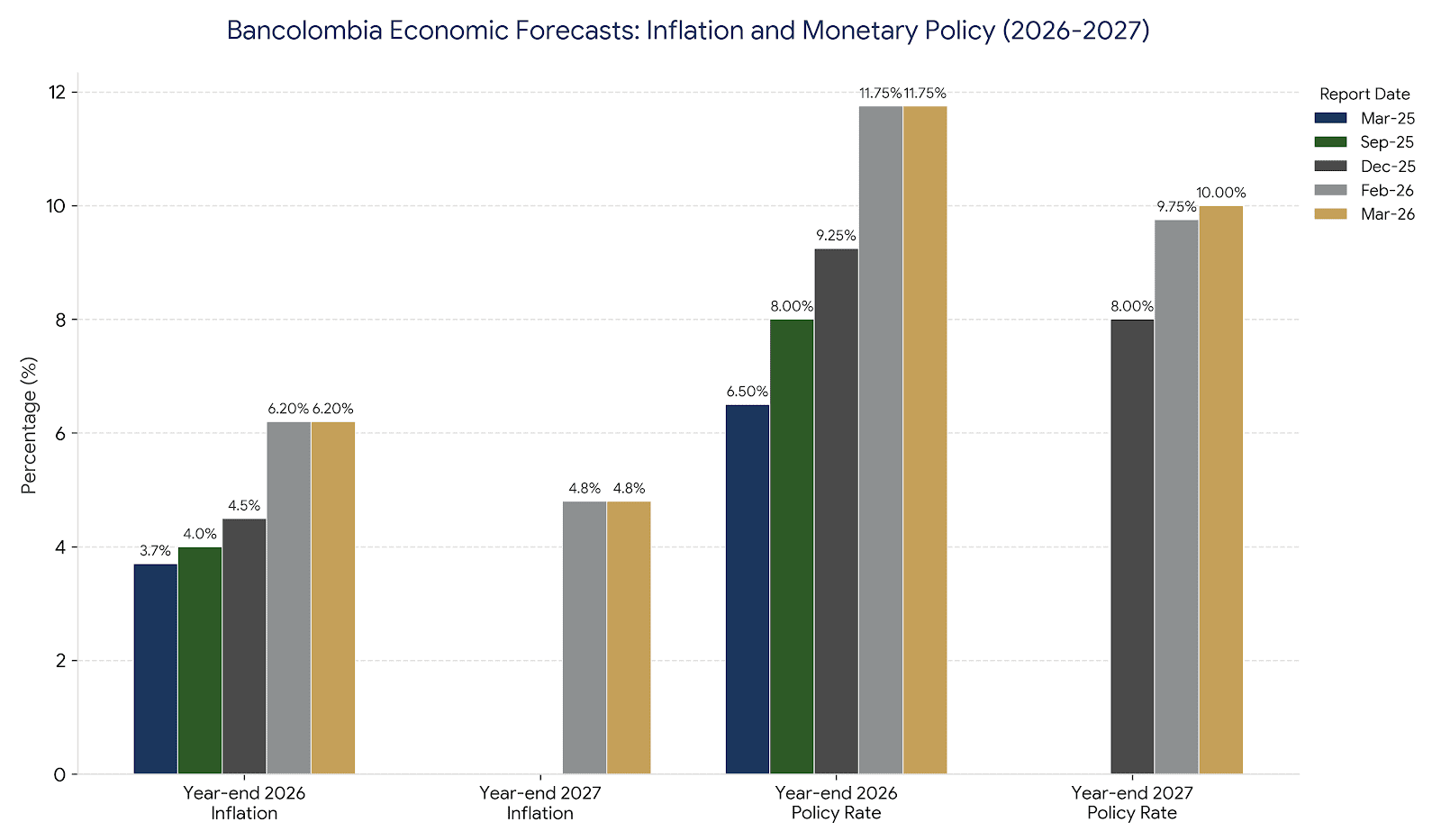
Chart based on data from Grupo Cibest & the Banco de la República.
Energy markets remain volatile as crude oil inventories in the US increased beyond expectations in the third week of March. Despite this, the price of Brent crude rose toward the end of the week, driven by skepticism regarding a potential ceasefire in the Middle East. The Colombian peso appreciated over the past week, tracking the intensity of the regional conflict.
The equity market results for the fourth quarter of 2025 remained neutral and aligned with market expectations. Global volatility continues to be shaped by energy shocks, geopolitical strife, and a cautious approach toward investments in artificial intelligence.
The projected rate hike by the Banco de la República is intended to send a definitive signal of commitment to price stability. This adjustment reflects not only recent inflation trends but also a strategic effort to prevent the further deterioration of expectations in a high-risk environment.
Headline image: Bogotá headquarters of Banco de la República (Banrepublica). Photo credit Juan Enrique Rodríguez, courtesy Banrepublica
While Colombia & Ecuador are at peace, the neighboring presidents have a sour relationship going back to when Colombian President Gustavo Petro initially refused to recognize Daniel Noboa’s election.
Traders and transport operators have suspended a 19-day blockade at the Rumichaca International Bridge, the primary land crossing between Colombia and Ecuador. The protest, catalyzed by a 50% tax imposed by the Ecuadorian government on Colombian goods, was lifted to accommodate travel and commerce during the Semana Santa holiday period. Despite the suspension of the strike, the regional business community reports that significant economic damage and diplomatic tensions persist.

Ecuador’s President Daniel Noboa (photo: Carlos Silva/Presidencia de la República)
The closure of the border crossing created a substantial disruption in binational economic activity. Estimates from the Cámara de Comercio de Ipiales in Nariño, Colombia indicate that losses reached approximately $5 million USD per day due to freight remaining stationary in the border zone. The Comité Gremial de Trabajadores de la Frontera de Ipiales stated that while the reopening is a responsible gesture for the high-traffic holiday season, current tariff policies continue to threaten hundreds of direct and indirect jobs linked to foreign trade.
The Governor of Nariño, Luis Alfonso Escobar, criticized the trade barriers implemented by the administration of Ecuadorian President Daniel Noboa. Governor Escobar argued that such measures inadvertently encourage illicit activities in the region. He emphasized that instead of facilitating formal commerce, high tariffs drive trade toward illegality, undermining regional security efforts. To mitigate the conflict, the Comunidad Andina de Naciones (CAN) has initiated high-level dialogues. Diplomatic delegations led by Colombian Deputy Minister of Foreign Affairs Juana Castro and her Ecuadorian counterpart, Alejandro Dávalos, held a virtual working group to address pending issues in trade, transport, energy, and hydrocarbons.
“Decisions adopted without considering the reality of our communities have put at risk the livelihood of merchants, transporters, foreign trade workers, and thousands of people who live from binational exchange,” stated the Comité Gremial de Trabajadores de la Frontera de Ipiales.
Diplomatic friction has extended into the energy sector. President Noboa claimed that in 2017, Ecuador assisted Colombia during a potential blackout by charging 1.6 cents USD per kWh, whereas in 2024, Colombia charged an average of 28 cents USD per kWh during Ecuador’s hydroelectric crisis. In response, the Colombian Minister of Mines and Energy, Edwin Palma, clarified that prices during the 2023-2024 El Niño phenomenon reflected the actual costs of production and distribution, particularly when fossil fuel-powered thermoelectric plants using fuel oil and diesel were activated.
The ongoing trade dispute has impacted more than 5,500 companies over the past two months. Diana Marcela Morales, the Colombian Minister of Commerce, Industry, and Tourism, confirmed scheduled meetings with Ecuadorian officials to de-escalate the conflict and establish fair, transparent rules. Concurrently, the Ministerio de Comercio, Industria y Turismo has moved to protect domestic industries by implementing new tariffs on steel and ceramics from countries without existing free trade agreements. These measures aim to counter market distortions and protect a sector that employs more than 50,000 people while promoting circular economy practices and reducing CO2 emissions.
Above photo: Border between Ecuador & Colombia looking towards Ipiales, Colombia (Photo: Cancillería de Colombia)
Governance concerns and profit drops dominate shareholder assembly.
The Ecopetrol (NYSE: EC, BVC: ECOPETROL) General Shareholders’ Meeting concluded at the Corferias convention center in Bogotá, marked by a decline in annual profits and an intensifying debate regarding the continuity of the company’s president, Ricardo Roa. During the assembly, shareholders approved a dividend of $121 COP per share for minority holders and a total payment of $4 trillion COP to the Colombian government, which serves as the majority shareholder. The government’s payout is scheduled for distribution in two installments, to be completed by June 30, 2026.
Click on above image to view shareholder meeting

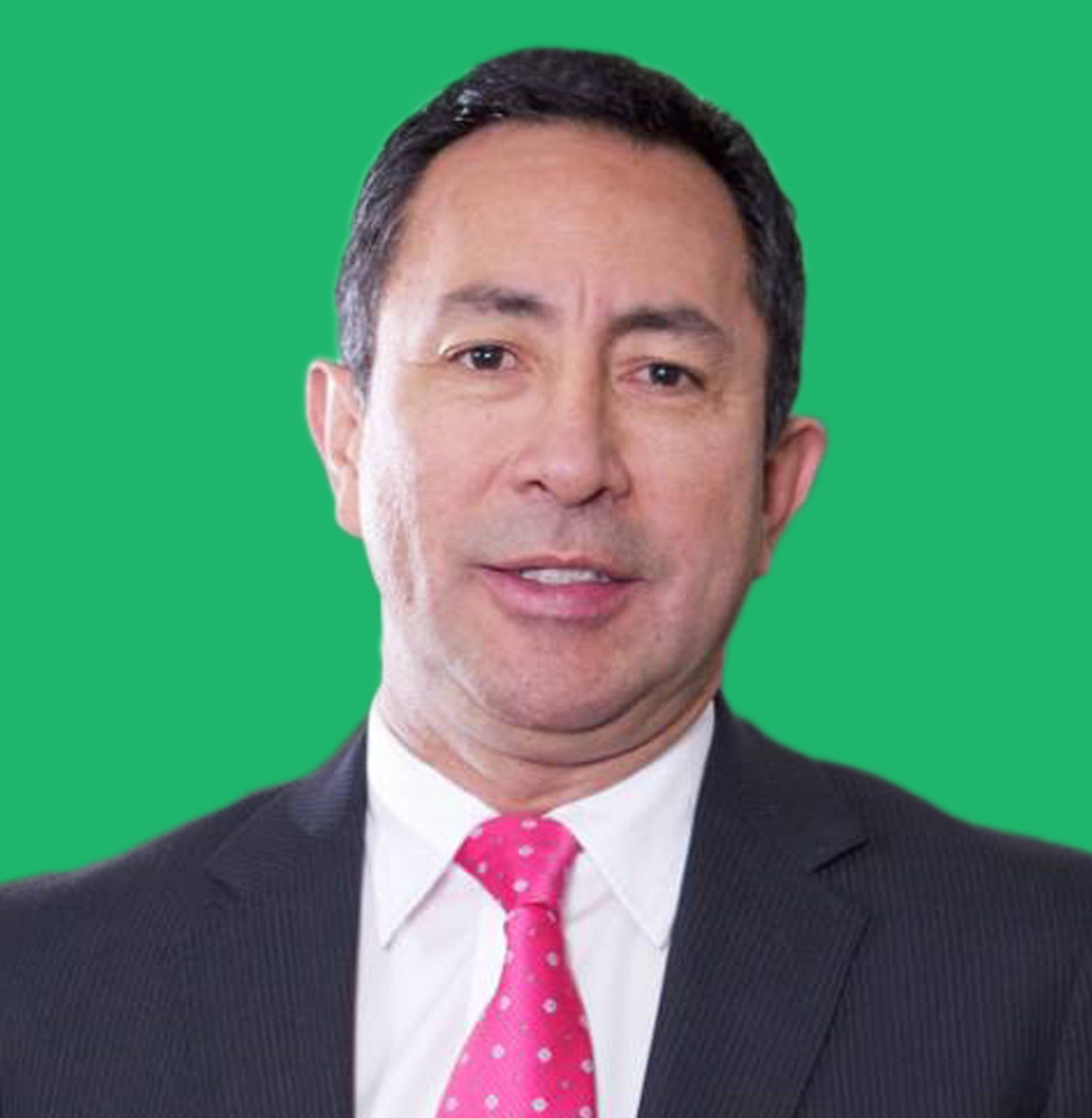
The financial results for the 2025 fiscal year revealed a significant contraction in net income, which fell to $9 trillion COP from the $14.9 trillion COP reported in 2024. Roa attributed this decline primarily to the volatility of international crude prices. He noted that the average price of Brent crude dropped from $80 USD per barrel to $68 USD per barrel over the period. According to company data, every $1 USD drop in the price of Brent corresponds to a reduction of approximately $500 billion COP in net profit and $700 billion COP in EBITDA. Despite the lower earnings, the company maintained a production level of 745,000 barrels per day and achieved a reserve replacement rate of 121%, the highest in five years.
Governance issues remained the primary focus of the assembly. Minority shareholders expressed concern over the legal challenges facing Roa, who is currently under investigation by the Fiscalía General de la Nación for alleged influence peddling. Additionally, the Consejo Nacional Electoral (CNE) has raised accusations regarding the alleged violation of spending caps during the presidential campaign of Gustavo Petro, which Roa managed. Angela Maria Robledo, Chair of the Board of Directors, defended the decision to retain Roa, stating that the board has activated a evaluation protocol while respecting the constitutional principle of the presumption of innocence.
Shareholders Erupt In Anger At CEO Ricardo Roa:
🚨Abuchean a Ricardo Roa en asamblea de Ecopetrol
“¡Fuera, fuera!”: Este es el momento del tenso abucheo de los accionistas al presidente de la empresa 🔽
Videos: Néstor Gómez pic.twitter.com/uyjh4chpl2
— EL TIEMPO (@ELTIEMPO) March 27, 2026
“Ecopetrol is listed on the New York Stock Exchange; we are governed by the strict regulations of US federal agencies. Agencies like OFAC and the SEC could intervene in the company and could even accelerate the payment of financial obligations, which would be extremely grave for Ecopetrol,” stated Martín Ravelo, President of the USO.
The Unión Sindical Obrera (USO), the primary labor union representing nearly one-third of the company’s workforce, has issued an ultimatum for Roa’s removal. Martin Ravelo, president of the USO, warned that the union will initiate a national strike and affect crude production if Roa is not aparted from his position by Monday, March 30. Ravelo expressed concern that Ecopetrol, which is subject to the regulations of the Securities and Exchange Commission (SEC) and the Office of Foreign Assets Control (OFAC), could face federal intervention. He highlighted that Ecopetrol’s current debt has reached $30 billion USD, exacerbated by rising interest rates, and warned that the company lacks the cash flow to respond to potential demands for early repayment of international obligations.
President Gustavo Petro responded to the union’s concerns via social media, stating that the executive branch will take measures to shield the company’s financial future. Petro emphasized the importance of maintaining investment during periods of high oil prices to prepare for future market downturns. He also criticized past administrations for failing to invest sufficiently in clean energy during previous price cycles. In contrast, Ravelo called for the board to maintain its independence from political influence, noting that four of the nine board members have already left formal records supporting Roa’s departure.
Ecopetrol also addressed the national gas supply, with Roa announcing that new regasification alternatives at Puerto Bahía and on the Pacific coast are expected to begin operations in the second half of 2026. These projects are intended to contribute between 186 and 430 Gbtud to the national grid. A third regasification facility in Coveñas is projected to start operations in 2029 with a capacity of 400 Gbtud. Despite these operational plans, the immediate focus of the international investment community remains fixed on the board’s upcoming meeting on Monday, where the leadership deadlock must be resolved to avoid a potential halt in national production.
Headline photo: Former Senator Jorge Robledo admonishes the Ecopetrol board of directors at the March 2026 shareholders’ meeting.
The search for Eric Fernando Gutiérrez Molina, a 32-year-old US flight attendant reported missing since March 22, concluded Friday following the discovery of a body in rural Antioquia, about two and a half hours south of Medellín. Medellín Mayor Federico Gutiérrez confirmed that the remains were located between the municipalities of Jericó and Puente Iglesias, stating there is a very high probability they belong to the American Airlines (NASDAQ: AAL) employee.
Gutiérrez Molina, a Salvadoran-American national who lived in Texas, arrived in Medellín on a commercial flight via José María Córdova International Airport. He was last seen alive on Sunday, March 22, after visiting commercial establishments in the El Poblado neighborhood. Investigations by the Secretaría de Seguridad y Convivencia suggest the victim was targeted by criminals using scopolamine, a sedative that can be used to incapacitate victims for robbery. According to witness statements, Gutiérrez Molina and another flight attendant were approached at a nightclub by individuals who lured them to another venue in Itaguí, a southwestern suburb of Medellín. While the companion flight attendant was able to make it back to her hotel, ill and disoriented, Gutiérrez Molina remained missing for five days.
“We have very clear leads on those responsible,” stated Mayor Federico Gutiérrez. “I have requested that justice be served and that the perpetrators be sought for extradition to the United States if necessary.”
The body was spotted by residents of Puente Iglesias floating in the Río Piedra ravine. The Instituto Nacional de Medicina Legal y Ciencias Forenses is currently conducting formal identification and an autopsy in Medellín. Mayor Gutiérrez reported that he has personally informed the victim’s father, the US Ambassador to Colombia, and the Consul General at the US Embassy in Bogotá regarding the development. The mayor stated that investigators have identified alleged perpetrators and expressed his intent to seek their extradition to the US.
‼️Tengo que dar una triste noticia.
Desde el pasado Domingo, estamos en la búsqueda de Eric Gutiérrez un ciudadano Estadounidense que se encuentra desaparecido.
Lamentablemente acaba de ser encontrado un cuerpo sin vida, entre el municipio de Jericó y Puente Iglesias.
Existe…— Fico Gutiérrez (@FicoGutierrez) March 27, 2026
This problem is not new. Criminals have been using scopolamine to prey on both Colombians and foreigners for years. Just last week, the Alcaldía de Medellín (Medellín Mayor’s Office) announced the capture of two women, aged 19 and 34, accused of drugging and robbing foreigners in Parque Lleras. The Policía Nacional and the Fiscalía General de la Nación (Colombia Attorney General’s Office) conducted raids in the Caicedo and Villa Hermosa neighborhoods to dismantle the operation. The suspects reportedly offered escort services as a facade to move victims to tourist accommodations, where they administered benzodiazepines such as clonazepam to facilitate the theft of high-value belongings and cash.
Manuel Villa Mejía, Secretary of Security and Convivencia, stated that the captured women had extensive judicial records for aggravated robbery. During the operations, authorities seized mobile devices, identification documents belonging to other women, and a firearm. Villa Mejía emphasized that the city is utilizing intelligence and focused operations to close pathways for those who instrumentalize tourism for criminal purposes. These actions are part of a broader strategy to weaken the financial operations of networks that continue to target international visitors in El Poblado.
Finance Colombia has also reported on the capture of the Queen of Scopolamine, who led a network dedicated to drugging and robbing tourists in Parque Lleras. Despite prior law enforcement successes against structures like Las Barbies and The Ghetto, predatory crime remains a concern for the international investment community and business travelers.
Also read: Don’t Be A Victim! Six Rules For Safety When Visiting Colombia
photo of Mr. Gutierrez from social media
The petroleum workers called for Ricardo Roa’s head following formal influence-peddling charges filed by Colombia’s Attorney General’s Office.
One of Colombia’s principal petroleum worker’s unions, the Unión Sindical Obrera (USO), has formally requested that Ecopetrol’s board of directors remove Ricardo Roa Barragán as president of the state-controlled oil company, amid ongoing investigations against him by the Attorney General’s Office. The union warned that it will call a nationwide strike if the request is not addressed.
The request was made in a letter dated March 24, sent after a meeting between union representatives and the company’s board. In the document, the USO stated that, “understanding the feelings of the Colombian people as reflected by the thousands of Ecopetrol workers, we immediately request that, within the framework of due diligence, the board of directors adopt the necessary measures to remove Dr. Ricardo Roa Barragán from his position as president of Ecopetrol.”
The union added that, if the request is not met, “this union will call for nationwide mobilization in defense of the most important asset of the Colombian people.”
On the same day, March 24, Ecopetrol’s board issued a public response, reported by outlets such as Caracol Radio, stating that it had reviewed requests from employees, the union and some minority shareholders.
In its statement, the board said it is “aware of its responsibilities within the framework of due diligence” and has been assessing the risks to the company stemming from reports related to Roa. However, it confirmed that Roa will remain in his position while the evaluation process continues.
The union’s request follows charges filed by the Attorney General’s Office on March 11 against Roa for alleged influence peddling. According to prosecutors, Roa is accused of favoring a third party in the allocation of a project in exchange for a reduction in the price of an apartment he purchased in 2023.
More details on the case can be found in the article “Colombia’s Top Prosecutor Charges Ecopetrol President in Alleged Influence-Peddling Case,” published by Finance Colombia.
At this stage, although the information has been publicly reported, judicial decisions remain under the authority of the Attorney General’s Office, which is leading the proceedings.
Roa’s legal situation is also linked to another investigation involving alleged irregularities in the financing of the Pacto Histórico presidential campaign in 2022, which he managed and which resulted in Gustavo Petro’s election as president.
In February, the Attorney General’s Office said investigators found indications that the campaign may have exceeded legal spending limits. A similar case had already been reviewed by Colombia’s elections authority, the National Electoral Council, which fined those responsible more than $5 billion Colombian pesos (over $1.4 million USD).
Photo by Ecopetrol.
So far, three people have been convicted in the killing of former presidential candidate Miguel Uribe Turbay, while arrest warrants target seven members of FARC dissident factions.
Colombia’s Attorney General’s Office is advancing its investigation into the assassination of Senator and presidential pre-candidate Miguel Uribe Turbay. On one hand, it sentenced alias “El Viejo” to more than 22 years in prison for acting as an intermediary between those who ordered the crime and the criminal network that carried out the attack; on the other, it issued arrest warrants for seven individuals belonging to a dissident faction of the FARC accused of ordering the killing.
The assassination of the Centro Democrático party senator and presidential candidate took place on June 7, 2025, in Bogotá while he was participating in campaign-related activities. The attack was carried out by a 14-year-old who fired multiple shots and was immediately captured after an exchange of gunfire with National Police officers and Uribe Turbay’s security team.
General attorney, Luz Adriana Camargo Garzón said the crime was not “an isolated act, but the result of a structured criminal operation that involved both an urban criminal network operating as outsourcing and an organized armed group” known as the “The Segunda Marquetalia.”
Miguel Uribe Londoño, a presidential candidate and the victim’s father, said in a tweet directed at President Gustavo Petro: “President @petrogustavo You harassed Miguel with your verbal abuse, making him a target for assassination. Your government failed to protect him. Your government has been tolerant of drug trafficking, and the criminals who benefited from your total peace used the Second Marquetalia to assassinate Miguel. But the masterminds behind this must continue to be sought within the Colombian government. We cannot continue to accept this violence. This is why Miguel’s legacy needs to be upheld in the Presidency, and I will carry it until the last day of my life.”
Presidente @petrogustavo.
Usted hostigó a Miguel con su violencia verbal poniéndolo como carne de cañón para que lo asesinaran.
Su gobierno no le dio protección.
Su gobierno ha sido tolerante con el narcotráfico y los criminales beneficiados con su paz total utilizaron a la… pic.twitter.com/mPPvVYZgJv
— Miguel Uribe (@migueluribel) March 22, 2026
Judicial developments and convictions
According to the Attorney General’s report, three individuals have already been convicted through plea agreements:
- Simeón Pérez Marroquín, alias “El Viejo,” identified as the link between those who ordered the crime and the criminal network, was sentenced on March 20 to 22 years and four months in prison.
- Carlos Mora González, who conducted surveillance at the attack site and transported other suspects, was sentenced to 21 years in prison.
- Katherine Andrea Martínez, who took part in planning meetings and retrieved the weapon used (a Glock pistol), was sentenced to 21 years and two months in prison.
The 14-year-old who carried out the attack was sentenced under Colombia’s Juvenile Criminal Responsibility System.
Criminal network and FARC dissident involvement
After nine months of investigation, prosecutors established the involvement of the dissident FARC faction known as The Segunda Marquetalia as the group that ordered the crime and issued arrest warrants against several of its alleged leaders and members.
According to the statement, those targeted include Kendry Téllez Álvarez, identified as a possible mastermind; Iván Luciano Marín Arango, alias “Iván Márquez”; Géner García Molina, alias “Jhon 40”; Alberto Cruz Lobo, alias “Enrique Marulanda”; Jhon Jairo Bedoya Arias, alias “Rusbel”; Diógenes Medina Hernández, alias “Gonzalo”, and José Aldinever Sierra Sabogal, alias “Zarco Aldinever”.
They face charges of aggravated homicide, conspiracy to commit a crime, and the manufacture, trafficking, possession or carrying of firearms, accessories, parts or ammunition.
Additionally, according to El Colombiano, authorities are offering a reward of up to $5 billion Colombian pesos (around $1,4 million USD) for information leading to the capture of alias “Iván Márquez”, and $4 billion Colombian pesos ($1,2 million USD) for alias “Jhon 40” and “Zarco Aldinever”, identified as key leaders of the group.
“Wanted dead or alive”
According to El Colombiano, “the inclusion of ‘Zarco Aldinever’ on the most-wanted list has raised questions, as he had reportedly been killed in August 2025 in alleged clashes with the National Liberation Army (ELN) guerrilla group”
“He is alive; that is, we have no evidence that he is dead. For us, “Zarco Aldinever” is alive. There is no corroborated evidence regarding the rumor that he was killed by the ELN. It remains a rumor, which is why the arrest warrant was issued,” the attorney general said.
Meanwhile, the whereabouts of Iván Luciano Marín Arango, alias “Iván Márquez”, one of the former negotiators of the 2016 peace agreement who later returned to armed activity, remain unknown. He has been reported dead on several occasions, most recently in July 2023, when it was speculated he had died from gunshot wounds in Venezuela.
However, the government has not confirmed those reports. “Despite intelligence efforts by the security forces, there is no reliable information to determine his whereabouts or status,” Defense Minister, Major General (ret.) Pedro Arnulfo Sánchez said.
Photo above. Colombia’s Attorney General Luz Adriana Camargo during a presentation on progress in the Miguel Uribe Turbay case. Photo courtesy of the Attorney General’s Office.
Photo in social media. Miguel Uribe Turbay. Photo courtesy of the Senate of the Republic of Colombia.
A C-130 Hercules aircraft crashed in Putumayo, southern Colombia, on March 23, killing 66 people, including soldiers, Air Force personnel and police. A total of 128 people were on board.
A Hercules aircraft operated by the Colombian Air Force (FAC) crashed shortly after takeoff from Puerto Leguízamo, in southern Colombia’s Putumayo department, in a tragedy on Monday, March 23, that left dozens of victims among members of the security forces.
According to Jhon Molina, governor of Putumayo, “58 soldiers, six members of the Air Force and two police officers were among the victims who died in the accident.” A total of 128 people were on board the aircraft. One survived unharmed, and four others remain unaccounted for.
The aircraft, a US-built C-130 Hercules used to transport troops and supplies, went down about one and a half kilometers from the airfield just minutes after takeoff.
Defense Minister, Major General (ret.) Pedro Arnulfo Sánchez, said the crash occurred as the aircraft “was taking off from Puerto Leguízamo (Putumayo, near the border with Peru and Ecuador) while transporting troops from our security forces.”
Investigation underway
The national government authorities said that, based on the information available so far, there is no evidence of an attack by illegal armed groups. According to the defense minister, “the fire triggered the detonation of part of the ammunition being transported, which explains the sounds heard in videos circulating on social media.”
The minister said that “all response protocols for the victims and their families have been activated, along with the corresponding investigation.” In a message posted on X, he added: “I extend my deepest condolences to the families of those affected and, out of respect for their grief, I urge people to avoid speculation until official information is available.”
President Gustavo Petro also addressed structural limitations within the armed forces, noting that bureaucratic processes have delayed modernization efforts. “Renewing the armed forces’ equipment has been a decision of my administration for years. Bureaucratic obstacles in military administration have prevented the approval of the Conpes/Confis (Colombia´s public policy instruments) for over a year since I requested it,” he said.
Statement from the Colombian Air Force
The Colombian Air Force (FAC) expressed its condolences following the crash. We “deeply regrets the tragic accident involving the C-130 Hercules, a loss that brings mourning to our military forces and National Police. The aircraft and its crew were in optimal condition to carry out the mission, with the professionalism that characterizes them.”
The institution added that “the pain and helplessness caused by the unexpected loss of our heroes in this tragic air accident are immense. But that pain is transformed into determination: to honor their memory and legacy with an even greater commitment to the nation, doing what we love: protecting Colombia.”
Gen. Carlos Fernando Silva of the Colombian Air Force said a technical investigation will be conducted with support from the US Air Force to determine the causes of the crash “with transparency and rigor.”
Photos courtesy of the FAC.
Wingo expansion strengthens Medellín as a regional aviation hub
Wingo, a subsidiary of Copa Holdings (NYSE: CPA), has announced the launch of two new direct international routes from Medellín to Guatemala City, Guatemala, and Montego Bay, Jamaica. With this expansion, the carrier becomes the only airline to operate these specific nonstop segments from José María Córdova International Airport in Rionegro, which serves the Antioquia region.
The new service increases Wingo’s international portfolio to 10 destinations from the city, complementing its existing network of five domestic routes. According to data provided by the airline, Medellín has become a primary operational base in Colombia. In 2025, approximately 35% of the carrier’s total passenger traffic, representing 1.2 million travelers, originated from or arrived in the city.
“Medellín is a strategic city for Wingo, and these two new routes reflect our confidence in the potential of the city and the response of travelers.” — Jorge Jiménez, Commercial and Planning Vice President of Wingo.
The Alcaldía de Medellín, through the Secretaría de Turismo y Entretenimiento and the Bureau de Medellín y Antioquia, coordinated with airport concessionaire Airplan to facilitate the new frequencies. The Medellín to Guatemala City route is scheduled to begin operations on June 25, 2026, with three weekly frequencies on Tuesdays, Thursdays, and Saturdays. The airline expects to offer 30,000 seats annually on this route, with one-way fares starting at $108 USD, including taxes and fees.
The connection to Montego Bay is slated for a June 23, 2026, start date, also operating three times per week on Tuesdays, Thursdays, and Saturdays. Introductory fares for the Jamaican destination are positioned at $159 USD per trayect. This move follows a 2025 pilot program where Jamaica was marketed as a high-interest destination for Colombian travelers.
Jorge Jiménez, Commercial and Planning Vice President at Wingo, stated that these routes reflect confidence in the potential of the city and the response of travelers to direct, low-cost international options. Ana María López Acosta, Secretary of Tourism and Entertainment, noted that the collaboration between the public and private sectors continues to project the city as an attractive destination for tourism and investment.
The expansion comes as the Aeropuerto Internacional José María Córdova continues to increase its capacity as a logistical platform for the country. Javier Benítez, Manager of the airport, indicated that the arrival of these routes reaffirms the facility’s potential to facilitate international business and connection for the region.
Grupo EPM, the multi-utility conglomerate owned by the municipality of Medellin, reported consolidated revenue of $40.6 trillion COP (approx. $11 billion USD) for the full year 2025. Despite a year characterized by climate variability and increased regulatory pressure, the group saw net income rise to $5.3 trillion COP, a 9% increase compared to 2024 results. Earnings before interest, taxes, depreciation, and amortization (EBITDA) reached $11 trillion COP ($2.98 billion USD).
The Medellín utility unit, EPM, contributed $20 trillion COP in revenue and $4.9 trillion COP in net income. Management attributed the stability of these figures to a diversified portfolio. Power generation remains the primary driver of profitability, accounting for 49% of net income, followed by energy distribution at 27%. The water, sewage, and waste management sectors contributed 15%, while transmission and natural gas accounted for 3% and 1% respectively.
In 2025, Grupo EPM obtained results that confirm its ability to advance in complex scenarios, reflecting work to achieve lasting efficiencies.” — John Maya Salazar, General Manager of EPM
Financial leverage remained within contractual covenants. The debt-to-EBITDA ratio for the group closed at 2.9x, comfortably below the 3.5x threshold required by many credit agreements. For the individual EPM entity, the ratio stood at 3.5x. This solvency allows the organization to continue its capital expenditure program, which saw $5 trillion COP ($1.36 billion USD) invested in infrastructure and social programs throughout the year.
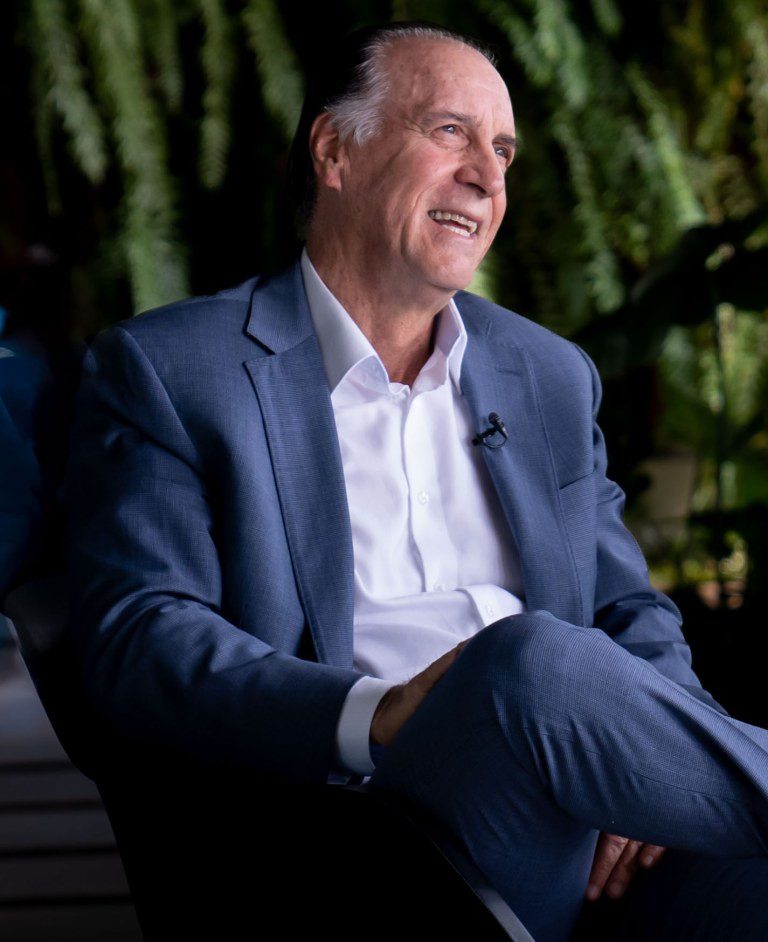
John Maya Salazar, General Manager of EPM (photo courtesy EPM)
A significant portion of the capital budget was directed toward the Hidroituango hydroelectric project. Approximately $1 trillion COP was allocated to Stage 2 of the project, specifically turbine units 5 through 8. Beyond energy, the company continued funding the Unidos por el Agua and Unidos por el Gas initiatives, which target utility access for vulnerable populations in the department of Antioquia and other regions.
Dividend and Fiscal Transfers
During the 2025 fiscal period, EPM executed transfers totaling $2.6 trillion COP to the Distrito de Medellín. These funds, representing 55% of the utility’s 2024 net income, serve as a primary funding source for the municipal development plan. Additionally, the group generated $21.8 trillion COP in total added value across its areas of operation, including $3.7 trillion COP in taxes, fees, and contributions to the state.
The company is currently undergoing a structural reorganization intended to modernize its operating model. According to management, this transition is designed to improve strategic efficiency as the group faces future macroeconomic shifts. The group’s economic footprint in 2025 included $6.7 trillion COP paid to suppliers and the financial system, along with $3 trillion COP dedicated to direct and indirect employment costs. Total reinvestment into the group’s various subsidiaries reached $5.6 trillion COP to ensure infrastructure modernization.
Financial data and sustainability reports are routinely filed with the Superintendencia Financiera de Colombia. Interested parties can find further information on the company’s investor relations portal or through the Alcaldía de Medellín official website.
Above video: An aerial view of EPM’s Hidroituango hydroelectric dam(video © Loren Moss)
 Empleobilingue.com

- Director/a de operaciones para hotel, restaurante y discoteca 1626320364.60 - Medellín, Medellin, Antioquia, Colombia
- Coordinador/a de calidad para La Unión 1626483143.1 - La Unión, Antioquia, Colombia
- Desarrollador fullstack - Bogotá, Bogota, Colombia
- Technical Analyst - Remote
- PIM Administrator - Ecommerce - Remote (Bogotá, Bogota, Colombia)
- Auxiliar de gestión humana y bienestar para Girardota 1626060072.28 - Girardota, Antioquia, Colombia
- Marketing Strategist
- Trainer Manager - Bogotá, Bogota, Colombia
- Tolemaida UH- 60 Inspector - Bogotá, Bogota, Colombia
- Virtual Assistant - Team Lead - Remote
Contact Us

