















A health-sector watchdog becomes an election-eve campaign weapon
Three developments over a single week in June have braided together to expose how Colombia’s health-oversight apparatus has become an instrument in the final stretch of the presidential race. At the center of all three is Daniel Quintero, the former mayor of Medellín who took office as National Superintendent of Health — head of the Superintendencia Nacional de Salud (National Health Superintendence) — in May despite facing more than 40 criminal and disciplinary investigations of his own. Within days, the office he now runs has been pointed squarely at the opposition’s presidential candidate, and the maneuver has split the very coalition it was meant to help.
An appointment the left now concedes “backfired”
The first thread surfaced on June 9, when Carlos Carrillo — who had just resigned as director of the National Unit for Disaster Risk Management (Unidad Nacional para la Gestión del Riesgo de Desastres, or UNGRD) — told Blu Radio that Quintero’s appointment had been “basically a shot in the foot for the campaign” of leftist candidate Iván Cepeda. Carrillo argued the decision — taken “a month before the elections” — cost Cepeda decisively in Antioquia, where, he said, “they beat us by almost 30 points.” Without that result, in his telling, “the winner of the elections is Iván Cepeda.” He said the Pacto Histórico (Historic Pact) “owes the people of Antioquia an apology,” and called handing the Superintendence to “those presumably crooked gentlemen, with all the investigations they carry,” an “enormous strategic error.”
That an ally would say so out loud underscores how exposed the appointment always was. As Finance Colombia reported in May, Quintero became the fifth health superintendent of President Gustavo Petro’s administration while carrying more than 40 criminal and disciplinary complaints tied to his 2020–2023 tenure in Medellín. The watchdog group Transparencia por Colombia (Transparency for Colombia) called the designation “inappropriate,” and Carrillo himself was quoted at the time noting that the Pacto Histórico “has no reason to bear the political cost of his legal troubles.”
“The charged official who left Medellín in intensive care now wants to pose as an anti-corruption defender by doing political favors for Cepeda.” — Centro Democrático
The most serious of those cases is the “Aguas Vivas” scandal, in which prosecutors at the Fiscalía General de la Nación (Attorney General’s Office) charged Quintero — alongside nine former officials and three private parties — with embezzlement (peculado), undue interest in public contracts, and malfeasance (prevaricato) over the reclassification of a 142,000-square-meter forest-reserve plot in Medellín’s El Poblado that allegedly inflated the land’s value. No conviction has been issued, and Quintero maintains his innocence. It is from this position — charged, awaiting trial, and his appointment under a nullity challenge admitted by the Consejo de Estado (Council of State) — that Quintero now wields one of the most powerful financial-oversight offices in the Colombian state, with authority over the EPS health insurers and the public funds that flow through them.
An election-eve probe aimed at the opposition candidate
The second thread arrived on June 15. That day, Cepeda announced a criminal complaint against his runoff rival, Abelardo de la Espriella, alleging the right-wing lawyer’s involvement in the “plundering of the health system” in the Caribbean region through the now-liquidated Salud Vida EPS. Within hours, Quintero announced that the Superintendence would “investigate the transfers made by these EPS to Joaquín Gutiérrez, his companies, and Abelardo de la Espriella,” framing it as a response to Cepeda’s allegations about “a group of EPS related to paramilitary leaders.”
Quintero put specific numbers on the claim. He described contracts “signed with health parafiscal resources for more than $18 billion COP” (about $4.5 million USD), set against what he called more than $160 billion COP (about $40 million USD) “diverted from Salud Vida EPS toward a front company in Panama.” He said the contract awarded to De la Espriella was not reported to the comptroller the Superintendence had designated at the time, citing the designated official’s statement that she “had no knowledge of the content and scope of the terms,” and asserted that records on the origin of those funds had been “extracted or eliminated” from the Superintendence’s databases in prior years. After reviewing more than 10,000 documents, Quintero said, the agency was forwarding copies to the Fiscalía, the Contraloría (Comptroller General’s Office), and the Procuraduría (Inspector General’s Office).
De la Espriella rejected the accusations outright, calling them a “smokescreen” driven by the proximity of the vote, insisting the contracts corresponded to “legitimate legal services” and that he would cooperate with the authorities. His campaign stressed — accurately — that opening an investigation “does not constitute a sanction” but a preliminary stage to gather information.
The timing did not escape the opposition. On June 16, the Centro Democrático (Democratic Center), the party of former president Álvaro Uribe that is backing De la Espriella, accused Quintero of weaponizing his office: “The charged official who left Medellín in intensive care now wants to pose as an anti-corruption defender by doing political favors for Cepeda,” the party said, pinning the system’s distress on the Petro government and citing “more than 2 million complaints, 313,000 tutelas [constitutional rights claims], medicine shortages, and a debt of more than $25 trillion COP owed to hospitals and clinics.”
The optics are conspicuous: an official who is himself charged, installed by the incumbent president weeks before the vote and whose own appointment is being litigated, has used the oversight powers of that appointment to open — and publicize — an investigation into the candidate running against the incumbent’s chosen heir, four days before the runoff.
A fight that spilled inside the left
The third thread shows the strategy turning inward. Also on June 15, Alianza Verde (Green Party) representative Catherine “Cathy” Juvinao criticized Cepeda’s decision to take the health fight to the courts, arguing that the way to win over independents and the center — the voters likely to decide June 21 — was “to recognize the mistakes of this government in health, withdraw the reform, and guarantee the negotiation of a new project,” not to move the programmatic debate “to the courts.”
Carrillo answered not by engaging the argument but by digging up Juvinao’s social-media posts from 2011 to 2013, when she was a fierce critic of the EPS and of Ley 100 (Law 100, the statute that created the current insurance-based system), and accusing her of having flipped: “She has made it sufficiently clear that between Iván and the EPS, she sides with the EPS… how power changes people.” The episode is telling on two counts. It places Carrillo — the same figure who days earlier had branded Quintero a crook and called his appointment a self-inflicted wound — in the position of defending the Cepeda camp’s health offensive against criticism from within his own ideological neighborhood.
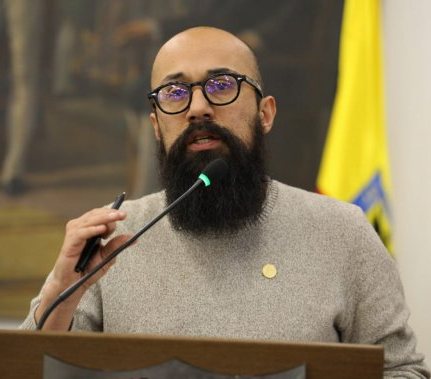
Carlos Carrillo, director of the UNGRD under the later part of the Petro administration.
And it confirms that Juvinao’s misgivings are not the opposition’s talking points but a live anxiety inside the center-left: that judicializing the campaign in its final days may repel precisely the undecided voters both sides are chasing.
Why it matters
Taken together, the three developments trace a single arc. The appointment that Carrillo concedes already cost the left votes in Antioquia has now produced an official willing to deploy his office against the opposition candidate on the eve of the vote — and that deployment has, in turn, opened a rift between those on the left who see the health card as a winning attack and those who fear it alienates the middle.
For Quintero, the calculus carries real risk. The investigation he has launched is preliminary, and the underlying allegations against De la Espriella — which the candidate denies — remain to be tested by the Fiscalía and the courts, not by a Superintendence headed by a man awaiting his own trial. Should De la Espriella, a combative litigator who built his fortune defending the accused and who has never been shy about using the courts himself, prevail in the runoff he led after the first round, the man who turned a state oversight office into a campaign instrument days before the election would find himself uniquely exposed — still charged in Medellín, his appointment still contested, and now on record having targeted the incoming president. Quintero’s tenure was always expected to be temporary; a new head of state takes office on August 7 with the power to replace him. Whether the gambit damages De la Espriella or merely deepens Quintero’s own jeopardy is a question the June 21 runoff will begin to answer.
Headline image: Daniel Quintero and President Gustavo Petro during the swearing-in ceremony of the new health superintendent. Photo courtesy of the Presidency of Colombia.
Builders cite legal uncertainty; Cepeda’s own plan reads more moderate
As Colombia heads into its June 21, 2026 presidential runoff, some companies are writing a contractual escape hatch into their deals — a provision the construction trade group Camacol Antioquia calls the “Cláusula Cepeda,” or “Cepeda clause” — that would let them pause or unwind agreements if leftist candidate Iván Cepeda wins, according to Teleantioquia and a televised news report. The accounts come from business representatives describing market sentiment; the prevalence of the clauses has not been independently quantified.
According to Eduardo Loaiza Posada, manager of Camacol Antioquia, “we know that the implementation of the ‘Cepeda clause’ exists in the market.” He said the possibility of a Cepeda win “generates so much uncertainty that many businesspeople have considered that, in the event of his victory, they would unwind deals already agreed.” Loaiza Posada framed the issue as one of confidence: “When there is doubt, uncertainty follows — and uncertainty is legal insecurity,” he told Teleantioquia, adding that “legal insecurity makes investment frightened.”
The trade group says the clauses surfaced across several productive sectors — housing, construction, and the financing of hotels and logistics centers — and that some projects have been shelved outright. “Even companies that were planning to build a new institutional or corporate headquarters have told the builders: ‘Let’s get the contract ready, but if this candidate wins, we undo the deal,'” Loaiza Posada said, according to Teleantioquia. He added that the hesitation is not limited to domestic players, citing instances of international funds and hotel chains reconsidering whether to finance or lend their brand to projects.
In a separate televised report, a real estate agent confirmed that some home purchase-and-sale contracts now include a clause letting the buyer withdraw based on market expectations and on changes to government policy and housing subsidies. The agent said the provision is “very much named at the moment” and is meant to offer investors an additional guarantee against a continuation of the current government’s policies, allowing a party to exit “without any penalty.”
“When there is doubt, uncertainty follows — and uncertainty is legal insecurity.” — Eduardo Loaiza Posada, manager of Camacol Antioquia
The practice is not new, and it is not unique to Cepeda. The same reports note that a “Cláusula Petro” appeared during the 2018 and 2022 campaigns, when Gustavo Petro was a candidate, transferring political expectations onto investment decisions in the same way. Legal commentators have described these as conditional clauses that are valid under Colombian private law: as Portafolio and El Tiempo reported in 2022, a contract can lawfully be made contingent on a future event, including an election outcome, and undone if that event occurs. By that reading, the “Cepeda clause” is a recurring feature of Colombian electoral cycles — a form of risk management — rather than a novel maneuver.
It also lands in a housing market already under strain for reasons that predate the runoff. According to figures from Camacol cited in the broadcast report, more than 134,000 households abandoned plans to buy a home between 2022 and February 2026, a 130% increase in the social-interest (VIS) segment. The report attributed much of that to regulatory uncertainty and policy decisions such as cuts to housing subsidies, alongside higher costs and rising interest rates. Data from the portal Finca Raíz cited in the same report showed sale prices climbing above inflation, with increases of up to 13%, as fewer project launches tightened supply. Colombia builds a little over 100,000 homes a year, the report noted, while DANE figures suggest 230,000 to 250,000 new families form annually — a structural gap that the slowdown widens.
Cepeda’s campaign has not publicly responded to the clause, and his published platform is more measured than the business alarm implies. His roughly 118-page plan, built around the idea of an “economy for life,” does propose a larger role for the state, a stronger internal market, and an emphasis on the peasant, popular and solidarity economy. But as La Silla Vacía and El Colombiano have reported, the document is more moderate than several positions President Petro has defended: it does not call for eliminating the independence of the central bank, a constituent assembly, or forced investments, and the campaign has sought to present a more pragmatic version of the current government’s agenda.
The runoff offers voters two markedly different economic visions — Abelardo de la Espriella campaigning to shrink the state, cut taxes and lean on the private sector, and Cepeda proposing deeper state intervention and expanded social programs — which is what the contractual hedging ultimately reflects: uncertainty about which direction policy will take. Cepeda advanced to the second round after the May 31 first round, in which he took 40.9% of the vote to De la Espriella’s 43.7%. With days to go, the market is watching the result and the signals it will send for housing and investment policy.
Dominio De la Espriella’s accumulated deficit nears $4 billion COP
The liquor company owned by Colombian presidential candidate Abelardo de la Espriella continues to lose money and has shut down its operation in the United States, according to an investigation by La Silla Vacía based on the company’s most recently published financial statements.
Dominio De la Espriella, the firm that produces and markets the candidate’s spirits brands, reported a net loss of $503 million COP (about $124,000 USD) for the year ended December 31, 2025, according to its published financial statements. With that result, the company has accumulated losses of roughly $3.88 billion COP (about $960,000 USD) since it was founded in late 2020, the same statements show. (USD figures throughout are approximate, converted at the 2025 average of about 4,050 COP per USD.)
Dominio De la Espriella produces Ron Defensor 12-year and 18-year rum and Vino Fratellone wine. Before De la Espriella’s entry into politics, it had become his most visible business project outside his law firm, La Silla Vacía reported. A bottle of the rum sells for between $265,000 and $351,000 COP and the Fratellone wine for $189,000 COP, according to prices listed by De la Espriella Style, the candidate’s merchandising company, as cited by La Silla Vacía.
The brand was formally launched in 2022 alongside vallenato singer Silvestre Dangond, who holds an 8% stake through the company Music Dreams, according to La Silla Vacía.
The US push was the company’s most ambitious bet. When Dominio De la Espriella launched, it set a target of more than $4 million USD in US sales, the outlet reported. According to the financial statements published for 2023 and 2024, the company recorded only $1,199 million COP in international sales — about $272,000 USD, or 7% of the target, La Silla Vacía reported. The 2025 statements report that “se cerró la operación” (“the operation was closed”) in that market.
The US chapter was brief. The financial statements show that in 2023, when the company entered the country, it received an injection of $1 million USD (then $4,332 million COP) from US investors, identified in the accounts only as “Dominio Estados Unidos,” money meant to fund production of 33,000 bottles, according to La Silla Vacía. A year later, the company reported that the deal had fallen through and that it now owed the $1 million back. La Silla Vacía reported that the recorded obligation fell from $1,891 million COP in 2023 to $799 million COP in 2024; the 2025 statements list a remaining “obligation for rescission of the US operation contract” of $722 million COP (about $178,000 USD).
With the US exit, revenue dropped sharply. La Silla Vacía reported a roughly 60% fall in operating income; the company’s statements show net operating revenue declining from $1,637 million COP in 2024 to $687 million COP in 2025. The 2025 statements report just $7 million COP (about $1,800 USD) in cash at banks, with the company’s resources concentrated in rum and wine inventory valued at $1,397 million COP and $1,403 million COP in receivables.
“Se cerró la operación” — “the operation was closed,” reads Dominio De la Espriella’s 2025 financial statement, describing the company’s exit from the US market (as reported by La Silla Vacía).
The statements also show how the business has been funded. Thirteen of the company’s 15 shareholders have contributed an additional $4,829 million COP (about $1.2 million USD) on top of the $500 million COP in founding capital to increase their stakes, but the shares have not been issued and the money remains recorded as a liability, according to La Silla Vacía. The candidate himself has been financing the operation, lending the company $1,695 million COP (about $420,000 USD) through 2025, the outlet reported.
A separate La Silla Vacía investigation into De la Espriella’s business holdings reported that 14 other companies hold stakes in the venture. According to that reporting, the 50% owner is Somos Inversiones, a Panama-based company whose papers list figureheads, and the structure also includes companies tied to relatives of Hugues Rodríguez — convicted for promoting paramilitary groups — and to oil businessman Serafino Iácono.
The US retail presence has also wound down. Liquor Dreams, the Instagram account that presented itself as Ron Defensor’s official ambassador in the United States, stopped posting about the brand, and a new management has been announced for the store in the Coral Gables area of Florida, La Silla Vacía reported. The venue had served as a place for De la Espriella to host Colombian politicians, among them former president Álvaro Uribe, according to the outlet.
The US departure follows the closure of De la Espriella’s Místico restaurant, also in Coral Gables, where he had likewise promoted his liquor brand. La Silla Vacía said it confirmed that Místico closed months ago and that a different restaurant now operates in its former location. Among Místico’s partners, the outlet reported, were Dangond and Héctor Amaris, known as “Oso Yogui.”
The reporting lands as De la Espriella heads into the June 21, 2026 presidential runoff against leftist senator Iván Cepeda. De la Espriella, an attorney campaigning on a hardline security platform, led the May 31 first round with 43.7% of the vote to Cepeda’s 40.9%, according to results reported by CNN and other international outlets.
What a De la Espriella or Cepeda win means for security and investment
Two men. Both running to be the next president of Colombia. Both swear they are tough, that they are clean, that they are the answer to a country that is exhausted. And both of them have a problem with the company they keep.
One is a defense lawyer who built his career representing mobsters, paramilitaries, and at least one alleged front man for the Maduro regime — and he tells you those relationships were strictly professional. The other fought to spring a FARC commander out of a maximum-security holding cell — and he tells you that relationship was strictly professional too. One says, in effect, “I only knew the narco because I was his attorney.” The other says, “I only knew the guerrilla because I was a peace negotiator.” Same sentence, opposite ends of the political spectrum. It is the strangest mirror in Colombian politics.
This Sunday, June 21, Colombians return to the polls for the runoff. In the first round on May 31, the right’s Abelardo de la Espriella came first with about 43.7 percent. The left’s Iván Cepeda came second with about 40.9 percent. No one else is left. Whoever wins walks into the Casa de Nariño on August 7.
What follows is an analysis, not an endorsement. I am pro-business, anti-crime, and anti-communist, and I am not Colombian, so I will not presume to tell Colombians how to vote. What I can do is lay out who these two men are, where they came from, and the honest pros and cons of each — because both carry serious problems, and readers with capital, operations, or ties in Colombia deserve them laid out straight. Much of the biographical reporting here draws on the long-form profiles published by La Silla Vacía, among the best political journalism in the country, and on Finance Colombia‘s own coverage of the race.
Who is Abelardo de la Espriella?
Start with de la Espriella, since he holds a slight polling lead. His campaign events are not subtle: the lights go yellow, blue, and red, footage of tigers plays on the screens, smoke machines fire, the national anthem swells, and out he comes flanked by bodyguards in a bulletproof vest, declaring, “Here is your tiger, roaring and biting.” The tiger is his symbol — claw, territory, attack — and the crowd chant is ponle la raya al tigre, “put the stripe on the tiger.” It is a show, and he runs it the same way every time, with discipline.
According to La Silla Vacía’s profile, Abelardo was born in Bogotá in 1978 and grew up in Sahagún and Montería, in Córdoba on the Caribbean side. His mother calls the family riquitos de pueblo — “small-town rich.” A respected name and political connections, but not the rosca, the Bogotá elite, and not one of the great national fortunes. His father was a Liberal Party congressman and an early backer of Álvaro Uribe in Córdoba in 2001; when Uribe reached the presidency, he made the elder De la Espriella a notary. That is where the long relationship between the De la Espriella and Uribe families begins.
From childhood, Abelardo wanted to be seen. By his family’s account he sang opera in the bathroom, had a children’s radio program his father arranged, got himself onto regional television as a teenager, and promised his grandmother a limousine in Miami. He studied law at the Sergio Arboleda University in Bogotá — not an academic powerhouse, but a real breeding ground for the Colombian right — and hustled the whole way through, selling whiskey, perfume, clothing, and emeralds on consignment. The man has always been building a legend about himself.
Here is the part he does not lead with on stage. De la Espriella made his name as a defense lawyer, and not for choirboys. His client list reads like a rogues’ gallery: politicians tied to paramilitary groups, the Nule brothers of the carrusel de contratos contracting scandal in Bogotá, the pyramid-scheme operator David Murcia of DMG, the disgraced Constitutional Court magistrate Jorge Pretelt, and — the big one — Álex Saab, the man the United States accused of being a front man for Nicolás Maduro. Early in his career, at 26, he did legal and public-relations work around the paramilitary demobilization at Santa Fe de Ralito through an NGO he ran. His childhood friend from Córdoba is Salvatore Mancuso, the paramilitary chief.
He will tell you — and it is a legitimate argument — that every defendant has a right to counsel, and that defending an unpopular client is not the same as committing the client’s crimes. Fair enough. We will return to it.
After the lawyering came the brand. He launched a rum called Ron Defensor, “the Defender,” with the vallenato star Silvestre Dangond. He launched a clothing line, released music, wrote books, went through an atheist phase, and then, roughly six years ago, underwent a very public religious conversion. Now he is the “God and family” candidate who calls himself “the Cyrus of Colombia.” By his own design he is a sybarite: Italian suits every year, a Miami mansion valued north of $5 million USD, a private plane, the whole production.
Three facts to keep in your carriel for later. First, he has never held elected office; he ran for a Bogotá council seat as a student in the 1990s, lost, and stayed out of electoral politics for nearly thirty years. Second, he holds three citizenships — American, Italian, and Colombian. Third, his running mate is José Manuel Restrepo, a name that returns in a big way when we reach the pros.
“The ‘tough on crime’ candidate has spent his career defending criminals, and the ‘human rights’ candidate stays silent on half the human rights abuses in his own backyard.” — Loren Moss, Finance Colombia
Who is Iván Cepeda?
If de la Espriella’s story is about a man who wanted to be seen, Cepeda’s is about a man shaped by a death.
On August 9, 1994, a young Iván Cepeda took a bus to Javeriana University, where he taught philosophy, after letting his father leave the house first. On the way he came upon ambulances, police cars, and a crowd around a bullet-riddled car. It was his father’s car. Manuel Cepeda, a senator for the Unión Patriótica, had just been assassinated.
The detail that explains Iván Cepeda is what he did next. He did not collapse over the body. He pulled from his jacket a column his father had written about another murdered activist, crossed the street to tell his wife, and then turned and spoke to journalists — composed, on message, calling on the president and the courts to act. “When my father was murdered,” he later said, “I already knew how I should act, what I should say.” He turned private grief into public, political language. La Silla Vacía describes his entire method of politics as organized around the truth of the victims, and that is exactly right.
Cepeda was born in 1962, while his father was in prison for interviewing a survivor of the army’s bombing of Marquetalia, the peasant enclave that became the founding myth of the FARC. His parents, Manuel Cepeda and Yira Castro, were journalists, communists, and revolutionaries; politics was the air the household breathed. At 13 he was in the Communist Youth. At 17, after his mother’s death, his father sent him to study philosophy in Sofia, Bulgaria. He returned in 1987, by his own account disillusioned with Soviet Marxism and the privilege he had seen inside the party there.
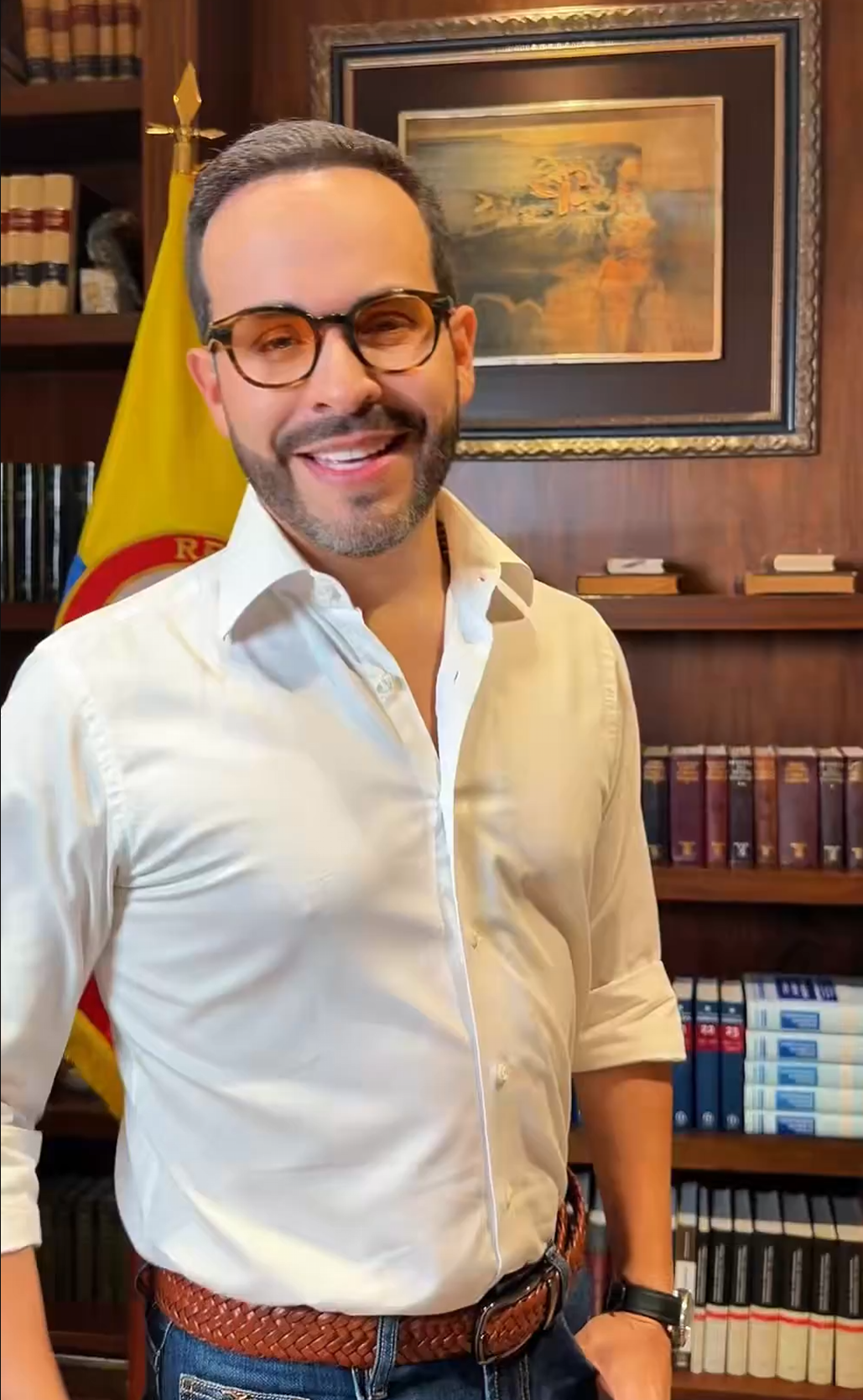
Abelardo de la Espriella is a millionaire defense attorney, singer & rum impresario. (photo: Twitter screencapture)
His father’s assassination was the turning point. The Unión Patriótica — a party born of a peace process, a vehicle for the FARC and the Communist Party to enter electoral politics — was then systematically exterminated, with thousands of members killed. Cepeda channeled all of it. He created the Manuel Cepeda Foundation, built memorial galleries with families of the disappeared, and founded MOVICE, the Movement of Victims of State Crimes. He pursued his father’s case until the Colombian state was held responsible and the Inter-American Court of Human Rights condemned the country.
Then he found his great adversary: Álvaro Uribe. For Cepeda, Uribe symbolizes the establishment he believes must confess its responsibility for paramilitarism and the killing of the left. He spent years pursuing Uribe — prison visits to extradited paramilitaries in the United States, the 2014 debate in Congress — and that work ultimately produced the witness-tampering case that put the former president on trial. Cepeda became, as La Silla Vacía puts it, the leftist who managed to put Uribe in the dock. That is the engine of his political career.
He reached Congress in 2010, famously arriving with a bucket, broom, and mop, promising to clean up a legislature stained by parapolítica — the scandal of lawmakers who colluded with paramilitary groups. He has been there ever since, four terms, mostly on the Second Committee, which handles military promotions, security, and foreign relations. The crucial point about his experience, and I will come back to it, is that he has never governed anything — no city, department, ministry, or large budget. His arena has been Congress as a moral and judicial forum. He was also the principal intellectual architect of Petro’s Paz Total, “Total Peace”; he coined the term.
His running mate is Aida Quilcué, an indigenous Nasa leader and senator who is herself a victim of state violence — her husband was killed by the military as they returned from a minga. One more thing matters because it is human and real: Cepeda is in fragile health. He has beaten cancer twice — colon cancer in 2018, liver cancer treated in 2022 — and people who have worked with him describe a worn body and an iron will. He is intellectually serious, sober, and predictable, the opposite of Petro’s chaos. Whatever you make of his politics, he is no lightweight.
The case for Abelardo de la Espriella
Let me make the genuine case for de la Espriella, as I see it.
He promises to be tough on crime — on the organized armed groups and on ordinary street crime alike. After four years in which armed groups roughly doubled in size under Total Peace, many Colombians are hungry for exactly that, and I understand why. He is pro-business and pro-investment, foreign and domestic, and he has built his whole pitch on the idea that prosperity comes from the private sector rather than the state. He is pro-US and promises to repair the relationship with Washington that frayed under Petro; he is, in fact, a US citizen himself, which tells you which direction he faces.
On the economy, I think he would restore investor confidence and likely work to repair Colombia’s diminished credit rating, which matters enormously for what the country pays to borrow. He supports lower taxes, which is a good thing when paired with genuine fiscal prudence — that is the caveat, but the instinct is right.
The strongest item on his ticket, for me, is his running mate, José Manuel Restrepo. Restrepo served as both Minister of Commerce and Finance Minister in Iván Duque’s cabinet and did the job well, even when Duque did not. He has few critics and brings a level of intellectual seriousness and economic credibility that the top of the ticket does not project on its own. A credible technocrat one heartbeat from the presidency is a real asset.
He wants to shrink the bureaucracy. Colombia’s is not as bloated as some in Latin America, but it can be streamlined — and the bigger problem than handing out sinecures is mermelada, the practice of spreading money through useless government contracts to friends and supporters. If he genuinely goes after that, good. He is also plainly intelligent; a successful defense attorney knows jurisprudence and procedure cold.
Two of his ideas deserve particular credit. He says he wants to promote home ownership for people of modest means, and El País reports a plan for below-market thirty-year mortgages. If that is real and it works, it is a genuinely good idea. The Peruvian author Hernando de Soto, in The Mystery of Capital, explains how broad asset ownership by ordinary people is what formalizes an economy and drives real progress: when you own assets, you can extract value from them, pass them to your descendants, and build lasting wealth. And on health care, he promises to fix the EPS system with financial oversight to root out corruption, rather than blow it up. That is far better than moving to a single-payer government scheme, which I think would be disastrous. The state has not shown the organizational competence to run one. Consider that Petro placed Daniel Quintero, the indicted former mayor of Medellín, in a role overseeing the EPS — and Quintero is accused of looting the city’s coffers. A couple of insolvent EPS providers is a manageable problem; a national government that cannot pay providers and collapses the whole system is not. Patching beats nationalizing.
He supports performance evaluations for teachers, which is reasonable even if FECODE will oppose it, and he wants to expand internet connectivity into rural and underserved regions, which is critical in a country with such a wide gap between rural and urban, rich and poor. Connectivity means opportunity. That is a real list — a coherent pro-growth, pro-security program. Now the other side.
The case against Abelardo de la Espriella
There is a lot here. Start with the Bukele worship. De la Espriella is an open admirer of El Salvador’s president, Nayib Bukele. Bukele has unquestionably cut crime, but he also shows clear authoritarian tendencies and no sign of willingly leaving power. More to the point, Bukele is no friend to a free press, and de la Espriella is notoriously thin-skinned: he uses the courts to file SLAPPs — Strategic Lawsuits Against Public Participation — designed to force critics to burn money and time on their defense. Even meritless, such suits can bankrupt a person or consume so much of their time they cannot do their job. This is not hypothetical. La Silla Vacía documented dozens of civil suits and criminal complaints against journalists, several of whom admit to censoring themselves. That should worry anyone who cares about press freedom.
He may also turn out to be soft on crime — especially organized crime — which sounds backwards for the “iron fist” candidate until you look at his career. He built it defending mobsters, paracos, and the corrupt: the Nule family, Álex Saab. He is childhood friends with the paramilitary chief Salvatore Mancuso. And he has been linked to a paramilitary known as “Boliche,” Jorge Luís Hernández Villazón, on trial in the United States for narcotrafficking. De la Espriella denies any connection with Boliche and says he knows him only through his work as a defense attorney. Fine — but it is a fair question how tough he will really be on his friends and former clients. That is not a cheap shot; it is a reasonable thing to want answered.
I also do not see a plan for the poor. I have looked, and I find nothing in his platform that signals a comprehensive plan — or much compassion — for the underprivileged and those without access to opportunity in the remote areas: the Pacific coast, the rural zones, the Atlantic coast. Perhaps one exists and I have missed it, but if so, where is it?
He seems inconsistent. This is a man who craves attention — a recording artist, a clothing line, a rum called “Defensor” — who then suddenly finds Jesus and becomes the “God and family” candidate. Maybe it is sincere. Forgive me for being skeptical of a conversion that lines up so neatly with a presidential run.
On the peace process, he has pledged not to implement the 2016 accords that won former President Juan Manuel Santos the Nobel Peace Prize. To be fair, the last two administrations did a poor job implementing them too. But my concern is simple: the people who genuinely laid down their arms need protection. You do not want to teach the next generation that demobilizing gets you killed. He also wants to end the Jurisdicción Especial de Paz, the Special Jurisdiction for Peace, arguing it is a political tool that does not deliver real justice. I do not know the JEP well enough to rule on that flatly, but I am skeptical of the claim; my sense is that it is doing some genuine good and should be reformed rather than scrapped.
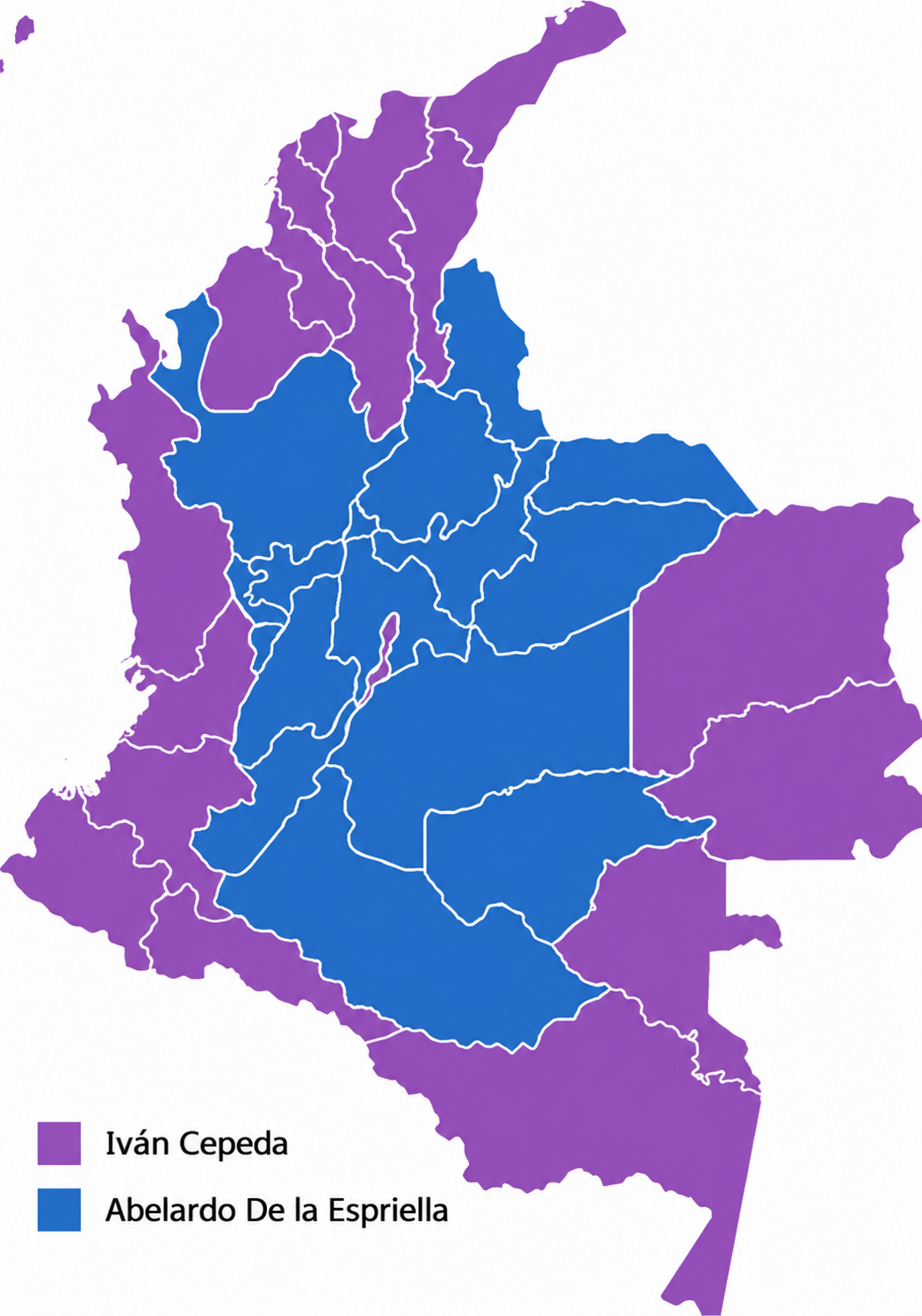
Colombia 2026 1st round top two (Graphic: Sofi Imfeld for Finance Colombia)
Then there is the absence of a track record. He has never held any office, so there is nothing to go on. Does he become a statesman or a caudillo wannabe? We do not know, and that uncertainty is itself a cost. Finally, the persona. His public identity strikes me as a bit of a gomelo — Colombian slang for a stuck-up rich kid. People often cultivate a public character that has little to do with who they really are, so perhaps the private Abelardo is a prince. But he is asking voters to choose the public one, and the public one rubs me the wrong way.
The case for Iván Cepeda
Now the honest case for Cepeda. He will very likely put real attention on the marginalized and the forgotten parts of the country, and the map backs this up: in the first round he carried the entire Pacific coast, the forested borders with Ecuador, Peru, and Brazil, and most of the Atlantic provinces — the exception being Antioquia, whose population concentrates far to the south around Medellín. Much of that Atlantic coast, outside Barranquilla and the touristy parts of Cartagena, has suffered generations of corruption and chronic underinvestment. Someone paying attention to those places is not a bad thing.
He is consistent and predictable. He has a long career and a coherent, stable ideology. I may disagree with that ideology — you will hear about it in the cons — but no one can call the man unpredictable. You know what you are getting, and in politics that is worth something.
He would try to actually implement Santos’s 2016 peace accords. The pact has real flaws and lacked genuine commitment from the current and previous administrations, but it did demobilize thousands of fighters who are no longer in the bush kidnapping and bombing people. Pushing to finish that work honestly has value.
And to be fair, he is clearly more competent than the ally currently in office. He is more intelligent and more disciplined than Gustavo Petro. Consider how Petro has governed: unable to push through much of his agenda, running the Casa de Nariño like a reality show, cycling more than sixty ministers through nineteen ministries in under four years. How do you accomplish anything while swapping in a new minister roughly every three weeks? I do not think a Cepeda administration would bring the same chaos and palace intrigue. And he would command the largest bloc of support in Congress, so he would be more effective at moving his agenda; he knows how the machinery works. Credit where it is due — he does not stand up in cabinet meetings inventing his own physics. That is a low bar, but Petro keeps walking under it and Cepeda clears it.
Finally, he has a real, lifelong commitment to the victims of violence in Colombia. Whatever else you say about him, that commitment is genuine and it is the through-line of his entire life. That counts.
The case against Iván Cepeda
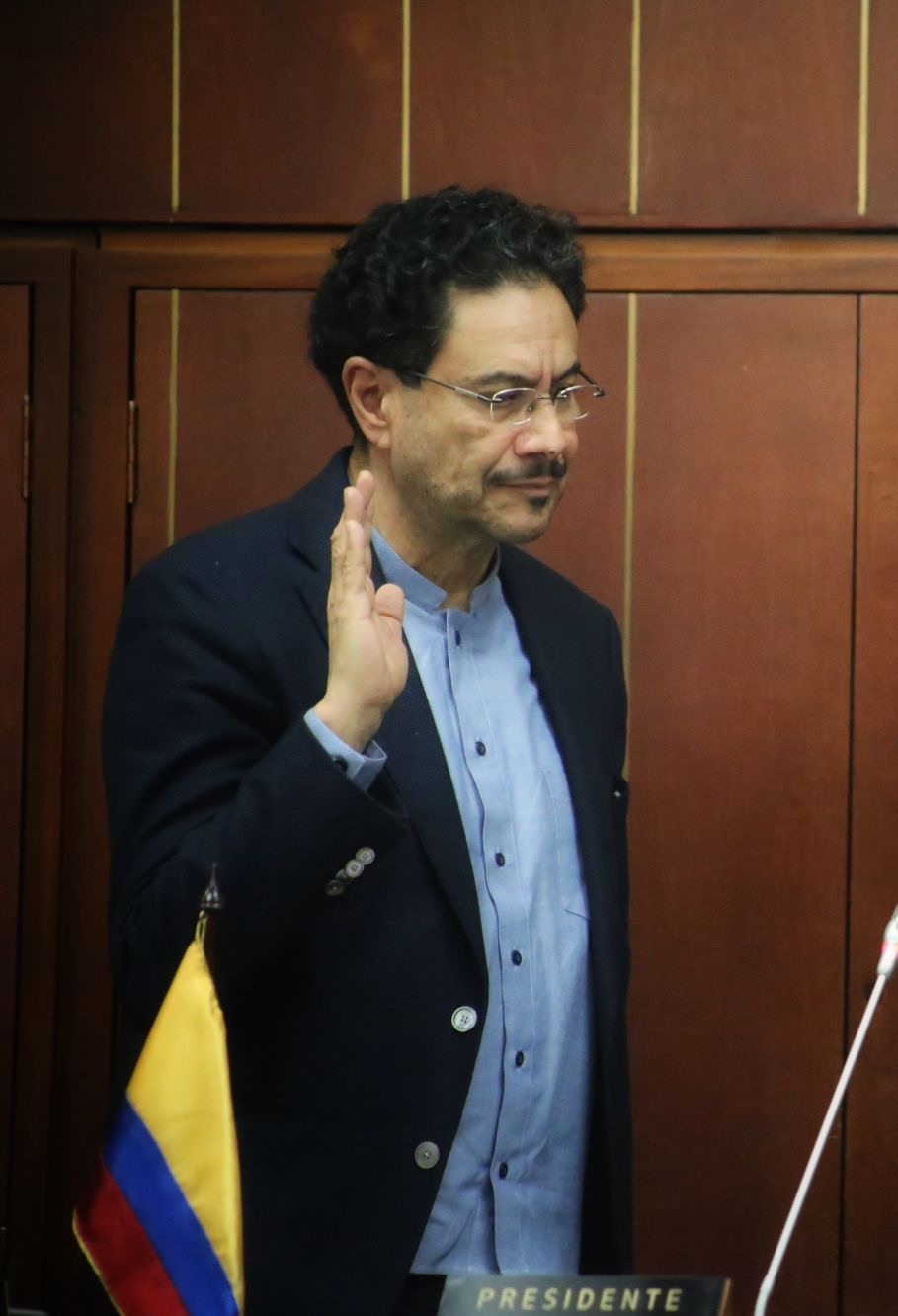
Iván Cepeda is a senator, former member of the Communist Youth, educated in Bulgaria during the Soviet era, and key player in the negotiation with armed guerilla groups. (photo: Colombian Senate)
And there are many cons. The first is the mirror I opened with: he has shady friends too. He was close to the Chavista senator Piedad Córdoba. Just as de la Espriella calls his contacts with Boliche purely professional, Cepeda says his ties to the FARC commander Raúl Reyes were purely those of a peace negotiator. But Cepeda went further. When the FARC commander Jesús Santrich was locked up and ready to be extradited to the United States on drug-trafficking charges, Cepeda worked fiercely to get him released from the Fiscalía‘s Bunker. Once out, Santrich fled into Venezuela and restarted the Segunda Marquetalia, a FARC dissident network. And here is the part that lands like a gut punch a year later: that same Segunda Marquetalia is the group Colombian prosecutors have now linked to the assassination of presidential candidate and senator Miguel Uribe Turbay, who was shot in Bogotá in June 2025 and died that August. I want to be careful and fair — that is an attribution by the Fiscalía, and serious analysts at Insight Crime have noted the public evidence is thin, so it should not be treated as settled fact. But the chain — Cepeda helps free Santrich, Santrich restarts the Segunda Marquetalia, the Segunda Marquetalia is tied to a magnicidio — is a heavy thing to carry into a presidential race.
Second, he is soft on the guerrillas, broadly. He has a proven record of leniency toward the FARC, the ELN, and armed groups generally, and he is an architect of Petro’s failed Total Peace. Under that nurturing approach those groups have flourished, and I think they would keep flourishing under a Cepeda administration. He seems to see them more as victims of state violence than as the kidnappers, narcotraffickers, extortionists, and terrorists that they are. La Silla Vacía’s own reporting — and they are not a right-wing outlet — concluded that Cepeda bears real political responsibility for the failure of Total Peace, having pushed a negotiation model that was too ambitious, legally ambiguous, and weak before armed groups. When the violence comes from the state, Cepeda sees structure and systemic responsibility; when it comes from the guerrillas, he tends to see context and a chance for peace. That blind spot defines him.

Former 2022 presidential candidate Rodolfo Hernandez (photo: candidate’s website)
Third is his health and his running mate, which is delicate but real. Cepeda has had cancer twice. The late Rodolfo Hernández, who lost to Petro in 2022, died in 2024 of cancer after also having had liver and colon cancer, so the risk is not hypothetical. If Cepeda did not finish his term, Aida Quilcué would take over, and her career — as an indigenous Nasa leader, minga organizer, and senator — has centered on those issues rather than monetary policy, foreign affairs, or national security, which makes her approach to them a genuine unknown. People also doubted Francia Márquez, and she turned out to be the articulate, level-headed one beside Petro’s wilder talk, so I will say nothing against Quilcué as a person. But a possible succession to a medically fragile president is an inarguable risk, and it would be foolish to pretend otherwise.
Fourth, I cannot imagine investor confidence improving under a Cepeda presidency. A data point worth chewing on: the peso is currently strong. Part of that is the dollar’s broad global weakness, but part of it, in my read, is the market reacting to the strong polling of Cepeda’s opponent. Markets vote too, and they are nervous about the left.
Fifth, the father — and I want to be fair here. You cannot reliably judge a son by his father; my own father was a politician, and as an adult I spent most of my life in the party opposite his, with a great relationship and very different philosophies. So I will not convict Iván Cepeda for his father’s beliefs. The difference is that Cepeda does seem broadly aligned with them. His father was secretary general of the Colombian Communist Party, Iván studied in Soviet Bulgaria, and though he says he grew disillusioned with the hypocrisy of Soviet communism, he still appears committed to a far-left ideology. If that is your cup of tea, count it a plus; I have never been fond of Marx or Engels.
Sixth is crop substitution, and this one deserves a direct conversation. On paper it sounds marvelous: rather than spray coca with herbicides that wreck the environment and people’s health, offer farmers a legal alternative and a path out. If it worked the way it is drawn up, I would back it one hundred percent. The problem is the gap between the brochure and the dirt road — and that gap is built on a premise that simply is not true on the ground: the premise that the campesino is a free actor who chooses to grow coca and could, if persuaded, choose to grow something else.
In much of rural Colombia, the small farmer does not get to volunteer. Where the FARC dissidents and the ELN hold territory, the armed group tells the farmer he will cultivate coca, do the manual labor of harvesting it, and sell the leaf or paste to the group at a price the group sets — under penalty of death. Refuse, and the farmer is driven off his land or simply killed. This is not a lifestyle preference; it is coercion at gunpoint. The reporting bears out the broader pattern. Finance Colombia’s coverage, drawn from InSight Crime, documents how the power vacuum left by the FARC’s 2016 demobilization was filled by the ELN, the Gaitanista Self-Defense Forces, and FARC dissidents fighting for control of coca zones, and how the state’s failure to deliver on substitution let armed groups fill the vacuum and tighten their grip. The human cost is staggering: after families signed substitution agreements, the murder rate of supportive social leaders rose by 546 percent, according to a study cited by InSight Crime, and only about 5 percent of the program’s 2023 budget was actually executed. You cannot ask a farmer to switch crops when the entity controlling his life and his land is not the government but a guerrilla faction that has already told him what he will plant.
That is why this is not a matter of asking farmers nicely to grow coffee or cacao. It is not their choice. Security has to come first. Crop substitution can only work where the state — not the guerrillas — holds the territory and can guarantee a farmer’s safety when he says no to coca. The armed groups must be displaced before substitution has any chance, and any candidate who treats substitution as a soft alternative to security has the sequence backwards. That is the simple truth of it, and it is the heart of my concern with the Total Peace approach Cepeda helped design.
Seventh, he wants to expand the state’s role across the board, including continuing Petro’s effort to take over the health sector. Before the pandemic, Colombia had one of the best reputations in the world for health-care quality. Is it unequal? Yes — care in an isolated hamlet does not match Cali or Medellín, and the south of Bogotá does not match the north. Then let the government build clinics and hospitals where they are missing. There is no reason to take over the parts of the private system that work in order to do that, unless one objects on ideology to doctors and dentists existing as small businesspeople. That is ideology, not health policy.
Eighth, if Cepeda wins he may well protect Daniel Quintero, the former mayor of Medellín under indictment on more than forty counts of corruption. That kind of debt-collection worries me. And ninth, the selective conscience. Cepeda is a former member of the Communist Youth — a plus if you are a communist, unsettling if you are not. The FARC and ELN are also communist groups; one wonders whether that is the root of his apparent sympathy. He casts himself as a human rights defender yet stays conspicuously silent on the abuses of the Chavista regime in Venezuela. La Silla Vacía documented this in detail: roughly a decade of avoiding criticism of Maduro’s repression, fraudulent elections, and alliances with Colombian guerrillas. Cepeda notices human rights violations committed by people he dislikes while exempting bad actors he is closer to, provided they are communist or socialist. The record on that is fairly clear.
So where does that leave us?
Two men. One built his life on being seen — a brilliant, theatrical defense lawyer for the powerful and the accused, now promising an iron fist while surrounding himself with at least one genuinely serious technocrat in José Manuel Restrepo. The other built his life on a single tragedy — a disciplined, consistent, ideologically committed man of the left who has fought for victims for thirty years, and who carries a blind spot the size of a guerrilla encampment.
Here is the paradox I cannot get past: the “tough on crime” candidate has spent his career defending criminals, and the “human rights” candidate stays silent on half the human rights abuses in his own backyard. Each is, in some way, the very thing he claims to oppose. This is not a runoff between an angel and a devil. It is a runoff between two men who each ask voters to trust that their inconvenient friendships were strictly professional.
I am uneasy about both candidacies, for very different reasons, and I am doing what I said I would: laying it out and handing it to the reader. For deeper background, see Finance Colombia’s earlier survey of how the leading candidates draw divergent maps for foreign capital, security, and the rule of law, its reporting on what is behind Colombia’s increased violence, and its account of the final push of the Total Peace policy. The runoff is Sunday, June 21, and the winner is inaugurated August 7.
While opponents seek to invalidate de la Espriella’s candidacy, current President Gustavo Petro is also an Italian citizen.
Abelardo de la Espriella, the conservative outsider who led the first round of Colombia’s presidential election and now heads into a June 21 runoff against leftist senator Iván Cepeda, has put an unusual question on the table: could Colombia, for the first time, elect a president who is also a citizen of the United States?
De la Espriella holds three nationalities. He was born in Colombia — making him Colombian by birth — inherited Italian nationality through his maternal grandparents, and obtained US citizenship by naturalization in February 2023, according to La Silla Vacía. It is that third passport, not the mere fact of multiple nationalities, that has triggered a constitutional debate which could shadow the campaign to its final day.
More than thirty jurists, academics, and constitutionalists — among them, La Silla Vacía reported, former Council of State president Stella Conto Díaz, Álvaro Echeverri, Ramiro Bejarano, Leopoldo Múnera, and Rodrigo Uprimny — signed a statement warning that his US citizenship could amount to an “incompatibility” with the presidency. Their objection is specific. Colombian naturalization in the United States requires an oath in which new citizens declare they renounce “absolutely and entirely” all allegiance to any other state of which they have been subjects. There, the signatories argue, lies a tension between that oath and the duties a Colombian head of state must perform — a concern they tie to the Constitutional Court’s own references to “potential conflicts of national loyalty.”
“Constitutional disqualifications are not discovered. They are expressly established or, simply, they do not exist.” — Mauricio Gaona, constitutional lawyer
The debate turns on what the Constitution actually requires. Article 191 states that to be president a person must be Colombian by birth, a citizen in exercise, and over 30 years of age. As campaign legal adviser Germán Calderón España told La FM, those are the only three conditions, and none excludes a Colombian by birth who holds a second nationality. Disqualifications, he argued, must be expressly written into the Constitution or the law rather than inferred. Calderón also said the campaign was facing what he called a “tutelatón” — an estimated 30 tutela constitutional-rights petitions a day from allies of the Pacto Histórico, Cepeda, and President Gustavo Petro.
Constitutional lawyer Mauricio Gaona reached the same conclusion in a published legal opinion, reported by Infobae. Gaona wrote that dual nationality is legally valid, that holding simultaneous legal duties to more than one state is possible, and that US naturalization — including its allegiance oath — “does not create a constitutional disqualification to exercise the Presidency of the Republic of Colombia.” He grounded the analysis in the Constitution, Law 43 of 1993, US nationality law, and US Supreme Court rulings including Afroyim v. Rusk (1967), Kawakita v. United States (1952), and Vance v. Terrazas (1980), as well as the US State Department’s position that “U.S. law does not require a U.S. citizen to choose between U.S. citizenship and another nationality.”
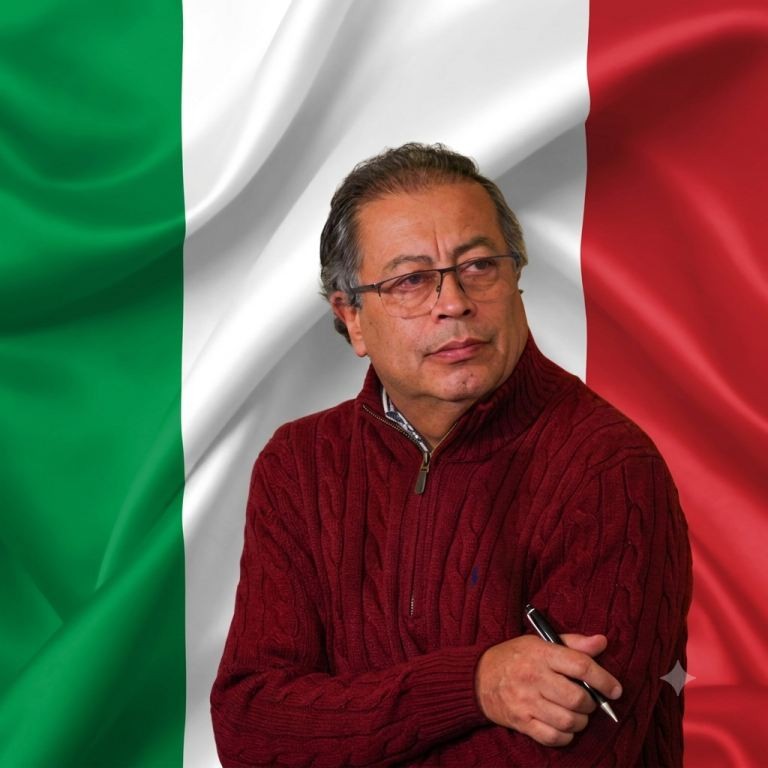
Current Colombian President Gustavo Petro is also an Italian citizen.
Gaona pointed to Article 191’s silence as decisive: the text, he wrote, does not require exclusive nationality, the absence of foreign citizenship, prior renunciation of another nationality, or a certificate of exclusive loyalty. He acknowledged that some specific posts — those tied to national security, intelligence, or classified information — can carry dual-nationality restrictions, but said any such limit must be expressly established. “Constitutional disqualifications are not discovered,” he wrote. “They are expressly established or, simply, they do not exist.”
The campaign has pointed to a sitting precedent: Petro himself holds Italian nationality, which he acquired through family descent, has openly acknowledged, and has cited as letting him travel to the United States without a visa; the US Treasury’s sanctions listing on the Colombian president records an alternate Italian citizenship, and in September 2025 he publicly weighed renouncing it in protest over the war in Gaza. The comparison has limits, however, and they cut to the heart of the dispute: Petro’s Italian citizenship — like De la Espriella’s own Italian nationality, which no one contests — was acquired by descent, without an oath. The critics’ argument rests specifically on the renunciation oath sworn in US naturalization, a step neither Petro’s nor De la Espriella’s Italian status involved.
There is also a political irony the candidate’s opponents have seized on: De la Espriella has built much of his campaign on overtly nationalist imagery, including the Colombian flag and the national soccer team’s jersey — symbols a tribunal ordered him to remove from his campaign within 24 hours, La Silla Vacía reported. His wife drew attention shortly before the first round when she suggested the family might move to Italy if he lost, a remark she later softened.
For now, the candidacy stands. The Fifth Section of the Council of State rejected a lawsuit seeking to strike De la Espriella from the ballot over his triple nationality, finding that the registration was not subject to that form of judicial review, La Silla Vacía reported. Whether the broader incompatibility argument ever reaches a definitive ruling — and from which court — remains unresolved.
The stakes are concrete for a country whose largest trading and security partner is the United States. De la Espriella, who campaigns as an admirer of US President Donald Trump and whose running mate is former finance minister José Manuel Restrepo, would bring an openly Washington-friendly posture to the Casa de Nariño; Cepeda would broadly continue the foreign policy of the Petro government. Voters return to the polls on June 21. If De la Espriella wins, the question of a president who also answers, at least on paper, to a second flag will move from the seminar room to the presidential palace.
25 years on, BPrO’s leader on building a world-class CX agenda
Ana Karina Quessep is the executive president of the Asociación Colombiana de BPO (BPrO), the trade association representing Colombia’s contact center and business process outsourcing (BPO) industry, and the driving force behind its annual CX Summit. Loren Moss, founder and publisher of Finance Colombia, spoke with Quessep in Cartagena as BPrO marked its twenty-fifth anniversary. The conversation has been lightly edited for clarity.
Finance Colombia: I’m here another year, another success, with Ana Karina Quessep. Ana — the head of BPrO, a youthful and tireless advocate for the contact center industry for over 25 years. BPrO this year is celebrating its 25th anniversary, and the event, the CX Summit, just keeps getting better. What do you consider to be the reason for the growth of BPrO, which started 25 years ago with 10 founding members and now has over 100?
Ana Karina Quessep: Well, actually, it’s been a great journey, and it’s a team effort, obviously — and it’s about how the sector has evolved, and all the companies established in Colombia, and those that also come to Colombia to do business. Obviously, growing the sites in Colombia helps us work better in order to have a better delivery. And one of the main things, I guess, is how we combine the academic agenda with all the commercial side — the booths and all the commercial partners are here. So I think that’s the most important thing, and that’s why we’ve been growing a lot.
“It’s been a great journey, and it’s a team effort.” — Ana Karina Quessep, executive president of BPrO
Finance Colombia: You know, you mentioned the academic sessions, the keynote speakers. I go to a lot of events. I just got back in the country Monday — I was at two different events, one in Las Vegas and one in Washington, DC — and I got back home here to Colombia and I was like, “I can’t wait to get home.” They were like, “But you’re a gringo.” I was like, “I want to go to Rionegro, Antioquia.” But the interesting thing is that, normally, at a lot of these events, the stands take the focus; and here we’ve got some great exhibitors, but the quality of the keynote speakers… I felt bad, because I felt like I couldn’t be out here mingling — I didn’t want to miss this session, and then the next session, and then the next keynote speaker. How do you attribute the success and the quality of the speakers? How do you find these people? You just had a big consultant from the United States who gave a speech, and at the end — who knew? — she’s Colombian. She grew up in the US. I had no idea. What’s your secret to the quality of speakers and attendees you have participating in the conference?
Ana Karina Quessep: Well, actually, it’s not an easy task, but we start with an academic committee. As soon as we finish here, we start searching for the right speakers and figuring out how we’re going to put together the whole agenda for next year. And one of the things is that I travel a lot, too, and I visit other countries and other conferences and try to summarize the best of the best and then bring it here — because it’s easier for Colombian companies, and companies from the region, to come to Colombia than to go to maybe Vegas. I mean, it’s very far away. But this is how we manage. So we have an academic committee, and we talk with the speakers and try to find the best every year. That’s basically it. And the other thing is that we do a panel survey at the end of the year in order to know what the companies want to hear at the next event. So, you know, we combine the committee, the search, and the survey — that’s how we build the agenda.
Finance Colombia: You’ve certainly figured it out. And I’ll let you go, because I know you have to mingle and you’re extremely busy. But I’m looking forward to the awards — in just a couple of hours we’ll know who won. Every year you have the awards, and they’re great, and I know the rigorous judging that takes place. So I’m super excited. I highly recommend this. I’ve talked to other people here at the event, and everybody is giving us positive feedback, saying this is the must-attend event — not just for Colombia, but for the region. So thanks so much. It’s great to see you again, and count on our enthusiastic support and collaboration always.
Ana Karina Quessep: Thank you so much to you, and for always being faithful to this event. I hope to see you next year.
Finance Colombia: Absolutely. Count on it.
Brad Cleveland is an author, consultant, and a founding leader of the International Customer Management Institute (ICMI), and one of the most widely recognized authorities on customer experience and contact center management. Loren Moss, founder and publisher of Finance Colombia, spoke with Cleveland on the sidelines of the Asociación Colombiana de BPO (BPrO) Customer Experience Summit in Cartagena, Colombia, where Cleveland was a featured speaker. Their conversation — touching on his latest book, Leading the Customer Experience, the role of artificial intelligence in customer service, and why better service often costs less — has been lightly edited for clarity.
Finance Colombia: I’m here with Brad Cleveland. It’s great to see you again, Brad. I’ve known you for a long time and been an admirer, as the founder of ICMI. I’ve been kind of an outside affiliate for a lot of years, as a judge for the awards that you all have. We’re here in Cartagena, Colombia, at the CX Summit put on by BPrO, which is the industry association here in Colombia. And it’s quite a nice surprise to see you here. Is this your first time at the CX Summit here in Colombia?
Brad Cleveland: It is, Loren, and great to see you. I know we’ve run into each other at a bunch of other events, and to be here in Colombia — yeah, this is my first time, and I’m really enjoying it.
Finance Colombia: Wonderful. I hope that after the event, whatever you do, you take a couple of days to go out and enjoy it and see things. We’re here in Cartagena, which is a beautiful, historic city. There’s so much to see.
I always try to do that when I’m here on business. But let me ask you: yesterday, you talked about leadership in customer experience, and I believe you also have a book that’s recently come out on that topic. Leadership is such a broad topic. Every industry talks about how important it is. LinkedIn is flooded with posts on leadership — but what is it about customer experience that prompted you to write this latest book? You talked about that yesterday, and that’s why I want to touch on it, because it’s a theme that is obviously very important and that you’ve given a lot of thought to.
Brad Cleveland: Yeah, well, thanks for the question. You’re on the right track. I would say there’s so much on leadership. I felt that customer experience needed more structure in terms of leadership. So Leading the Customer Experience covers the 10 pillars, starting with: what’s your vision, and the values behind that? And then it goes chapter by chapter. The second is that we’ve got to get our team on board. We really need them on board as we establish our vision, right? So these things do work together. And then there’s the customer engagement, the customer service, and the customer advocacy that we put in place as a culture; the budget — that’s a chapter. How do we budget for this? So the idea was to really lay this out step by step — not the customer experience cookie cutter. It’s big. It’s everything. It’s products, services, processes, our brand, our reputation. But I felt like there was a place for a little more structure in how we lead this.
Finance Colombia: You know, you bring up several good points right there, because a lot of times companies… And you see the companies that — not to overuse the word — lead in this area get it, and they integrate the customer experience into the whole fabric of who they are as a company. And it doesn’t matter whether it’s a consumer products company like Procter & Gamble (NYSE: PG), Smucker (NYSE: SJM), or Nike (NYSE: NKE) that doesn’t necessarily interact with its end user on a day-to-day basis, or those companies that do. We both got here on airlines.
And the airline industry is going through a lot of changes, and people are trying to figure out how to get it right. One of the things — when we talk about leadership — that I see and that concerns me is how AI, which I think overall is a good thing, is being implemented into CX, and how the decisions are being made around that. And my concern is not like a lot of people’s: “Oh, it’s going to replace all the jobs, it’s going to replace everything.” It’s not so much that. But if you remember — I’m old enough to remember — back in the ’90s when IVRs came out, everybody, especially the telecom carriers, went to replace everything with interactive voice response (IVR) systems. And you’d get into a loop. First they tried to have voice — that rudimentary voice recognition — and it would say, “I don’t understand. Can you repeat that?” And you’d get into this loop and you could never get out; you could never reach anybody. They just thought they could turn on this IVR system, fire everybody, go home, and everybody would be happy. It didn’t quite work out that way. I feel like it’s déjà vu all over again. Is there a breakdown in leadership, or what do you see that could be precipitating this?
Brad Cleveland: Well, there were predictions out of the World Economic Forum in Davos back in the 1990s that the internet was going to take over customer service. That proved to be exactly wrong. I mean, the internet grew the need for customer service. We’re seeing much the same with AI. It is a powerful, powerful capability, but we can’t make the same mistakes we’ve made in the past. There are three levels of value, and here’s how I like to think about this. The first level is efficiency. We’ve got to be efficient at what we do. A second level is customer experience: are we making things easier and better for our customers? The third level is strategic: what are we learning in the course of serving our customers that can help us improve products, services, and processes? This is a goldmine of insight. So right now, much of the industry is focused on, “Well, we’ve got this work — how can AI help with it?” Oh, and then there’s agentic AI, and there’s this and there’s that. We’ve got to think of all three levels and really put ourselves in our customers’ shoes: what’s going to work best at all three levels, where AI can be a partner with us — and a powerful one — if we use it right.
Finance Colombia: I think that’s key. People look at it too much as a line on a spreadsheet and say, “Hey, this can reduce these costs.” And yes, it can, but you can do it the right way and you can do it the wrong way. It’s just like there’s nothing at all wrong with running a BPO in India, for example — not to pick on India. There’s nothing wrong with doing that in itself, but so many people did it wrong. India wasn’t the problem; the way they implemented it was the problem.
Brad Cleveland: Well, right. And the same with our team, the same with technologies. It’s really all a matter of going back to our vision and values, and then the support behind that to make it work. Steve Jobs once said — and we’ve all heard this quote, but it’s a good one, and there’s a reason we repeat it so often: “You’ve got to start with the customer and then work back to the technology.” And the same thing is true with anything. You’ve got to start with the customer and then work back to our standards, our objectives, the processes we’re putting in place, the technology — everything to support that.
Finance Colombia: You know, I just had a problem at home with our fiber internet to the house, and I was so upset. I said, “Well, I’ll just change to the other company.” So I went to the other company’s sales channels, and they had tried to implement these automated chatbots. And I was ready — I was so mad at the other company that I was ready to buy. And I got put into a loop. I can show you — I can pick up the phone and show you where they never answered their own system that they had implemented. So that’s a failure on their part. And I sat there thinking to myself: if there were a third telecom option, an additional option, that would charge me more money but give me somebody to handle a problem when I have one, I would pay 20% more, maybe even 30% more. You can’t get ridiculous, but I would pay more.
Brad Cleveland: And the surveys all say that we all want it to be easy. Here’s the irony: it costs less internally to do a great job and to really involve humans where humans are best, because we’re going to get your business, right? And we’re going to have those problems solved so they don’t come back over and over. You put a pencil to that, and it doesn’t cost more to provide better service. It’s very rewarding to the budget side of things.
Finance Colombia: You can charge more, too. I’m not a rich guy, but I did not fly in the budget economy here. I paid more. I didn’t fly first class or anything, but I paid more to get the extra legroom and the free boarding and those little things. So you can charge more, too. Don’t be afraid to do that. There are people out there who will pay. There’s always going to be the bargain basement, but there are people who will pay for that experience. Now, I don’t want to take up too much time, because I see lunch is starting — I don’t want us to starve here. But I do want to mention that ICMI’s Contact Center Expo is coming up, I believe, October 27th to 30th. It’s always at the Loews Royal Pacific in Orlando, unless it’s been moved or something.
Brad Cleveland: Yes, it’s there this year again.
Finance Colombia: Okay, I’ve got to make my reservations. I always make my reservations early. So if you could — is there a website? I know ICMI is part of Informa. And if you don’t have it, don’t worry, we’ll add it in the lower thirds.
Brad Cleveland: Yeah, you can find it easily just by going to ICMI.com and looking for events — it’ll drop down. And, yeah, I’ve got to make my reservations as well. It’s coming up. It’s going to be a great conference. It’s an important time right now, with all the developments taking shape.
Finance Colombia: And ICMI — I’m there almost every year. It’s so important. It’s worth it. It’s a great conference, just like this one. It’s not a huge convention like something in Las Vegas, but it’s where you interact with your peers. Just like here at the CX Summit, there’s always a lot of thought put into the keynotes. You always leave not just inspired, but having learned something. And it’s big enough to be worthwhile, but small enough to really interact with people — not just the vendors, but colleagues. And I think that colleague interaction is a lot more important. Last question for you: what’s your impression — not just of your first time in Colombia, which I know you haven’t really seen outside of the lovely Hilton — but of the Customer Experience Summit put on by BPrO?
Brad Cleveland: I have loved it so far. It’s a great event, very focused on not just the technology and not just the management part, but the heart of customer experience — how it’s impacting our cultures, our future, our families. There have been some really great sessions that give a comprehensive view of where things are going and how important customer experience is to all of us. And just while we’re here — the food, the people are great. It’s just been a fun experience.
Finance Colombia: Absolutely. Just like with Informa, just like with ICMI, they’ve got great leadership at BPrO and CX Summit, and I think that makes a difference.
Brad Cleveland: Yeah, what a great team. What a great team they have.
Finance Colombia: Great. Brad, see you in October.
Brad Cleveland: Thanks, Loren. See you soon. Thank you.
BPrO honors Colombia’s top CX and BPO operators in its 16th awards at its 25th CX Summit
The Asociación Colombiana de BPO (BPrO) has announced the winners of its Interaction Awards 2026, the sixteenth edition of the association’s national program recognizing excellence in customer experience (CX) and business process outsourcing (BPO) in Colombia.
“The Interaction Awards recognize companies in all sectors of the economy with customer interaction processes, which, in the implementation of projects, contribute to the success of the company, providing a better service and promoting company/client relationships.” — Asociación Colombiana de BPO (BPrO)
The Interaction Awards are given out by BPrO to recognize companies “in all sectors of the economy with customer interaction processes, which, in the implementation of projects, contribute to the success of the company, providing a better service and promoting company/client relationships.”
BPrO, which is marking its twenty-fifth anniversary, created the awards to highlight the kind of standout performance and service delivered by companies central to the BPO industry, and to encourage others to follow their lead. The recognitions accompany the association’s Customer Experience Summit 2026 in Cartagena. (For context, see our coverage of last year’s CX Summit 2025 winners.)
BPrO’s 16th Interaction Awards honor Colombia’s top BPO, CX, and shared-services operators, led by Emtelco, Konecta, and Emergia.
The following is the full list of gold, silver, and bronze winners in each category.
Best Human Capital Management
Best Contribution to Social Responsibility
- Gold: Emergia
- Silver: Lean Solutions Group
- Bronze: DIAGEO
Best Technological Contribution
- Gold: Credibanco Cari AI
- Silver: Ayesa
- Bronze: Outsourcing
Best Data Analytics Strategy
Best Collection Strategy
Best Inclusion and Diversity Strategy
- Gold: Emtelco
- Silver: BPM Consulting
- Bronze: Atento
Best Customer Experience Strategy
- Gold: Konecta
- Silver: AV Villas
- Bronze: AlmaExperience Colombia
Best Employee Engagement Strategy
- Gold: Emtelco
- Silver: Atlantic Quantum Innovations
- Bronze: Jazzplat
Best Human Resources Management for Shared Service Centers
- Gold: Spectrum Brands
- Silver: Coomeva Centro de Soluciones y Servicios
- Bronze: Ecopetrol
Best Innovation Strategy for Shared Service Centers
Best Social Networking Strategy
Best Multichannel/Omnichannel Strategy
Best Export Management
Best Outsourcing Company Operation
- Gold: CallCenterMall
- Silver: Emtelco
- Bronze: Atento
Best Internal Operation
Talent Award
- Camilo Adolfo Rodríguez Sánchez, Emtelco
Executive of the Year Award
- Alcides Vargas Manotas, ScotiaGBS (Scotiabank group)
Carrier nears air operator certificate as seaplane service launches
Commercial seaplanes have returned to Colombia after a seven-decade absence, with the arrival in Medellín of the first amphibious aircraft in ALMA Air‘s fleet — a milestone for the country’s aviation sector, tourism industry, and regional connectivity.
Click above to watch the full interview
The aircraft departed from Fort Pierce, Florida, and made stops in the Bahamas, Jamaica, and Panama before landing in Medellín, completing a 1,555-nautical-mile journey over roughly 11 hours of flight. Three pilots took turns operating the crossing, and ALMA Air CEO Rupert Stebbings joined the aircraft in Panama for the final leg into Colombia.
With the arrival, Medellín becomes ALMA Air’s first base of operations as the company advances a plan to expand to Cartagena during 2026. The initiative aims to reshape air mobility in Colombia through amphibious connections to tourist destinations, coastal areas, and territories that are otherwise difficult to reach.
“Today we are not just bringing an aircraft to Colombia; we are giving the country back a way to connect with its geography, its tourism, and its enormous natural potential.” — Rupert Stebbings, CEO, ALMA Air
Although the company has already completed technical training and maintenance reviews abroad, it is now entering a key phase of coordination with Colombian authorities. ALMA Air said it will work alongside the country’s civil aviation authority, the Aeronáutica Civil, to ensure that the return of seaplanes operates under the highest operational safety standards — something the company describes as an essential part of its corporate DNA.
In parallel, the carrier will pursue approvals with agencies including the maritime authority Dirección General Marítima (DIMAR), the Ministerio de Transporte, and various municipalities to obtain the permits required at future water-landing sites. Among the first zones projected for operation are Barú, the Pacific coast, Guatapé, Ayapel, and Mompox, with the company noting that additional destinations across other regions will follow.
“Today we are not just bringing an aircraft to Colombia; we are giving the country back a way to connect with its geography, its tourism, and its enormous natural potential,” said Rupert Stebbings, CEO of ALMA Air. “This flight represents years of preparation, investment, and technical work to ensure that the return of seaplanes is done to the highest standards of safety and sustainability. Colombia has coastlines, rivers, lakes, and unique destinations that deserve new mobility alternatives, and at ALMA Air we believe we are about to open a new chapter for the country’s regional and tourism aviation.”
ALMA Air added that its team and operations are fully structured and that it is in the final stretch of obtaining its Air Operator Certificate (AOC), the indispensable requirement for beginning commercial service. Once that process is complete, the company expects to open a new era for tourism and regional aviation in Colombia, offering travelers a transport experience it describes as innovative, efficient, and connected to the country’s natural richness.
ALMA Air, established by Irelandia Aviation, first detailed its Colombia plans to Finance Colombia in an earlier exclusive interview with Stebbings.

Alma Air’s 1st Cessna Grand Caravan Seaplane (photo: Loren Moss)
Tecnoglass Inc. (NYSE: TGLS), the Barranquilla-based manufacturer of aluminum and vinyl windows and architectural glass, said its board of directors has declared a second-quarter 2026 dividend of $0.15 USD per share, equal to $0.60 USD per share on an annualized basis. The dividend will be paid on July 31, 2026 to shareholders of record as of the close of business on June 30, 2026.
The US-listed glassmaker maintains its $0.60 USD annualized payout.
The declaration holds the company’s quarterly dividend at the same $0.15 USD level it has paid each quarter since the start of 2025.
Tecnoglass manufactures windows and architectural glass for the single-family, multi-family, and commercial markets, and describes itself as the second-largest glass fabricator serving the United States and the largest architectural glass transformation company in Latin America. The company says its vertically integrated, 5.8 million-square-foot complex in Barranquilla supplies close to 1,000 customers across North, Central, and South America, with the United States accounting for 95% of revenue.
While its production base remains in Barranquilla, Tecnoglass redomiciled to the United States and shifted its headquarters to Miami over the past year, a move tied to its overwhelmingly US customer base. The company reported record 2025 revenue of $983.6 million USD.
Tecnoglass glass and windows appear on properties including One Thousand Museum and Paramount in Miami, Salesforce Tower in San Francisco, Via 57 West in New York, Hub50House in Boston, El Dorado International Airport in Bogotá, One Plaza in Medellín, and the Pabellón de Cristal in Barranquilla. Additional information is available on the company’s website.
Photo: Loren Moss
 Empleobilingue.com

- Director/a de operaciones para hotel, restaurante y discoteca 1626320364.60 - Medellín, Medellin, Antioquia, Colombia
- Coordinador/a de calidad para La Unión 1626483143.1 - La Unión, Antioquia, Colombia
- Desarrollador fullstack - Bogotá, Bogota, Colombia
- Technical Analyst - Remote
- PIM Administrator - Ecommerce - Remote (Bogotá, Bogota, Colombia)
- Auxiliar de gestión humana y bienestar para Girardota 1626060072.28 - Girardota, Antioquia, Colombia
- Marketing Strategist
- Trainer Manager - Bogotá, Bogota, Colombia
- Tolemaida UH- 60 Inspector - Bogotá, Bogota, Colombia
- Virtual Assistant - Team Lead - Remote
Contact Us

