

















Collective Mining (NYSE American: CNL; TSX: CNL) has reported results for eleven drill holes from its 2026 program at the Guayabales and San Antonio projects in Caldas, Colombia, headlined by the discovery of a new tungsten-enriched, high-grade subzone roughly 300 meters below surface at the Apollo system.
Drill hole APC-162, collared from Pad 31 and directed to the southwest, cut high-grade mineralization with observable coarse scheelite, chalcopyrite, and sporadic sphalerite and galena, returning 27.35 meters grading 37.55 grams per ton gold equivalent — 1.68% tungsten trioxide (WO3), 11.62 g/t gold, 54 g/t silver, and 0.43% copper — beginning approximately 300 meters below surface.
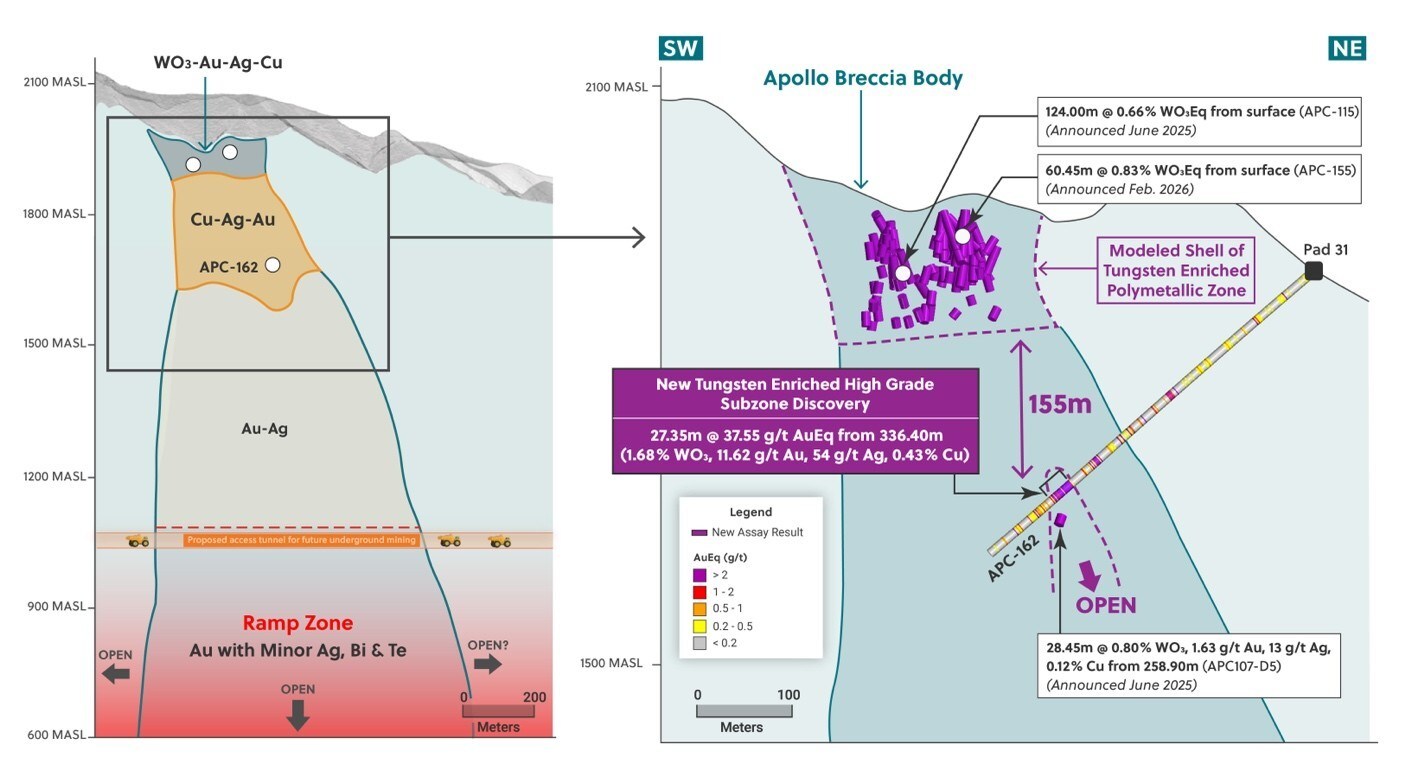
Figure 1: Section of the Apollo System Highlighting the new Tungsten Enriched Subzone Discovered 300 Meters Below Surface (CNW Group/Collective Mining Ltd.)
The hole was designed as the initial follow-up to test for an up-dip extension of a tungsten-rich interval first intersected in hole APC107-D5, which returned 28.45 meters at 0.80% WO3, 1.63 g/t gold, 13 g/t silver, and 0.12% copper. Together, the two holes define a new tungsten-enriched subzone that begins at approximately 300 meters below surface and is distinct and separate from the upper tungsten-rich zone, which covers the top 100 meters of the Apollo breccia body from surface. The new subzone remains fully open down-dip along the eastern contact margin of the Apollo breccia, with follow-up drilling expected to begin shortly.
“These results reinforce the exceptional scale and depth potential of the Apollo system,” said Ari Sussman, the company’s executive chairman. “The discovery of a new high-grade, tungsten-enriched subzone beginning 300 meters below surface, distinct from and well below the near-surface tungsten zone, demonstrates that Apollo continues to grow in both size and metal endowment with virtually every hole we drill. With 13 rigs turning and a fully funded 2026 program, we are well positioned to continue expanding the Apollo system in multiple directions.”
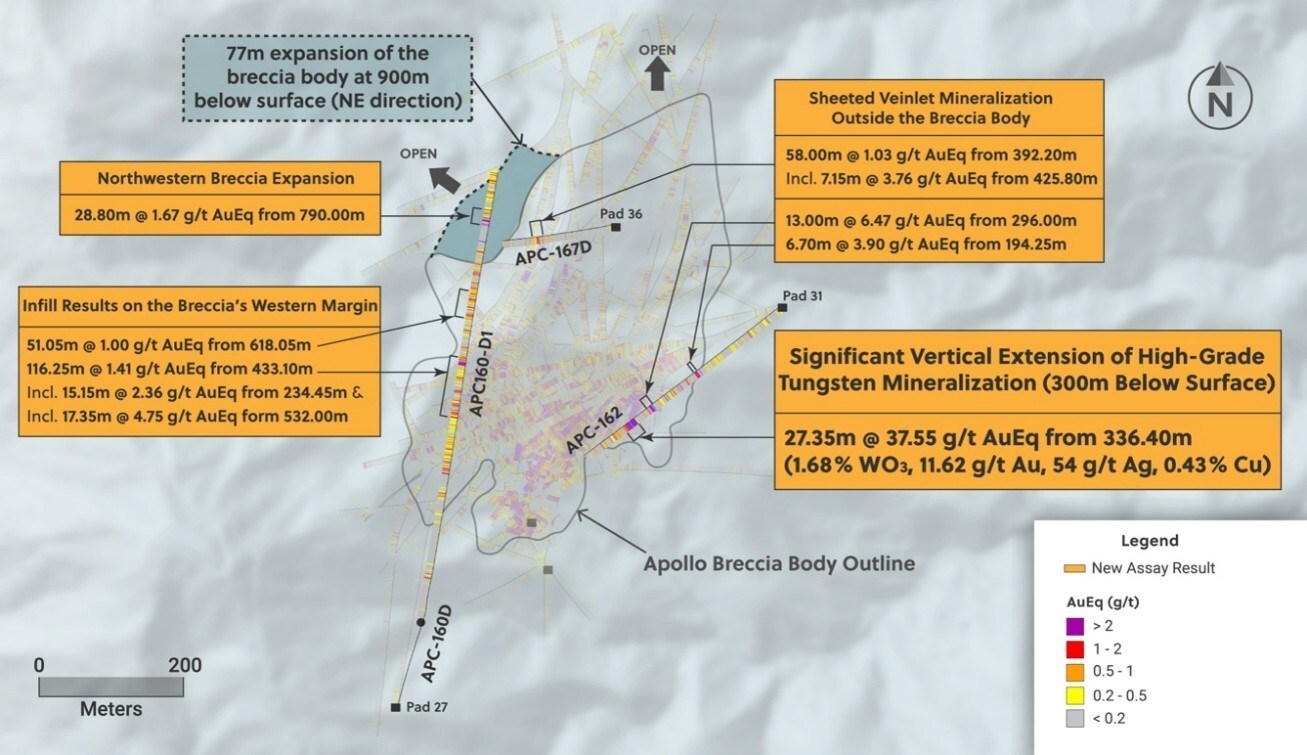
Figure 2: Plan View of the Apollo System Highlighting Drill Holes Announced in this Release (CNW Group/Collective Mining Ltd.)
A second hole, APC160-D1 — the initial directional hole collared from mother hole APC-160D at Pad 27 and directed north along the breccia’s western margin — extended the breccia body 77 meters to the northwest beyond its current outline at 900 meters below surface, intersecting 28.80 meters at 1.67 g/t gold equivalent. The same hole returned infill mineralization along the western margin, including 116.25 meters at 1.41 g/t gold equivalent from 647 meters below surface — with higher-grade cores of 15.15 meters at 2.36 g/t and 17.35 meters at 4.75 g/t — and 51.05 meters at 1.00 g/t gold equivalent from 800 meters below surface.
“The discovery of a new high-grade, tungsten-enriched subzone beginning 300 meters below surface, distinct from and well below the near-surface tungsten zone, demonstrates that Apollo continues to grow in both size and metal endowment with virtually every hole we drill.” — Ari Sussman, Executive Chairman, Collective Mining
Two further holes, APC-167D and APC-162, were drilled into diorite host rock north of and outside the main breccia body to improve confidence in the lower-grade halo mineralization surrounding it. Both intersected sheeted veinlet mineralization grading better than the company’s existing internal block model, with APC-167D returning 58.00 meters at 1.03 g/t gold equivalent from 418 meters below surface, including 7.15 meters at 3.76 g/t, and APC-162 returning 6.70 meters at 3.90 g/t gold equivalent from 223 meters and 13.00 meters at 6.47 g/t gold equivalent from 264 meters below surface. Four other holes — APC160-D2, APC169-D1, APC169-D2, and APC-173 — were exploratory in nature and did not intersect significant mineralization beyond thin, modestly grading individual veinlets.
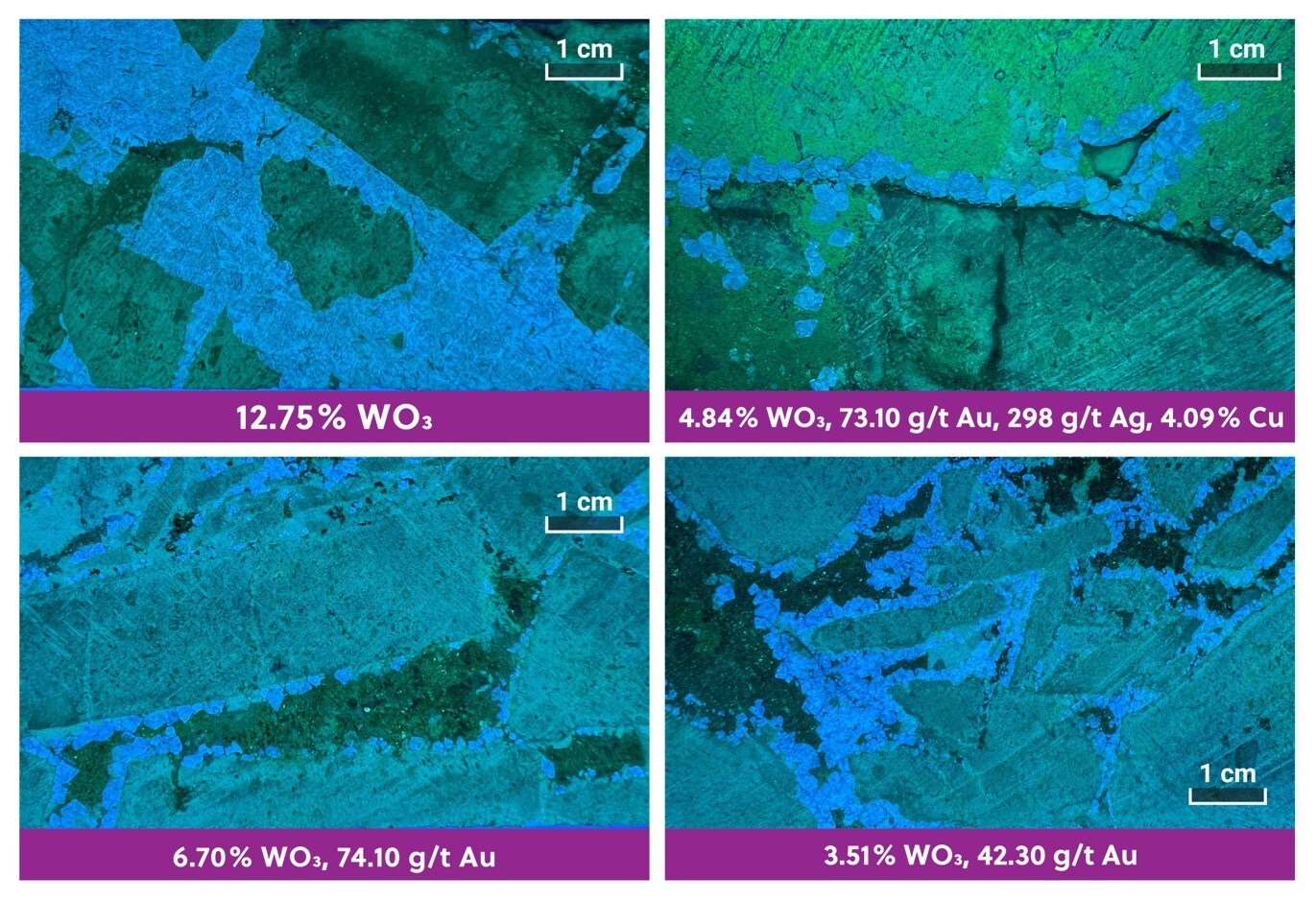
Figure 3: Core Photos Under Ultra-Violet Light Illuminating Coarse Scheelite (Tungsten) in Drill Hole APC-162 (CNW Group/Collective Mining Ltd.)
The Apollo system anchors the Guayabales Project, where Collective has been drilling the high-grade Ramp Zone and, in late 2025, announced its 2026 drill campaign. The company first disclosed the high-grade Ramp Zone discovery in October 2024 and has since reported strong metallurgical recovery rates at Apollo.
At the separate San Antonio Project, four exploratory holes — SAC-36, SAC-37, SAC-38, and SAC-39 — were collared from Pad 15 and Pad 16 at the Dollar target, about 700 meters south of the deep porphyry discovery at the Pound target. Modest porphyry-related vein mineralization was encountered in two of the holes. SAC-36 returned 0.90 meters at 962 g/t silver, 0.98 g/t gold, 0.15% copper, and 0.58% zinc from 101.40 meters downhole, plus 2.00 meters at 14.15 g/t gold from 471.35 meters. SAC-39 returned 29.20 meters at 1.28 g/t gold, 11 g/t silver, and 0.30% zinc from 246.30 meters downhole, including 5.95 meters at 3.51 g/t gold and 1.03% zinc. The company said it is evaluating San Antonio to assess its exploration potential and define priority targets ahead of future fieldwork.
To date, Collective has completed 184,000 meters of diamond drilling across the Guayabales and San Antonio projects, including 120,000 meters at the flagship Apollo system. The company reported $113.3 million USD in cash as of March 31, 2026, and said it is fully funded for a 2026 program that envisions up to 100,000 meters of drilling. It currently has 13 diamond drill rigs operating across the Guayabales Project.
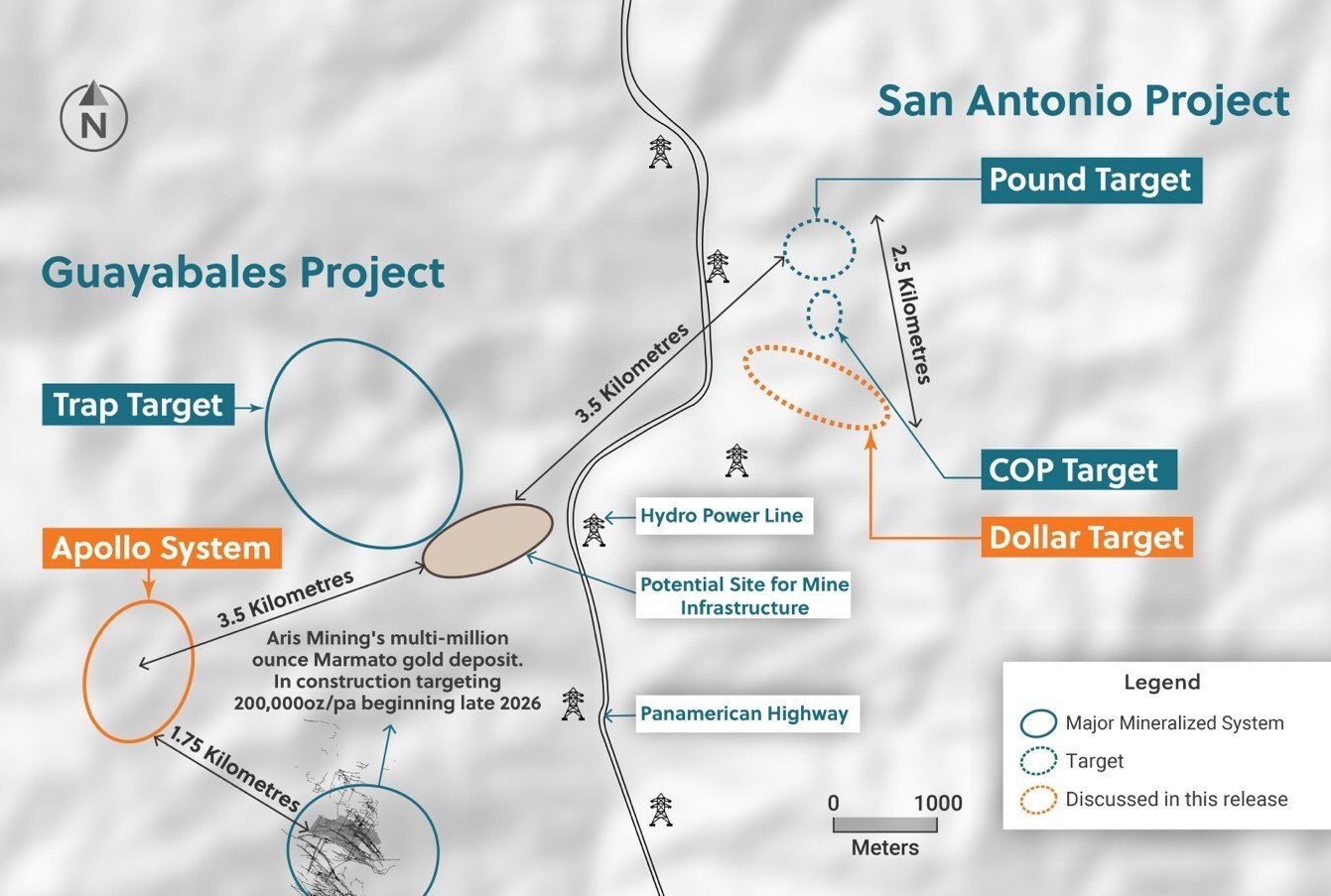
Figure 4: Plan View of the Guayabales Project Highlighting the Apollo System (CNW Group/Collective Mining Ltd.)
Gold-equivalent grades are calculated using metal prices of $3,000 USD per ounce of gold, $50 USD per ounce of silver, $5.00 USD per pound of copper, $1.35 USD per pound of zinc, and $90.72 USD per pound of WO3, with assumed recovery rates of 97% for gold, 85% for silver, 95% for copper, 85% for zinc, and 72% for tungsten. The company notes that the zinc recovery assumption is speculative, as limited metallurgical work has been completed to date, and that reported true widths are between 60% and 100% of the total intercept length, with uncut grades.
Collective Mining was founded by the team that developed and sold Continental Gold to Zijin Mining for approximately $2 billion USD in enterprise value. The company explores for gold, silver, copper, and tungsten in Caldas, where its two projects sit within an established mining camp that hosts ten fully permitted and operating mines. Management, insiders, a strategic investor, and close family and friends own 45.2% of the company’s outstanding shares. Collective Mining is listed on the NYSE American and the TSX under the symbol CNL.
Colombia’s Instituto Nacional de Vigilancia de Medicamentos y Alimentos (INVIMA, the National Institute for Food and Drug Surveillance) has granted sanitary registration to the CRISPR-TB Blood Test Kit, a molecular diagnostic for tuberculosis developed by IntelliGenome, clearing the test for commercial sale in the country.
The registration, issued under INVIMA Registration No. 2026RD-0009793, authorizes the importation and sale of the assay in Colombia.
Alongside the approval, IntelliGenome named Velez Lab S.A.S. as its exclusive distribution partner in Colombia under a long-term commercial agreement to expand access to the test across the country.
“We believe CRISPR-TB’s blood-based approach has the potential to expand access to tuberculosis testing, particularly for patients who are difficult to diagnose using conventional methods.” — Kurt Wehrle, vice president of partnerships and strategic alliances, IntelliGenome
The CRISPR-TB Blood Test is a blood-based molecular diagnostic designed to detect cell-free DNA from the Mycobacterium tuberculosis complex in patients with suspected tuberculosis. It uses CRISPR technology to support detection from blood samples through both laboratory-based and point-of-care testing, which the company says can serve centralized and decentralized healthcare settings.
Colombia is among the higher-priority tuberculosis markets in Latin America, with continuing demand for diagnostic approaches that complement existing testing strategies and support earlier diagnosis.
“Tuberculosis remains a significant public health challenge in Colombia, and innovative diagnostic approaches are needed to support earlier detection,” said Kurt Wehrle, vice president of partnerships and strategic alliances at IntelliGenome. “We believe CRISPR-TB’s blood-based approach has the potential to expand access to tuberculosis testing, particularly for patients who are difficult to diagnose using conventional methods.”
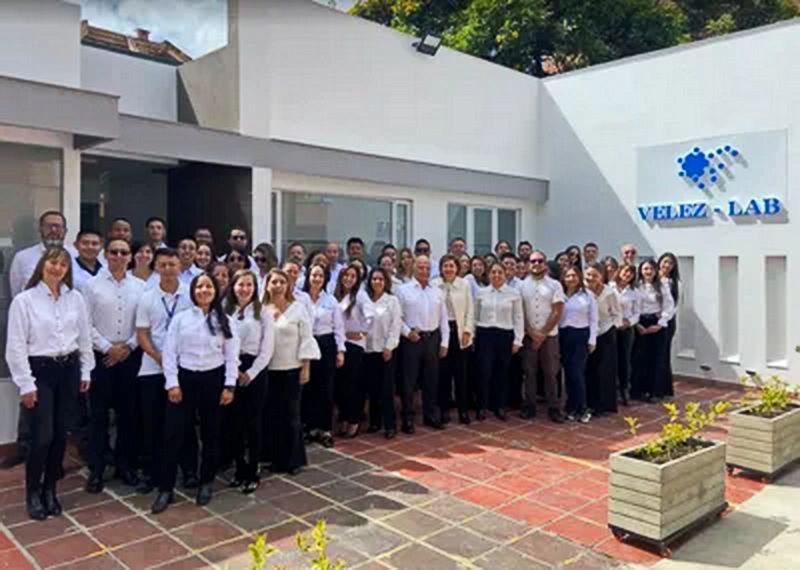
Velez Lab S.A.S. is a leading Colombian provider of laboratory technologies, medical devices, and in vitro diagnostic solutions serving clinical laboratories, hospitals, healthcare institutions, and research organizations throughout Colombia.
“We are excited to partner with IntelliGenome to bring the CRISPR-TB Blood Test to Colombia,” said Álvaro Vélez, chief executive officer of Velez Lab. “We believe this innovative technology has the potential to enhance tuberculosis detection and provide clinicians with an important new diagnostic option.”
The companies said they plan to work with healthcare institutions, researchers, and public health stakeholders to generate clinical evidence in pediatric tuberculosis, extrapulmonary tuberculosis, and other high-priority populations, with the aim of supporting future integration into tuberculosis screening, diagnosis, and patient management.
IntelliGenome is a molecular diagnostics company focused on CRISPR-based diagnostic technologies. Its CRISPR-TB platform is being evaluated through collaborations with clinical, academic, and public health partners, and the company is developing both laboratory-based and near-patient testing.
Velez Lab S.A.S. is a Colombian provider of laboratory technologies, medical devices, and in vitro diagnostic products serving clinical laboratories, hospitals, healthcare institutions, and research organizations. The company has operated for more than four decades.
United Airlines (Nasdaq: UAL) will become the first US carrier to operate nonstop flights from Houston and Washington to Cartagena, Colombia, with service from both hubs scheduled to begin December 17, the airline announced.
The flights will operate from George Bush Intercontinental Airport (IAH) in Houston and Washington Dulles International Airport (IAD), connecting both cities to Cartagena’s Rafael Núñez International Airport (CTG). United plans year-round service on each route, beginning with four flights per week during the winter season. The launch is subject to government approval.
Cartagena will be United’s third destination in Colombia, complementing existing service to Bogotá and Medellín. The airline has operated in the country for more than three decades. United recently added a Medellín–Houston route and expanded Bogotá service to the New York metropolitan area.
“Colombia has been an important part of United’s Latin America network for more than 30 years, and our new service to Cartagena reflects our continued investment in the country and commitment to offering customers new and distinct travel experiences.” — Patrick Quayle, Senior Vice President of Network Planning and Global Alliances, United Airlines
United said it offers more flights to Latin America than any other airline in both Texas and the Washington area, with nonstop service to 57 destinations from Houston and 18 from Dulles. The carrier said the new routes will connect Cartagena to more than 70 destinations across the US through its two hubs.
The Cartagena flights will be operated with a Boeing (NYSE: BA) 737. United said the aircraft offers seatback screens with Bluetooth connectivity at every seat and larger overhead bins, and that the airline plans to add free Starlink Wi-Fi for MileagePlus members. Lonely Planet named Cartagena a 2026 Best in Travel destination.
“Colombia has been an important part of United’s Latin America network for more than 30 years, and our new service to Cartagena reflects our continued investment in the country and commitment to offering customers new and distinct travel experiences,” said Patrick Quayle, senior vice president of network planning and global alliances at United Airlines. “As our third destination in Colombia, complementing our service to Bogota and Medellín, Cartagena gives our customers access to a different side of the country while making it easier for travelers across North America to experience one of the Caribbean’s most iconic destinations.”
“The architectural beauty, vibrant culture and thriving culinary scene are just a few reasons why travel experts say Cartagena should be on people’s bucket list this year,” said David Kinzelman, senior vice president and chief customer officer at United Airlines. “By flying direct, we’ll give our customers even more time to see the sights and along the way, they’ll enjoy all the value we pack into each flight — seatback screens, Bluetooth connections, larger overhead bins and a suite of tools to make the journey easier in the United app.”
Tickets are available on United.com and through the United app. The schedule below is subject to change.
| Route | Frequency | Departure | Arrival | Aircraft |
|---|---|---|---|---|
| Washington Dulles–Cartagena (IAD–CTG) | From Dec 17; Tue, Thu, Sat, Sun | 8:20 | 13:10 | Boeing 737 |
| Cartagena–Washington Dulles (CTG–IAD) | From Dec 17; Tue, Thu, Sat, Sun | 16:00 | 20:40 | Boeing 737 |
| Houston–Cartagena (IAH–CTG) | From Dec 17; Tue, Thu, Sat, Sun | 9:35 | 14:50 | Boeing 737 |
| Cartagena–Houston (CTG–IAH) | From Dec 17; Tue, Thu, Sat, Sun | 14:20 | 17:45 | Boeing 737 |
Avianca Group International Limited said on June 25 that its subsidiary Avianca Midco 2 PLC priced an offering of $650 million USD in aggregate principal amount of new 10.250% Senior Secured Notes due 2032, a step the Colombia-based airline group will use to refinance debt coming due in 2028 and lengthen its maturity profile.
The notes were priced on June 24, according to the company. Their terms and the collateral securing them are identical to those of Avianca’s existing 9.625% Senior Secured Notes due 2030 and 9.500% Senior Secured Notes due 2031.
Proceeds retire Avianca’s 9% 2028 notes, extending debt maturities
Avianca intends to use the net proceeds to redeem all of its outstanding 9.000% Senior Secured Notes due 2028 and all of its outstanding 9.000% Tranche A-1 Senior Notes due 2028, with the remainder going toward general corporate purposes that may include repaying other indebtedness in the future. The company said the transaction is meant to extend the maturity of its debt. The announcement does not constitute a redemption notice for the 2028 notes or the Tranche A-1 notes.
The offering is expected to close on July 7, subject to customary closing conditions.
The notes have not been registered under the US Securities Act of 1933 and may not be offered or sold in the US absent registration or an applicable exemption. They are being offered to qualified institutional buyers under Rule 144A and to certain non-US persons in offshore transactions under Regulation S.
After more than ten years in the courts, a judge in Barranquilla has convicted eight of the thirteen people accused in the “Global Brokers” case, one of the largest real estate frauds in Colombia’s Caribbean region, according to an investigation by El Heraldo. The losses attributed to the scheme exceeded $32 billion COP — about $9.4 million USD at current exchange rates. (USD figures throughout are approximate, converted at roughly 3,480 COP per USD.)
According to El Heraldo, which obtained the 209-page ruling, the Juzgado Cuarto Penal del Circuito con Funciones de Conocimiento de Barranquilla, presided over by Judge Martha Lucía Fábregas Araujo, convicted Kimberly Hutchinson Vargas, Gloria Hutchinson Garrido, José Gregorio Pérez Arteaga, Janett Vargas Gómez, Carlos Andrés Leal Chávez, Ostap Rafael Tapias Artuz, María Mónica Montero Castilla and Gina Maestre as co-perpetrators of estafa agravada en masa (aggravated mass fraud). The decision is a first-instance ruling and can be appealed before the Sala Penal del Tribunal Superior del Distrito Judicial de Barranquilla.
According to the investigation by the Fiscalía General de la Nación, as reported by El Heraldo, between 2012 and 2015 the defendants operated a corporate web built around companies including Global Brokers Asociados S.A., Grupo Constructores Aliados S.A.S., Grupo Empresarial Aliados S.A.S. and Alianza Grupo Empresarial. The pitch, El Heraldo reported, was simple and seductive: properties said to be under seizure, headed to judicial auction, or tied to negotiable mortgage debt, offered well below market value to buyers hungry for a home of their own.
In a 2016 bulletin, the Fiscalía said the companies, “through deception,” told clients the homes were assets held by the now-defunct Dirección Nacional de Estupefacientes (DNE) — Colombia’s former narcotics-asset agency — and that, although buyers paid the purchase price for the firms to handle the transfer, the properties were never delivered. The same property was sold under several contracts, and some units offered were not in any legal process at all, the Fiscalía said. While headquartered in Barranquilla, the network also operated in Cartagena, Valledupar, Montería, Santa Marta, Cali and Bucaramanga, according to the prosecution. By August 2016, the Fiscalía had registered more than 330 victims.
The court found that the offers never materialized. According to the ruling cited by El Heraldo, victims were “contacted by telephone, by email or in person, and summoned to formal physical offices located in recognized buildings in Barranquilla and other cities, which created an appearance of legality and solvency.” Buyers were shown listings, photographs, addresses and supposed case files — at times using tools such as Google Maps to prove a property physically existed — and were told the company held “a privileged right” to acquire it. They signed management, mandate or “good-faith offer” contracts, then handed over their money.
The funds, the ruling found, were not used to buy the promised mortgage portfolios or litigation rights but were diverted “to other business or personal ends,” or used to make partial refunds to earlier clients and keep the operation running, according to El Heraldo. When victims demanded their money back, they received bounced checks, new deadlines that came and went, or shuttered offices. In many cases, El Heraldo reported, the properties were never awarded, no real auction existed, or the same unit had already been sold to other buyers.
The ruling drew on at least 80 statements from victims and court officials, El Heraldo reported, documenting losses of $24.875 billion COP in payments to Global Brokers, $4.861 billion COP to Grupo Constructores Aliados, and $2.941 billion COP from people seeking homes. The human cost ran deeper than the balance sheet. As El Heraldo put it, over the years of the case “many were the people who died waiting for the delivery of the supposed property for which they had paid Global Brokers.”
The contrast between the victims’ losses and how the company’s money was spent surfaced early. At a 2016 detention hearing, the case prosecutor, Francisco Cuesta Manyoma, alleged that one of the firm’s directors, Eduardo Vargas Gómez, “lived the life of a rich man” — bankrolling a women’s football team he owned and, on one occasion, spending $1 billion COP (roughly $300,000 USD at 2016 exchange rates) in a single week “with a stunning blonde,” all with clients’ money, as reported by El Heraldo and Pulzo. The prosecutor added that some victims had sold their homes to invest in the scheme, and that one of them died “of moral grief” (de pena moral) in his living room after realizing he had lost everything.
On the sentence itself, the court imposed 114 months in prison — nine years and six months — on each of the eight, plus a fine of 838 monthly minimum wages (salarios mínimos mensuales legales vigentes), more than $1 billion COP, and disqualification from public office for the same period, according to El Heraldo. The judge acquitted all the accused of captación masiva y habitual de dinero (mass unlawful deposit-taking), finding the conduct did not fit the offense, and declared the concierto para delinquir (conspiracy) charge time-barred under the statute of limitations.
Here the passage of time did more than test the victims’ patience — it reshaped the outcome. According to El Heraldo, the court determined that five of the convicted — Kimberly Hutchinson Vargas, Gloria Hutchinson Garrido, José Gregorio Pérez Arteaga, Carlos Andrés Leal Chávez and Ostap Rafael Tapias Artuz — had already served their prison terms through the time they spent in preventive detention during the proceedings, and ordered their release; they remain liable for the fines. The remaining three were granted house arrest, subject to a compliance undertaking and a bond of two minimum wages.
The timeline shows how the case stretched across a decade. The Fiscalía moved against the network as early as 2016: in a July 2016 operation by the Cuerpo Técnico de Investigación (CTI) and military police, seven alleged members were captured, and company directors were placed under house arrest, the prosecution announced that August. The Fiscalía General de la Nación then filed its formal accusation in January 2017 against thirteen people, El Heraldo reported, charging aggravated fraud, mass deposit-taking, conspiracy and forgery of private documents. The preparatory hearing began in June 2017 and, given the number of defendants, defense lawyers, victims and pieces of evidence, ran across multiple sessions. The oral trial opened in January 2018. The verdict came on June 5, 2026.
It was not the first conviction in the saga. In 2019, a separate Barranquilla court sentenced Adonis Antonio Brugés Herrera, described as one of the masterminds of the scheme, to 143 months in prison and a fine of about $596 million COP, as Zona Cero reported at the time. El Heraldo had already chronicled the scheme as far back as 2017 and tracked its defendants through 2018.
Why it took so long
The scandal is not only what the fraudsters did; it is that the system took more than ten years to deliver a partial reckoning — and that, for several defendants, the punishment was effectively complete before the verdict arrived. “Justice delayed is justice denied,” the maxim holds, and the Global Brokers case is a study in the structural features of Colombian justice that produce that delay.
The first failure came before any courtroom. According to Zona Cero’s 2019 reporting, the Superintendencia de Industria y Comercio — the consumer-protection regulator — declined to investigate victims’ complaints and shelved them, with its consumer-protection investigations director concluding that no breach by Global Brokers had been proven and accepting the company’s claim that it had returned customers’ money. That claim, Zona Cero reported, proved false; it was the Fiscalía, not the regulator, that ultimately built the criminal case.
The courts themselves are chronically overloaded. According to the Corporación Excelencia en la Justicia, a respected judicial-monitoring nonprofit, congestion in the judicial branch has hovered around half of the docket for years. The same organization found that 93% of criminal complaints in Colombia never advance beyond the preliminary inquiry stage, and Asuntos Legales has reported that barely 5% of criminal proceedings end in a sentence. A complex, multi-defendant fraud trial competes for scarce hearing time against an enormous backlog.
Time also runs against the prosecution by law. Under Colombia’s accusatory criminal-procedure code, the clock on the statute of limitations restarts once charges are formally filed and then runs for a period tied to the penalty — which, combined with repeated hearing postponements, can let charges expire before a verdict. In Global Brokers, that is precisely what happened to the conspiracy count, which the judge declared time-barred.
Finally, the case illustrates how lengthy preventive detention can invert the order of justice. For five of the defendants, years held before a final verdict became the sentence itself — punishment served first, conviction confirmed later, with the appeal still ahead. Colombia’s Congress passed Ley 2477 of 2025 specifically to reduce judicial congestion and speed up decisions, but for the Global Brokers victims, the reform arrives a decade too late.
The ruling, El Heraldo noted, does not resolve what victims most want to know: whether they will ever recover the money they paid. It is a first-instance decision, and it can still be appealed.
Unregistered or dormant nonprofits face administrative dissolution and cancellation of legal status
Colombia’s Ministry of Commerce, Industry and Tourism (MinCIT) has published a draft decree that establishes the procedure for dissolving and cancelling the legal status of nonprofit entities that fail to register with chambers of commerce or that remain inactive for extended periods.
In Colombia, chambers of commerce are public-private entities that maintain the official commercial registry of legal entities such as nonprofits, and are responsible for their legal recognition and renewal.
The measure implements Article 86 of Law 2294 of 2023, the National Development Plan, and formalizes how administrative authorities must proceed when foundations, associations, and other nonprofit entities do not comply with basic registration and reporting obligations.
Under the proposal, entities that fail to complete registration or renewal with their local chamber of commerce, or that are deemed to have ceased operations, would lose their legal status through an administrative process led by the competent inspection and control authority.
The draft establishes that once the legal deadline for registration has expired without compliance, authorities must initiate dissolution and cancellation procedures ex officio, meaning without a request from third parties.
“Once the deadline has passed without the registration obligation being met, the competent inspection, surveillance and control authority must, ex officio, declare the dissolution and cancellation of its legal status.” — Article 86 of Law 2294 of 2023.
In practice, this framework targets Entidades Sin Ánimo de Lucro (ESAL), including foundations, associations, and other nonprofit structures that operate under Colombian commercial and civil regulations.
Registration with chambers of commerce in Colombia serves as a mechanism for legal recognition and ongoing oversight. Entities that do not renew or maintain their registration risk being classified as inactive or noncompliant under existing regulatory frameworks.
Under Colombian administrative practice, an entity may be considered inactive when it fails to renew its registration, does not report activity, or shows no evidence of ongoing operations.
The draft decree also reinforces the role of supervisory authorities such as the Superintendencia de Sociedades, which oversees compliance and enforcement in the nonprofit sector under Decree 1074 of 2015.
Once implemented, the regulation would give authorities a clearer procedural path to close inactive or noncompliant organizations, particularly those that fail to demonstrate ongoing operational activity.
The Ministry has stated that the measure will improve transparency and ensure that the public registry reflects only active legal entities operating within Colombia’s nonprofit ecosystem.
The draft is now open for public comment before moving forward in the regulatory approval process.
Above photo: The Centro de Comercio Internacional in Bogotá (Photo: Pete Angritt / Wikimedia Commons)
With the National Electoral Council’s certification, Colombia’s 2026 presidential election has officially concluded
Colombia’s National Electoral Council (CNE) on Thursday, June 25, officially issued the credential certifying Abelardo de la Espriella as Colombia’s president-elect following his victory over lefties candidate Iván Cepeda in the presidential runoff held the previous Sunday. With this act, the electoral authority formally concluded the country’s 2026 electoral process.
The ceremony, broadcast on the CNE’s official YouTube channel, marked the end of the administrative phase of the election and opened the way for the presidential inauguration scheduled for August 7.
However, the election process demonstrated that it does not end when the polls close. Instead, it includes several administrative stages that voters should understand, particularly when the margin between candidates is as narrow as it was this year, at less than 1%.
Between election day and the official certification of the winner, a series of institutions, legal provisions and procedures intervene to verify the results and guarantee the integrity of the process. The following explains how the system works.
A two-round electoral system
Colombia’s 1991 Constitution establishes that the president and vice president are elected to four-year terms. The electoral process is governed primarily by Decree 2241 of 1986, known as the Electoral Code; Law 403 of 1997, which establishes benefits for voters; and Law 1475 of 2011, which regulates political parties and electoral processes. Since the 2015 constitutional amendment, immediate presidential reelection has been prohibited.
The presidential election consists of up to two rounds of voting. In the first round, political parties nominate their candidates, while independent candidates may also compete after collecting signatures from citizens, as was the case with Abelardo de la Espriella.
If no candidate wins an absolute majority: that is, 50% plus one of the valid votes, the two candidates receiving the highest number of votes advance to a runoff election, where only a simple majority is required. That mechanism determined this year’s presidential election.
National Registry and National Electoral Council: two different roles
Once voting concludes, the administrative phase of the electoral process begins. Two institutions make up Colombia’s electoral authority: the National Civil Registry (RNEC) and the National Electoral Council (CNE).
The National Civil Registry administers the voter registry, organizes the logistics of the election and receives information from polling stations across the country.
The National Electoral Council, meanwhile, is an independent body responsible for supervising, monitoring and overseeing the electoral process, resolving electoral complaints and issuing the official credentials certifying elected candidates.
Preliminary count and official canvass: what is the difference?
Following Colombia’s 2026 presidential election, both President Gustavo Petro and then-candidate Iván Cepeda urged the public to wait for the official results before recognizing the winner. Their calls reflected the distinction between two key stages of Colombia’s electoral system: the preliminary vote count (preconteo in Spanish) and the official canvass (escrutinio).
The preliminary count is the first report of election results. Poll workers, citizens appointed to receive and count ballots at each polling station, prepare the preliminary tally sheets and submit the information to the National Civil Registry.
The preliminary count is the first report of election results. Poll workers, citizens appointed to receive and count ballots at each polling station, prepare the preliminary tally sheets and submit the information to the National Civil Registry.
This procedure is purely informational. It provides an early indication of the election outcome but carries no legal effect.
Although differences between the preliminary count and the official presidential canvass have historically been minimal, this year’s narrow margin, less than 1% between the two candidates, led political leaders to insist on waiting until the legal certification process had concluded.
The official canvass produces the final results
The second stage is the official canvass, a legally binding process coordinated by the National Electoral Council.
During this phase, electoral witnesses accredited by political parties and campaigns review the tally sheets prepared by poll workers and may file objections if they believe counting errors or inconsistencies occurred.
Judges and notaries then examine those objections, compare the original tally sheets and determine the final result for each polling station.
It is during this stage that the electoral records acquire full legal validity, and the election results become legally binding.
According to the National Electoral Council, in no recent presidential election has the difference between the preliminary count and the official canvass exceeded 0.01%.
Legislative elections, however, may produce more significant changes. For example, during the final canvass of the March 2026 congressional elections, the Pacto Histórico coalition gained more than 390,000 additional votes, allowing it to secure two extra seats in Congress.
Certification and presidential inauguration: the last stage
Once the nationwide canvass has been completed, the National Electoral Council issues the official credentials certifying the elected candidates.
That step was completed on June 25 with the presentation of the presidential credential to Abelardo de la Espriella.
The final stage of the process is the presidential inauguration, scheduled for August 7, 2026, before the Congress of the Republic. During that ceremony, the president-elect will formally assume office for a four-year term. The inauguration is held before Congress because, under Colombia’s representative democracy, it serves as the institutional representative of the Colombian people.
Photo courtesy of the National Electoral Council.
Editor’s note: This article was published in 2020 during the COVID-19 health crisis. In March of that year, the government decided to close entry to the country to non-resident foreigners. Although the entry of foreigners into the country was reestablished in September, many regulations were constantly changing. The information presented in this article reflects the context of that moment regarding travel health policy options; however, the content has been edited to better represent the 2026 legal context and relevant information for travelers.
There is a lot of confusion right now regarding travel to and from Colombia during the COVID-19 Pandemic. Even the government seems confused about whether travelers must arrive with a recent negative coronavirus test, but what is important for the international traveler is to be prepared for any health contingencies during their travels, whether coronavirus-related or otherwise.
Finance Colombia spoke with colleagues at expatgroup.co to clarify the options available to travelers and visitors in order to protect their health and ensure proper coverage. Now more than ever, it is critically important to be properly protected in the case of illness or injury. Here is how travelers can take an essential fundamental first step towards a prudent visit.
The Colombian government has reopened the country for tourism. Still, passengers are concerned. What would you recommend for visitors or those seeking to live in Colombia for a time?
For all those foreigners who wish to come to Colombia either for a temporary or permanent stay, even if a negative COVID test is not required at this time, the recommendation is that they acquire a health policy with international coverage, which is valid in Colombia and also allows them to obtain health care in case of COVID-19.
But acquiring a travel health policy is not only recommended for those who enter Colombia for tourism. For foreigners who intend to apply for a visa and carry out activities other than tourism, having a health policy has become a priority.
Through Resolution 5477 of 2022, the Ministry of Foreign Affairs has eliminated many of the gray areas that previously allowed certain policies to be used. Today, the law requires specific details, such as whether the travel health policy covers elements like funeral repatriation or certain pre-existing illnesses.
These elements are not included in many traditional travel health policies. This is why, at Expatgroup.co, we recommend EG Assist: a health policy designed to meet the regulations required for those seeking a visa for Colombia.
What travel health policies are available for foreigners visiting Colombia? Are there different options?
Of course. The most important thing is to understand that each foreigner who applies for a health policy for a visa has different needs:
Visa Category:
EG Assist, for example, offers different types of plans that adjust to applicants’ profiles: they cover digital nomads, retirees, investor, residents, and many more. Each one adapted to the visa’s requirements.
The available budget:
Depending on the profile, some people are willing to make a higher investment in their security policies. With EG Visa Protect Pro, a person can increase the maximum amount that the policy covers for accidents or pre-existing illnesses. It even adds protection for missing luggage, something that not many health policies offer.
Period of Coverage:
One of the main reasons the vast majority of travel health policies are not optimal for visa applications is the duration. According to Resolution 5477, the health policy must be valid for the intended length of stay in Colombia, and in recent years, the goverment has become stricter and pursues that the health policy match the maximum granted time for a visa.
And since most visas have a maximum granted time of three years, this means that most health policies that work on a yearly basis are not optimal for a visa application. Instead, a foreigner should look for options like EG Assist that offer flexible, long-term terms, available for up to 3 consecutive years.
Overall, a foreign student should not only look for a health policy that complies with the law but also one that adapts to their needs. With EG Assist, you can compare plans to choose the one that best suits you.
What requirements do travelers need to purchase a travel health policy for their stay? (Documents, etc.)
Any traveler who wishes to purchase an international health policy can easily do so by providing the following information:
– Copy of the main page of the passport.
– Date of departure to Colombia and date of birth.
– Personal and emergency contact information.
Buying a policy in the country is really not a complex procedure. In fact, with EG Assist, a person only needs to scan their passport, and their system will recognize key data, such as the document number, name, and nationality.
Please keep in mind that the travel health policy is designed for people applying for different types of visas, such as the Nomad Visa or the Retirement Visa. For this reason, unlike other options, age is not a factor in determining the cost; it is determined by the length of coverage and additional benefits.
![Traveling to Colombia requires travel health policies that can work for you and for your companions' conditions. Photo by [Add author name here].](https://www.financecolombia.com/wp-content/uploads/2026/07/Secundaria-The-type-of-health-policy-for-your-trip-should-fit-the-purpose-of-your-trip-and-your-medical-conditions-1.jpg)
Traveling to Colombia requires travel health policies that can work for you and for your companions’ conditions. Photo by [Add author name here].
Does having a travel health policy influence the level of care that is available?
When a foreign tourist in Colombia has an emergency or urgent need during their stay, it is much easier to receive timely medical attention if they have an active travel health policy. When a foreigner does not have medical coverage for Colombia, he or she will receive care if his or her physical integrity is at risk because the right to life prevails; however, care times may be slower, and the standards of care received may not be the highest.
People who purchase a travel health policy in Colombia often hear terms like EPS, ARL, etc. Are these relevant to the expat or visitor? What do they mean?
They are important, mainly because many people confuse these terms with alternatives that they can use to apply for a health policy to obtain a visa in Colombia.
The terms EPS (Empresa Prestadora de Salud) and ARL (Sistema General de Riesgos Laborales) apply only to Colombians and foreigners holding a Colombian visa and a foreign identity card. In fact, we have an article that talks about how foreigners residing in Colombia should contribute to the EPS. You can read more here.
But to sum up this glossary of terms within the health system: EPS are the companies that affiliate and coordinate health provision services in Colombia. On the other hand, ARLs are the companies that insure employers and are responsible for covering work-related risks and accidents. You may also hear terms such as IPS (Instituciones Prestadoras de Servicios de Salud), which are the hospitals or laboratories that directly serve people, under the authorization, direction, or company of an EPS. To be more specific, an EPS is a public health policy, distinct from a private travel health policy.
Precisely because of the number of words and terms, there is usually a lot of confusion when presenting the health criteria for a visa in Colombia. But an EPS does not include some of the stipulations in resolution 5477 of 2022, such as funeral repatriation, coverage for previous illnesses, and perhaps the most important: a guarantee of health coverage for the time you want to stay in the country. For this reason, a travel health policy is always recommended.
What is the best way for foreigners to purchase a health policy for their visit or stay?
The first step is to make an informed decision about the type of health policy you will purchase. As we mentioned before, each visitor’s characteristics will greatly affect the type of coverage you should request. Are there pre-existing illnesses? Is it a health policy to apply for some type of visa? How long should the coverage be?
The best way is to do it online before arriving in Colombia, so that, from the moment they arrive in the country, they will be covered. Through expatgroup’s partner, EG Assist, foreigners can request information from their team of experts and even complete the registration and payment process directly on their site.
In fact, the travel health policy offered by EG Assist is designed to cover all eventualities a foreigner may face before and during their stay in Colombia: medical emergencies resulting from accidents or pre-existing illnesses, as well as the possibility of repatriating the body.
Not only that, but with expatgroup.co, foreigners can receive comprehensive advice, not just on health coverage. If one of your reasons for coming to the country is to apply for a Colombian visa, in addition to recommending the best health policy, we can guide you through the process with the Ministry of Foreign Affairs. This support aims to save time and money for foreigners interested in living in Colombia.
You can contact us before you plan your trip to Colombia for comprehensive advice.
Website: expatgroup.co
WhatsApp/Telephone: +19547993692
E-mail: [email protected]
Dirección: Av. El Poblado ##1 Sur-188 Torre Empresarial Davivienda, Oficina 508, Medellín, Antioquia
DHL Launches Fulfillment Network in Colombia With New Bogotá and Medellín Hubs
In June 2026, DHL Supply Chain has launched its DHL Fulfillment Network in Colombia and is introducing a logistics platform designed to support the growing volume of e-commerce transactions in the country and across international markets.
The system is intended to handle operations that start at roughly 1,500 orders per month and scale beyond 6,000 monthly orders, positioning itself primarily as a logistics backbone for small and mid-sized e-commerce businesses.
The launch includes initial fulfillment centers in Bogotá and Medellín, two of Colombia’s main logistics and consumption hubs, where DHL will operate multi-client facilities that are designed to adjust capacity based on demand.
The company said the network integrates warehousing, inventory management, order picking and packing, distribution, and reverse logistics under a standardized operational model connected to a global network of more than 80 fulfillment centers.
“Colombia already moved past the stage of basic e-commerce adoption. The current challenge is execution and having the right logistics technology. The increase in order volumes is putting pressure on operations, where accuracy, visibility and responsiveness define the customer experience,” – Robinson Vásquez, general manager of DHL Supply Chain.
The launch comes as Colombia’s e-commerce sector continues to expand. According to the Colombian Chamber of Electronic Commerce (CCCE), online sales grew 11.1% in 2025 compared with the previous year and reached $145.4 billion COP and more than 684 million transactions. Payments CMI projects annual sector growth of approximately 16% through 2027.
Industry research from the NubeCommerce Colombia 2025–2026 report also points to a maturing market, where consumers are becoming more selective and companies are increasingly focused on operational efficiency and technology adoption.
E-Commerce Growth Intensifies Demand for Faster Fulfillment
As online shopping continues to grow in Colombia, retailers are facing greater pressure to deliver orders quickly and reliably. Meeting customer expectations has become increasingly important as consumers demand faster shipping and more visibility into the status of their purchases.
DHL’s fulfillment service is designed to handle warehousing, inventory management, packing, shipping and returns on behalf of businesses. Companies can track orders and inventory through the company’s MySupplyChain platform.
The system can also connect with online stores, marketplaces and business management software, allowing retailers to manage orders across multiple sales channels.
Operating from fulfillment centers in Bogotá and Medellín, DHL said the network can reach more than 1,000 destinations across Colombia as well as international markets. Deliveries to major cities can be completed within 24 to 48 hours, depending on the service selected.
The company said the two facilities were strategically located to serve regions with the highest concentration of online shoppers and help shorten delivery times.
Vásquez said logistics capabilities are becoming increasingly important for small and medium-sized businesses competing in e-commerce.
“Small and mid-sized companies competing in e-commerce need more than capacity. They need consistency and operational confidence,” he said. “Scaling omnichannel fulfillment without losing control of inventory, integrating multiple sales channels efficiently, and managing returns effectively are now critical to sustained growth.”
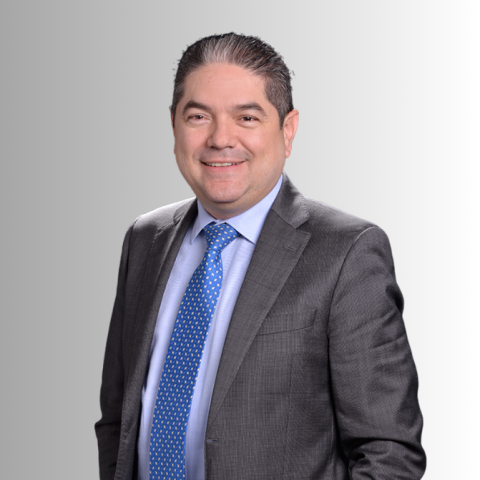
Robinson Vásquez, general manager of DHL Supply Chain Colombia
The Technology and Sustainability Components
DHL said the Colombian rollout includes a warehouse management system (WMS) that uses artificial intelligence to support inventory control and improve picking and dispatch accuracy.
The system is designed to integrate with digital sales channels and enterprise systems. This allows for real-time visibility across operations.
The company also highlights sustainability-related features in its fulfillment operations, which include LED lighting systems with automated sensors and waste segregation and recycling processes. These measures are part of DHL Group’s broader goal of reaching net-zero emissions by 2050.
How Does the Launch Fit Into Colombia’s E-Commerce Growth?
Colombia’s e-commerce sector has expanded rapidly in recent years, which is supported by rising digital adoption and improved payment infrastructure.
According to Payments CMI, Colombia’s e-commerce sector is expected to continue growing through 2027, which will be supported by increasing digital adoption and improvements in logistics infrastructure.
Above photo: A DHL warehouse. (Photo: DHL)
Quarterly reporting and workplace-adjustment requirements would formalize compliance under the labor reform
Colombia’s Ministry of Labor (Ministerio del Trabajo) has published a draft decree that would establish how private employers must comply with disability hiring quotas introduced under Law 2466 of 2025, the country’s labor reform legislation.
The proposal sets out how employers must calculate the quota, report workers with disabilities to the government, implement workplace accommodations, and demonstrate compliance during labor inspections. If approved, the rules would affect thousands of private-sector employers and create new reporting obligations beginning June 26, 2026.
Colombia already has disability employment protections on paper through prior legislation, but enforcement has historically relied more on general labor inspections than on standardized employer reporting systems. This draft decree moves the policy from principle-based obligations to a more measurable compliance framework that is tied to specific quotas and reporting deadlines.
How the Hiring Quota Would Work
Law 2466 of 2025 requires employers with between 100 and 500 permanent workers to employ at least two workers with disabilities for every 100 employees. Companies with more than 500 workers must add one additional worker with a disability for each additional block of 100 workers.
The decree provides examples of how the quota would apply in practice. A company with 100 permanent workers would be required to employ two workers with disabilities, while a company with 500 workers would need 10. At 1,000 workers, the quota rises to 15 employees with disabilities, and larger employers would see the requirement continue to increase proportionally. Companies with fewer than 100 permanent workers would not be subject to the quota.
The obligation would be phased in over time. During the first year following the law’s entry into force, application of the quota would remain optional while employers conduct technical reviews of their workplaces and evaluate any adjustments that may be necessary. Beginning in the second year, compliance would become mandatory.
“Companies with up to 500 workers must hire or maintain at least two (2) workers with disabilities for every 100 workers.” — Article 15, Law 2466 of 2025
Which Workers Count Toward Compliance?
Under the draft decree, permanent workers are defined as employees hired under employment contracts lasting longer than one month, regardless of contract type. Temporary staffing companies would be required to count both their internal personnel and workers assigned to client companies when calculating their workforce.
The proposal also addresses apprentices. While apprentices would not increase the workforce base used to calculate the quota, apprentices with disabilities could count toward compliance. Employers that ensure at least 25% of their apprentices are persons with disabilities would also see their apprenticeship obligation reduced by half.
To be counted toward the quota, a worker must hold a disability certificate issued under Resolution 1197 of 2024 of the Ministry of Health and Social Protection and be registered in Colombia’s Registro de Localización y Caracterización de Personas con Discapacidad (RLCPD), the national disability registry.
The requirement to be registered in the national disability registry is significant in practice because it links employer compliance directly to Colombia’s public health and identification systems rather than self-declaration or internal HR classification.
New Reporting Requirements
Beginning June 26, 2026, employers covered by the quota would be required to submit information to the Ministry of Labor identifying qualifying employees. Until the government’s planned national worker registry becomes operational, reports would be submitted directly to the ministry.
Employers would be required to provide company identification information, employee identities, hiring dates, disability certification documents, and certification of the company’s total number of permanent workers. After the initial filing, companies would be required to submit quarterly reports during the first 10 business days of January, April, July, and October.
The ministry would verify compliance by cross-checking employer submissions against disability certification records maintained by health authorities.
Reasonable Adjustments Become a Central Requirement
A substantial portion of the draft decree focuses on ajustes razonables, known in English-language disability law as reasonable accommodations or reasonable adjustments.
The proposal would require employers to evaluate workplace barriers, assess individual needs, and work with employees to identify accommodations that allow workers with disabilities to perform their duties effectively. Examples cited in the decree are physical accessibility improvements, adaptive furniture, assistive technologies, modified schedules, telework arrangements, and other workplace adaptations.
Employers would generally be expected to prioritize the accommodation preferred by the worker unless it creates a disproportionate or undue burden. Where a requested accommodation is not feasible, the employer would be required to justify its decision, propose alternatives, and evaluate whether those alternatives are effective.
The decree further states that failure to provide reasonable adjustments could constitute workplace discrimination. In Colombian labor practice, the concept of reasonable adjustments has increasingly been shaped by Constitutional Court jurisprudence, which has tended to interpret workplace accommodation as an enforceable obligation rather than a discretionary employer measure in cases involving protected groups.
When Compliance Is Not Possible
The draft also establishes a procedure for employers that believe compliance is genuinely impossible. This could include situations in which no qualified candidate with a disability applies for a position or where an employer argues that a specific role cannot be performed by a person within any recognized disability category, even after reasonable accommodations are considered.
In such cases, employers would be required to notify the Ministry of Labor and provide supporting evidence. Labor inspectors would then evaluate the claim, reviewing workplace conditions, occupational-risk assessments, and the feasibility of accommodations before issuing a determination.
Any finding of impossibility would remain valid for no more than one year and would not reduce the employer’s calculated quota. This mechanism is designed to prevent employers from using operational constraints as a permanent exemption, limiting impossibility findings to time-bound administrative determinations subject to renewal and review.
Inspections and Enforcement
Employers covered by the quota would also be required to publish vacancies through Colombia’s Public Employment Service (Servicio Público de Empleo), which would refer candidates, including applicants with disabilities.
Compliance would be monitored through quarterly reports, payroll reviews, and verification of disability certifications. Employers found in violation could face administrative investigations under Law 1610 of 2013, which governs labor inspections and sanctions.
The ministry said personal information collected through the reporting process would be handled in accordance with Colombia’s data protection regime established under Law 1581 of 2012.
Part of a Broader Inclusion Framework
The draft decree builds on Colombia’s existing legal framework for disability rights and workplace inclusion. It incorporates principles established under Statutory Law 1618 of 2013, Law 361 of 1997, the United Nations Convention on the Rights of Persons with Disabilities, and International Labour Organization Convention 159.
The proposal also references recent Constitutional Court jurisprudence, including Sentencia T-062 of 2025, which addressed employers’ obligations regarding reasonable accommodations in the workplace.
The draft decree, signed by Minister of Labor Antonio Eresmid Sanguino Páez, has been published for public comment before moving forward in the regulatory approval process.
 Empleobilingue.com

- Director/a de operaciones para hotel, restaurante y discoteca 1626320364.60 - Medellín, Medellin, Antioquia, Colombia
- Coordinador/a de calidad para La Unión 1626483143.1 - La Unión, Antioquia, Colombia
- Desarrollador fullstack - Bogotá, Bogota, Colombia
- Technical Analyst - Remote
- PIM Administrator - Ecommerce - Remote (Bogotá, Bogota, Colombia)
- Auxiliar de gestión humana y bienestar para Girardota 1626060072.28 - Girardota, Antioquia, Colombia
- Marketing Strategist
- Trainer Manager - Bogotá, Bogota, Colombia
- Tolemaida UH- 60 Inspector - Bogotá, Bogota, Colombia
- Virtual Assistant - Team Lead - Remote
Contact Us

