

















Colombia’s national government issued Decree 636 on June 26, 2026, establishing a 35% import tariff on colorless float glass for a term of five years. The measure, signed by Commerce, Industry and Tourism Minister Diana Marcela Morales Rojas and Finance Minister Germán Ávila Plazas, covers two customs subheadings — 7005.29.10.00 and 7005.29.90.00 — and takes effect 15 calendar days after its publication in the Diario Oficial (Official Gazette).
Because the decree applies without prejudice to the trade agreements Colombia already has in force, the duty falls in practice on imports from countries with which the country has no free trade agreement. According to the technical analysis cited in the text, those origins are led by China, followed by Indonesia and Malaysia.
“In order to protect the national production of float glass and to prevent trade diversion, the application of a tariff becomes necessary.” — Decree 636 of 2026, Ministry of Commerce, Industry and Tourism
The government based the tariff on a steep rise in imports. Total purchases of colorless float glass under the two subheadings grew about 134% between 2022 and 2025, rising from roughly 26,334 metric tons to 61,673 metric tons. Over the same period, the share supplied by countries without a trade agreement climbed from 52.36% to 87.07%. In 2025, China accounted for 57.74% of the volume imported from those origins, followed by Indonesia at 23.65% and Malaysia at 17.08%.
Imports from partners with an agreement in force — chiefly the United States, Mexico and Brazil — fell 36.50% between 2022 and 2025, while shipments from countries without an agreement rose 289.02% over the same period. The decree also documents a widening price gap. The average cost, insurance and freight (CIF) price of glass from trade-agreement countries slipped from $0.705 USD per kilogram in 2022 to $0.660 USD in 2025, a drop of 6.38%. Prices from countries without an agreement fell far more steeply, from $0.604 USD to $0.291 USD per kilogram, a decline of 51.82%. The gap between the two blocks widened from 14.24% in 2022 to 55.86% in 2025.
The decree describes colorless float glass as a strategic input for construction, manufacturing, industrial processing, architectural finishes, the automotive sector and safety-glass production, and notes that Colombia has registered domestic production of the material. Citing the risk of trade diversion, it points to trade-remedy measures that other countries — including Brazil, Mexico, India, Chinese Taipei, Botswana, Eswatini, Namibia and South Africa — have applied to float glass from various Asian origins, as recorded by the World Trade Organization.
The Comité de Asuntos Aduaneros, Arancelarios y de Comercio Exterior (Committee on Customs, Tariff and Foreign Trade Affairs) recommended the 35% rate for a five-year term during its session on May 4, 2026. The Ministerio de Vivienda, Ciudad y Territorio (Ministry of Housing, City and Territory) issued an opinion on April 24, 2026 stating that the measure would help soften inflationary effects and preserve the continuity of housing construction and improvement projects. The Departamento Nacional de Planeación (National Planning Department, DNP) found on April 29, 2026 that the measure aligned with the government’s reindustrialization policy and with the housing objectives of the 2022–2026 National Development Plan.
The Dirección de Impuestos y Aduanas Nacionales (National Tax and Customs Directorate, DIAN) estimated additional fiscal revenue from the adjustment of $248.127 billion COP, accumulated over the 2026–2035 period. The decree was opened to public consultation for 15 calendar days, from May 7 to May 21, 2026, on the ministry’s website.
The tariff rests on the president’s constitutional authority over customs and foreign trade, Laws 7 of 1991 and 1609 of 2013, and Decision 805 of the Comunidad Andina (Andean Community), which allows member countries to adopt tariff modifications. It partially amends Article 1 of Decree 1881 of 2021, the customs tariff schedule in force since January 1, 2022.
The move continues a series of tariff actions by Colombia’s Ministry of Commerce, Industry and Tourism directed at domestic industry. In recent months the ministry has drafted a “smart tariffs” decree tying import duties to domestic production capacity, moved to reintroduce duties on 32 goods and raw materials, and extended a 35% tariff on footwear imports.
Bancolombia sees the peso at 3,440-3,580 per dollar in July.
The Colombian peso was the standout performer among global currencies in June, appreciating 7.4% on the month even as the US dollar broadened its strength and oil prices dropped sharply. According to the Monthly FX Market Report published by the research arm of Bancolombia (NYSE: CIB, BVC: BCOLOMBIA), the peso closed the month at 3,415.25 per dollar, a gain of 274 pesos over the period. The report was prepared by the Economic, Industry and Market Research Area of Grupo Cibest, the financial holding group that owns Bancolombia.
The move ran against the grain of the month’s external drivers. The dollar index (DXY) strengthened 2.3% and Brent crude fell 20.7%, a combination that would ordinarily weigh on a commodity-linked emerging-market currency. Instead, the peso rose on domestic factors tied to Colombia’s presidential election, tracking a rally in local assets that priced in a higher probability of a market-friendly outcome.
The election set the tone
The peso’s appreciation was in line with the rally in local assets that followed the first round of the presidential election, which raised the perceived odds of a right-wing candidate’s victory, the report said. That pattern — commonly observed across the region — limited any upside for the dollar after the second round. Abelardo de la Espriella was elected to govern for the 2026–2030 term, winning 49.63% of the vote, or 12,960,166 ballots, in the tightest race since 1994. Iván Cepeda secured 48.67%, or 12,708,312 votes, and conceded after the official tally was released.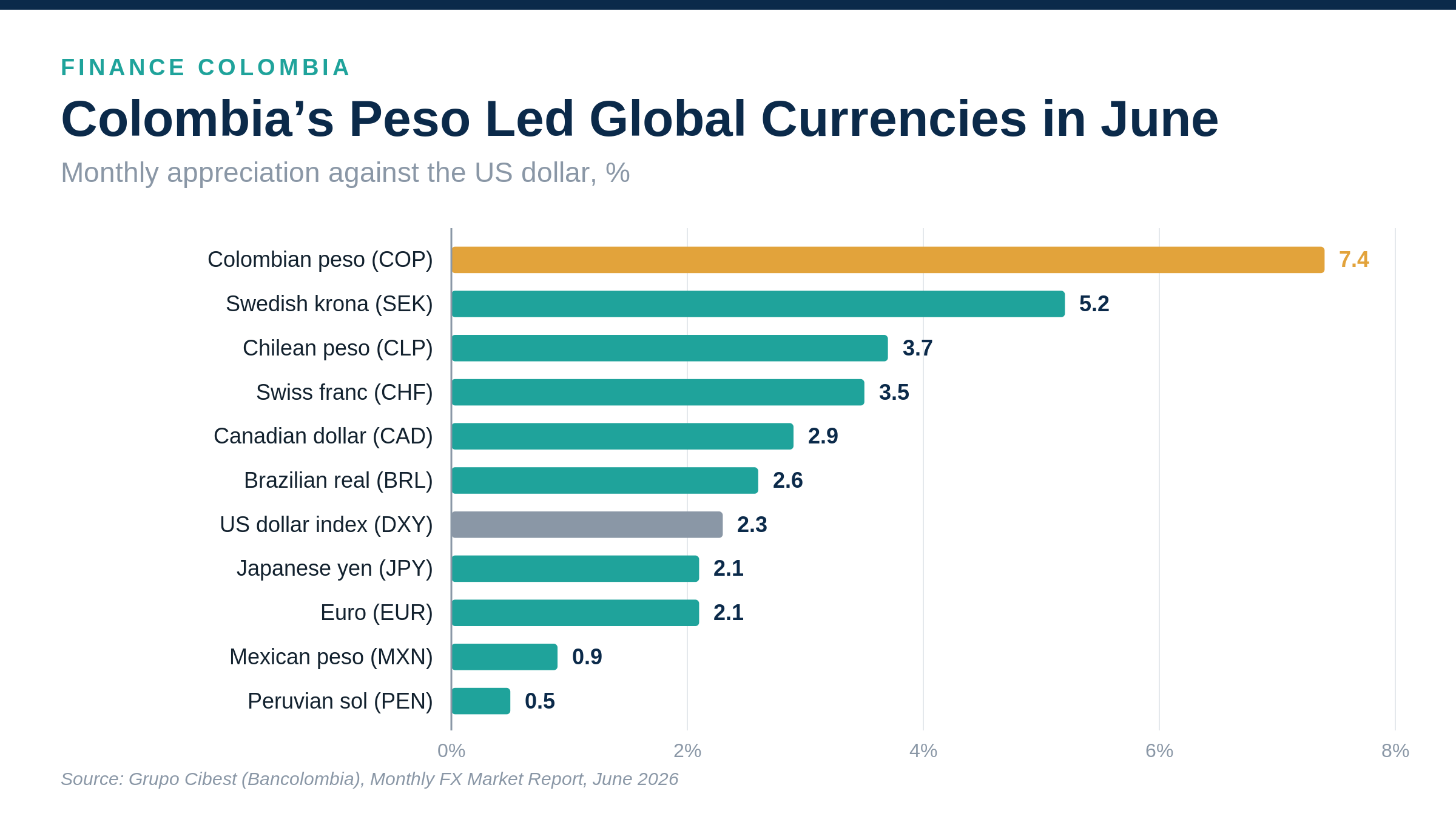
Overseas voting favored de la Espriella, at 64%, the report noted, while domestically he drew strong support in central regions, including Norte de Santander at 76%, Casanare at 69%, Santander at 65%, Antioquia at 64% and Huila at 61%. Voter turnout reached a historic high of 26.3 million participants, or 63.6% of the electorate, with blank votes marginal at 1.6%.
Markets reacted positively to the shift in the government’s political spectrum. JP Morgan recommended maintaining long positions in TES, Colombia’s peso-denominated treasury bonds, according to the report; the bank also held a neutral stance on the peso and closed its short positions against the Brazilian real and the Mexican peso. Through the month the dollar traded between 3,385 and 3,613 pesos, with average intraday volatility of 44 pesos.
“The Colombian peso appreciated in June on idiosyncratic factors, defying the global backdrop.” – Economic, Industry and Market Research Area, Grupo Cibest (Bancolombia), Monthly FX Market Report, June 2026
The central bank resumes its hiking cycle
Following a pause in April, the Banco de la República, Colombia’s central bank, resumed its tightening cycle and, by majority decision, raised its policy rate by 75 basis points to 12%. The report characterized the decision as reinforcing a more restrictive stance amid persistent inflationary pressures, in an environment where tensions between the bank and the Executive appeared to have eased. That rate level, it said, is supportive of long peso positions.
Major central banks abroad kept a cautious posture. The Federal Reserve unanimously held its policy rate in the 3.50% to 3.75% range and revised its expected rate path higher, with the median projection for 2026 pointing to a 25-basis-point increase. The European Central Bank raised its policy rate by 25 basis points to 2.25%, a level not seen since April 2025, while the Bank of Japan lifted its rate by 25 basis points to 1.0%, its highest since 1995.
Defying the global backdrop
The peso appreciated on idiosyncratic factors even as the broader environment turned less favorable, the report said. Markets closely tracked the Middle East conflict, where the US and Iran reportedly reached a peace memorandum that included the reopening of the Strait of Hormuz, the lifting of the US blockade on Iranian ports, the release of frozen Iranian assets and a 60-day window to discuss Iran’s nuclear program. In that context Brent prices fell 20.7%, closing at $72.97 USD per barrel, while WTI settled at $69.60 USD, down 20.3% on the month. The report cautioned that the normalization of trade flows would be gradual, citing reported Israeli attacks and episodes of tension between the US and Iran that leave a definitive peace uncertain. Gold prices fell 11.8%, closing at $4,023 USD per ounce, on shifting rate expectations and reduced demand for dollar-denominated safe-haven assets.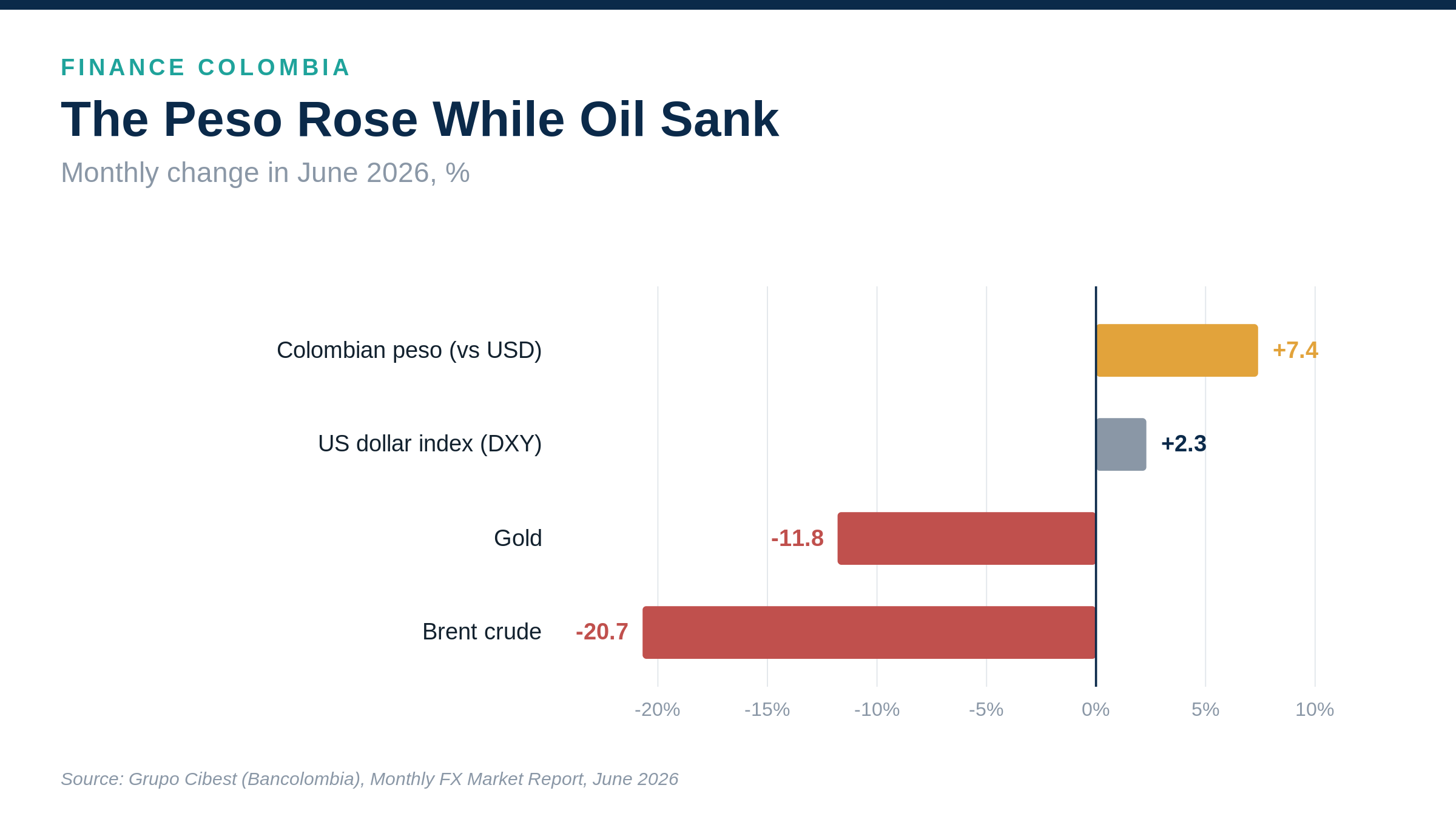
The dollar index, meanwhile, strengthened 2.3%, driven by expectations of higher-for-longer US interest rates. Even so, the peso outpaced its regional and developed-market peers by a wide margin. Among the currencies that gained against the dollar in June, the Swedish krona rose 5.2%, the Chilean peso 3.7%, the Swiss franc 3.5%, the Canadian dollar 2.9%, the Brazilian real 2.6%, the Japanese yen 2.1% and the euro 2.1%, while the Mexican peso and the Peruvian sol added 0.9% and 0.5%, respectively. The Colombian peso’s 7.4% advance left the field behind.
The month ahead
The research team expects the dollar to trade within a range of 3,440 to 3,580 pesos in July, against a backdrop of elevated global uncertainty. Markets are likely to maintain a constructive bias following the change in government, the report said, though cabinet appointments and signals on fiscal consolidation from the incoming administration will be key to sustaining the trend.
The bank framed the risks in two directions. Upside risks for the dollar remain linked to the deterioration of public finances: the Ministry of Finance has explicitly highlighted the need to strengthen fiscal revenues through an adjustment of around 1.6% of GDP, a scenario the report said would be necessary to stabilize net debt below 60% of GDP over the next decade. Colombia’s fiscal trajectory has already drawn scrutiny from ratings agencies, with S&P Global Ratings cutting the country to BB- earlier this year on fiscal concerns. Downside risks for the dollar, by contrast, persist in connection with carry-trade strategies, particularly as the central bank resumes its rate-hiking cycle and widens the rate differential that rewards holders of peso assets.
The Monthly FX Market Report was prepared by the Economic, Industry and Market Research Area of Grupo Cibest, with contributions from International FX and Rates Analyst Maria Paula Gonzalez, Chief Economist Laura Clavijo and Macroeconomic Research Manager Jose Luis Mojica, drawing on data from SetFx, LSEG Workspace, the Banco de la República, the Departamento Administrativo Nacional de Estadística (National Administrative Department of Statistics) and JP Morgan.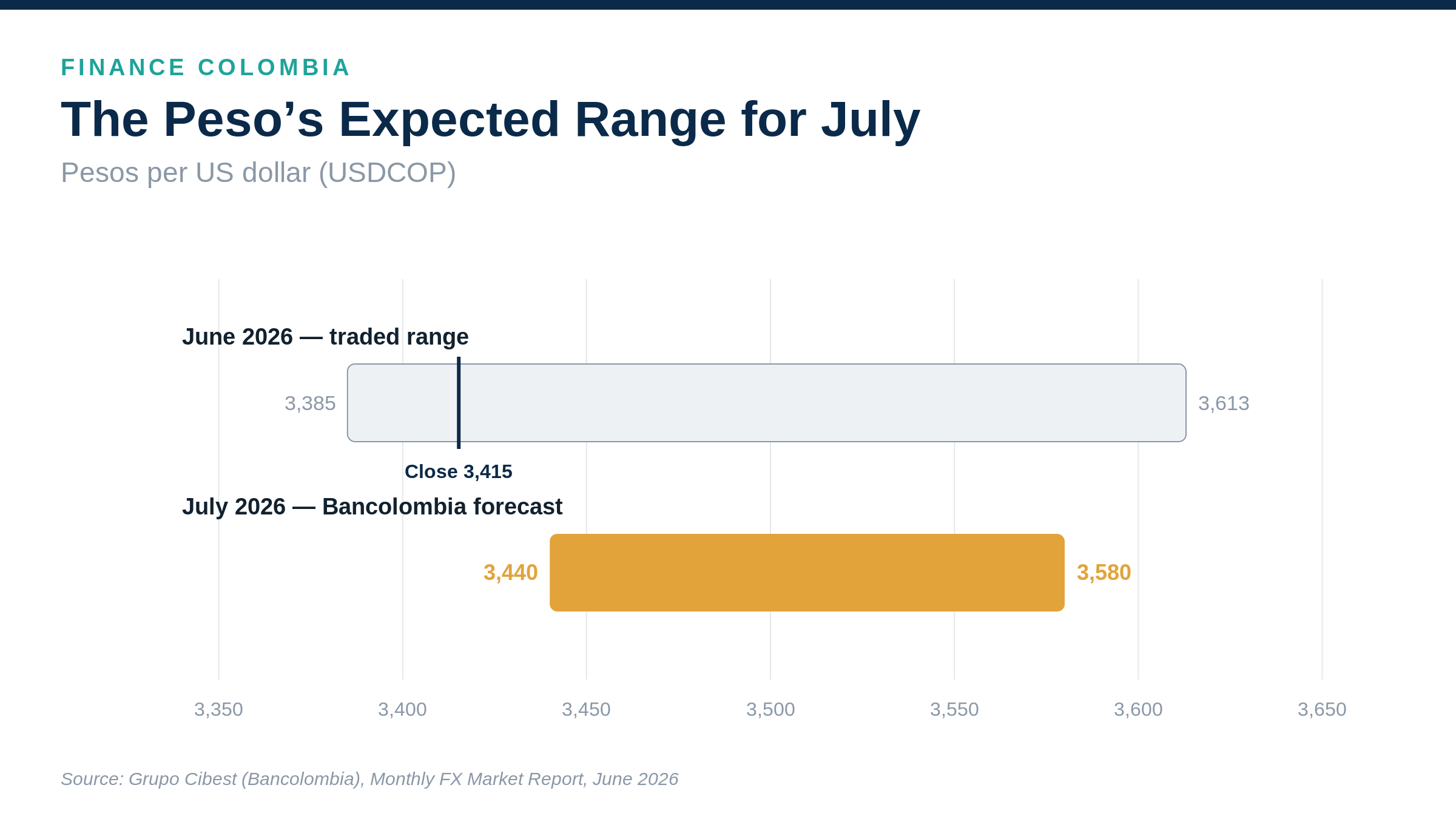
Colombia’s DIAN tax authority gains a revamped enforcement code for import operations.
Colombia’s Congress has passed Law 2586 of 2026, adopting a new sanctions and merchandise-seizure regime for customs matters along with the procedure that the National Tax and Customs Directorate (Dirección de Impuestos y Aduanas Nacionales, or DIAN) must follow when penalizing importers and exporters that fail to meet their obligations in foreign-trade operations.
The statute consolidates into a single framework the rules for imposing sanctions and seizing goods, and the administrative procedure DIAN applies when customs duties and disposals are breached. It takes effect upon promulgation and repeals Decree Law 920 of 2023 as well as Article 51 of Law 1762 of 2015.
“The present law has as its object to establish the provisions that constitute the sanctions regime and the seizure of merchandise in customs matters, as well as the applicable procedure to be followed by DIAN for the imposition of sanctions and the seizure of merchandise.” — Law 2586 of 2026, Article 1
The regime applies across the entire national customs territory, without prejudice to special provisions in Colombian law and in the international agreements and treaties the country has signed. Its reach extends, where international law allows, to customs procedures and controls carried out in the territory of another country under binational, multilateral, or regional agreements ratified by Colombia.
The law sets out ten binding principles that the customs authority must observe: favorability, legality, typicity, the prohibition of double sanction for the same infraction or seizure for the same act, the prohibition of analogy, proportionality, good faith, the prevalence of substance over form, harm (lesividad), and due diligence. Under the due-diligence principle, the burden of proof shifts to the investigated party, who can rebut fault by demonstrating that it acted diligently.
DIAN is named as the competent authority to verify the legality of foreign-trade operations and compliance by customs users. The law grants the agency broad audit powers, including the authority to order searches of business premises through a reasoned resolution, inspect accounting records, take samples of merchandise, and impose precautionary measures to preserve evidence. Searches of a person’s home require prior judicial authorization.
Among the law’s central instruments is the Post-Clearance Audit (Auditoría Posterior al Despacho), modeled on standards issued by the World Customs Organization (Organización Mundial de Aduanas) and the World Trade Organization. The audit is designed to support and accompany traders after goods clear customs, with the stated aim of preventing new infractions and promoting voluntary compliance. It can take three forms: a desk audit conducted from available information, an on-site audit at the trader’s premises, and a mixed audit combining both.
The law builds in incentives for traders to correct errors. Through a persuasive-invitation mechanism, an importer or customs user that accepts a proposal can file a correction or proof of payment and close the administrative proceeding, while acceptance and reduction provisions lower the sanction for those who acknowledge the contested facts. The law also distinguishes non-sanctionable formal errors from infractions that warrant penalties.
DIAN’s power to impose sanctions lapses three years after the act or omission that constitutes the customs infraction, the period within which the administrative decision must become final.
For repeat offenders, the law graduates the temporary closure of a business establishment by the value of the seizure, measured in Tax Value Units (Unidades de Valor Tributario, or UVT), ranging from five days for the lowest tier up to 30 days above 5,000 UVT. A separate schedule phases in appraisal thresholds for seizures: from August 1, 2026 for cases below 2,000 UVT, from August 1, 2027 for cases below 4,000 UVT, and from August 1, 2028 for cases below 10,000 UVT.
The overhaul follows years of debate over how DIAN administers customs enforcement, a recurring theme in Colombia’s foreign-trade policy. Finance Colombia has previously reported on DIAN’s tightening of import controls and on criticism of how the agency applies customs rules.
Colombia’s Ministerio de Vivienda, Ciudad y Territorio (Ministry of Housing, City and Territory) has issued Resolution 0337 of 2026, requiring that new residential and commercial buildings in the country’s larger municipalities be wired to support the future installation of electric-vehicle charging points.
Signed on June 9 by Housing Minister Helga María Rivas and published in the Diario Oficial (Official Gazette) on June 16, the measure sets the minimum technical guidelines that special-category and category 0, 1, 2, and 3 districts and municipalities must use to ensure that buildings whose construction licenses are properly filed include an electrical connection for charging or refueling electric vehicles.
The rule applies to new-construction, expansion, and modification licenses for residential, commercial, or mixed-use projects, and it takes effect only where a municipality has a minimum number of registered electric vehicles in its jurisdiction. Municipal categories follow the classification set by the Contaduría General de la Nación (National Accountant General’s Office). Social-interest and priority-interest housing — Vivienda de Interés Social and Vivienda de Interés Prioritario — are excluded, as are projects that generate no new private parking or that authorize only a single private parking space.
Under the resolution, the builder or license holder must run the electrical connection and supporting infrastructure from the main distribution network — which may include the public grid, solar panels, or battery banks — to a point near the private parking spaces, so that charging equipment can be connected later. The share of parking spaces that must be prepared is calculated from the total private spaces required in each license.
“The builder or holder of the construction license must foresee and provide an electricity connection for charging or refueling electric vehicles that facilitates the later installation of any of the possible charging schemes in the private parking spaces generated.” — Resolution 0337 of 2026, Ministry of Housing, City and Territory
That percentage is set annually by the Ministry of Housing in coordination with the Ministerio de Transporte (Ministry of Transport), drawing on data from the Registro Único Nacional de Tránsito (National Traffic Registry), known as RUNT, and published in the first quarter of each year. The wiring requirement applies only when the calculated percentage for a given jurisdiction reaches 2% or higher.
Installations must comply with the Reglamento Técnico de Instalaciones Eléctricas (Technical Regulation for Electrical Installations), or RETIE, and other technical standards set by the Ministerio de Minas y Energía (Ministry of Mines and Energy). Connections must allow electricity consumption to be metered individually, so that each parking-space owner bears the cost of their own charging. In buildings under a horizontal-property regime, an owner installing a charger in an individual private space need only notify the homeowners’ association in advance and assumes the full cost.
For buildings already licensed before the new guidelines took effect, owners may voluntarily adapt their installations to accommodate charging infrastructure. Curadores Urbanos (Urban Curators) — and, where they do not exist, the local licensing authority — must report the licenses issued under the measure. The Ministry of Housing has up to nine months after the resolution enters into force to establish the reporting mechanism.
The resolution builds on Ley 1964 de 2019 (Law 1964 of 2019), Colombia’s framework for promoting electric and zero-emission vehicles. The country has worked to encourage adoption through measures such as reduced import duties on electric vehicles, and the consumer market has continued to develop since Tesla’s official launch in the country.
NG Energy International Corp. (TSX: GASX; OTCQX: GASXF) has spudded Magico-2X, the second well in its six-well 2026 drilling program at the Sinú-9 Block in Colombia, marking a new step in the campaign that is expanding the company’s natural gas production base along the country’s Caribbean coast. The well was spudded on June 26, 2026, with the newly discovered Pre-CDO–San Cayetano formation as its primary target.
Magico-2X is operated by Maurel & Prom Colombia Sociedad Limitada, the Colombian arm of French producer Etablissements Maurel & Prom S.A., which took a working interest in Sinú-9 earlier this year. The well is designed with three sections: the 16 inch, 12-1/4 inch, and the 6-3/4 inch, drilled to a total measured depth of 7,500 feet. NG Energy expects drilling and completion to take approximately 35 days, after which the well will be connected to the block’s central processing facility for production.
“We are pleased that M&P Colombia, as operator of the Sinú-9 Block, delivered the spud of Magico-2X on schedule, targeting the Pre-CDO–San Cayetano formation as its primary target,” said Jorge Fonseca, CEO of NG Energy.
The focus on the Pre-CDO–San Cayetano formation follows results at the Hechicero-1X well, which tested at rates of up to 26.4 MMcf/d gross (10.3 MMcf/d net) from the zone. NG Energy describes Pre-CDO–San Cayetano as a newly discovered formation that has opened a wider area for natural gas at that stratigraphic level across Sinú-9.
Following the test, M&P Colombia has elected to manage Hechicero-1X at a sustainable production rate of approximately 15 MMcf/d gross (5.85 MMcf/d net), which the company says is consistent with reservoir-management practices intended to protect the well’s long-term performance and integrity.
“Hechicero-1X has already demonstrated the strength of this zone, testing at rates of up to 26.4 MMcf/d gross and now sustaining steady production at 15 MMcf/d — exactly why we believe Pre-CDO–San Cayetano has the potential to be a key driver of production growth across the Sinú-9 Block as the six-well campaign advances,” Fonseca continued.
On the infrastructure side, the initial pipeline loop to Jobo, built by NG Energy’s infrastructure partner INFRAES S.A.S. E.S.P., has been completed. Mechanical commissioning at the Jobo and Guayabal facilities is underway over the coming weeks and is expected to raise transportation capacity at Sinú-9 from the current 30 MMcf/d gross (11.7 MMcf/d net) to between 40 and 45 MMcf/d gross (15.6 to 17.6 MMcf/d net). Current production at Sinú-9 is approximately 17.5 MMcf/d gross (6.8 MMcf/d net). NG Energy brought first gas online at the Sinú-9 site as it built out the block.
At the María Conchita Block in La Guajira, total field production is currently approximately 14.8 MMcf/d gross (11.8 MMcf/d net), against infrastructure that supports up to 30 MMcf/d gross (24.0 MMcf/d net) of processing and transportation capacity.
The next development well at María Conchita, Aruchara-6, is expected to spud immediately after the completion of the ongoing Aruchara-1 workover. That workover began on June 15, 2026, and is expected to be completed by July 10, 2026, targeting the isolation of currently produced zones, the opening of new zones, the deployment of sand control equipment, characterization of upper intervals, and recompletion of the well.
Civil works at the Aruchara-6 location are expected to begin in the coming week, with the drilling rig to be mobilized immediately after the Aruchara-1 workover concludes. NG Energy previously installed a natural gas plant in La Guajira to support the block.
“Combined with the completion of the INFRAES pipeline loop to Jobo, we are positioning the block for a meaningful step-up in takeaway capacity as commissioning progresses over the coming weeks,” Fonseca added. “At Maria Conchita, our team is advancing the Aruchara-1 workover ahead of spudding Aruchara-6, our next development well at the block. It is a productive period across both of our assets, and we look forward to providing further updates as this work progresses.”
NG Energy also confirmed progress on the transaction with Maurel & Prom. The company has received the $15 million USD installment payment from Etablissements Maurel & Prom S.A. due in June 2026 in connection with the Sinú-9 transactions, bringing total consideration received to approximately $135 million USD to date. The remaining $15 million USD installment is expected in July 2026, which would bring total consideration received on the transaction to the full $150 million USD.
The activity comes as Colombia contends with a widening natural gas deficit that has pushed energy costs higher and drawn attention to domestic supply. NG Energy positions itself as a supplier of gas into the premium-priced Colombian market, and has outlined progress across its Caribbean coast petroleum projects as it scales output.
NG Energy holds its working interests in the María Conchita and Sinú-9 blocks through Operadora NG Energy Sucursal en Colombia (formerly MKMS Enerji Sucursal Colombia), the Colombian branch of the company’s indirect wholly owned subsidiary Operadora NG Energy International, S.A.
Headline photo: Aruchara-4 Drilling Rig CNW Group/NG Energy International Corp.
Colombia’s trajectory as a premier destination for foreign direct investment, retirement, and digital nomadism remains undeniably strong. Over the years, the country has attracted a steady influx of expats drawn by its dynamic markets and strategic geographical positioning. However, as the nation’s international appeal has matured, so too has its regulatory framework.
The Colombian immigration system is no longer the highly permissive environment it once was; it has fundamentally shifted toward a structure built on strict legal compliance. In 2026, navigating the visa application process requires far more than just proving financial solvency or investment intent. Resolution 5477 of 2022 was designed to safeguard the country’s interests, particularly by protecting the public medical infrastructure and ensuring that foreigners do not place a heavy burden on the national healthcare system.
Consequently, securing a compliant health policy for visas—a primary requirement for Visitor and Migrant types—has evolved from a standard administrative formality into a non-negotiable, heavily scrutinized legal mandate that directly impacts visa approvals. Article 30 of Resolution 5477 explicitly states that health coverage must be private and protect the holder within the national territory against all risks, including accidents, illness, maternity, disability, hospitalization, death, or repatriation. Furthermore, the policy must remain valid for the expected duration of the foreigner’s stay in Colombia.
However, despite the clarity of this requirement across all relevant visa categories, applicants frequently bypass it by submitting local resources—such as EPS, Medicina Prepagada, and other monthly health services—as proof of coverage, even when they don’t meet the specific items their health policies must have.
This reality has been ongoing since the entry into force of Resolution 5477, which is the main reason why visa rejections have been increasing since last year. Visa experts of expatgroup.co say that the Ministry of Foreign Affairs’ analysts have restricted their visa studies by ensuring every applicant fulfills the requirements of the law. If they dismiss at least one of the coverages, submit a monthly health policy, or even only 1-year of coverage, for visas that allow up to 3 years of validity, their visa applications could be unadmitted, approved for 365 days or less, or even required for more years of coverage.
Jaime Aristizábal, an immigration expert and CEO of expatgroup.co, has shared his more than 10 years of knowledge to clarify the complexities of the health policy for visas—outlining exactly what it must include and highlighting the most common compliance mistakes expats make in their applications.
The non-negotiable must-haves of a health policy for visas in Colombia
One of the most frequent reasons for application delays or outright denials is a fundamental misunderstanding of what constitutes valid coverage. The Ministry of Foreign Affairs does not merely verify the existence of a health policy certificate; analysts also conduct a granular review to ensure that specific legal clauses are explicitly stated in the policy documentation.
|
“Particular” Health Policy |
The health policy must be a private type, which excludes all public options, both Colombian (EPS) and those from other countries. |
|
Coverage Throughout the National Territory |
The policy is required to comprehensively protect the applicant in all of these scenarios while they remain within Colombian national territory. |
|
All-Risk Requirement |
The plan accounts for a broad spectrum of incidents beyond standard illness, including accidents and other unforeseen events. |
|
Illness Coverage |
Provides necessary medical treatment and care for any sickness, disease, or medical condition experienced by the applicant while residing in Colombia. For some profiles (such as retirees and seniors), the government will require specific pre-existing condition coverage. |
|
Accident Coverage |
Ensures access to emergency medical attention and covers expenses resulting from unforeseen physical injuries or accidents occurring within the national territory. |
|
Maternity Coverage |
Guarantees comprehensive medical support and healthcare services for pregnancy-related scenarios during the foreigner’s authorized stay. |
|
Disability Coverage |
Accounts for medical care and necessary support in the event of an unforeseen condition that impairs the applicant’s physical or mental abilities while in the country. |
|
Hospitalization Coverage |
The documentation must clearly demonstrate that the applicant has guaranteed access to emergency medical care and prolonged hospitalizations, so the expat doesn’t need to rely on the national public health system. |
|
Death and International Repatriation |
It must cover both medical evacuation—transporting the individual back to their home country in the event of a severe health crisis—and funeral repatriation, involving the return of remains in the unfortunate event of death. |
|
Time of Validity for the Entire Expected Stay |
Expats must submit a health policy with a coverage period that matches the maximum validity of the chosen visa. If the coverage is shorter than the maximum allowed stay, applicants face a strict administrative choice: they must either upgrade their policy to meet the full term or submit a formal letter confirming that their intended stay in Colombia will not exceed the policy’s expiration date. |
Aristizábal emphasizes that applicants must meticulously verify that their chosen provider addresses these exact requirements, as partial coverage will not satisfy the Ministry of Foreign Affairs’ criteria. Missing even a single mandatory element can compromise the entire visa application, leading to unnecessary administrative hurdles.
About the Visitors and Migrant Visas that Require a Compliant Health Policy
For all Visitor Type visas, presenting a fully compliant health policy is an absolute, non-negotiable requirement. This mandate covers a wide spectrum of temporary stays, meaning that expatriates must secure private coverage regardless of whether they are applying for a Digital Nomad visa, a Student visa, a Tourist visa, a Market Research Visa, a Medical Treatment Visa, or another category. It is important to highlight that the period of validity must match the expected stay of the chosen visa (Digital Nomad Visa, with a 2-year health policy).
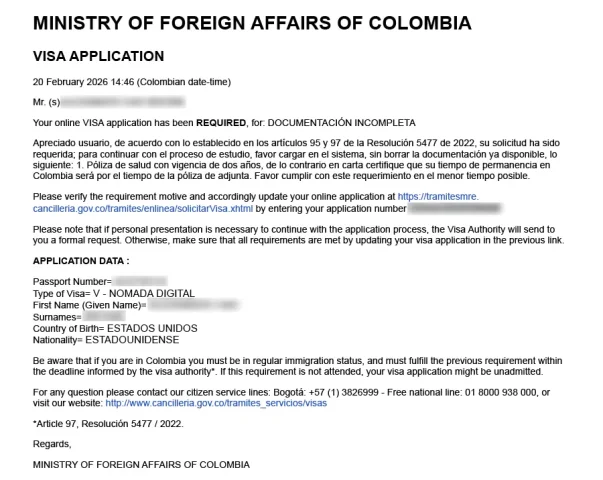
An extended time of coverage will be required to match the maximum validity of the visa.
On the other hand, given the long-term nature of Migrant Type visas, Colombian authorities place extra scrutiny on the submitted health documentation. A private health policy is strictly required as part of the application for several key Migrant categories, including the Retirement visa, Real Estate Investment visa, and Freelancer visa.
|
Other Migrant categories—such as the Spouse visa, Partnership visa, Business Owner visa, and Worker visa—do not explicitly mandate a private health policy. However, Aristizábal strongly advises applicants to include one regardless. |
Quote “In 2026, the Colombian government has increasingly begun approving Migrant visas for periods of less than 1 year. In practice, presenting a comprehensive private health policy has proven to be a strategic asset in mitigating this risk. Voluntarily submitting a compliant policy significantly increases the probability of securing an extended approval of 2 or even 3 years”. – Jaime Aristizábal, immigration specialist and CEO of expatgroup.co |
The Challenge of Securing a Health Policy for Visas with Full Coverage and 1-to-3 Year Validity
Besides the strict legal rules of Resolution 5477, the duration of the coverage is a major challenge in the global market. When searching for a compliant health policy for visas, expats often find that traditional travel assistance companies have strict limits. Usually, these providers only offer coverage for up to 1 year. Also, they frequently lack the mandatory repatriation or all-risk clauses required by Colombian law.
This one-year limit is a problem for long-term migrants. For example, Retirees, Real Estate Investors, or Digital Nomads can often get up to 2 or 3 years’ visas. However, if they submit a policy valid for only 365 days, the Ministry of Foreign Affairs will often limit the visa approval to match the policy’s coverage period, forcing visa holders to renew every year.
To solve this issue, expats need specialized immigration-focused solutions rather than generic tourist health assistance. Aristizábal and the expatgroup.co visa experts recommend the EG Assist health policies, one of the few providers that can offer a compliant health policy for visas with continuous validity for up to 2 or 3 years. By securing multi-year coverage with all mandatory clauses, applicants can align their health policy with the maximum term of their desired visa.
For expats, investors, and digital nomads seeking a fully compliant health policy tailored to their visa category, expert support is invaluable. To explore multi-year options or receive personalized guidance for your health policy, you can reach out to the EG Assist team through the following channels:
-
Website: https://egassist.com/
-
Phone: +19256054656
-
WhatsApp: +19256054656
-
Email: [email protected]
-
Google My Business: EG Assist – Visa Health Plans Colombia
Cinemotion Labs, a conference focused on technology and innovation in film and audiovisual production, has published the academic program for its 2026 edition, built around a single premise: content production is moving from a linear chain of steps to a connected ecosystem in which early decisions ripple across the entire lifecycle of a project.
The two-day program, themed Del Proceso Lineal al Ecosistema Interconectado (From the Linear Process to the Interconnected Ecosystem), treats the integration of creativity, technology, and operations as the determining factor in whether productions are efficient, collaborative, and innovative — a framing that maps closely onto how enterprise media, marketing, and communications teams increasingly manage high-volume content.
The first day examines the impact of artificial intelligence across creative work, production, postproduction, and the generation of new content, along with process automation and the workflow openings AI creates. The second day addresses the enabling technologies: virtual production, motion capture, connectivity, and cloud-based collaboration, and the methodologies changing how films, series, commercials, and digital content are produced.
“Cinemotion Labs was created to connect the audiovisual industry with the technologies that will shape its future,” said Verónica Marín, project manager of Cinemotion Labs.
“Cinemotion Labs was created to connect the audiovisual industry with the technologies that will shape its future,” said Verónica Marín, project manager of Cinemotion Labs. “Our academic program aims to offer a comprehensive view of how artificial intelligence, virtual production, and new workflows are transforming the way we create stories and develop audiovisual projects.”
Beyond the sessions, an exhibition floor will feature manufacturers, distributors, and specialized firms showing production and postproduction solutions, complemented by networking spaces, a cocktail reception, and an awards ceremony.
Admission to the academic program is free and includes access to all sessions and the commercial exhibition, digital proceedings, an electronic certificate of attendance, a digital subscription to the event’s official media outlet, and access to the cocktail reception and awards.
The event takes place at the facilities of Telemedellín in Medellín, Colombia — a market that has steadily grown as a base for creative and technology talent. Registration is available at the Cinemotion Labs website.
President-elect Abelardo de la Espriella appointed Rodrigo Lara Restrepo as interior minister. Here’s why the position is critical to his administration
Just over a month before president-elect Abelardo de la Espriella takes office, Colombia’s political landscape is beginning to take shape as the incoming administration seeks to build congressional support, a key requirement for governing after August 7, 2026.
The first step in that strategy was the appointment of Rodrigo Lara Restrepo as minister of the Interior, the first Cabinet nomination announced by the far-right De la Espriella since his victory in the presidential runoff.
The appointment is no coincidence. The president-elect’s party, Salvación Nacional, will hold only four seats in the new Congress, an insufficient number to advance its legislative agenda without reaching agreements with other political parties.
In that context, the Ministry of the Interior takes on a central role, as it will be responsible for managing the executive branch’s relationship with Congress and negotiating the majorities needed to pass legislation and reforms.
Lara Restrepo, once widely known as Colombia’s “anti-corruption czar,” served as director of the Presidential Program for Efficiency, Transparency and the Fight Against Corruption from 2006 to 2007 under then-president Álvaro Uribe. He later served two terms in the Senate (2007-10 and 2018-22) and one term in the House of Representatives (2014-18), experience that has given him extensive knowledge of how Colombia’s legislature operates.
He is also the son of former Justice Minister Rodrigo Lara Bonilla, who was assassinated in 1984 on the orders of drug leader Pablo Escobar after leading the government’s war against the Medellín Cartel.
“No more backroom deals. No more hidden pacts. No more corruption,” De la Espriella wrote on X when announcing the appointment. The president-elect also said that, with the support of the new minister, his administration would begin “an era of harmony, transparency and major social reforms.”
Lara Restrepo responded by saying, “We will forge a broad agreement around the fundamental issues that unite us and that can endure over time.”
El que NUNCA abandonó lo que más ama.
Emprendedor, abogado, docente universitario, senador de la República, presidente de la Cámara de Representantes y zar anticorrupción.
El que NUNCA, a pesar de haber sido víctima de la violencia, dejó de trabajar por su Patria; el que NUNCA… pic.twitter.com/K2QYhpjvV7
— Abelardo De La Espriella (@ABDELAESPRIELLA) June 26, 2026
Political coalitions begin to take shape
Alongside the appointment of the interior minister, political parties have begun defining their positions toward the incoming administration.
Law 1909 of 2018, known as the Opposition Statute, requires political parties represented in Congress to declare whether they will join the government, remain independent or enter the opposition within one month of the installation of the new Congress, scheduled for July 20, 2026.
The first formal endorsement of the incoming administration came from Centro Democrático, the party led by former President Álvaro Uribe Vélez, which will become the second-largest bloc in Congress with 46 seats: 17 in the Senate and 29 in the House of Representatives.
That decision was followed by Cambio Radical, the party to which Lara Restrepo belongs, which, despite its relatively weak electoral performance, will hold 19 seats in Congress, six senators and 13 representatives. In recent days, Creemos, the political movement led by Medellín Mayor Federico “Fico” Gutiérrez, also announced its support. The party will hold two seats in the House of Representatives.
Although these endorsements strengthen the president-elect politically, they remain far from guaranteeing a legislative majority. Moreover, De la Espriella has not issued any public statement regarding those endorsements.
Attention is now focused on the Conservative Party, the Liberal Party and the Party de La U, none of which has yet decided whether it will support the incoming administration, remain independent or join the opposition. Under the legal deadline, those parties have until August 19 to formally announce their decisions, a development that could significantly reshape the political landscape.
Attention is now focused on the Conservative Party, the Liberal Party and the Party de La U, none of which has yet decided whether it will support the incoming administration, remain independent or join the opposition. Under the legal deadline, those parties have until August 19 to formally announce their decisions, a development that could significantly reshape the political landscape.
Meanwhile, Pacto Histórico, the largest political coalition in the new Congress, has announced that it will serve as the opposition under the leadership of former presidential candidate Iván Cepeda.
The coalition holds 66 seats across both chambers and could coordinate with other center-left groups, including Alianza por Colombia (20 seats), representatives elected through the Special Peace Constituencies (16 seats) and other smaller progressive parties.
A fragmented Congress
The fragmentation of the new Congress makes the Ministry of the Interior one of the most strategic Cabinet posts in the incoming administration.
De la Espriella’s government will need to build permanent coalitions to advance any legislative initiative, particularly during its first months in office, when it must submit both the National Development Plan and the General Budget of the Nation to Congress.
In addition to parliamentary opposition led by Cepeda, the incoming administration will also have to contend with the outgoing President Gustavo Petro‘s continued ability to mobilize public support.
Colombia’s Congress consists of 103 senators and 183 members of the House of Representatives. Depending on the type of legislation, bills require simple majorities, absolute majorities or, in the case of constitutional amendments, approval by two-thirds of both chambers.
In the coming weeks, De la Espriella is expected to announce the remaining members of his Cabinet, which must be finalized before his inauguration on August 7.
Want to read more? After a Polarized Vote, Colombia’s Next President Must Navigate a Fragmented Congress
A few hours after the polls closed, the votes were counted and Tiger Abelardo was declared the next President of Colombia. The streets of Medellín are packed with celebrating paisas, energized by the idea of the far right returning to power. And they have every right to celebrate because without them, his hopes of power would be dust.
The overall poll was much closer than most expected, 49.7%–48.7%, a difference of just 250,000 votes out of a total of 26 million — almost 25% higher turnout than in 2022, which is great news for democracy. However, Antioquia, where Medellín lies, delivered the victory as he won the province by 1 million votes. Just as importantly, he lost in nearly every other major city in Colombia — including his hometown of Barranquilla.
Combining the slim margin of victory with his struggles in many parts of Colombia raises questions about what he can achieve over the next four years.
As I watched the feral campaign in Medellín while reading Abelardo’s ambitious election manifesto, one question has nagged away:
“Who will end up most disappointed — the supporters of Petro in 2022, or those of Aberlardo in 2026?”
Before Petro came Iván Duque, where there were few expectations and he lived down to them spectacularly. Petro himself benefited from those lost years, getting elected on the promise of changing the lives of the masses forever. Although he achieved several things toward that end, his supporters were largely disappointed, primarily due to his inability to administer.
Will Abelardo suffer the same fate? It could well happen.
He has no political party, will need to horse trade in Congress, and, more concerningly, many parts of Colombia do not want him. Even the huge vote in Antioquia was arguably not for him but for local boy, Vice President José Manuel Restrepo – and for arguably the first time we have a vice president who has genuine power and can provide checks and balances to any radical behaviour.
I have mentioned before the chaos of Duque’s last 12 months in office and the street protests that dogged his reform process. Given his lack of geographical reach, Abelardo would be well advised to tread carefully when trying to roll back reforms. Petro/Cepeda have lost the presidential battle, but 12.7 million votes suggest they are more than prepared for a war if the Tiger pushes too hard on his reform agenda.
The first skirmish of that war could occur if Abelardo follows through with his threat to declare 70 Trump-style decrees on day one in August.
Setting all that aside, Colombia has reconfirmed its status as South America’s preeminent democracy with a record turnout, minimal reports of fraud, even fewer incidents of violence, and paper results delivered in less than 120 minutes.
It only remains to buy the popcorn, sit back, and watch the fun starting in August.
My regards,
Roops
Colombia’s peso-denominated government bonds rallied across the entire yield curve over the past month, lifted by the close of a contentious presidential election and a calmer reading of global risk, but the research arm of Bancolombia (NYSE: CIB, BVC: BCOLOMBIA) cautions that the gains sit on top of a fiscal outlook the government’s own framework treats too optimistically. The assessment comes from the bank’s Monthly Public Debt Market Report for June, prepared by the Dirección de Investigaciones Económicas, Sectoriales y de Mercado (Directorate of Economic, Sector and Market Research) of Grupo Cibest, the financial holding group that owns Bancolombia.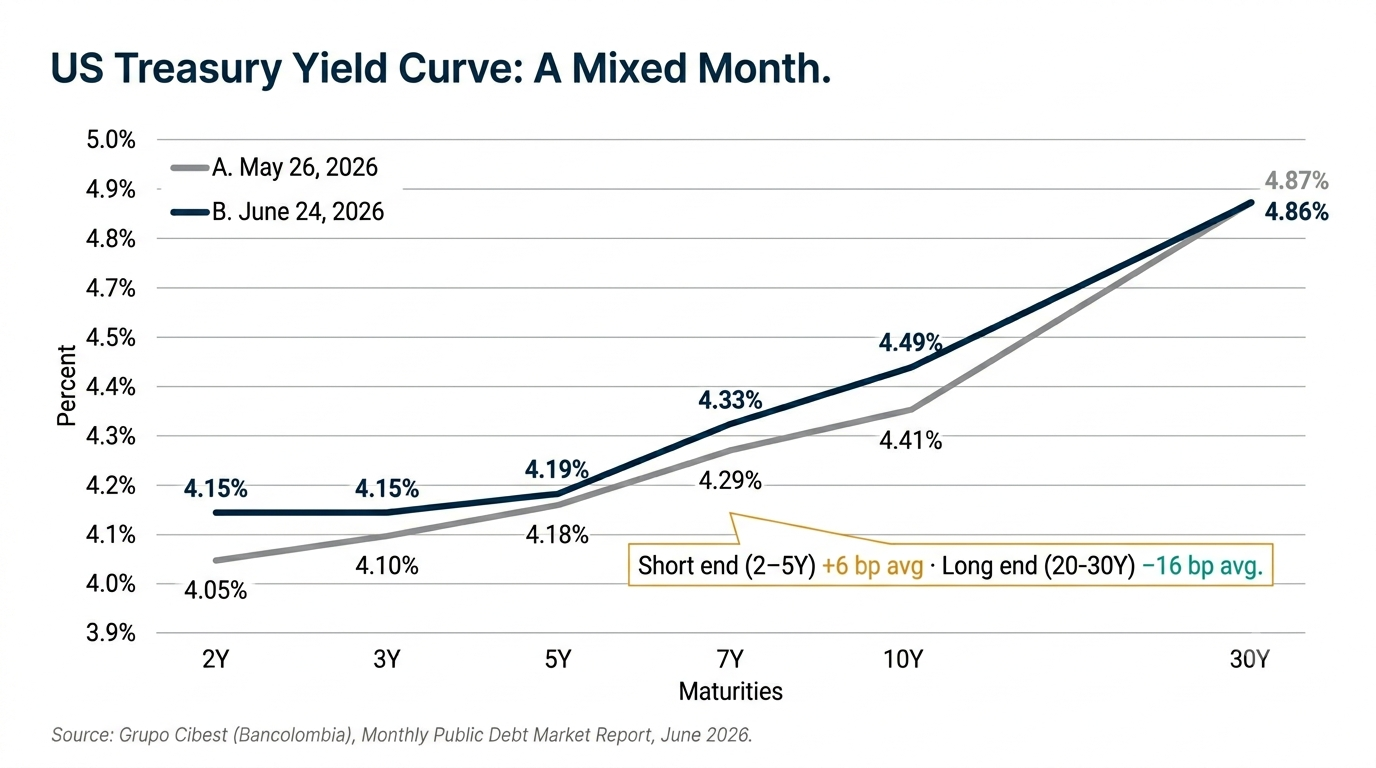
A mixed month for US Treasuries
Between May 26 and June 24, the US Treasury yield curve moved in two directions, according to the report. Yields on maturities between two and five years rose by an average of 6 basis points, while the 20- and 30-year segments fell by an average of 16 basis points. The research team tied the move to a communiqué indicating that the US and Iran had reached a memorandum of agreement during the final week of the period, aimed at extending the current ceasefire. Oil prices swung on mixed headlines through the period, and markets also took in inflation data that landed in line with the analyst consensus. In the US labor market, the report noted a stable unemployment rate alongside a significant increase in job openings.
Against that backdrop, the Federal Open Market Committee voted unanimously to hold the federal funds rate in the 3.50% to 3.75% range, a decision the bank flagged as the first without dissent in the past year and consistent with the Federal Reserve‘s prudent stance. The accompanying projections revised the 2026 growth outlook lower and the 2028 outlook higher; the unemployment forecast was cut only for 2026, while the inflation view was revised upward.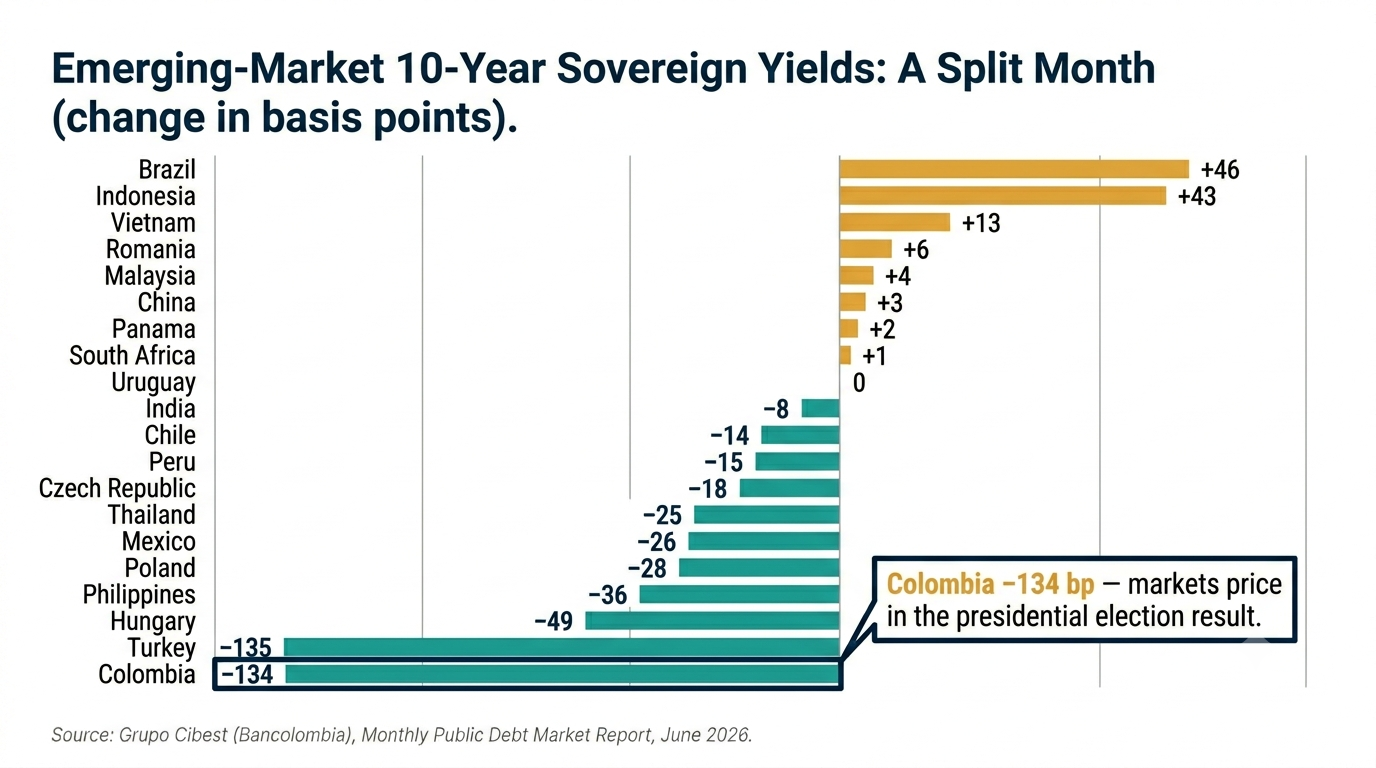
Cross-border demand for US debt strengthened. The US Treasury reported that foreign investors made net purchases of long-term bonds of $50.5 billion USD in April, the highest figure since November 2025. Private investors accounted for $30.8 billion USD of net buying in long-term Treasuries, a moderation from the pace seen in March. By geography, the net purchases concentrated in the United Kingdom and Japan, at $26 billion USD and $14.7 billion USD respectively, while investors domiciled in Canada were the largest net sellers as the country’s foreign reserves fell by $42.3 billion USD, followed by Norway and Korea.
Across emerging markets, 10-year sovereign yields moved unevenly over the month as investors responded to country-specific factors. Brazil led the increases at 46 basis points, followed by Indonesia at 43, Vietnam at 13 and Romania at 6, while Chile, Peru, India, Poland and the Czech Republic recorded declines. The report highlighted a 134-basis-point drop in Colombia, which it attributed to the market’s reaction to the first- and second-round presidential results that left Abelardo de la Espriella as president-elect for the 2026–2030 term.
The TES curve gains across the board
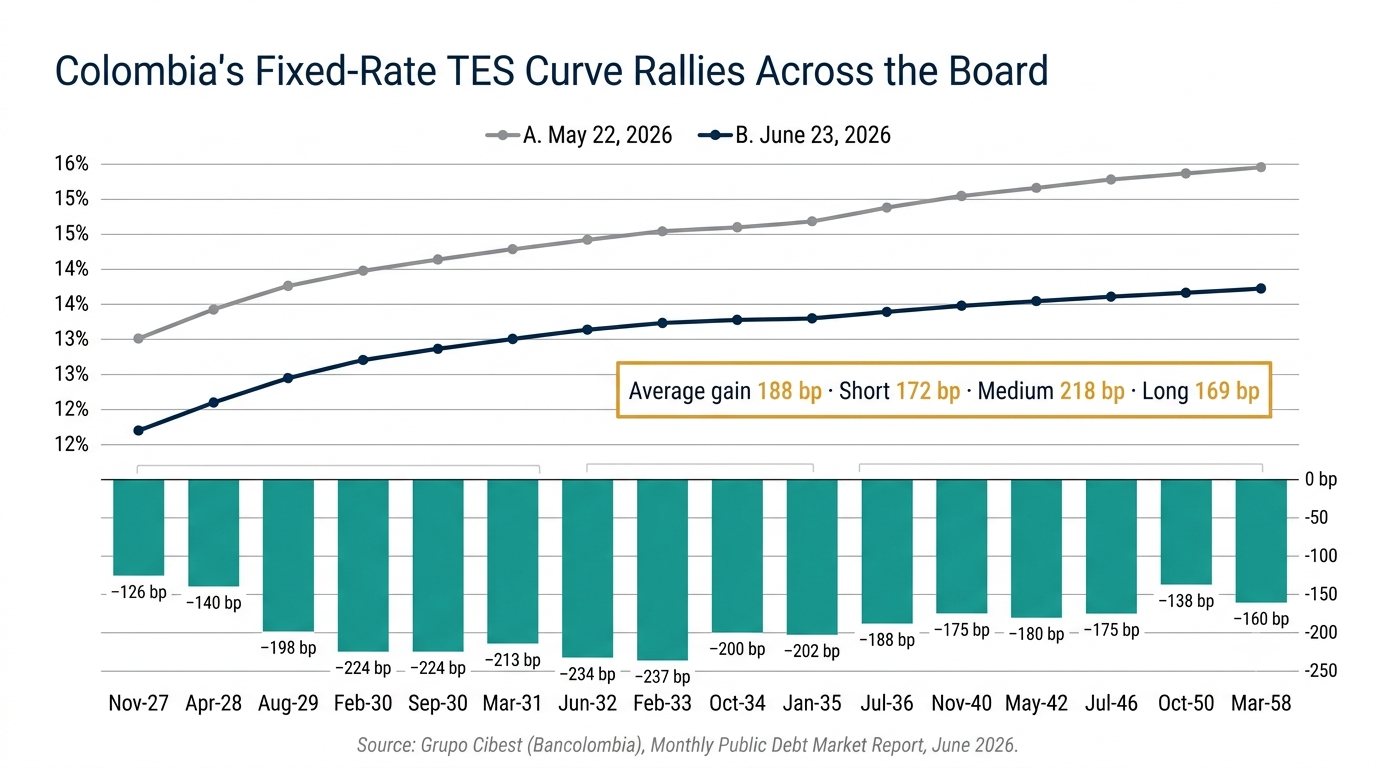
At home, the fixed-rate TES curve — Colombia’s peso-denominated treasury bonds — appreciated along its entire structure. Between May 22 and June 23 the curve gained an average of 188 basis points as yields fell across every segment: the short end (one to four years) by 172 basis points, the middle (five to nine years) by 218, and the long end (more than 10 years) by 169. The report attributed the move on the external side to the evolution of the Middle East conflict and the expectation of de-escalation agreements, and to the Fed’s decision to hold rates, which reinforced a cautious tone. Locally, it said the rally responded mainly to the first-round presidential result and held through the following three weeks, producing a stronger appetite for local debt.
An optimistic fiscal frame the bank questions
The report said the fiscal deficit would narrow in 2026 according to the figures in the Marco Fiscal de Mediano Plazo (Medium-Term Fiscal Framework). After its most recent update, the bank wrote, the National Government presented an optimistic outlook that does not fully incorporate the fiscal fragilities for 2026. The framework projects a deficit of 5.3% of GDP and a primary deficit improving to 2.1% of GDP. The research team countered that, while debt-management operations have improved the structure of debt service, they have been insufficient to halt the structural growth of interest payments, which would reach 3.9% of GDP in 2027 and remain above 4% in the following years. It added that debt reduction could be constrained by new financing needs in a low-liquidity environment, and that the framework itself acknowledges the need for an additional revenue adjustment of close to 1.6% of GDP to stabilize the debt.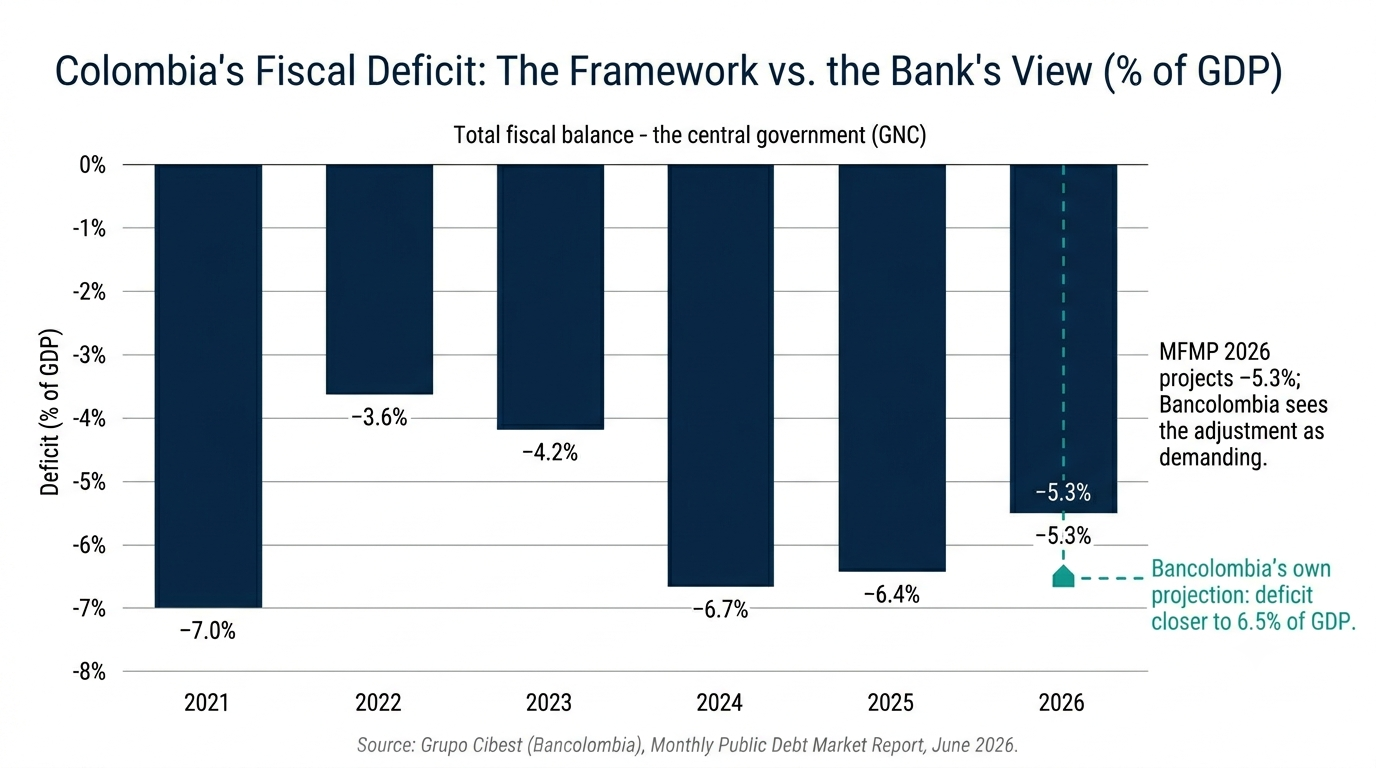
The bank’s own outlook is more cautious than the government’s headline number. In its factor-by-factor view of the coming month, the research team described the fiscal panorama as a continuing source of concern and said the projected 2026 adjustment looks demanding, with revenue and spending pressures pointing to a deficit closer to 6.5% of GDP. Colombia lost a notch of its sovereign credit rating earlier this year, when S&P Global Ratings cut the country to BB- on fiscal concerns.
On budget execution, the report said the Presupuesto General de la Nación (General Budget of the Nation) had reached 46.7% of accumulated appropriations through May. Commitments under the budget totaled $259.8 trillion COP year-to-date, 5.5 percentage points above the same period of 2025. By component, investment led with 58.1% execution, followed by debt service at 50.0% and operating expenses at 43.1%. In terms of effective execution, accrued obligations through May reached $187.2 trillion COP, or 33.7% of appropriations, while payments stood at $185.7 trillion COP, or 33.4%.
Pension funds and banks lead TES buying
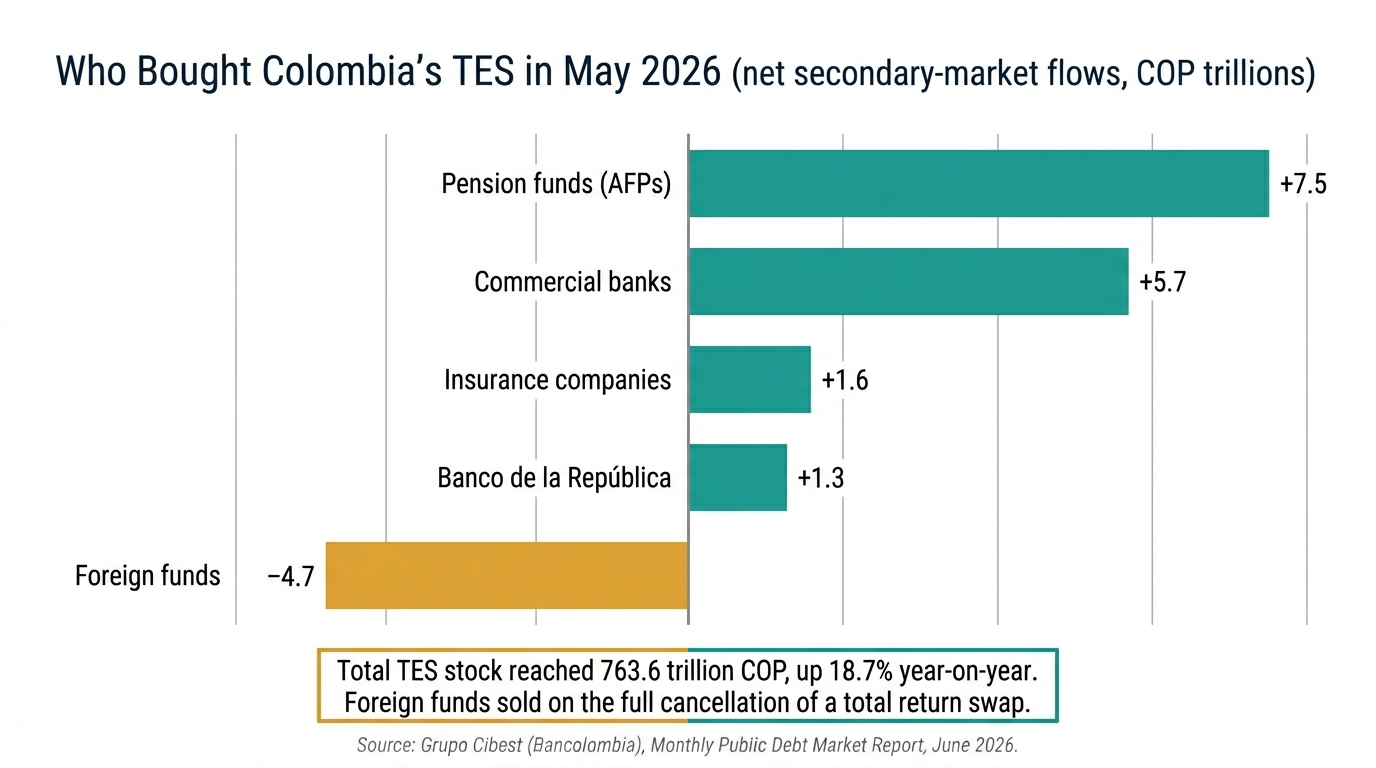
In May, pension fund managers (AFPs) and commercial banks led the month’s TES purchases, the report said. The total stock reached $763.6 trillion COP, an annual increase of 18.7% and a 1.9% gain over April. In the secondary market, net purchases came to $14.1 trillion COP, driven mainly by AFPs at $7.5 trillion COP, commercial banks at $5.7 trillion COP, insurance companies at $1.6 trillion COP and the Banco de la República at $1.3 trillion COP. Foreign funds were the largest net sellers, with a balance of -$4.7 trillion COP, a result the report attributed to the full cancellation during the month of a total return swap (TRS).
A negative tilt for the month ahead
Looking to the next month, the research team rated the balance of factors for the fixed-rate TES curve as negative overall, with the most negative readings at the short end. It pointed to a Federal Reserve holding a restrictive stance amid persistent inflation and a resilient labor market, and to external uncertainty tied to the Middle East and energy prices. On the domestic side, it noted that the economy grew 2.5% year-on-year in the first four months — less dynamic than initially expected after a retreat in primary activities — while public spending and private consumption should continue to support activity through the rest of the year.
The bank flagged inflation and monetary policy as the clearest pressures on local bonds. Annual inflation has stalled in its convergence toward the Banco de la República’s 2.0%–4.0% tolerance range and has begun to accelerate on high indexation and economic momentum, with gasoline-price adjustments, costlier fertilizers and an El Niño event capable of adding further pressure and putting inflation near 6.4% at year-end. With expectations rising, the policy rate stands at 11.25% and, the report said, could reach 12.00% at the June meeting and approach 12.75% in the second half of 2026 as the central bank works to anchor expectations. Set against those headwinds, the bank noted that Colombia’s sovereign risk premium fell over the month to below the Latin American average following the end of the electoral process, even as questions about the sustainability of public finances remain.
The report was prepared by the Directorate of Economic, Sector and Market Research of Grupo Cibest, led by Laura Clavijo, drawing on data from the Federal Reserve, the US Treasury, the Ministry of Finance and Public Credit (Ministerio de Hacienda y Crédito Público), the Banco de la República, LSEG Workspace and JP Morgan.
 Empleobilingue.com

- Director/a de operaciones para hotel, restaurante y discoteca 1626320364.60 - Medellín, Medellin, Antioquia, Colombia
- Coordinador/a de calidad para La Unión 1626483143.1 - La Unión, Antioquia, Colombia
- Desarrollador fullstack - Bogotá, Bogota, Colombia
- Technical Analyst - Remote
- PIM Administrator - Ecommerce - Remote (Bogotá, Bogota, Colombia)
- Auxiliar de gestión humana y bienestar para Girardota 1626060072.28 - Girardota, Antioquia, Colombia
- Marketing Strategist
- Trainer Manager - Bogotá, Bogota, Colombia
- Tolemaida UH- 60 Inspector - Bogotá, Bogota, Colombia
- Virtual Assistant - Team Lead - Remote
Contact Us

