

















The Caldas gold developer hires a former Ecopetrol projects chief
Collective Mining (NYSE American: CNL; TSX: CNL) has advanced engineering and permitting work for its planned exploration adit at the Guayabales Project in Caldas, Colombia, while appointing Josué Romanos as vice president of projects to support the company’s next phase of development.
“The progress on our exploration adit marks an important step in accelerating our understanding of the system from underground and advances the Guayabales Project towards our ultimate goal of production.”
— Ned Jalil, Chief Executive Officer, Collective Mining
The company said construction of the exploration adit is expected to begin in the fourth quarter of 2026. The underground access project is designed to provide a new platform for studying the Apollo system and the broader Guayabales Project, including additional drilling, geotechnical and hydrological studies, and future metallurgical sampling.
Collective Mining first announced the exploration adit plans on March 11, 2026. Since then, the company said it has progressed engineering studies, execution planning, and permitting activities to prepare for construction.
Early preparations have included the construction of an explosives storage facility, which Collective said has been inspected and approved by the relevant authorities.
The adit will support underground drilling activities at Guayabales, where the company is focused on advancing exploration of the Apollo system and the high-grade Ramp Zone. The work is expected to contribute technical information required for future project studies and development decisions.
Alongside the exploration update, Collective Mining announced the appointment of Josué Romanos as vice president of projects, effective immediately.
Romanos brings more than three decades of experience in energy and infrastructure projects in Colombia. He spent more than 15 years at Ecopetrol, Colombia’s state-controlled energy company, most recently serving as general manager of projects, where he oversaw engineering, construction, commissioning, and quality assurance activities across a multi-billion-dollar capital portfolio.
During his time at Ecopetrol, Romanos also participated in the company’s investment committee. Earlier in his career, he held operations and commissioning roles at BP Exploration and PetroSantander on projects in Colombia.
Romanos is a petroleum engineer from Universidad de América and holds a postgraduate specialization in gas engineering from Universidad Industrial de Santander.
Collective Mining said the appointment strengthens its internal project execution capabilities as Guayabales advances through technical studies, permitting, and operational preparation.
Founded by the team behind Continental Gold, which was acquired by Zijin Mining for approximately $2 billion in enterprise value, Collective Mining is exploring gold, silver, copper, and tungsten projects in Caldas.
The company’s Guayabales Project is located within an established mining district and is centered on expanding exploration targets including the Ramp Zone, Hanging Wall Vein Zone, and additional greenfield targets.
Collective Mining is listed on the NYSE American and the Toronto Stock Exchange under the symbol CNL. Management, insiders, strategic investors, and close family and friends hold approximately 45.2% of the company’s outstanding shares.
Two new daily routes add over 5,000 weekly seats to South Florida
Avianca, part of Grupo Abra, has begun operating direct flights from Barranquilla and Cali to Fort Lauderdale, adding two nonstop connections between Colombia and the United States.
The new routes connect Colombia’s Caribbean region and the department of Valle del Cauca with South Florida, one of the most important destinations for Colombian travelers for tourism, business, investment, and family connections.
“With these routes we not only offer direct and convenient options to the United States, but we also give our customers access to a global network of more than 80 destinations in the Americas and Europe.”
— David Alemán, Avianca’s director of sales for Colombia and South America
The flights are operated with Airbus A320-family aircraft configured for 180 passengers per flight. Operating daily, the two routes add more than 5,000 seats per week between Colombia and Fort Lauderdale.
The service began on July 15, 2026, with three of the four flight segments launching that day and the Cali–Fort Lauderdale return service beginning on July 16.
The new schedules are:
| Route | Flight | Departure | Arrival | Frequency | Start |
|---|---|---|---|---|---|
| Barranquilla – Fort Lauderdale | AV 0228 | 16:25 | 20:20 | Daily | July 15, 2026 |
| Fort Lauderdale – Barranquilla | AV 0229 | 22:10 | 00:05 | Daily | July 15, 2026 |
| Fort Lauderdale – Cali | AV 0237 | 20:55 | 23:45 | Daily | July 15, 2026 |
| Cali – Fort Lauderdale | AV 0236 | 01:30 | 06:25 | Daily | July 16, 2026 |
All times correspond to local time at each airport.
The routes operate through Fort Lauderdale-Hollywood International Airport and provide passengers with onward access through Avianca’s network of more than 80 destinations across the Americas and Europe.
Avianca said the expansion reflects its continued effort to strengthen international connectivity from Colombia’s regions. The airline currently operates more than 400 weekly flights to and from the United States, connecting 14 cities in Latin America with its broader network.
The carrier has previously expanded and reactivated routes between Colombia and major US destinations including New York, Miami, and Orlando.
Tickets for the new Barranquilla and Cali routes are available through Avianca’s website, mobile application, contact center, physical sales points, and travel agencies across Colombia.
Avianca and Grupo Abra expand regional network
A member of Star Alliance and part of Grupo Abra, Avianca operates a network that includes passenger, loyalty, and cargo businesses.
The airline group includes Aerovías del Continente Americano S.A., Taca International Airlines, Avianca Costa Rica, Avianca Ecuador, Aviateca, Regional Express Américas, Lifemiles, and Avianca Cargo.
With more than a century of operations in Colombia, Avianca operates more than 155 routes and more than 700 daily flights with a fleet of Airbus A320-family aircraft and Boeing 787 Dreamliners.
In 2025, the airline carried nearly 37 million passengers across more than 262,000 flights. Its Lifemiles loyalty program has more than 15 million members, while Avianca Cargo serves more than 350 destinations through cargo flights, passenger aircraft capacity, and interline agreements.
Grupo Abra brings together Avianca and Brazilian airline GOL under a broader Latin American aviation platform. The group also includes strategic investments involving Wamos Air and Sky Airline.
The company said the platform has approximately 30,000 employees and a fleet of more than 300 aircraft serving more than 25 countries and over 145 destinations.
Above image: Barranquilla skyline.
Extortion demands have been made; no operational disruption reported yet
Ecopetrol S.A. (BVC: ECOPETROL; NYSE: EC) disclosed on July 17 that an unidentified external actor gained unauthorized access to digital resources belonging to the company and its subsidiaries, downloading data associated with approximately 3,300 user accounts and then issuing extortion demands.
The unauthorized access affected cloud-based file storage environments at roughly 15 subsidiaries, including Ecopetrol itself. According to the company’s disclosure, the external actor threatened to publicly release the information that had been extracted. A separate ransomware attempt against the group was blocked by cybersecurity controls already deployed across the company and its subsidiaries.
Ecopetrol said it opened an investigation and activated its incident response and management protocols. The measures it described include the immediate revocation of unauthorized access to the compromised digital assets, blocking of the mechanisms tied to mass downloads of information, and identification, analysis and containment of the tactics, techniques and procedures used by the actor.
The company also filed a criminal complaint with the Fiscalía General de la Nación (Office of the Attorney General of Colombia) and began cooperating with specialized national authorities. It said it is working to identify the external infrastructure used to store or download the information in order to pursue restriction or blocking actions, and has activated support mechanisms with insurers and specialized capital markets teams.
Remaining steps disclosed by the company include a detailed assessment of the downloaded information to determine its criticality, and enhanced monitoring of its technology infrastructure under critical alert protocols with continuous validation of preventive and detective controls.
“The Company has not identified any material disruption to its critical operations, production capacity, or essential services.” — Ecopetrol S.A., market disclosure, July 17, 2026
No production or refining impact reported
As of the date of the disclosure, Ecopetrol said it had not identified any material disruption to its critical operations, production capacity or essential services, nor any direct financial impact that would prevent it from continuing to conduct business. It also said it had not identified any public disclosure of the information subject to the unauthorized access.
The company qualified that assessment, stating that it continues to evaluate the potential exposure of corporate information, which could include confidential, restricted, proprietary or personal data. Ecopetrol said it cannot guarantee that the incident will not have a material adverse effect on its business, reputation, operating results or financial condition, and that it will disclose any material developments to the market in accordance with applicable regulations.
Scope of the exposure
The breadth of the affected corporate perimeter is the element investors are likely to watch. Ecopetrol is the largest company in Colombia, with more than 19,000 employees, and is responsible for more than 60% of the country’s hydrocarbon production along with most of its transportation, logistics and refining systems. It also holds leading positions in petrochemicals and gas distribution.
Through its acquisition of 51.4% of the shares of ISA, Ecopetrol participates in power transmission, the management of real-time systems through XM, and the Barranquilla–Cartagena coastal highway concession. Internationally, the company holds stakes in strategic basins across the Americas, with drilling and exploration operations in the United States — in the Permian basin and the Gulf of Mexico — as well as in Brazil and Mexico. Through ISA and its subsidiaries, Ecopetrol holds power transmission positions in Brazil, Chile, Peru and Bolivia, road concessions in Chile, and interests in telecommunications.
Ecopetrol shares trade on the Bolsa de Valores de Colombia and, as American depositary receipts, on the New York Stock Exchange. The company said it will continue to monitor developments and disclose material facts as they are identified. Further disclosures are published through its investor relations channel.
Prosecutorial inaction pushes the reckoning toward US courts
In an extended interview on Noticias Caracol’s analysis program La Clave, Ricardo Calderón, director of the network’s investigative unit, laid out the case that the secret 2022 overtures his team documented between the Petro government and the Clan del Golfo were not empty exploratory talk — because, he argued, nearly everything the government’s peace envoy promised the criminal organization in private is matched, line by line, by what the state then did in public. The interview arrives roughly a month before outgoing President Gustavo Petro hands the Casa de Nariño (presidential palace) to president-elect Abelardo de la Espriella on August 7, and it reframes what began as a Colombian political scandal as a matter that Calderón believes will ultimately be examined in the United States.
The reporting rests on recordings from a September 2, 2022 meeting — three weeks into Petro’s term — in which the government’s alto comisionado para la Paz (High Commissioner for Peace), Danilo Rueda, met Luis Armando Pérez, alias “Jerónimo,” a commander of the Clan del Golfo, formally the Autodefensas Gaitanistas de Colombia (AGC). In the audio, Rueda offers a mutual military standstill he calls a game of “congelados” (freeze tag), a halt to aerial bombardments, a purge of military and police intelligence, and relief on extraditions, with no equivalent commitments recorded from the criminal side. Finance Colombia has tracked the failures of the paz total (total peace) strategy across the Petro term; what Calderón emphasized on La Clave is corroboration — the method by which his team tested whether the promises became policy.
The Method: Promises Checked Against the Public Record
Calderón described a verification process he said took roughly eight months and drew on more than twenty sources. Rather than publish the audio and let it speak for itself, the unit says it cross-checked each recorded commitment against the government’s own subsequent conduct, using official responses obtained through derechos de petición (right-to-petition requests) to the Ministry of Defense.
“What we did was cross every sentence of the conversation with what actually happened in the following years,” Calderón said, describing the core of the exercise as confirming that “they were fulfilled.”
“There may eventually be favoritism shown to a terrorist and drug trafficking group here, and those are cases that will be taken there.” — Ricardo Calderón, director of the Noticias Caracol investigative unit
He also addressed authenticity directly, given the current climate of manipulated media, a concern sharpened by Petro’s claim that material recovered in a separate case had been fabricated with artificial intelligence. Calderón said the unit obtained original voice samples and commissioned forensic audio analysis (peritazgo) to confirm the speakers before publishing, a step he described as slow but essential.
His team, he said, also consulted officials from prior peace processes and former intelligence directors to establish where the legitimate boundaries of each official’s role lay. They concluded that in the cases of both Rueda and the intelligence chief, “there are things that crossed the line.”
Promise by Promise, Matched to What Followed
On bombardments, the recording captures Rueda telling the Clan del Golfo emissaries he had spoken with the minister and that orders had been given to stop planned strikes in the group’s areas. Days after the meeting, then-Defense Minister Iván Velásquez publicly announced a halt to bombings where minors might be present. According to Ministry of Defense figures cited by Noticias Caracol, no aerial bombardment was carried out against the Clan del Golfo for roughly two years afterward; the first did not come until late 2024.
In the officer corps, Rueda presents a “cleanup” of intelligence as evidence of good faith. On August 12, 2022 — three weeks before the meeting — more than 35 generals were retired in the largest single command shakeup in recent Colombian history, and further removals followed, reaching roughly 40 senior officers. Calderón said the unit focused on three colonels named in the conversation because Jerónimo specifically asked for their removal: officers who had served in Operation Agamenón, the multi-year spearhead against the Clan del Golfo.
Their strategic roles, and the systematic drawdown of elite units trained by United States and United Kingdom agencies to pursue the group, were confirmed against the record; Calderón described a gradual but permanent dismantling of “the most experienced units” fighting the Clan del Golfo and the dissident groups.
On intelligence itself, Rueda is heard reassuring the emissary that the government was “dismantling intelligence.” Calderón said the paper trail of command changes and unit disbandments tracked that statement. On extradition, which is historically the Colombian state’s most effective instrument against cartel leadership, the recording shows Rueda accepting the group’s concerns as something that “gets done,” a concession Calderón and his sources characterized as far outside the mandate of a peace commissioner.
The macro-level corroboration, Calderón argued, is what the Clan del Golfo did with the space it was given. Drawing on Ministry of Defense data, Noticias Caracol reported that between 2022 and 2025 the organization’s membership nearly tripled, from 4,061 to 9,915 fighters, while its municipal footprint more than doubled, from 145 to 338 municipalities, even as, in Calderón’s words, the group “did nothing on peace.” InSight Crime has documented the same pattern of criminal expansion under permissive conditions, and Finance Colombia’s editorial analysis concluded that total peace had produced total chaos.
Two Investigations, One Thread
Calderón described the reporting as having “two legs.” The first is the Rueda audio. The second grew out of a parallel inquiry into the Dirección Nacional de Inteligencia (National Intelligence Directorate, DNI), the successor to the disbanded DAS, after the unit obtained conversations involving its then-director, Jorge Lemus.
That strand placed Lemus, who was accompanied by the DNI’s counterintelligence chief, Ricardo Rey Rosanía, in an August 2025 meeting in central Bogotá with Edward Ferney Rincón, an emerald trader (esmeraldero) and confessed former narcotrafficker known as alias “Boyaco Sinaloa.”

President Gustavo Petro in New York joining rally for Palestine. Photo credit: Colombia Presidency.
According to the recordings, the officials asked Rincón to use his contacts in Congress to advance the ley de sometimiento (criminal-submission bill) that then-Justice Minister Eduardo Montealegre had filed in July 2025, and to help arrange direct contact with alias “Chiquito Malo,” the Clan del Golfo’s top commander. The common denominator across both investigations, three years apart, Calderón said, was the Clan del Golfo.
The DNI thread also cuts against one of Petro’s signature security narratives. In the recording, the intelligence director’s own interlocutor dismisses the existence of the so-called Junta del Narcotráfico (Narcotics Trafficking Board), the Dubai-based cartel “board” that Petro has repeatedly claimed wants to assassinate him. Calderón noted that no intelligence agency, police, or prosecutor has validated the alleged plot, yet the government assembled an organizational chart around it — a construction that, he said, its own sources contradicted.
From Obstruction to Terror-Support: Why the Venue Shifts to Washington
The escalation Calderón stressed is jurisdictional. The United States designates the Clan del Golfo as a Foreign Terrorist Organization, and the US State Department has offered reward money for the capture of its leaders.
Dismantling US- and UK-trained interdiction units in a manner that Calderón says was intended to benefit that structure is, in his framing, more than possible obstruction. “There may be favoring of a terrorist and drug-trafficking organization here, and those are cases that will be handled over there,” he said, pointing to the US.
The same exposure, he added, attaches to the treatment of the dissident groups. Washington’s interest is not abstract: the US Drug Enforcement Administration has already opened a probe of Petro himself for alleged cartel ties.
The Fiscalía’s Silence
Against that backdrop, Calderón pointed to the inaction of Colombia’s Fiscalía General de la Nación (Office of the Attorney General). He noted that when the unit published the “computers of Calarcá” — which were files tied to a dissident commander — in November 2025, the Fiscalía had already held the devices for more than a year and a half.
Had prosecutors acted, he argued, some of the individuals later shown to have participated in the killings of social leaders might have been captured: “in colloquial terms, we could have saved lives.”
On the current matter, he said, the Fiscalía opened a preliminary inquiry into Rueda only in early July 2026 — days before the interview, and more than a week after the audio was published. This is a sequence he said “leaves many questions” about the office’s role. That inquiry names four former officials — Rueda, Iván Velásquez, Jorge Lemus, and Ricardo Rey Rosanía — over the benefits allegedly offered to the Clan del Golfo, and was assigned to the unit of prosecutors delegated before the Supreme Court of Justice.
A Four-Year Pattern, and a Government About to Change
Calderón placed the recordings inside a longer series of disclosures over the Petro term: the Calarcá computers, the emergency-management chats, and other episodes pointing to opaque contacts between senior officials and armed structures. As many as 22 regional peace tables were opened, he noted, on promises resembling those in the audio. The pattern lands at a moment of maximum political consequence: Petro, himself a former member of the M-19 (Movimiento 19 de Abril) guerrilla movement before its 1990 demobilization, is weeks from handing power to a successor who has staked his mandate on the opposite approach.
De la Espriella, who won the June 21 runoff over senator Iván Cepeda with running mate José Manuel Restrepo, has already issued a communiqué urging the vice-president-elect to investigate the disclosures and, if warranted, to refer them to US authorities. In his victory address he vowed that “there will be no zones off-limits to the State” and “no organizations above the Constitution and the law,” and he has said Colombia will join a regional counter-crime initiative promoted by Washington.
Security analysts expect the peace zones established under the Ley de Paz Total (Total Peace Law), which carry no legal permanence beyond the current government, to be revoked after the August 7 handover. Petro has spent his final months pressing to formalize Clan del Golfo concentration zones before he leaves office.
Rueda’s Defense
Rueda, who surfaced only after the first report aired, has maintained that the encounters were preliminary, exploratory approaches involving promises that, by his account, were never fulfilled, and that no presidential decision was ever taken to halt operations against the Clan del Golfo. Calderón’s rebuttal returns to the corroboration: the Ministry of Defense’s own statistics, he said, “prove otherwise.” Whether that gap between the recorded private commitments and the government’s public posture amounts to a crime is now, belatedly, before the Fiscalía — and, if Calderón is right about the US interest, may not stay in Colombia.
Primary reporting by the Noticias Caracol investigative unit, drawn from Ricardo Calderón’s interview on the program La Clave. Related Finance Colombia coverage: Editorial: Gustavo Petro’s Total Peace Has Led to Total Chaos in Colombia; Halfway Through His Term, Petro’s Total Peace Is Failing; InSight Crime: Colombian Criminal Groups Gaining Strength Under Petro; Petro Advances Temporary Concentration Zones for Clan del Golfo.
Headline image: Colombian government representative Álvaro Jiménez (left) shakes hands with Clan del Golfo spokesperson Luis Armando Pérez in the presence of Qatar’s Minister of State for Foreign Affairs, Mohammed bin Abdulaziz bin Saleh Al-Khulaifi (center), in Doha on September 18, 2025, at the start of peace talks. Photo shared by Colombia’s Office of the High Commissioner for Peace
Colombia stays a Swedish priority as Stockholm cuts aid elsewhere
Sweden has formalized a new development cooperation strategy with Colombia covering 2026 through 2031 and maintains the Andean nation among its priority international partners as Stockholm reduces the number of countries receiving dedicated Swedish aid strategies. This comes after the Colombian government agreed to purchase a fleet of Saab Gripen fighter jets.
The strategy, which enters into force on July 1, 2026, and runs until the end of 2031, is expected to mobilize approximately SEK 150 million ($16 million) annually for initiatives focused on employment, democratic strengthening, human rights, and peacebuilding. The final allocation will be determined through Sweden’s annual budget process.
The decision comes as Sweden has narrowed its international cooperation framework, reducing the number of dedicated aid strategies from nearly 70 to 32 countries. A significant portion of Sweden’s aid resources has been redirected toward Ukraine, while several previous partner countries have lost dedicated support.
Colombia’s continued inclusion reflects the importance Stockholm places on the bilateral relationship, particularly around peacebuilding, sustainable development, trade, and democratic institutions.
“Aid will now be based on what we know works.” – Benjamin Dousa, Sweden’s Minister for International Development Cooperation and Foreign Trade
The new Colombian strategy is built around three main priorities: expanding livelihood opportunities through inclusive institutions, employment, trade, and digitalization; strengthening democracy, human rights, and the rule of law; and supporting the consolidation of negotiated peace through stronger institutions for peace and security.
Additional areas of cooperation include fossil-free energy, biogas and biomass, mining, agroindustry, climate-smart technologies, and waste management.
The announcement followed Colombian Foreign Minister Rosa Yolanda Villavicencio’s visit to Stockholm on February 9 for the Second High-Level Dialogue between Colombia and Sweden. During the visit, Villavicencio held a bilateral meeting with Sweden’s Foreign Minister Maria Malmer Stenergard, with discussions focused on peace, security, sustainability, energy transition, trade, education, and economic development.
The Colombian Embassy in Sweden and Iceland stated that the dialogue contributed to maintaining and expanding Sweden’s cooperation strategy with Colombia.
Beyond the bilateral strategy, Colombia will also benefit from Sweden’s new Regional Strategy for Latin America and the Caribbean, which will provide an additional SEK 75 million ($8 million) annually to support trade, democratic development, and the green transition across the region.
The strategy will be implemented through Swedish International Development Cooperation Agency, Sweden’s development cooperation agency, with the full cooperation framework published by the Swedish government.
Colombia is among a limited group of countries, including Guatemala, Cuba, Bangladesh, the Democratic Republic of the Congo, Kenya, Rwanda, and Sudan — receiving dedicated Swedish cooperation strategies through 2031.
The renewed framework builds on a broader strengthening of bilateral ties. In 2024, Sweden and Colombia signed a partnership agreement elevating their relationship to a strategic partnership, alongside memorandums of understanding covering sustainability, energy transition, innovation and technology, education, transport, and space cooperation.
Headline photo: A Saab Gripen E at Colombia’s 2023 F-AIR airshow (photo © Loren Moss)
Half-year revenue tops $680 million USD as Aris holds 2026 guidance
“We delivered a strong first half of 2026, with gold production up 31% from the same period in 2025, and we remain on track to deliver our 2026 production guidance of 300,000 to 350,000 ounces.” – Neil Woodyer, Chair and CEO, Aris Mining
Aris Mining Corporation (TSX/NYSE: ARIS), the Canadian gold producer whose core operations are the Segovia and Marmato underground mines in Colombia, reported on July 7 that consolidated gold production reached 148,000 ounces in the first half of 2026, a 31% increase over the same period a year earlier. The company sold 147,000 ounces over the six months, generating revenue of more than $680 million USD.
Second-quarter production totaled 73,700 ounces, up 26% from the second quarter of 2025. Aris sold 72,100 ounces during the quarter at an average realized price of approximately $4,445 USD per ounce, yielding gold revenue of roughly $320 million USD. The company reported a cash balance of more than $425 million USD as of June 30, 2026. The results follow the 36% year-over-year production increase Aris posted for the first quarter.
| Gold production & sales | Q2 2026 | Q1 2026 | Q2 2025 | H1 2026 | H1 2025 |
| Segovia (koz) | 64.4 | 66.6 | 51.5 | 131.0 | 99.1 |
| Marmato (koz) | 9.3 | 7.8 | 7.1 | 17.1 | 14.3 |
| Total production (koz) | 73.7 | 74.3 | 58.7 | 148.0 | 113.4 |
| Total sales (koz) | 72.1 | 74.8 | 61.0 | 147.0 | 115.3 |
Meeting Production Goals and Outputs
Aris said it remains on track to meet its 2026 production guidance of 300,000 to 350,000 ounces and expects output to rise in the second half of the year, supported by the continuing ramp-up at Segovia and the near-term completion of a new carbon-in-pulp (CIP) plant at Marmato.
“We delivered a strong first half of 2026, with gold production up 31% from the same period in 2025, and we remain on track to deliver our 2026 production guidance of 300,000 to 350,000 ounces,” said Neil Woodyer, chair and chief executive officer. “We expect gold production to increase in the second half of the year, supported by the ongoing production ramp-up at Segovia and near-term completion of construction of the new Marmato CIP plant.”

Aris Mining reported an increase of 21% in its gold production compared to the same time period in 2025. Photo by Csaba Nagy from Pixabay.
Segovia, the larger of the two operations, produced 64,400 ounces in the second quarter and 131,000 ounces for the half, processing ore at an average grade of 10.23 grams per ton with recoveries of 95.7%. Output has climbed since the company completed installation of a second mill at Segovia in June 2025, expanding processing capacity.
Marmato produced 9,300 ounces in the quarter and 17,100 ounces for the half through its existing small-scale flotation plant, as increased underground mining capacity lifted output. Construction of the new CIP plant is advancing, with mill components being assembled and first gold on track for the fourth quarter of 2026, following the underground connection Aris completed at Marmato in April. Once ramped up, Segovia and Marmato are together expected to produce about 500,000 ounces of gold a year.
Longer-Term Objectives for Gold Production
The two mines produced roughly 257,000 ounces combined in 2025. Aris has said its portfolio supports a longer-term objective of about 1 million ounces of annual production, anchored by the high-grade Soto Norte project in Colombia and the Toroparu project in Guyana, where a prefeasibility study is underway and a construction decision is expected in early 2027. The company reported prefeasibility results for those projects in September 2025.
Aris described the second-quarter figures as preliminary and said full financial and operating results for the period are expected on or around July 29, 2026.
Headline Image: Second mill at the Segovia Operations (CNW Group/Aris Mining Corporation)
Rising wages meet weaker demand, squeezing hotel margins in 2026
Colombia’s hotel industry entered 2026 with occupancy, real revenue, and formal employment all falling at once, a convergence that the country’s main lodging trade group says threatens the financial and labor sustainability of hotels nationwide.
The Colombian Hotel and Tourism Association (Asociación Hotelera y Turística de Colombia, Cotelco) issued the alert based on the first-quarter results of the National Administrative Department of Statistics (Departamento Administrativo Nacional de Estadística, DANE) and its Encuesta Mensual de Alojamiento (Monthly Lodging Survey, EMA).
“The results of the Monthly Lodging Survey show that the sector is facing a moment of high pressure: we have lower real income, an occupancy rate that cannot recover the levels of previous years, and a reduction in formal employment,” said José Andrés Duarte, president of Cotelco. “The hotel industry remains an engine of economic and regional development, but it needs conditions that allow companies to sustain their operations and keep generating jobs.”
Occupancy at its lowest in five years
The national occupancy rate stood at 48.4% between January and April 2026, the lowest reading for that period in five years. The figure confirms a downward trend: the indicator reached 52.6% in 2022, 52.1% in 2023, 49.5% in 2024, and 49.3% in 2025. The gap against 2022 amounts to 4.2 percentage points; against 2023, the drop was 3.6 points, while the declines relative to 2024 and 2025 moderated to 1.0 and 0.9 points, respectively. Cotelco sees the recent readings as an apparent stabilization around 49%, though still below the levels recorded during the post-pandemic recovery.
Revenue has not recovered since 2024
Even with this stabilization, however, real revenue in the lodging subsector fell 5.1% between January and April 2026 against the same period of 2025. Comparing January-April 2024 with the same months of 2026, the sector has accumulated a real reduction of 6.9% in billings, a sign that hotels have not fully rebuilt their income levels. For the single month of April 2026, real hotel revenue fell 5.7% year-on-year, according to the EMA.
The contraction was far from uniform across the twelve regions the survey tracks. Antioquia posted the deepest fall, with real revenue down 14.8%, followed by the Central region at -12% and Cartagena at -8.9%. At the other end, only the Pacific region and the Santanderes grew, rising 3.3% and 3.4%, respectively.
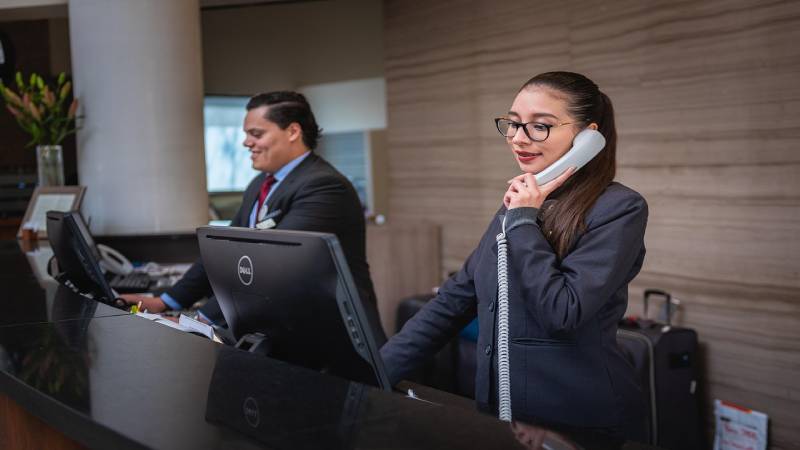
While wages have gone up in the hotel sector, headcounts of employed people in the sector have gone down. Photo by Rodrigo Salomón Cañas from Pixabay.
Formal employment keeps shrinking
Because of falling revenue, the personnel employed in the subsector fell 4.1% between January and April 2026 against the same period of 2025, a decline Cotelco attributes to staffing adjustments amid weaker tourism activity. Since 2024, formal employment in the subsector has accumulated a contraction of 5.1%. In April alone, national hotel headcount fell 5.4% year-on-year, with the sharpest cuts in San Andrés and Providencia (12.1%), the Pacific region (6.5%), and Antioquia (6.2%).
The employment cuts coincided with sharp wage increases. Hotel salaries rose 10.9% in April year-on-year, and real wages in the sector accumulated growth of 10.3% between January and April, even as revenue fell and staffing shrank.
The increases were driven largely by the 23% rise in Colombia’s minimum wage that took effect at the start of the year, with the steepest gains in the Amazon region (21.9%), the Coffee Axis (13.7%), the Pacific (13.3%), and the Caribbean Coast (13.0%). The combination of softer demand and rising operating and labor costs, Cotelco warns, is squeezing the finances of establishments that must sustain daily operations with fewer resources.
Occupancy leaders and the Bogotá exception
San Andrés and Providencia recorded the country’s highest occupancy in April, at 62.6%, up from 58.5% a year earlier. Cartagena remained the second-highest at 59.8%, slightly below the 60% of the prior year. Bogotá registered 55.0% occupancy, with a distinct profile: unlike most regions, where leisure is the main reason for travel, business trips contributed 30.1 percentage points to the capital’s total. Nationally, leisure remained the predominant motive, contributing 25.6 points to the 46.3% total occupancy recorded in April, down from 46.7% in the same month of 2025. Room rates rose only modestly on an annual basis, with single accommodation up 1.8% and double up 2.6%, though both fell month-on-month against March.
“The sector is facing a moment of high pressure: we have lower real income, an occupancy rate that cannot recover the levels of previous years, and a reduction in formal employment.” — Jose Andres Duarte, president of Cotelco
Travel agencies diverge from hotels
While hotels contracted, travel agencies showed relative resilience. The DANE Encuesta Mensual de Agencias de Viaje (Monthly Travel Agency Survey, EMAV) reported that agencies’ nominal revenue grew 2.1% in April, even as their headcount fell 2.8% — the lowest reading since the series began — and average nominal wages rose 11.4%.
Commissions drove the positive result, contributing 1.7 points to the 2.1% total, while the online sales channel edged up to 37.1% of bookings from 36.3%, and the traditional channel slipped to 62.9% from 63.7%. Because hotel figures are stated in real terms and agency figures in nominal terms, the two are not directly comparable, but the divergence points to a shift in how tourism spending is distributed along the value chain.
Cotelco’s requests to the government
The trade group is calling for technical roundtables with the national government to stimulate tourism demand, strengthen formality, and improve operating conditions. Cotelco has also reiterated the urgency of updating the national tourism registry and tightening control over informal supply, which it says undermines the sustainability of destinations, formal employment, and the safety of residents and visitors. The market closed in 2025 with roughly 12,957 hotels and 297,487 rooms.
The current weakness marks a reversal from the sector’s recent peaks. Finance Colombia has previously reported that Colombia hit record-high hotel occupancy and that March occupancy once reached its best level in 11 years, even as domestic tourism approached pre-pandemic levels. The latest DANE readings suggest that rising visitor numbers are no longer translating into stronger results for the formal lodging sector.
According to a first-quarter report released by DANE, hotel occupancy has fallen as tourism revenue slows its growth. Photo by Manuela Jaeger from Pixabay.
A 40-seat scouting tour showcases Medellín’s real filming locations
Cinemotion Labs will open its 2026 edition with an exclusive location-scouting tour through Medellín on Monday, August 10, one day before the conference officially begins. The tour is aimed at producers, directors, filmmakers, creative agencies, audiovisual companies, and investors, and is limited to 40 participants.
Attendees will visit some of the settings that have made Medellín a strategic destination for national and international productions, including the El Perpetuo Socorro creative district, downtown Medellín, and the heritage neighborhood of Prado. The route is designed to show real filming locations, production opportunities, and the city’s audiovisual ecosystem, along with the competitive advantages Medellín offers for film, series, commercials, and digital content.
The experience includes transportation, a specialized guide, and networking among professionals from different countries, which organizers say is meant to strengthen collaboration and new projects across the sector.
“We want attendees to experience the industry beyond the conferences,” said Verónica Marín, project manager of Cinemotion Labs. “This tour will let them see why Medellín has established itself as an attractive setting for international-caliber audiovisual productions, and at the same time build connections that can turn into future partnerships and projects.”
The activity underscores Medellín’s push to market itself as a filming hub. The El Perpetuo Socorro district is the city’s first Área de Desarrollo Naranja (Orange Development Area), part of a broader creative-economy strategy that Finance Colombia has tracked through the country’s growth in the motion picture sector and the tax incentives behind its creative “orange economy.”
“This tour will let attendees see why Medellín has established itself as an attractive setting for international-caliber audiovisual productions,” said Verónica Marín, project manager of Cinemotion Labs.
The tour is available only to those who register for the Cinemotion Labs academic program, and organizers have capped participation at 40 people because of the personalized nature of the experience. Cinemotion Labs’ conference will be happening from August 11 to 12, 2026.
Registration and additional details for the conference and the location tour are available through the Cinemotion Labs website.
Headline photo of Medellín’s Comuna 13 (photo © Loren Moss)
Colombia has a thriving, growing BPO industry, as evidenced by the success of the CX Summit 2026, organized by the industry association, Bpro. While the sector is known to have some very innovative employers, Lisa Walden, co-founder of Good Company Consulting and co-author of The Future of Work Is Human was a keynote speaker at this year’s event where she spoke about how organizations can build more human-centered workplaces by moving beyond traditional leadership approaches and understanding employees as individuals.
Her presentation explored the “platinum rule” of leadership, which is treating people the way they want to be treated, as well as the changing expectations of different generations entering the workforce.
With Colombia’s BPO industry employing a large and increasingly younger workforce, Walden, A Colombian with roots in Santander, discussed how leaders can better engage Gen Z employees, build psychological safety, improve communication, and adapt to a rapidly changing global workplace shaped by technology, globalization, and shared experiences such as the COVID-19 pandemic.
Finance Colombia’s Executive Editor Loren Moss was able to speak with Walden about her concepts and guidance for innovative employers in any industry sector.
Finance Colombia: We’re here at the CX Summit 2026. I’m with Lisa Walden. You’re quite the superstar. There’s been such a line of people looking at your book, The Future of Work is Human. You gave a great talk, and it’s exciting to have you here. At the end, there was a big surprise for me. I heard you speaking pretty good Spanglish, and then I learned you’re Colombian.
Lisa Walden: Yes, I am.
Finance Colombia: Wow, that’s so cool.
Lisa Walden: Yeah, I think so too. I very much represent Colombian pride as much as I can. This necklace is actually from Colombia, so I wanted to be wearing it on stage with me.
Finance Colombia: Great. And we could talk for an hour about that, but I think we want to talk about your presentation today. You gave an interesting talk, and you also have a book about this: how to relate to people differently in the workplace.You talked about the Golden Rule, which is to treat people the way you would want to be treated, but then—
Lisa Walden: The Platinum Rule.
Finance Colombia: Yes, exactly. The Platinum Rule: treat people the way they would want to be treated.
Lisa Walden: Yes, exactly.
Finance Colombia: Which is all the difference in the world, isn’t it?
Lisa Walden: Yeah. We don’t live in a one-size-fits-all world. Being able to know how to customize your leadership approach for the people you’re leading is the way to do it better: to lead in a more human-specific, nuanced way.
I know that’s hard. It’s not easy to do that if you have a team of 20. But that’s why I always say micro moves are your best friends. Think about what micro adjustments you can make that will help you connect and lead more effectively.
Finance Colombia: Something else that you touched on was interesting: how leaders in businesses — and that doesn’t just mean managers and directors, but leaders of all types, no matter their title — interact with people from different generations.
In a way, this can become a stereotype when people talk about Baby Boomers, Gen X, and other generations. But I think the message is to understand the people on your team and relate to them in a way that makes sense and is productive for both the organization and the individual. Is that the gist of it?
Lisa Walden: Oh yeah, 100%. As you said, sometimes people use these generational names as stereotypes, and I really caution against that.
It’s more a lens that you see other people through. It’s one piece of information, one additional bit of texture and nuance to how you lead, but you have to do the work yourself as well.
You have to find out, as individuals, what their preferences are, how they like to receive feedback, how they like to be appreciated, and what their style of work is. When you gain all that information, that’s what really helps you be a better leader.
Finance Colombia: Now, your consultancy has a business partner, and you both do consulting aside from having written a book together.
Lisa Walden: We have it here!
Finance Colombia: The Future of Work is Human. We’ll link to it, of course. Beautiful cover, by the way.
Lisa Walden: Thank you. We worked really hard on that. The first few we received were a no, but we landed on something good.
Finance Colombia: Great. My question is: what do you do as partners in your consultancy? What’s the purpose of the business, and what type of clients do you serve?
Lisa Walden: Our very tongue-in-cheek mission is to help people create workplaces that don’t suck.
We used to work together at an organization as generational consultants, and everyone would say, “Oh, we love your job. It’s so awesome. How do we work for you?”
We identified the gaps where people could focus more on the humans in the workplace and decided to make it our mission to help people create workplaces that don’t suck — but even better, make awesome workplaces.
The work that we do is focused on that people-first lens. We look at generations at work: Boomers, Gen X, Millennials, Gen Z. We look at building psychological safety and trust, communication, and compassionate leadership.
Mostly, we deliver this content at meetings, associations, and events. But we also go into organizations. We do team building, workshops, and consulting engagements when a client comes to us with a very specific ask.
Our mission is simple: helping people create workplaces that don’t suck. The way we disseminate that information and pursue that mission is pretty varied.
Finance Colombia: That’s fascinating. Is there a website or a way people who might need that service can get in touch with you?
Lisa Walden: Absolutely. You can find me on LinkedIn. My name is Lisa X Walden, and you can find me easily with the X Walden. The X is for my middle name, Ximena, which is very common here in Colombia.
You can find us on Instagram at @goodcompanyconsulting, and you can also find our website at www.goodcompanyconsulting.com.
Finance Colombia: Lastly – and you’ve been very generous with your time – I love seeing the interest. We’ve been standing here and people keep coming up to you, which is amazing.
Lisa Walden: It’s cool.
Finance Colombia: I’ve been coming to this event for about 15 years, and I’ve never seen that kind of response. I’ve seen other popular people, but not like that. That’s really impressive for the keynotes.
Lisa Walden: Wow. Thank you for saying that.
Finance Colombia: What are the takeaways that people in the BPO industry specifically can use and apply?
Also, you talked about life-defining events and the things we remember — whether it’s 9/11 or other major events. It’s fascinating because you look at the parallels and differences between Colombia and other generations.
I think about the older generation when they think about the Bogotazo, when the presidential candidate was killed and everything that happened afterward. Were there differences that you found, or any surprises as you prepared for this and unpacked that?
Lisa Walden: I focused mostly on Gen Z because that was my ask. It sounds like for many BPOs, a vast majority of their employees are within that generational age range.
Gen Z right now is between 16 and 30, so I really focused on them in my interviews and research for this event.
I’ll also say that when we look at generations, the way we talk about them is through events and conditions during formative years — roughly your teenage years. Of course, a different country is going to have different formative events for different generations.
For Gen Z, there is so much that’s similar because of globalization, the internet, COVID, and technology. We have access to the same types of things, so they are showing up much more similarly across the board than older generations.
Of course, there are some uniting events. For example, I asked the room, “What is an event or condition you remember from your formative years?” I want to say there was a Millennial in the room who said 9/11, and a Colombian Millennial who said a Colombian event.
There are shared events and conditions globally, but for Gen Z, there are so many of them. I went in knowing that, but I was surprised to find the level of similarity between how that is shaping them at work.
Things like really prioritizing mental health, prioritizing their own wellness, and pushing for work-life harmony — that’s what we call it. It’s not balance, but it’s about getting resources from work that make them better people outside of work and then being able to unplug after work so they can be better at their work when they come back.
They also have a different association with people in positions of authority and a different kind of work ethic, I would say. It can push some people because it’s different from what they’ve seen in the past.
We see that cyclical conversation: “Oh, this generation doesn’t want to work anymore.”
What really surprised me was the similarities and how many there were. It was truly shocking, even as a generational researcher, to say: “Wow, the similarities across these countries are pretty staggering.”
Finance Colombia: Absolutely. We’re all on the same internet and connected. If you look at globalization, Colombians consuming US content and people in the US being able to access channels from Uzbekistan and Bangladesh on their cable systems now — it’s a different world.
Lisa Walden: Yep, exactly. You can see the whole world now. So yeah, it makes sense.
Finance Colombia: Great. You’ve been so generous with your time. Thanks so much. It’s an honor to talk to you, and it’s been a lot of fun.
Lisa Walden: Thank you for having me. It’s such a pleasure. I’m just happy to be here.
Finance Colombia: Great.
Property may be defended, but not with a life, the court holds
Colombia’s Corte Suprema de Justicia (Supreme Court of Justice) has upheld the homicide conviction of a Boyacá landowner who shot and killed two men on his rural property, but slashed his sentence from 23 years to four years and four months after concluding he had acted in exceso en la legítima defensa (excess of self-defense). The July 1 ruling, written by Justice Myriam Ávila Roldán for the court’s Sala de Casación Penal (Criminal Cassation Chamber), offers one of the clearest recent statements of how far Colombians may go in defending their property — and where that right ends.
The case dates to the night of May 12, 2014, when Luis Alberto Reyes Buitrago found brothers José Fernando and José Danilo Caro Caro on “Chorro Blanco,” his cattle property in the vereda (rural hamlet) of Potreros, in Ramiriquí, Boyacá. Reyes fired on the two men, killing both, then turned himself in the following morning, handing over the firearm — which he was not licensed to carry — and stating that he had shot “to defend his patrimony.”
The path to the Supreme Court was unusually long. A trial court in Ramiriquí acquitted Reyes in 2018, citing reasonable doubt. In April 2024 the Tribunal Superior del Distrito Judicial de Tunja (Tunja Superior District Court) reversed that decision, convicting him for the first time of simple homicide on two counts and imposing 276 months — 23 years — in prison. Because Colombian law guarantees anyone convicted for the first time on appeal a further review, known as doble conformidad (double conformity), Reyes was able to challenge the conviction through an impugnación especial (special appeal), placing the matter before the high court.
“The economic patrimony cannot be placed before, or equated with, the life of a human being.” — Colombia’s Corte Suprema de Justicia, Criminal Cassation Chamber (Justice Myriam Ávila Roldán, writing for the panel)
The Supreme Court reaffirmed that a valid claim of legítima defensa (self-defense) requires five elements: an illegitimate aggression, the absence of sufficient provocation by the defender, that the aggression be current or imminent, that the defense be necessary, and that the response be proportional. Crucially, the court held that self-defense is not confined to threats against life or physical integrity — it can also protect patrimonio económico (economic patrimony), correcting the Tunja tribunal’s narrower reading.
On the facts, the court found the first four elements satisfied. The victims’ unexplained nighttime presence on private land, in an isolated area with a documented history of hurto de semovientes (livestock theft), amounted to a real and imminent aggression against Reyes’s property that he was entitled to confront.
Proportionality was where the defense failed. Forensic evidence showed Reyes fired repeatedly — the two bodies bore four and three gunshot wounds, respectively, striking vital organs from multiple directions — while investigators found no firearms on the victims, only a screwdriver, and recovered a single shell casing at the scene, matching Reyes’s gun. Emptying a firearm into two people, the court held, went far beyond what was necessary to repel a threat to property.
“The economic patrimony cannot be placed before, or equated with, the life of a human being,” the chamber wrote, adding that the defense of property, even under real risk, “does not authorize the use of lethal force.” Because the killing began within a genuine defensive context but exceeded its limits, the conviction stands as an incomplete justification: guilt and unlawfulness remain, but the penalty is sharply reduced. Recalculating under Article 32 of the Penal Code, the court arrived at 51.66 months — four years and four months — and granted house arrest, subject to a bond of two monthly minimum wages, citing Reyes’s roots in the community.
For readers accustomed to US self-defense law, the decision maps onto familiar concepts while diverging on the central question. Colombia’s legítima defensa privilegiada (privileged self-defense) — a legal presumption favoring someone who repels an intruder entering their home or its immediate surroundings — functions much like the American “castle doctrine.” It did not apply here because the shooting occurred on open rural land rather than a dwelling, where Reyes did not live. Colombia also has no equivalent to US “stand-your-ground” statutes; its necessity requirement asks whether other reasonable options existed before force was used.
The sharpest contrast is over property itself. Most US states, like Colombia, bar deadly force to protect property alone. Texas is the notable exception: its penal code expressly permits deadly force against theft “during the nighttime” on one’s land when lesser measures would expose the owner to serious harm — nearly the exact scenario Reyes described. On comparable facts, Colombia’s highest court reached the opposite conclusion.
The ruling lands as security and the rule of law remain central to Colombia’s political debate, and as some sectors press to widen the presumption of self-defense for property owners. Congress moved in that direction with Law 2197 of 2022, which systematized privileged self-defense and codified a proportionality standard — but this decision, applying the law as it stood in 2014, signals that proportionality remains a firm ceiling on the force the law will excuse.
Above Photo © Loren Moss
 Empleobilingue.com

- Director/a de operaciones para hotel, restaurante y discoteca 1626320364.60 - Medellín, Medellin, Antioquia, Colombia
- Coordinador/a de calidad para La Unión 1626483143.1 - La Unión, Antioquia, Colombia
- Desarrollador fullstack - Bogotá, Bogota, Colombia
- Technical Analyst - Remote
- PIM Administrator - Ecommerce - Remote (Bogotá, Bogota, Colombia)
- Auxiliar de gestión humana y bienestar para Girardota 1626060072.28 - Girardota, Antioquia, Colombia
- Marketing Strategist
- Trainer Manager - Bogotá, Bogota, Colombia
- Tolemaida UH- 60 Inspector - Bogotá, Bogota, Colombia
- Virtual Assistant - Team Lead - Remote
Contact Us

