

















Abra Group, the Latin American holding company behind Avianca, GOL (B3: GOLL54; NYSE: GOL) and Wamos Air, used the opening day of the Farnborough International Airshow to announce two moves aimed at expanding its fleet and its global network: an order for up to 45 Embraer (B3: EMBJ3; NYSE: EMBJ) E195-E2 jets, and a Memorandum of Understanding (MoU) with Etihad Airways to link Latin America with the Middle East and Asia.
Up to 45 E195-E2 jets for regional and domestic growth
Abra and Embraer confirmed an agreement for Abra to acquire 20 E195-E2 aircraft, with 10 purchase options and 15 purchase rights, for a total of up to 45 aircraft, subject to certain additional conditions being met. The E195-E2, the largest model in Embraer’s E-Jet E2 family, is designed to deliver lower fuel consumption, reduced emissions and an improved passenger experience.
Abra said the aircraft will let it better match capacity to demand across its network, open new markets and add frequencies as it builds out its strategy as a pan-Latin American platform. The first deliveries are expected in the fourth quarter of 2027, with the order set to be added to Embraer’s third-quarter backlog once all final conditions are met.
“The E195-E2 will give Abra the flexibility to seize new opportunities as part of our disciplined fleet-allocation approach, generating greater value when and where our customers need it most,” said Adrian Neuhauser, CEO of Abra Group. “This agreement reflects our commitment to keep investing in efficient, next-generation aircraft as we expand connectivity and strengthen our network at both the regional and domestic level.”
“We are proud to accompany Abra Group on its growth journey with the E195-E2, one of the most efficient and sustainable single-aisle aircraft available today,” said Arjan Meijer, President and CEO of Embraer Commercial Aviation. “This agreement reinforces Embraer’s position as a strategic partner for airlines seeking versatility and performance in smaller narrow-body aircraft.”
Embraer said the E195-E2’s aerodynamics, next-generation Pratt & Whitney GTF engines and lower environmental footprint deliver significant reductions in fuel burn and emissions compared with earlier-generation aircraft.
“Together with Etihad, we are building a new bridge between Latin America and the Middle East.” — Adrian Neuhauser, CEO of Abra Group
An MoU with Etihad to bridge Latin America and the Middle East
Separately, Etihad Airways and Abra signed an MoU establishing a strategic alliance intended to strengthen connectivity between Latin America, the Middle East and Asia by combining Etihad’s network with those of Abra’s airlines: Avianca, GOL and Wamos Air.
Under the alliance, Abra and Etihad will explore opportunities in network development, loyalty programs, aircraft leasing arrangements, ACMI (Aircraft, Crew, Maintenance and Insurance) services and broader commercial cooperation. The agreement also contemplates expanded cooperation between Etihad, Avianca and GOL through reciprocal loyalty-program benefits, commercial collaboration and codeshare arrangements, with plans to launch these initiatives during 2026.
Beyond passenger connectivity, GOL and Etihad intend to evaluate a possible operating (dry) lease of an Airbus A330-900, targeted to begin in November 2026, while Wamos Air is expected to support Etihad’s expansion plans by deploying up to three aircraft starting in March 2027. The parties said they will continue working toward definitive agreements governing the proposed initiatives, subject to regulatory approvals, commercial agreements and operational feasibility assessments.
“This alliance reflects the strategy of Abra to leverage the complementary strengths of Avianca, GOL and Wamos Air to expand connectivity and generate new commercial opportunities,” said Neuhauser. “Together with Etihad, we are building a new bridge between Latin America and the Middle East, while exploring innovative ways to integrate our brands and operations in network development, loyalty programs and fleet cooperation. It is an honor for our teams at Avianca to work alongside Etihad; from South America to the United Arab Emirates, this joint effort reflects our shared commitment to exceptional service, giving our customers the best of both worlds. This is an important step in advancing Abra’s vision of a more connected and competitive airline industry.”
“Latin America is an increasingly important market for Etihad, and this alliance creates a strong platform to connect more travelers with Abu Dhabi and destinations across our growing global network,” said Antonoaldo Neves, CEO of Etihad Airways. “This alliance brings together two complementary airline groups to create stronger connections between our regions. Together we are strengthening the ties between Latin America, Abu Dhabi and destinations across our global network, expanding opportunities for our passengers and supporting Abu Dhabi’s continued growth as a destination and connecting hub.”
About the companies
Abra is one of the leading air transport groups in Latin America, bringing together the Avianca and GOL brands along with a strategic investment in Wamos Air under an integrated pan-Latin American platform. The company also includes the region’s leading loyalty programs, LifeMiles and Smiles, along with cargo operations. Abra also holds convertible debt representing a minority equity stake in Sky Airline. Avianca, the world’s second-oldest airline, operates a fleet made up primarily of Airbus A320 and Boeing 787 passenger aircraft, along with freighters. GOL, one of Brazil’s leading airlines, operates a fleet built mainly around Boeing 737 aircraft. Wamos Air is a leading European wide-body ACMI (Aircraft, Crew, Maintenance and Insurance) provider, operating Airbus A330 passenger aircraft. Abra employs approximately 30,000 people and operates a fleet of more than 300 aircraft, with scheduled flights connecting more than 25 countries and more than 145 destinations.
Embraer is a global aerospace company headquartered in Brazil, operating in the Commercial Aviation, Executive Jets, Defense & Security and Agricultural Aviation segments. Founded in 1969, the company has delivered more than 9,000 aircraft and is the world’s leading manufacturer of commercial jets with up to 150 seats.
Etihad Airways, the national airline of the United Arab Emirates, was founded in 2003 and is based in Abu Dhabi. The airline operates passenger and cargo flights to destinations across the Middle East, Africa, Europe, Asia, Australia and North America.
A giant dove suspended more than 15 meters above what its organizers call the largest natural flower tapestry in the world has gone on display in Medellín, the capital of the department of Antioquia. The tapestry, built from more than 220,000 flower stems, occupies the central plaza of Centro Comercial Santa Fé Medellín and remains on view through August 30.
The exhibition is the 16th edition of the shopping center’s annual floral event, presented this year as World of Flowers 2026 under the slogan “When love unites, peace blossoms.” It runs alongside the Feria de las Flores (Festival of the Flowers), the city’s flower festival held across July and August, and draws on the region’s silletero (flower-bearer) tradition of carrying flower arrangements on wooden back-frames.
Each edition is organized around a theme, and the 2026 centerpiece is peace. “The floral dove symbolizes the peace we long for throughout the world. With it, we want to convey a message of empathy and hope at a time when the world is facing so many conflicts,” María Fernanda Bertel, general manager of Centro Comercial Santa Fé Medellín, told the Spanish news agency EFE.
“The floral dove symbolizes the peace we long for throughout the world.” — María Fernanda Bertel, general manager, Centro Comercial Santa Fé Medellín
For 46 days, the 1,000-square-meter plaza holds a floral carpet of 27,000 plants carrying more than 220,000 flowers grown in eastern Antioquia. The arrangement combines petunias in fuchsia, purple, white, and red with marigolds ranging from orange to yellow.
“The species we have chosen adapt well to our square and to our infrastructure, which features retractable roofs that open in the morning and afternoon, providing the lighting conditions these flowers require,” Bertel said.
The dove is built on a metal frame and covered with white leaves made from biodegradable materials designed to resemble flowers, attached one by one to a sculpture measuring 10.5 meters high and 16.8 meters wide. According to Bertel, more than 200 people worked on World of Flowers 2026, from initial design through installation, and a team of eight gardeners maintains the display, monitoring watering and condition throughout the run.
The shopping center staged its first flower carpet in 2011. In 2025 the initiative marked its 15th anniversary and drew 3.1 million visitors to installations placed throughout the property, with a hot-air balloon as that year’s main attraction.
A Colombian eye-care provider sets a global accreditation precedent
Clínica de Especialidades Oftalmológicas (CEO), a Medellín-based ophthalmology provider, has become the first healthcare organization in the world to receive accreditation under Global Healthcare Accreditation’s (GHA) Standards for Accreditation of Healthcare Organizations 1.0 and the first institution to complete GHA’s Integrated Accreditation Program for Medical Travel.
“CEO has shown that medical travel, when aligned with clinical quality and patient-centered care, can directly support better outcomes and a stronger healthcare experience for both local and international patients.” – Renée-Marie Stephano, Chief Executive Officer, Global Healthcare Accreditation
The recognition covers CEO’s facilities in Medellín, Envigado, and Rionegro, following an integrated evaluation process that assessed both healthcare quality standards and the organization’s ability to manage the complete journey of international patients.
GHA’s Integrated Accreditation Program combines clinical quality, patient safety, operational performance, and medical travel services into a single framework. The model is designed to help healthcare organizations align domestic and international patient care while creating consistent processes across areas such as coordination, communication, risk management, and follow-up.
“This international recognition confirms that it is possible to achieve world-class standards in patient safety, clinical quality, and patient experience in Colombia,” said José Francisco Bernal Márquez, General Manager of Clínica de Oftalmología CEO.
Bernal Márquez said the accreditation followed a year-and-a-half process that included training, gap assessments, and preparation work aimed at strengthening quality systems and improving services for both Colombian and international patients.
The accreditation evaluates healthcare organizations across areas including governance, infection prevention and control, medication management, workforce competency, risk management, continuity of care, and continuous improvement. The standards have also received validation from the International Society for Quality in Health Care External Evaluation Association (ISQua EEA).
The medical travel component examines the complete international patient experience, from initial inquiries and pre-arrival coordination to treatment, discharge planning, follow-up care, cultural considerations, financial transparency, and long-term sustainability.
“CEO’s achievement demonstrates how a serious medical travel program can strengthen an organization far beyond international patient growth alone,” said Stephano. “When patient experience, safety, quality, and operational systems are improved across every touchpoint, the benefits extend to all patients.”
According to Claudia Jorgenson, Director of Clinical Operations at Global Healthcare Accreditation, CEO stood out for its commitment to continuous improvement and its willingness to strengthen systems beyond accreditation requirements.
“The Integrated Accreditation process is rigorous because it looks at the organization from multiple perspectives, including clinical quality, patient safety, governance, risk management, care coordination, and the full patient experience,” Jorgenson said.
Founded 18 years ago, Clínica de Especialidades Oftalmológicas has grown into one of Colombia’s leading ophthalmology providers. The organization works with 57 ophthalmologists and performs approximately 1,000 surgical procedures each month.
CEO has completed more than 150,000 ophthalmic surgeries throughout its history. During the evaluation process, GHA highlighted the organization’s quality culture and patient-focused approach, while CEO reported eight years without institutional surgical infections, a 0.8% reoperation rate, zero complex adverse events, and a 0.3% minor adverse event rate.
The accreditation positions CEO as an example of how Colombian healthcare providers are increasingly integrating international standards into specialized medical services and medical tourism offerings.
More information about CEO is available at ceomedellin.com.
A closer read of the labor data reveals fragile, public-led job gains
Colombia’s unemployment rate has held in single digits on a rolling-quarter basis since March 2025, but a closer look at the data shows the improvement rests on weaker foundations than the headline figure implies, according to the latest Radar Bancolombia weekly report, published June 16 by Grupo Cibest, the research arm of Bancolombia (NYSE: CIB, BVC: BCOLOMBIA).
The report’s authors argue that the jobs Colombia is adding are increasingly vulnerable, more dependent on public spending, and of lower quality — limitations the unemployment rate alone does not capture.
The inactivity behind the falling jobless rate
The unemployment rate counts only people actively looking for work, so those who stop searching — the inactive — drop out of the measure even though they still weigh on the market.
“The employment being generated is increasingly vulnerable, more dependent on public spending, and of lower quality.” — Radar Bancolombia, June 16, 2026, Grupo Cibest
Using the metaphor of an iceberg, Grupo Cibest describes unemployment, near 8.7% on a moving-year average to April 2026, as the visible portion. Meanwhile, inactivity, sits below the surface, exceeding 35% of the working-age population according to the report. Between January 2020 and February 2026, the ratio of inactive to unemployed people rose from 4 to 5 for every unemployed person, suggesting the drop in unemployment reflects not only more opportunity but also people leaving the labor force.
Formal jobs, fragile foundations
Formal employment has been rising, but the report flags long-term weaknesses. The Bancolombia Formality Index, part of a new set of employment-vulnerability indicators, closed March 2026 at 72.7 points, above its 2022–2025 average and well above the 50.5 points recorded in March 2025.
Formality and coverage of health and pension contributors both increased through 2026, which appears positive at first glance. Much of that covered employment, however, does not stem from a genuine private-sector recovery. The report’s hypothesis is that the minimum-wage increase at the start of the year raised the cost of formalizing jobs, discouraging formal hiring at the moment the economy most needed it.
Quality is the bigger worry
The Bancolombia Employment Quality Index — which weighs formal workers’ income relative to the minimum wage, the mix of dependent and independent workers, and the share of non-vulnerable formal jobs — stood at 20 points in March 2026, below the prior year and marking a change in trend from the preceding three years. The deterioration reflects a lower income relative to the minimum wage in 2026 compared with the 2022–2025 average, a narrowing gap between dependent and independent workers that points to more independent and vulnerable formal employment, and a rising share of independents within total formal workers.
The report concludes that Colombia needs sustained formalization that does not rely on public spending as the main engine of job creation, nor on minimum-wage adjustments as the main tool of labor policy. The underlying figures draw on the National Administrative Department of Statistics (Departamento Administrativo Nacional de Estadística, DANE) and its Gran Encuesta Integrada de Hogares (Great Integrated Household Survey, GEIH), with calculations by Grupo Cibest.
Other highlights of the Report
On the domestic economy, the report noted that the Economic Policy Uncertainty Index from the think tank Fedesarrollo eased in May from a high April reading, and estimated that Colombia’s economy grew at a solid pace in April, with commerce expanding at double digits, manufacturing recovering gradually, and consumer confidence likely remaining in double digits in May.
In local markets, the fixed-rate TES curve — Colombia’s peso-denominated government bonds — gained 34 basis points on average the prior week, and the report cited a projected fiscal deficit of 5.3% of GDP under the 2026 Marco Fiscal de Mediano Plazo (Medium-Term Fiscal Framework). Pension fund managers and commercial banks led May purchases of class B TES in the secondary market. The Colombian peso appreciated in line with global and regional trends, while crude prices fell on the prospect of a US–Iran agreement and OPEC approved a fourth consecutive output increase for July.
Stock photo by Kevin Seibel via Pixabay.
Ten-year seal aligns UNIMINUTO business degrees with global standards
The Faculty of Economic and Administrative Sciences at Corporación Universitaria Minuto de Dios (UNIMINUTO) Antioquia-Chocó has earned international accreditation from the Accreditation Council for Business Schools and Programs (ACBSP), one of the world’s principal accreditors of business and management education.
Founded in the United States in 1988, ACBSP accredits business programs in more than 60 countries and counts over 1,200 affiliated institutions worldwide. The accreditation that UNIMINUTO received is valid for 10 years and covers the faculty’s Business Administration and International Marketing Technology programs at UNIMINUTO’s campus in Bello, Antioquia.
“This accreditation reflects the commitment and transformative presence of this great educational project in the country’s regions. Today we celebrate and recognize the diligent, determined, and committed work of our entire educational community — an effort that allows the academic quality of UNIMINUTO to now have international recognition,” said John Anderson Virviescas, dean of the Faculty of Economic and Administrative Sciences.
During the evaluation, ACBSP highlighted the faculty’s social impact — particularly its work with students from lower-middle socioeconomic strata and the improvement of students’ and graduates’ family and professional environments. The accreditor also cited the faculty’s community-service and volunteer practices, the participation of professors, students, graduates, and employers in its institutional development plan, its university-wellbeing policy, ongoing curriculum updates, student support through the MAIE program, and its faculty-development plans.
Benefits for students, graduates, and faculty
According to the faculty, the accreditation gives students access to internationally validated training aligned with global quality standards and measurable learning outcomes, along with opportunities to take part in international academic experiences such as business-simulation tournaments, internationalization projects, mirror classes, and Collaborative Online International Learning (COIL). For graduates, it strengthens their professional profile and competitiveness in domestic and international labor markets. For faculty, it opens access to professional-development plans, academic mobility, and international research networks.
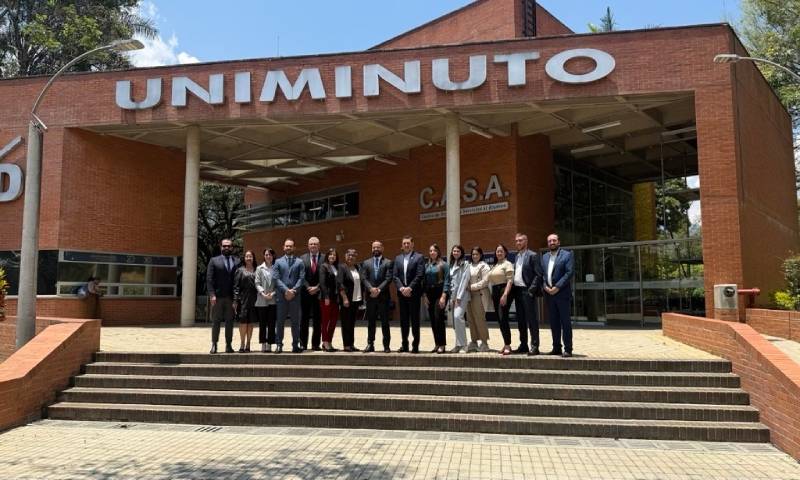
The Accreditation Council for Business Schools and Programs shows the community-focused education of the Faculty of Economic and Administrative Sciences at Corporación Universitaria Minuto de Dios. Photo provided by UNIMINUTO Press Office.
A five-year process
The path to accreditation began in 2020 with eligibility, self-assessment, and continuous-improvement stages. In October 2021, the faculty received official approval to move into the self-study phase, an integral review of its academic, administrative, and strategic processes. Following site visits and technical reviews by international peers, the institution consolidated its strengths and reduced the improvement opportunities identified during the evaluation.
“This accreditation reflects the commitment and transformative presence of this great educational project in the country’s regions.” — John Anderson Virviescas, dean of UNIMINUTO’s Faculty of Economic and Administrative Sciences
Faculty profile
The faculty has trained 9,206 students through a program model built around social, business, and global challenges. Its Business Administration and International Marketing Technology programs currently enroll 4,546 active students and count 4,660 graduates.
The faculty employs 44 professors, six of whom hold doctorates in related fields, and 70% hold C1 English certification. Its internationalization efforts include 19 visiting international professors and academic mobility for eight professors at higher-education institutions abroad. In 2025, professor Natalia Marulanda was named “Breakthrough Professor” (Docente Revelación) by the Colombian Association of Business Administration Faculties (ASCOLFA).
UNIMINUTO’s newly-accredited faculty has two research groups recognized by Colombia’s Ministry of Science, Technology and Innovation (MinCiencias): the Research Group in Economic and Administrative Sciences, ranked in category A, and the Research Group in Innovation and Social Management, in category B.
They are joined by four research seedbeds with more than 70 students and a team of three senior researchers, six associates, and two junior researchers. Students can also take electives in fields such as data science, artificial intelligence, big data, business intelligence, data mining, and Power BI, along with classroom-based consulting methodologies that connect coursework directly with the productive sector.
The ACBSP accreditation adds to UNIMINUTO’s presence across Colombia’s regions and positions its two Bello-based programs within a global network of accredited business education.
Headline Image provided by UNIMINUTO Press Office.
Non-branch channels carried 85% of operations and 70% of value.
Colombia’s financial system handled 6,078 million operations in the first quarter of 2026, according to the latest operations report from the Superintendencia Financiera de Colombia (Financial Superintendency of Colombia), the country’s banking and securities regulator.
Credit institutions and specialized electronic deposit and payment companies, known by their Spanish acronym SEDPE, accounted for those 6,078 million operations. Of that total, 3,568 million were monetary operations worth $3,153 trillion COP, and 2,509 million were non-monetary, such as balance inquiries.
“84.6% of all operations were carried out through non-presential channels, accounting for 69.9% of the value transacted.” — Superintendencia Financiera de Colombia, first-quarter 2026 operations report
Separately, low-value payment system administrators, or EASPBV, together with the Banco de la República (Colombia’s central bank), processed 963 million monetary operations worth $1,081 trillion COP.

The Financial Superintendency of Colombia estimated that 66% of monetary interactions came from mobile applications. Stock photo by Kevin Schneider via Pixabay.
Non-presential channels — those that do not require a visit to a branch or physical point — continued to account for the bulk of activity, handling 84.6% of all operations and 69.9% of the value transacted. The remaining 15.4% of operations went through in-person channels. For the quarter, internet and bank offices were the channels through which the largest amounts of money moved.
Among in-person channels, the largest share of operations was concentrated in three departments: Bogotá at 33%, Antioquia at 25%, and Valle del Cauca at 13%.
For monetary operations, mobile applications were the most-used channel at 66%, followed by point-of-sale terminals at 13%. For non-monetary operations, mobile applications accounted for 81% and internet for 16%, while interactive voice response systems, virtual assistants, and telephone call centers were the least used.
Measured by the volume of payments tied to economic activity, professional, scientific, and technical activities led with 27% of the total. They were followed by wholesale and retail trade, including motor vehicle and motorcycle repair, at 19%; financial and insurance activities at 12%; information and communications at 11%; and electricity, gas, steam, and air conditioning supply at 10%.
Headline image: Stock photo by Rupixen via Pixabay.
Travel and transport powered an 11.3% rise in services exports
Colombia continued to diversify its export base in the first quarter of 2026, with nearly two of every three dollars earned from foreign sales now coming from non-mining and non-energy goods and services.
Services exports reached $5.34 billion USD between January and March, up 11.3% from $4.8 billion USD in the same period of 2025, according to balance-of-payments data from the Banco de la República (Colombia’s central bank) analyzed by the Ministerio de Comercio, Industria y Turismo (Ministry of Commerce, Industry and Tourism).
“Colombia is building a more complex international integration, with greater added value and less concentration in the mining and energy sectors.” — Diana Marcela Morales Rojas, Minister of Commerce, Industry and Tourism
Combined with $6.48 billion USD in non-mining, non-energy goods exports, the country’s non-mining export basket totaled $11.82 billion USD. That represented 61.7% of Colombia’s total exports for the quarter, above the 55.8% target set for 2026.
“We are advancing a productive transformation aimed at broadening and adding sophistication to the country’s exportable supply, strengthening business and regional capacities, and diversifying the sources of foreign-exchange generation,” said Diana Marcela Morales Rojas, Minister of Commerce, Industry and Tourism. “The results show that Colombia is building a more complex international integration, with greater added value and less concentration in the mining and energy sectors.”

Tourism has driven the 11.3% increase in Colombian service exports this year. Stock photo by Norbert via Pixabay.
Tourism powers services exports
The increase was driven mainly by tourism-related activity, particularly travel and transport, which together accounted for 67% of services exports between January and March. Within transport, passenger transport was the main driver of the growth.
Travel, which made up 50.1% of the services export portfolio, generated $2.68 billion USD in the quarter, a 9.5% increase over the first quarter of 2025. Transport accounted for 16.8% of services exports, reaching $898 million USD, up 11% year over year.
The third-largest category was other business services, at 16.4% of services exports. The segment, which covers trade-related technical services along with consulting and business support, exported $874.7 million USD in the quarter, up 11.7% from a year earlier.
Headline image:Stock photo by Rudy and Peter Skitterians via Pixabay.
The partnership ensures the continued progress of renewable energy resources in Colombia.
NOVVA Group, a Singapore-based clean energy infrastructure platform, has signed a definitive agreement to acquire a Colombian solar portfolio from ABO Energy, the German renewables developer announced June 22.
The portfolio comprises three advanced-stage solar projects with a combined installed capacity of 37.8 MWac, located in the Andean highlands of central Colombia. The projects have secured grid connection approvals and long-term land lease agreements; commercial operation is targeted for early 2028.

The NOVVA deal by ABO Energy showcases the Singaporean company’s expansion strategy. Stock photo by Solar Energy/solarpanal355 via Pixabay.
A ‘Milestone’ in Energy Expansion
NOVVA describes the acquisition as a milestone in its Latin American expansion, citing Colombia’s accelerating demand for clean power driven by digital transformation and industrial modernization. The government’s 2024–2031 National AI Roadmap targets AI adoption across 50% of enterprises and public-sector institutions, the company said.
“Colombia is exactly the kind of market Novva is built to serve. By combining specialized financing with global delivery expertise, we are accelerating the local energy transition and laying the green power foundation that tomorrow’s digital economy and high-growth industries will rely on,” said Steven Liu, Founder and CEO of NOVVA Group.
Ingo Burdack-Debes, General Manager at ABO Energy, said the transaction advances high-quality assets with a partner capable of executing on financing and construction. “Their financing and execution capabilities make them an ideal partner to take the projects forward, driving local growth and accelerating Colombia’s clean energy transition,” he said.
NOVVA Expands Into Multiple Markets
The Colombian deal follows NOVVA’s recent acquisition of a 120 MWp solar project in the Philippines, expanding its footprint across emerging markets in Southeast Asia and Latin America. NOVVA Group Pte. Ltd. originates, finances, builds, and operates clean energy assets across both regions.
ABO Energy is headquartered in Wiesbaden, Germany, and develops wind, solar, storage, and hydrogen projects globally, managing the full project lifecycle from site assessment through long-term operations.
Headline image stock photo by Sebastian Ganso via Pixabay.
Revenue and spending both track at or above the 2026 fiscal path.
Colombia’s tax collection reached $23.3 trillion COP in June, a 6.5% increase over the same month a year earlier, according to proprietary indicators published by Grupo Cibest (NYSE: CIB; BVC: CIBEST, PFCIBEST), the Medellín-based financial holding company that owns Bancolombia. The estimate comes from the group’s Bancolombia Tax Tracker, one of two tools the bank has built from its transactional data to monitor public revenue and spending between official reports.
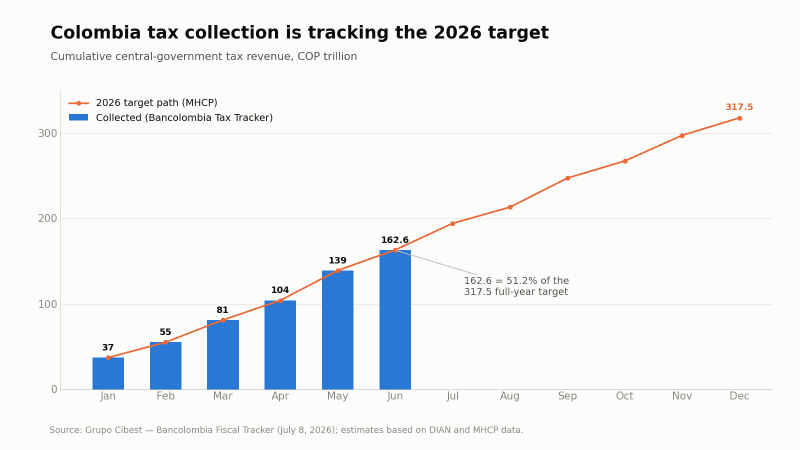
Colombia’s tax collection is tracking the 2026 target.
The trackers are produced by Grupo Cibest’s Economic, Industry and Market Research area. The Tax Tracker applies machine-learning models to the group’s transaction and payment-channel data to estimate monthly tax collection disaggregated by type of tax, while the companion Bancolombia Execution Tracker draws on the Bancolombia NowCast reading for the public administration sector to estimate budget execution by the central government.
Grupo Cibest states that the indicators are intended to complement, and under no circumstances replace, the official figures published by the national tax authority, the Dirección de Impuestos y Aduanas Nacionales (National Tax and Customs Directorate, or DIAN), and the Ministerio de Hacienda y Crédito Público (Ministry of Finance and Public Credit).
“Tax collection is in line with the Government’s tax revenue target for 2026.” — Grupo Cibest, Economic, Industry and Market Research
Increases in Tax Collection Across the Board
On the revenue side, the June increase was driven mainly by domestic value-added tax, up 13.5% year over year; the financial transactions tax (Gravamen a los Movimientos Financieros, or GMF), up 10.9%; and tariff revenues, up 7.6%. With the June result, cumulative tax collection in the first half of 2026 reached $162.6 trillion COP, 9.1% above the level recorded in the same period of 2025.
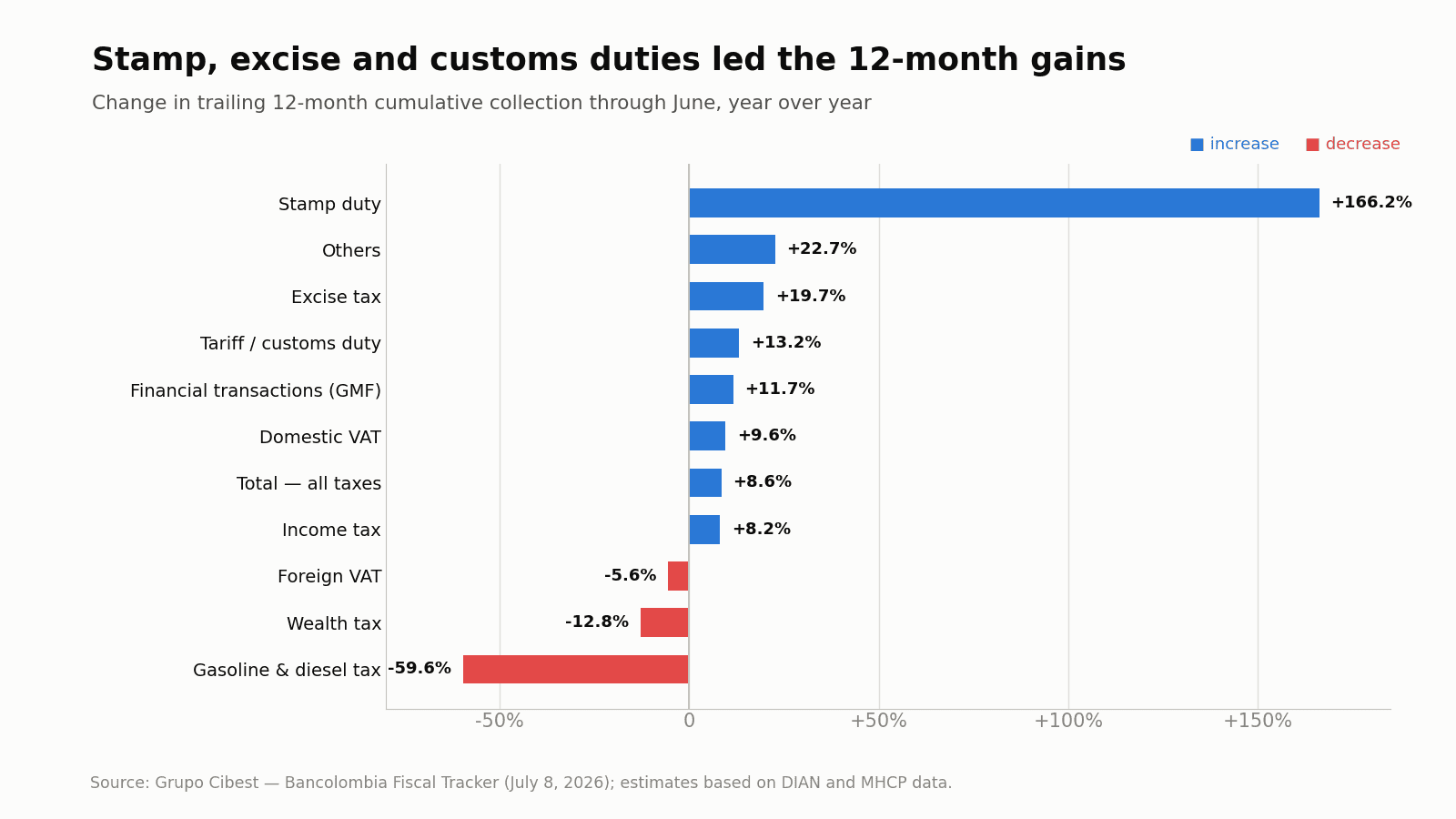
Stamp, excise and customs duties led the 12-month gains.
Measured against the government’s full-year goal, the first-half total is equivalent to 51.2% of the annual target of $317.5 trillion COP. Grupo Cibest estimates that, relative to the objective projected for the first six months of the year, collection reached 100% compliance, placing revenue in line with the government’s 2026 target.
The tracker’s breakdown by tax type, expressed as the year-over-year change in the trailing 12-month cumulative total through June, shows the widest gains in stamp duty, up 166.2%, and excise taxes, up 19.7%, followed by tariff and customs duties at 13.2%, the financial transactions tax at 11.7%, domestic VAT at 9.6%, and income tax at 8.2%, for a total increase of 8.6%. Three categories moved the other way: revenue from the gasoline and diesel tax fell 59.6%, the wealth tax declined 12.8%, and foreign VAT contracted 5.6%.
Government Expenditure Overshoots Target
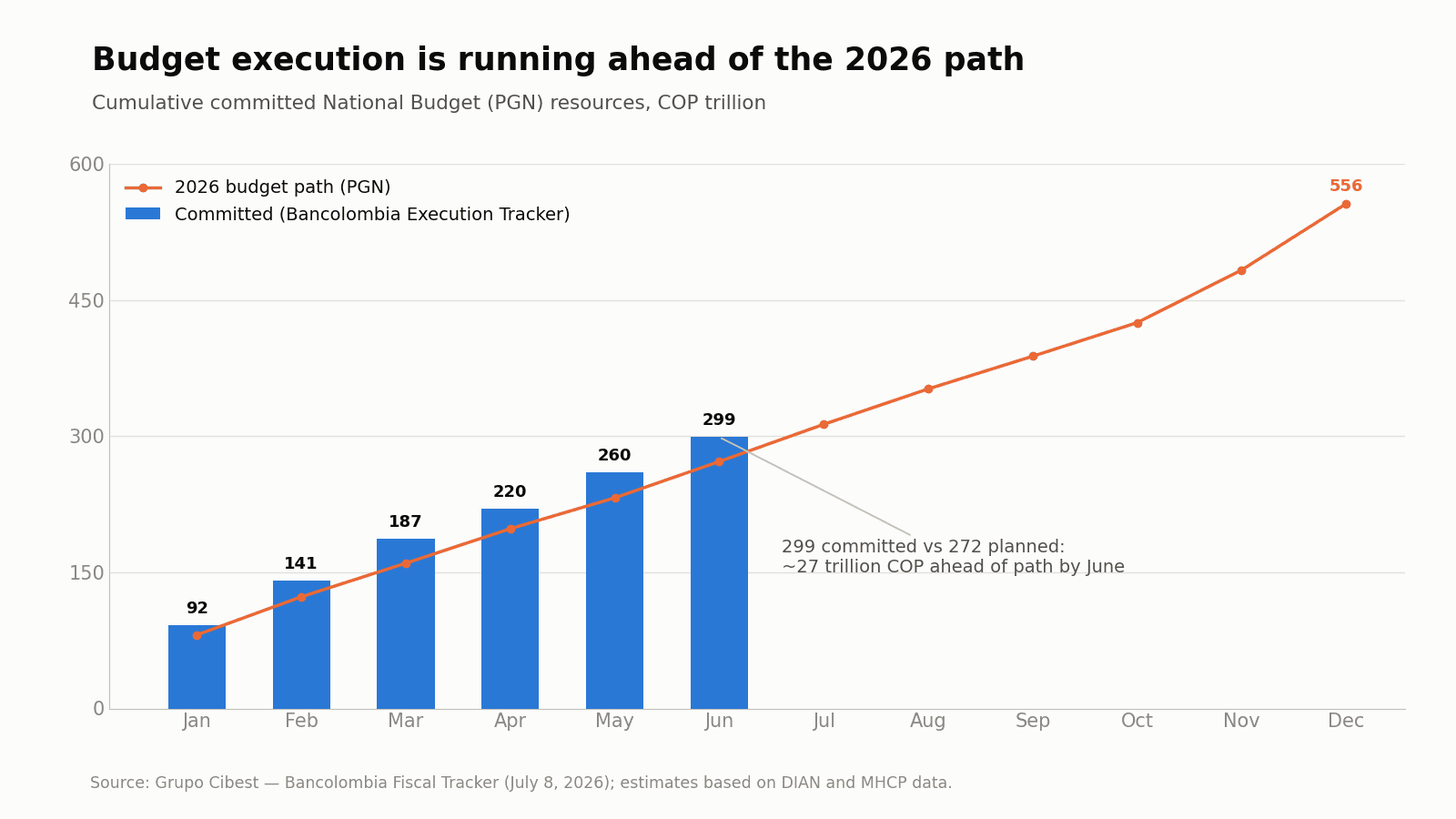
Budget execution is running ahead of the 2026 path.
On the expenditure side, the Bancolombia Execution Tracker estimates that the government committed $39.2 trillion COP in resources from the Presupuesto General de la Nación (National Budget, or PGN) during June, a 9.0% increase over the same month one year earlier. Committed resources for the year through June reached $299 trillion COP, an execution rate of 53.8% of the 2026 National Budget.
Grupo Cibest characterizes that pace as an overperformance relative to the execution path scheduled through the sixth month of the year. To reach the budget’s full-year total of $556 trillion COP, the government would have needed to commit about $272.3 trillion COP by June; the actual figure implies an overshoot of roughly $26.7 trillion COP against the monthly target.
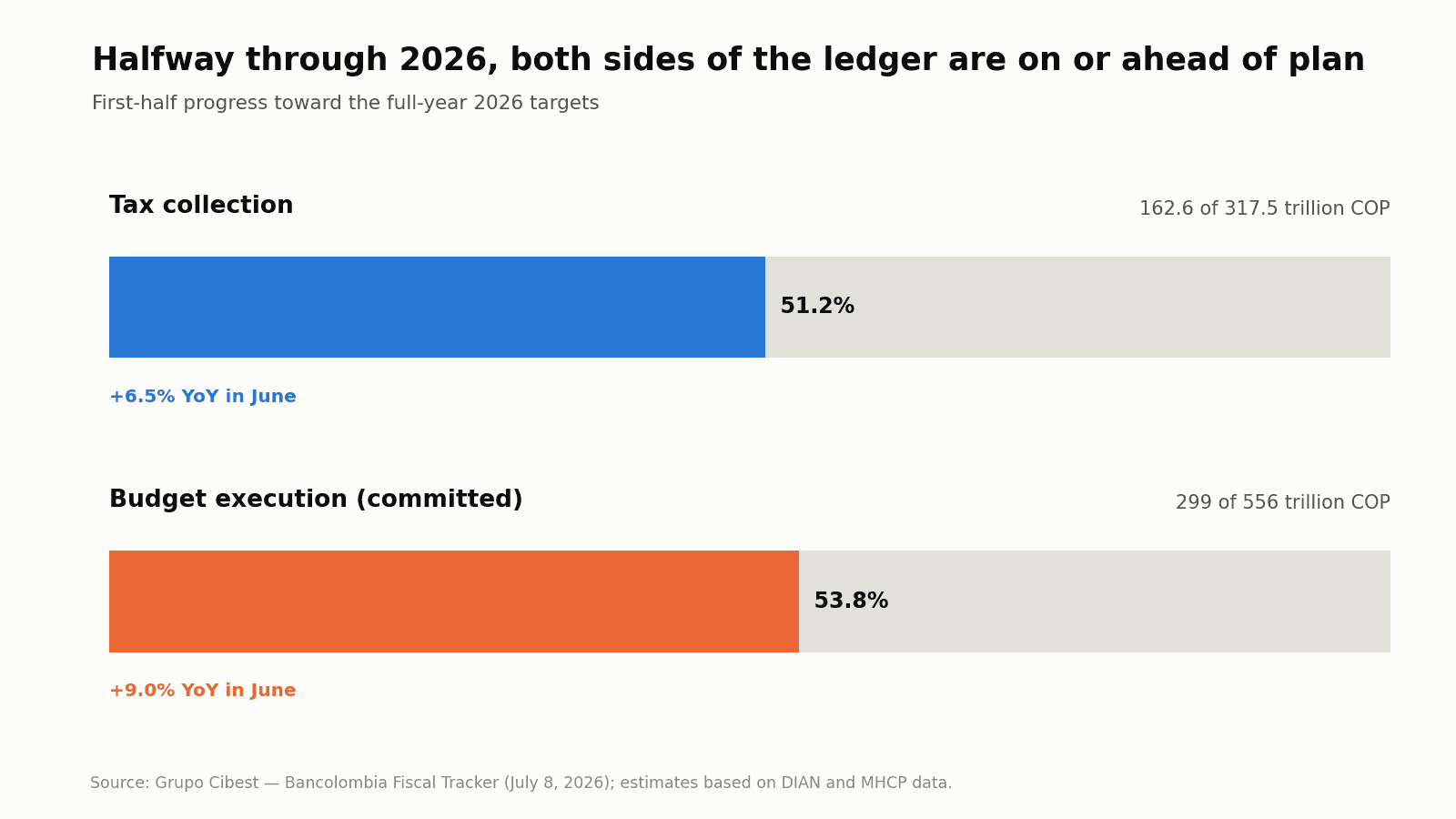
Halfway through 2026, both sides of the ledger are on or ahead of plan.
The group notes uneven performance beneath the aggregate figures. Revenue from domestic VAT, the financial transactions tax, and income tax has been strong through the year, while collection tied to fuel taxes, the wealth tax, and foreign VAT has shown weaker dynamics.
The Bancolombia Fiscal Tracker is an initiative of Grupo Cibest’s Economic, Industry and Market Research area, which describes it as an effort to monitor two variables central to the evolution of the fiscal deficit: tax collection and national-budget execution. The July edition was prepared by Macroeconomic Research Manager Jose Luis Mojica Agudelo, Quantitative Research Manager Arturo Yesid González Peña, and Macroeconomic Specialist Hector Steben Barrios.
Headline image by Csaba Nagy via Pixabay.
After a sub-1% win, governing will be harder than campaigning.
The honest answer to “what comes next” is that nobody knows. Abelardo de la Espriella is the rarest thing in Colombian politics: a genuine outsider, a man who has never held so much as a dogcatcher’s post, elected president by a margin so thin it barely registers. On June 21 he defeated Senator Iván Cepeda by less than one percentage point. Anyone who claims to know exactly how he will govern is selling something. But we can read the tea leaves he has left so far — the cabinet, the coalition math, and the mess he is inheriting — and they tell us a good deal.
Start with the result itself, because it is the key to everything that follows. In the May 31 first round de la Espriella took 43.7% of the vote — 10,361,473 ballots — finishing ahead of both Cepeda and Paloma Valencia, the establishment-right candidate backed by former president Álvaro Uribe. To me the message was unmistakable: Colombians rejected Gustavo Petro’s collectivist experiment, but they also rejected Uribe as the standard-bearer of the right. It was a vote of “we don’t like them, but we don’t much like you either.” The two old duopoly parties, the Liberals and Conservatives, have not put a president in the Casa de Nariño since the 1990s, and this election confirmed that the country is exhausted with its traditional institutions.
The runoff was closer than expected. Valencia’s votes drifted to de la Espriella, as anticipated, but Cepeda’s Pacto Histórico (Historic Pact) mobilized its base with real skill and nearly pulled even. That near-parity is now the defining fact of the incoming presidency.
A mandate for conciliation — whether he wants one or not
Here is de la Espriella’s central problem: he won with roughly half the vote and, as an outsider, he has almost no one in Congress. His movement, Salvación Nacional (National Salvation), holds just three Senate seats and one in the House of Representatives — effectively nothing in a body of 103 senators and 183 representatives, as Finance Colombia laid out in its analysis of the fragmented Congress. Cepeda, meanwhile, returns to the Senate as the runner-up and will lead an opposition bloc of roughly 30 unified legislators who intend to fight nearly everything the new government proposes.
So de la Espriella will govern by horse-trading. Expect the Conservatives, Cambio Radical — especially strong on the Caribbean coast, where he is based — the Party of La U, and much of Uribe’s Centro Democrático to drift into his camp. That is precisely why his most consequential early pick is his interior minister. In Colombia that job is the government’s legislative fixer, and de la Espriella has handed it to Rodrigo Lara, a former senator whose father was murdered by the Medellín cartel and who left politics years ago to build a career in cybersecurity. He knows how Congress works, and he is going to need every bit of that knowledge.
“He campaigned as a firebrand and delivered a conciliatory victory speech. Which is the real Abelardo? We simply do not know yet.” — Loren Moss, Finance Colombia
The cabinet: technocrats and costeños
The names announced so far tell two stories. The first is competence. The vice president-elect is José Manuel Restrepo, whom I interviewed a decade ago when he was rector of the Universidad del Rosario and could not stop talking about social inclusion. He served as commerce minister and then finance minister under Iván Duque, and while I regard the Duque presidency as largely a failure, Restrepo did a genuinely good job in both posts. The finance portfolio goes to Miguel Gómez, another respected Rosario figure and former ambassador to France who has led the state development bank Bancóldex, the insurance federation Fasecolda, and the flower-growers’ association Asocolflores. His remit is to restore fiscal balance, and it is a brutal assignment.
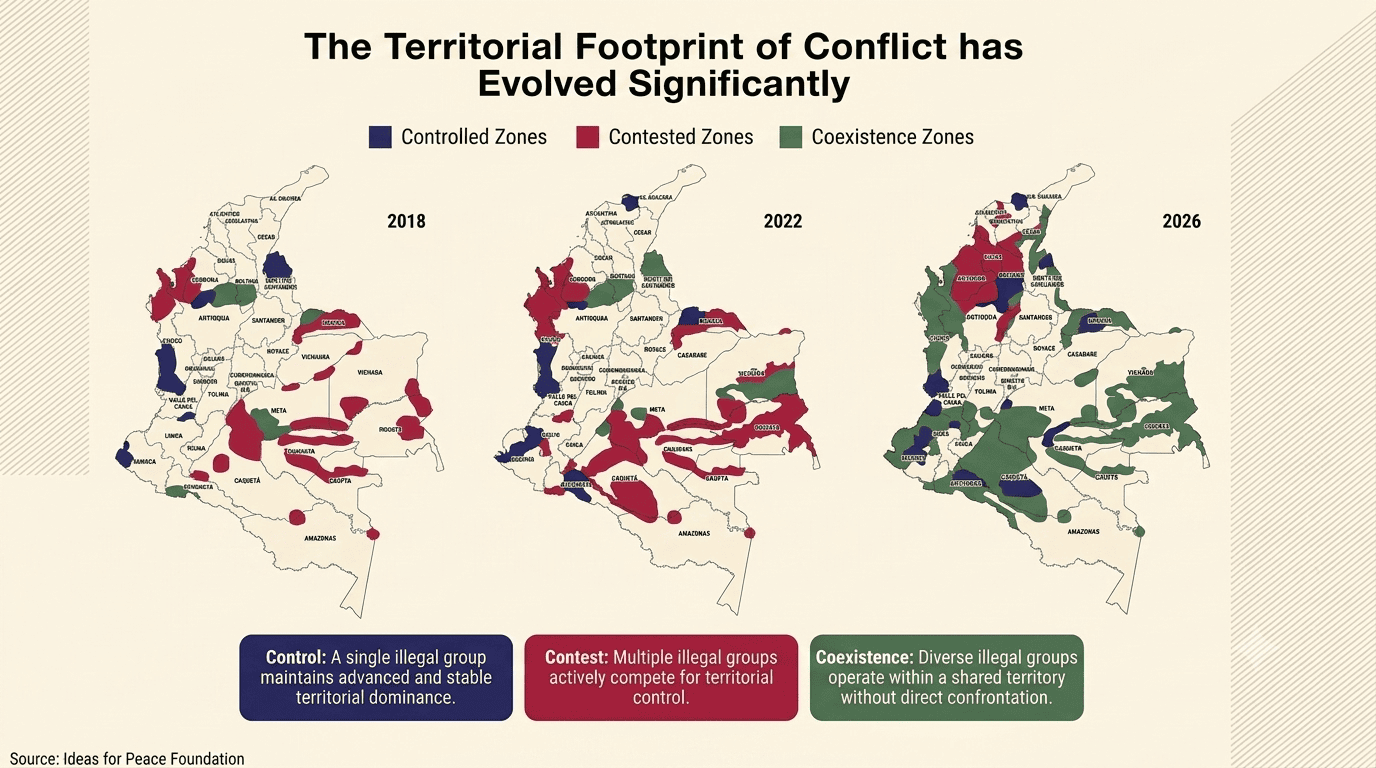
The territorial footprint of Colombia’s armed groups, 2018–2026: blue marks zones under a single group’s control, red marks zones where groups actively fight, and green marks zones where they coexist without direct confrontation. Source: Fundación Ideas para la Paz (Ideas for Peace Foundation).
The security portfolio went to a pointed choice: Gen. (r) Jorge Mora, a retired general whom Petro forcibly retired during a purge of the senior officer corps and who has since been a vocal critic of the outgoing government’s security policy. He is calling for a stronger military and police presence in the vast rural areas where the state has simply ceased to exist. Rounding out the bench are a striking number of costeños, people from the Caribbean coast: Elsa Noguera at Transportation (former mayor of Barranquilla, former governor of Atlántico, former housing minister), Mauricio Gómez Amin at Commerce, and, most controversially, Viviane Morales at Education. Morales is an evangelical conservative who has said the country should “take Marx out of the schools and put God back in,” and she is drawing more opposition than any other appointee. My guess is that reality — a hostile Congress and a powerful teachers’ union — will moderate whatever she has in mind, and that if she becomes a distraction she will not last. The reassuring pick is Fabio Arjona Hincapié at Environment: a marine biologist and former director of Conservation International in Colombia. He is a career environmentalist, not an extremist, and business need not fear him chaining himself to a drilling rig. Jaime Andrés Beltrán, the former mayor of Bucaramanga, takes Housing.
Foreign policy: a great reset
On the international front, de la Espriella’s team is signaling a return to career diplomacy rather than campaign loyalists in ambassadorial chairs. He has said he will restore relations with Israel, which Petro severed. He is warmer toward Washington — US President Donald Trump’s affection for him is no secret — and I expect the personalized, temperamental feuds Petro picked with Peru and Ecuador to cool. Those were real: Colombia and Ecuador escalated to 100% border tariffs, and Petro manufactured a dispute with Peru over an Amazon river island that had not been an issue in a century, later inflamed by a gunfire incident on the Putumayo River. One irony worth noting: both Petro and de la Espriella are, in addition to being Colombian, Italian citizens.
The business mood: relief bordering on celebration
Objectively, this is a win for the business sector. The mining and petroleum industries are already popping corks, because the outgoing government issued no new drilling permits and the sector had warned for years that Colombia was heading toward a natural-gas shortfall. De la Espriella has pledged to restart exploration and production onshore and offshore, and the reaction has been immediate — the petroleum guild ACP and the mining sector are visibly re-energizing ahead of the September mining expo. The merchants’ federation Fenalco and the industrialists of ANDI endorsed him outright. I did not see a single major trade group line up behind Cepeda. This matters because confidence had quietly drained away: a European manufacturer that announced a glass factory in Cundinamarca shelved it in 2023 for lack of confidence, and the pace of tech and services investment into Medellín slowed markedly over the past three years. I expect that to reverse — barring a US recession, which would shrink the pool of investment capital regardless of who governs Colombia.
The security inheritance
This is the inheritance that makes Mora’s harder line resonate. The map above is not subtle: the green and red have spread across far more of the country than when Petro’s Paz Total (Total Peace) policy began. As I argued in March, that policy delivered its opposite. Colombia logged 40,663 homicides in the first three years of the Petro presidency, more than 400 human rights defenders were killed between 2022 and 2025, and Human Rights Watch found that the ELN and FARC dissidents expanded their territory by as much as 55%, pushing Colombia back into the Global Terrorism Index top ten. Five years ago I would drive from Medellín to the coast without a second thought; today I would fly. Expect violence to rise before it falls: if you go to war with the mafias and the guerrillas, there will be a war.
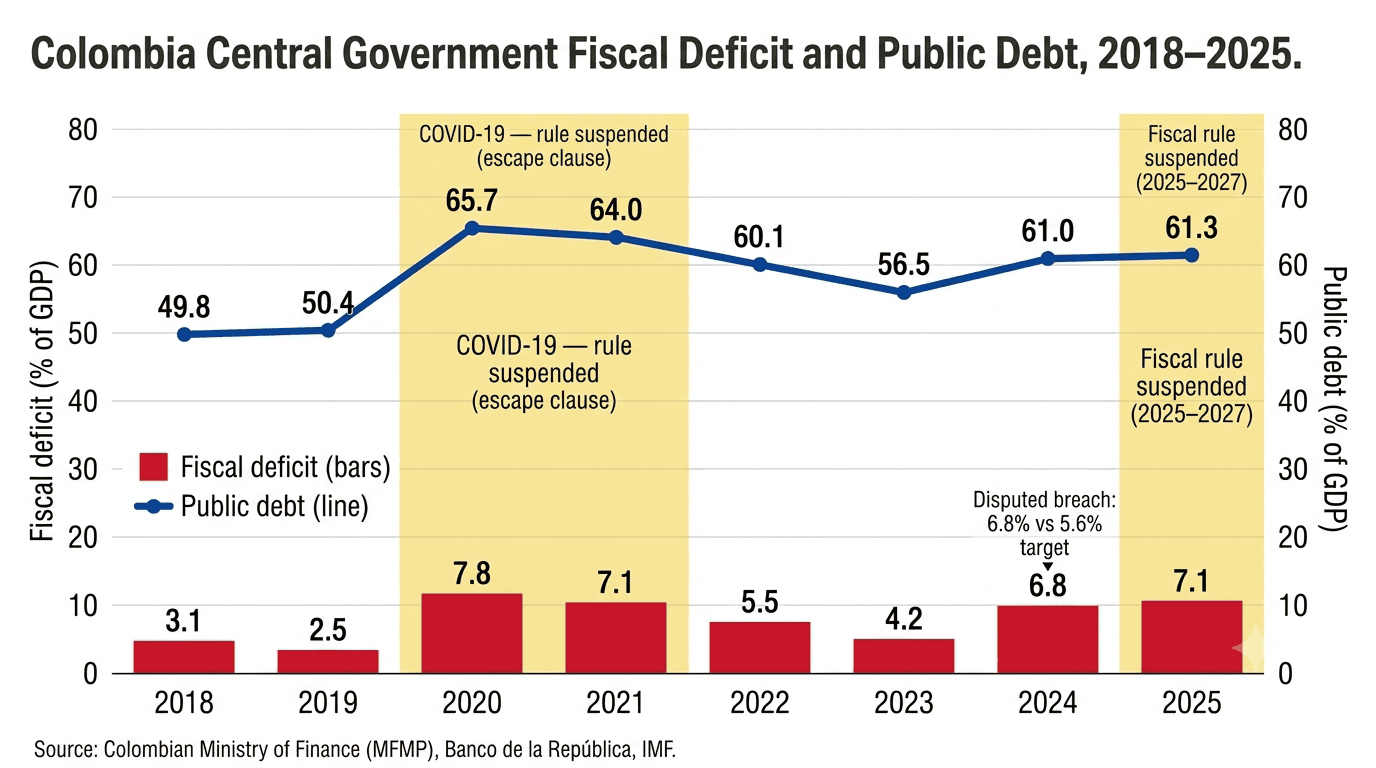
Colombia’s central-government fiscal deficit (bars) and public debt (line) as a share of GDP, 2018–2025. Sources: Colombian Ministry of Finance, Banco de la República, IMF.
The fiscal reckoning
The harder story is fiscal, and Gómez’s assignment is the least enviable in the cabinet. Colombia’s fiscal rule (Ley 1473 de 2011, reformed in 2021) is meant to anchor net debt toward 55% of GDP, with a hard ceiling of 71%, and it is monitored by the independent CARF (Comité Autónomo de la Regla Fiscal, the Autonomous Fiscal Rule Committee). In 2024 the government ran a deficit of 6.8% of GDP against a 5.6% target, which the CARF classifies as non-compliance. Then, in June 2025, facing a widening gap, the government invoked the rule’s escape clause to suspend it through 2027 — over the CARF’s formal objection — and raised the deficit target from 5.1% to 7.1% of GDP, with a stated return to the rule in 2028. That is the box the new finance minister must climb out of. The one cushion is a strong peso, which rallied 7.4% in June on the election result and makes dollar-denominated debt cheaper to service. But that will not last; when the peso weakens, those payments get more expensive, and the opposition will blame the people cleaning up the mess for the mess itself.
What I am watching
Three things give me pause. First, human rights are a blank page: as a defense lawyer de la Espriella represented some unsavory clients, yet he also pursued, pro bono, a landmark femicide case that changed Colombian law. We simply have no governing record to read. Second, he is thin-skinned and has a history of filing nuisance suits against journalists who anger him — the goal being to impose cost and induce self-censorship. Third, and most fundamentally, he is a blank slate. A candidate campaigns the way he must to win; how he governs may or may not follow. He ran an aggressive campaign and then gave a conciliatory speech on election night. Which is the real Abelardo? We will find out.
All my sources say the handover happens on August 7 as scheduled, despite Petro’s noise — he has questioned the result, the two camps suspended their technical transition meetings, and Cepeda has floated a citizenship challenge that the constitution does not support. I believe the transfer will be peaceful. Then again, we all thought January 6th would be routine, too. If it holds, de la Espriella has a narrow, real window to do what he promised on election night and govern for all Colombians. With less than half the vote, that is the only mandate he actually holds.
 Empleobilingue.com

- Director/a de operaciones para hotel, restaurante y discoteca 1626320364.60 - Medellín, Medellin, Antioquia, Colombia
- Coordinador/a de calidad para La Unión 1626483143.1 - La Unión, Antioquia, Colombia
- Desarrollador fullstack - Bogotá, Bogota, Colombia
- Technical Analyst - Remote
- PIM Administrator - Ecommerce - Remote (Bogotá, Bogota, Colombia)
- Auxiliar de gestión humana y bienestar para Girardota 1626060072.28 - Girardota, Antioquia, Colombia
- Marketing Strategist
- Trainer Manager - Bogotá, Bogota, Colombia
- Tolemaida UH- 60 Inspector - Bogotá, Bogota, Colombia
- Virtual Assistant - Team Lead - Remote
Contact Us

