

















Segovia margins fund record capex as Marmato plant nears first gold
Aris Mining Corporation (TSX: ARIS) (NYSE: ARIS) reported adjusted EBITDA of $179 million USD for the second quarter of 2026, as the Canadian gold producer’s two operating mines in Colombia generated the cash to fund $121 million USD in capital projects during the quarter while leaving the company with a cash balance of $426 million USD as of June 30.
“Aris Mining delivered another strong quarter with our operations generating the cash required to fund more than $120 million of capital investments during the second quarter while maintaining a strong balance sheet.” — Neil Woodyer, Chair & CEO, Aris Mining
The company produced 73,700 ounces of gold in the quarter, consistent with the 74,300 ounces produced in the first quarter, and booked gold revenue of $321 million USD at an average realized price of $4,450 USD per ounce. Adjusted net earnings came in at $96 million USD, or $0.47 USD per share. On a trailing 12-month basis, adjusted EBITDA now stands at $690 million USD, up from $610 million USD one quarter earlier.
First-half production of 148,000 ounces represents a 31% increase over the 113,400 ounces produced in the first half of 2025, as Finance Colombia reported earlier this month, and the company says it remains on track to meet its full-year guidance of 300,000 to 350,000 ounces, with output weighted toward the second half of the year.
“Aris Mining delivered another strong quarter with our operations generating the cash required to fund more than $120 million of capital investments during the second quarter while maintaining a strong balance sheet,” said Neil Woodyer, chair and CEO of Aris Mining.
Segovia Ramps Up Mining Capacity
The Segovia operations in Antioquia produced 64.4 thousand ounces during the quarter, bringing first-half output to 131.0 thousand ounces. The mill processed 202,500 tons at an average gold grade of 10.23 grams per ton, a 15% increase in throughput from the 175,400 tons at 12.41 grams per ton processed in the first quarter, as the operation works toward consistent utilization of the expanded 3,000 tons-per-day processing capacity installed in June 2025.
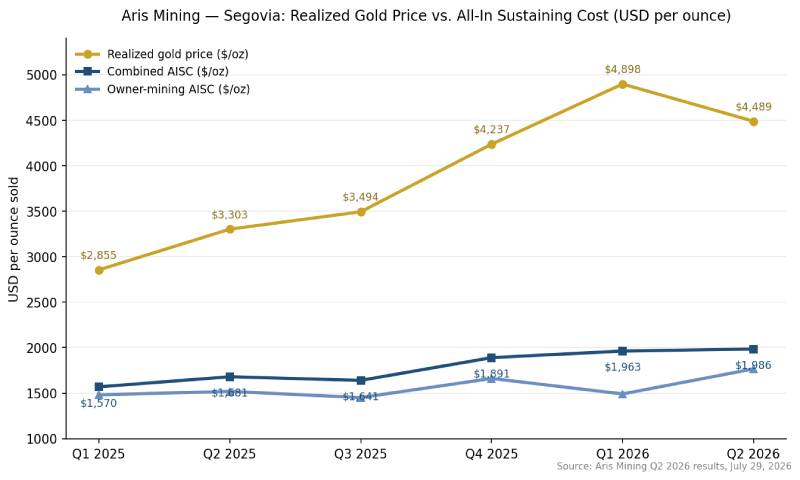
This graph shows the increasing realized gold price of Aris Mining’s Segovia operations versus its current cost per ounce. Photo provided by Aris Mining.
Total investment at Segovia rose to $31 million USD in the quarter from $17 million USD in the first quarter, funding new ramps and a main underground haulage circuit connecting the El Silencio, Providencia, and Sandra K mines, along with an expanded mining fleet acquired through purchase and leasing arrangements.
Owner-operated mining, which contributed 67% of mill feed, recorded an all-in sustaining cost of $1,767 USD per ounce sold, keeping the first-half figure of $1,623 USD per ounce below the company’s full-year guidance range of $1,700 to $1,800 USD. Material sourced from contract mining partners, which contributed the remaining 33% of mill feed, delivered an all-in sustaining cost sales margin of 46%, above the top end of the full-year guidance range of 35% to 40%. Segovia generated an all-in sustaining cost margin of $157 million USD in the quarter and $356 million USD in the first half.
Marmato on Schedule for First Gold in Q4 2026
The Marmato mine in Caldas produced 9.3 thousand ounces in the quarter, bringing first-half production to 17,100 ounces, with the mill processing 84,600 tons at an average grade of 3.79 grams per ton. Throughput is expected to increase materially once the new 5,000 tons-per-day carbon-in-pulp (CIP) plant is commissioned, with first gold expected in the fourth quarter of 2026.
The SAG and ball mills are on site and mechanical installation is underway, and the underground connection completed earlier this year established direct access between the Bulk Mining Zone and the new process plant area.
As of July 1, 2026, the estimated capital required to achieve first gold from the Marmato CIP plant is approximately $118 million USD. After a final $42 million USD installment expected from Wheaton Precious Metals (TSX: WPM) (NYSE: WPM) in the third quarter, the net funding requirement of approximately $76 million USD will come from the company’s cash balance and operating cash flow.
Aris Mining plans to exit 2026 operating the new plant at approximately 3,000 tons per day, ramping up to approximately 4,000 tons per day by mid-2027 and reaching the full 5,000 tons-per-day design capacity by the end of 2027, following commissioning of the paste backfill plant.
Soto Norte and Toroparu Advance the Growth Pipeline
At the Soto Norte project in Santander, environmental studies and preparation of the environmental license application are nearing completion. The project’s design incorporates a metallurgical process free of cyanide and mercury, and allocates approximately 750 tons per day of processing capacity — over 20% of the project’s planned 3,500 tons-per-day total — to local miners through the company’s contract mining partner program. A prefeasibility study completed in September 2025 outlined average annual gold production of 263,000 ounces in years two through 10, with an after-tax net present value of $2.7 billion USD at a 5% discount rate and a 35% internal rate of return at an assumed gold price of $2,600 USD per ounce.
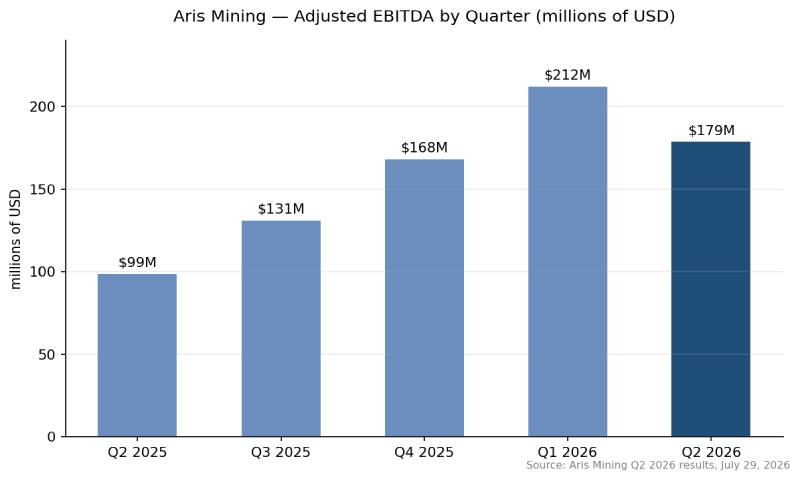
The adjusted EBITDA by quarter of Aris Mining remains on track with the last two quarters, and larger than Q2 and Q3 of the operations in 2025. Photo provided by Aris Mining.
At the Toroparu project in Guyana, a prefeasibility study remains on schedule for completion in the second half of 2026, supporting a construction decision targeted for early 2027. Pre-construction activities are underway, including construction of the Puruni River bridge, camp expansion, and road improvements, and the project team has grown to 100 employees in the country. A preliminary economic assessment completed in October 2025 outlined average annual gold production of 235,000 ounces, an after-tax net present value of $1.8 billion USD at a 5% discount rate, and a 25% internal rate of return at an assumed gold price of $3,000 USD per ounce. The company continues engagement with the Government of Guyana and the Guyana Geology and Mines Commission to obtain the project’s mining license.
Aris Mining’s Segovia and Marmato operations together produced approximately 257,000 ounces of gold in 2025. The company’s expansion projects at the two mines are expected to lift annual production to approximately 500,000 ounces, and its broader portfolio, including Soto Norte and Toroparu, supports a longer-term objective of approximately 1 million ounces of annual gold production.
Headline image description: Second mill at the Segovia Operations. Photo from CNW Group/Aris Mining Corporation.
Colombia’s government has recognized Morocco’s sovereignty over Western Sahara, reversing a policy that had backed the territory’s independence movement as recently as November 2025. Vice President José Manuel Restrepo and Foreign Minister Omar Bula Escobar announced the shift on August 8, 2026, during a meeting in Cali with Morocco’s Minister of Foreign Affairs, African Cooperation and Moroccan Expatriates, Nasser Bourita, who was in the city representing King Mohammed VI at the inauguration of Colombia’s new president, Abelardo de la Espriella.
“Colombia recognizes Morocco’s sovereignty over its Sahara,” Bula Escobar said at the meeting. Restrepo described the announcement as “a new beginning” for the two countries and called Morocco “Colombia’s first ally in Africa,” adding that Bogotá wants to build a strategic partnership with Rabat. Restrepo also raised the possibility of negotiating a free trade agreement to encourage Moroccan investment in Colombia, though no such talks have formally begun.
Colombia reconoció la soberanía de Marruecos sobre el Sáhara Occidental.
El anuncio se dio durante el primer encuentro del vicepresidente José Manuel Restrepo (@jrestrp) y el canciller Omar Bula (@omarbula) con el Ministro de Asuntos Exteriores del país africano.
Con esta… pic.twitter.com/aas0pirwSc
— Cancillería Colombia (@CancilleriaCol) August 8, 2026
Two days later, Colombia’s Ministry of Foreign Affairs (the Cancillería) issued a formal statement confirming the decision followed a “sovereign review” of the recognition its predecessor government had granted to the entity it calls the República Árabe Saharaui Democrática (Sahrawi Arab Democratic Republic, or SADR), noting that the United Nations does not recognize it as a member state. Bogotá said it would freeze all political and diplomatic contact with the SADR, halt exchanges of missions, and withdraw support for it in multilateral forums, “including the United Nations and the Security Council, where Colombia currently serves as a non-permanent member.” The ministry identified trade, investment promotion, tourism, food security, port and logistics development, and Atlantic connectivity as areas it wants to expand with Morocco.
A colonial-era dispute still unresolved
Western Sahara has been contested since Spain withdrew from its former colony in 1975. Morocco organized the “Green March” that year, sending hundreds of thousands of civilians into the territory to press its claim, and has administered most of it since. The Polisario Front, an armed movement representing the territory’s indigenous Sahrawi population, fought Morocco and declared a government-in-exile, the SADR, in 1976. A 1991 ceasefire monitored by the UN Mission for the Referendum in Western Sahara (MINURSO) held for nearly three decades without the referendum ever taking place; fighting between Morocco and the Polisario Front resumed in November 2020 and has continued intermittently since. Morocco controls roughly the western three-quarters of the territory, separated from the Polisario-administered “Free Zone” to the east by a fortified sand berm running the length of the territory. Morocco has offered the region autonomy under its sovereignty since 2007; the Polisario Front continues to demand a UN-supervised independence referendum.
A widening diplomatic tilt toward Rabat
Colombia’s move follows a broader realignment in Morocco’s favor. The UN Security Council adopted Resolution 2797 on October 31, 2025, renewing the MINURSO mandate and, for the first time, calling on the parties to negotiate on the basis of Morocco’s autonomy proposal as the most “feasible” path to a settlement. Eleven Council members voted in favor; China, Russia and Pakistan abstained, and Algeria — not a Council member at the time — did not take part. Morocco’s foreign ministry says more than 130 countries now back the autonomy plan as the most realistic basis for resolving the dispute, and only about a dozen of the African Union’s 54 members still recognize the SADR. Mali withdrew its recognition of the SADR in April 2026 and Ecuador suspended its own in 2024; Peru ended its recognition in 2023. Colombia’s reversal extends that trend into what had been one of the Polisario Front’s remaining strongholds in Latin America.
For Morocco, Colombia’s recognition is a further diplomatic gain and another setback for Algeria, the Polisario Front’s principal regional backer. It also positions Rabat as an intermediary between Latin American and African markets, a role Bourita highlighted directly, saying Morocco and Colombia “could represent economic platforms for each other” given their respective positions on the two continents. He described Colombia’s decision as “historic,” saying it could give “great momentum” to bilateral relations, and said his presence in Cali reflected the Kingdom’s intent to elevate ties “to a higher level.”
“A regrettable quid pro quo arrangement driven by a deeply ideological agenda.” — Polisario Front, in a statement condemning Colombia’s decision
The Polisario Front rejected the decision. In a statement carried by Moroccan outlet Yabiladi, the movement said it “strongly condemned” Colombia’s move, calling it “a regrettable quid pro quo arrangement driven by a deeply ideological agenda” that helps “legitimize a situation resulting from the military occupation of a territory that remains subject to a decolonization process.” The Front argued the decision conflicts with Article 9 of Colombia’s own constitution, which grounds the country’s foreign relations in respect for international law and peoples’ right to self-determination, and said it undermines “Colombia’s international role as an important actor in the pursuit of peace.” It called on Bogotá to reconsider. Algeria has long framed the dispute as a matter of “incomplete decolonization and an unfulfilled right to self-determination,” and has backed the Polisario Front diplomatically and militarily for decades.
Why Colombia had not recognized Morocco’s claim before
Colombia’s position on Western Sahara has shifted with its governments for four decades. Bogotá first recognized the SADR in 1985 under President Belisario Betancur, then froze those ties in 2001 under President Andrés Pastrana. President Gustavo Petro restored full diplomatic relations with the SADR in August 2022, shortly after taking office, framing it as support for Sahrawi self-determination consistent with his government’s broader identification with Global South and non-aligned foreign-policy positions. Petro reaffirmed that stance as recently as November 2025, pledging what he called “unrestricted” support for the Sahrawi cause and linking it to Colombia’s arrival on the UN Security Council for a two-year term beginning in 2026.
That position did not survive the change of government. De la Espriella, a right-of-center former defense lawyer who took office August 7, had campaigned on unwinding Petro’s foreign policy, and moved quickly on more than one front: alongside the Western Sahara reversal, his government also recognized Israeli sovereignty over the Golan Heights and moved to restore ties with Israel, becoming only the second country after the United States to do so. Colombia’s recognition of Morocco’s claim over Western Sahara is best read in that context — less a response to new facts in the territory than a marker of where the incoming administration wants to position Colombia internationally, closer to Washington, Jerusalem and Rabat and further from the non-aligned coalition Petro had cultivated.
What remains untested is the commercial follow-through. Restrepo’s reference to a possible free trade agreement was aspirational rather than an announcement of negotiations, and the Colombian and Moroccan governments have yet to lay out a timeline for the trade, investment, port-logistics and Atlantic-connectivity cooperation both sides say they want to pursue.
Three private companies — airline Alma Air, air-ambulance operator Ambulancias Aéreas de Colombia, and fuel distributor Terpel (BVC: TERPEL) — formed an alliance to make aircraft capacity available at no cost to move medicine, medical supplies, and health personnel into areas of western Colombia affected by Monday’s magnitude 7.4 earthquake.
The alliance’s first flight departed Enrique Olaya Herrera Airport in Medellín at approximately 8:00 a.m. on Wednesday, August 12, bound for Quibdó, the capital of Chocó department, one of the areas affected by the earthquake. The aircraft carried medicine and medical supplies donated by Búsqueda y Rescate Aeronáutico de Colombia (BRAC, Aeronautical Search and Rescue of Colombia), a volunteer search-and-rescue organization based in Medellín, to support the emergency response in Chocó.
The companies assigned a Cessna Grand Caravan, a single-engine turboprop capable of carrying cargo and passengers, to the operation. According to the companies, the aircraft remains available to Colombia’s Ministerio de Salud y Protección Social (Ministry of Health and Social Protection) and to other government entities, multilateral organizations, and foundations that need to move medicine, medical supplies, or health personnel to affected areas, as needs are identified.
The companies said the arrangement was not conceived as a single flight. They agreed to keep the capacity available for further humanitarian operations as determined by the authorities and organizations coordinating the emergency response.
“We may have only one aircraft, but if it can make a small contribution to rescue and emergency response efforts, it is an honor for us to help.” — Rupert Stebbings, CEO, Alma Air
Three companies, one response
The alliance combines three private-sector companies with different roles — an airline, an air-ambulance operator, and a fuel and energy distributor — each contributing a specific capability toward moving aid to affected areas more quickly.
Alma Air, a certified Colombian airline, said it offered its aircraft the same Monday the earthquake struck, while company representatives were in meetings with Aeronáutica Civil (Aerocivil, Colombia’s civil aviation authority) and the Ministerio de Transporte (Ministry of Transport).
“The same Monday morning the earthquake happened, Alma Air was in meetings with both Aerocivil and the Ministry of Transport, and the need to help was evident. We immediately offered our support to the Ministry. We may have only one aircraft, but if it can make a small contribution to rescue and emergency response efforts, it is an honor for us to help,” said Rupert Stebbings, CEO of Alma Air.
Ambulancias Aéreas de Colombia, which operates air-ambulance services, joined the alliance citing its experience operating in territories that are difficult to reach by other means.
“As a leading company in the air-ambulance sector in Colombia, we have a social commitment to the country, and our purpose is to save lives in a timely manner where others cannot. This has motivated us to organize humanitarian alliances aimed at helping the communities most affected, drawing on our experience in the health and aviation sectors. The most difficult moments are when Colombia most needs to stay united,” said Sebastián Pérez, co-CEO of Grupo Ambulancias Aéreas de Colombia.
Terpel joined the alliance under what it describes as its “Aliado País” (“Country Ally”) initiative, which the company has used previously to support relief efforts in Colombia during emergencies.
“At Terpel, we believe that difficult moments are when we should be closest to communities. As a country ally, we connect with the most pressing needs of those facing complex situations, and we act with solidarity and commitment. That is why we are making all of our capabilities, resources, and efforts available to provide support where it is needed most, convinced that when we join forces we can help thousands of people move forward,” said Daniel Perea, Terpel’s vice president of corporate affairs.
BRAC: support for the first flight to Quibdó
Búsqueda y Rescate Aeronáutico de Colombia (BRAC) also supported the first humanitarian flight from Enrique Olaya Herrera Airport, donating the medicine and supplies that were loaded onto the aircraft ahead of its departure Wednesday.
The earthquake struck a region where geography has long limited timely access to complex health services. Chocó is among the Colombian departments with the least availability of specialized medical personnel. Dense jungle, rivers that serve as a primary means of transportation, and the absence of a permanent road network leave numerous communities hours away from specialized services under normal conditions. During a large-scale emergency, when demand for medicine, equipment, specialized personnel, and transport capacity rises simultaneously, that distance becomes a larger factor in patient outcomes.
A national mobilization after a magnitude 7.4 earthquake
The earthquake struck western Colombia at 7:34 a.m. on Monday, August 10, with a moment magnitude of 7.4 and an epicenter near San José del Palmar, Chocó, according to Colombia’s Servicio Geológico Colombiano (Colombian Geological Survey), as Finance Colombia reported at the time. As of 7:30 a.m. on August 12, the Unidad Nacional para la Gestión del Riesgo de Desastres (UNGRD, National Disaster Risk Management Unit) reported 239 deaths, 3,755 injuries, and 287 people missing. The agency said the emergency has affected 403 municipalities across 14 departments, with roughly 49,200 people affected across about 24,300 families, and reported 9,215 homes destroyed, 45,457 damaged, and 140 buildings collapsed, according to figures reported by El Colombiano. Authorities continue to update the toll as search, rescue, and recovery operations continue.
In this context, the capacity to move medicine, supplies, equipment, and personnel quickly to affected territories is a significant component of the broader response. The alliance among Alma Air, Ambulancias Aéreas de Colombia, and Terpel adds private air-transport capacity to that response, as other companies and organizations continue directing resources toward the areas affected by the earthquake.
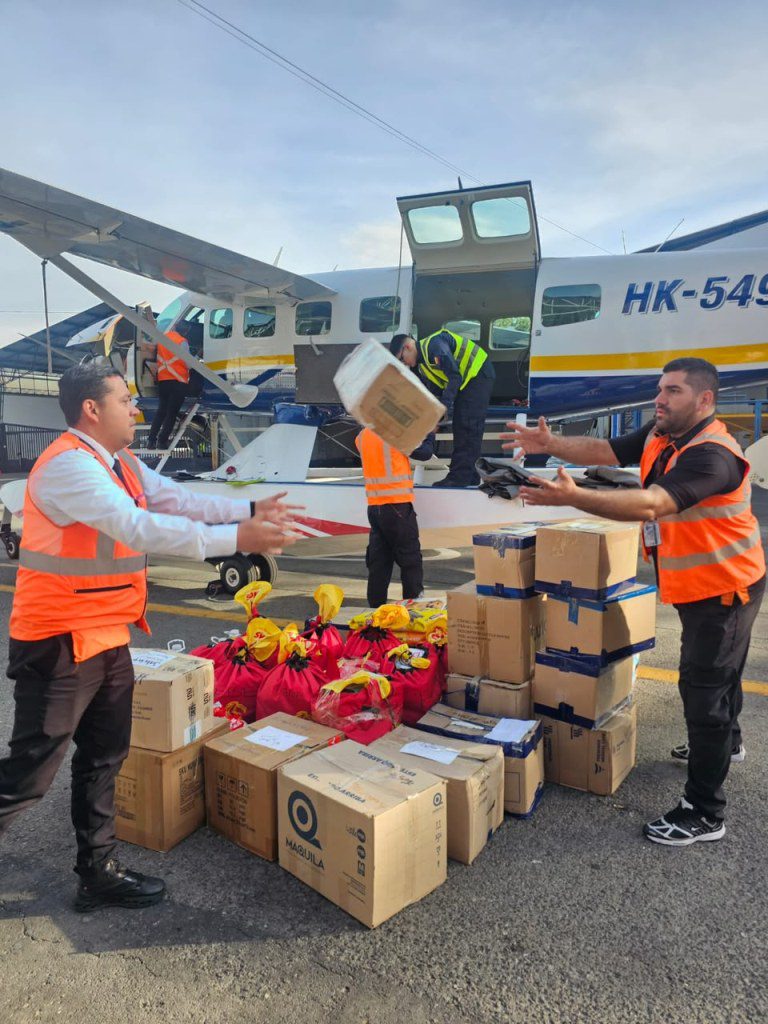
No fee attached — three companies moved medicine into Chocó just over 48 hours after the quake.
Interpol cooperation leads to three extradition-related arrests in one week
Three foreign nationals wanted by authorities in the United States, Panama and the Netherlands were captured in and around Medellín within a single week in July, in operations involving Interpol Colombia and international law-enforcement agencies.
The arrests involved a Mexican citizen wanted in the United States for alleged fraud and money laundering, a Panamanian wanted by his country’s authorities over alleged drug trafficking and conspiracy offenses, and a citizen of Curaçao sought by the Netherlands in connection with alleged drug trafficking.
“International cooperation continues to demonstrate that borders are not an advantage for those seeking to evade justice.” – Manuel Villa Mejía, Secretary of Security and Coexistence of Medellín.
The Medellín government said the three cases demonstrate the role of real-time information sharing between Colombian authorities and international partners in locating pe0ople sought through Interpol Red Notices. The three individuals were detained with a view to extradition and placed at the disposal of Colombia’s Fiscalía General de la Nación while the relevant legal and diplomatic procedures proceed.
Mexican national sought by the United States
The most recent of the three cases involved Mexican citizen Bryan Gardea, who was detained at José María Córdova International Airport in Rionegro after arriving on a flight from Miami on July 15.
Gardea was the subject of an Interpol Red Notice requested by US authorities. Colombian and US authorities allege that he led a scheme that fraudulently obtained more than $1.04 million from US economic-assistance programs created during the COVID-19 pandemic.
According to reporting on the case, the alleged scheme involved the creation of fictitious companies, falsified documentation and fraudulent financial statements. The funds were allegedly diverted to personal accounts and used for private expenditures and real-estate purchases. US authorities are seeking his extradition on allegations including wire fraud, bank fraud and money laundering.
Gardea was placed under the authority of Colombia’s Fiscalía following his arrest, with extradition proceedings expected to continue through the agency’s international-affairs authorities. Colombian reporting subsequently confirmed the legality of his detention.
Panamanian national linked to alleged container trafficking network
The second case involved Ismael Abdiel González Pomares, a Panamanian citizen detained in Medellín’s Laureles neighborhood on July 21.
González Pomares was wanted by Panamanian authorities under an Interpol Red Notice for alleged offenses including drug trafficking, conspiracy and crimes against collective security. Colombian and Panamanian investigators reportedly identify him as a suspected senior figure in a transnational organization involved in moving narcotics through commercial cargo.
Authorities allege that the organization used contaminated commercial containers at the Port of Balboa in Panama to move drugs toward international markets. Reporting also says the investigation identified a sophisticated logistical structure and alleged infiltration of strategic port facilities. The operation involved cooperation between Colombian and Panamanian authorities, with support from the US Homeland Security Investigations agency.
González Pomares was placed at the disposal of Colombian authorities as the process for his eventual transfer to Panama proceeds.
Curaçao citizen wanted by the Netherlands
The third arrest involved José Manuel Rodríguez Dacova, a citizen of Curaçao wanted by authorities in the Netherlands on an alleged drug-trafficking offense.
According to Medellín authorities, Rodríguez Dacova was detained while travelling by road between Barranquilla and Medellín. His arrest was likewise carried out in response to an Interpol Red Notice and with extradition proceedings in mind.
Unlike the Gardea and González Pomares cases, publicly available reporting on Rodríguez Dacova provides fewer details about the underlying Dutch investigation. The Colombian authorities’ announcement identifies drug trafficking as the basis for the Netherlands’ extradition request.
29 Red Notice arrests recorded in 2026
The three arrests brought the number of people detained in Medellín during 2026 through Interpol Red Notices to 29, according to the city’s security authorities.
The municipality said these individuals were subsequently captured for extradition after the requesting countries formalized their respective requests. The detainees were placed at the disposal of the Fiscalía while judicial and diplomatic procedures continue.
The cases showed the distinction between an Interpol Red Notice and a conviction. A Red Notice is an international request to locate and provisionally detain a person pending extradition or a similar judicial process; it is not itself an international arrest warrant or a finding of guilt.
For Medellín, the arrests also form part of a broader effort to strengthen cooperation with foreign law-enforcement agencies as the city seeks to address criminal networks operating across national borders.
As of August 2026, no publicly confirmed development was identified that materially changes the status of the three July cases. The individuals remain subject to the respective extradition processes, with the Fiscalía responsible for Colombia’s proceedings and the requesting countries’ authorities responsible for pursuing the underlying cases.
Headline photo: A picture of one of the fugitives beside the Colombian authorities. (Photo provided by Medellín’s mayor’s office)
US-Colombia cultural exchange takes center stage in Medellín.
The city of Medellín will welcome an evening of blues, jazz and soul on Friday, September 4, as the Centro Colombo Americano Medellín and Teatro El Tesoro present Noche de Blues, Jazz y Soul en El Tesoro. Scheduled for 7:00 p.m., the performance will bring together US vocalists Jillian Harrison-Jones and Sandy Lomax with the Big Band de Medellín for an evening centered on music’s ability to connect people across cultures and generations.
The concert will feature enduring classics including Misty, How High the Moon and Green Dolphin Street, alongside other selections from the blues, jazz and soul repertoire. The organizers describe the evening as a celebration of music’s ability to elevate the human spirit, inspire audiences and create connections across generations.
The principal artist, Jillian Harrison-Jones, is a US vocalist, choir director, educator and cultural ambassador whose career has taken her to audiences across the United States and internationally. Known for her expressive interpretation and ability to connect with audiences, Harrison-Jones combines performance with a broader commitment to music education and cultural exchange.
She will be joined by guest artist Sandy Lomax, an internationally active US jazz vocalist whose career has taken her from clubs and concert halls in Indiana to audiences throughout Europe and the United States. Lomax is recognized for her warm and expressive vocal style and ability to move naturally between jazz, blues and contemporary styles. Her career has also included work as an actress and producer.
The Colombian component of the collaboration comes from the Big Band de Medellín, an ensemble with a history dating back to 1988. Founded by Dr. Ricardo Uribe together with musicians Luis Uribe Espitia, Juancho Vargas and Jaime Uribe, the group has performed at important venues in Medellín, including the Teatro Metropolitano. Its repertoire encompasses classic big-band jazz from the 1940s and 1950s, contemporary arrangements, Latin jazz and Colombian music adapted for the ensemble.
The Centro Colombo Americano Medellín is a binational nonprofit organization dedicated to educational and cultural exchange between Colombia and the United States. Through English-language education, arts programming and cultural initiatives, the organization provides a platform for Colombians and Americans to engage through shared educational and artistic experiences.
The performance will take place at Teatro El Tesoro, located within the El Tesoro complex in Medellín. Ticket prices range from $67,500 COP for upper balcony seating to $108,000 COP for central seating, with side seating priced at $94,500 COP and balcony seating at $81,000 COP.
Members of the Colombo Americano Medellín community can receive a 10% discount on tickets by using the code COLOMBOTESORO at checkout.
The event will take place on Friday, September 4, at 7:00 p.m. at Teatro El Tesoro in Medellín.
Tickets are available through Tuboleta.
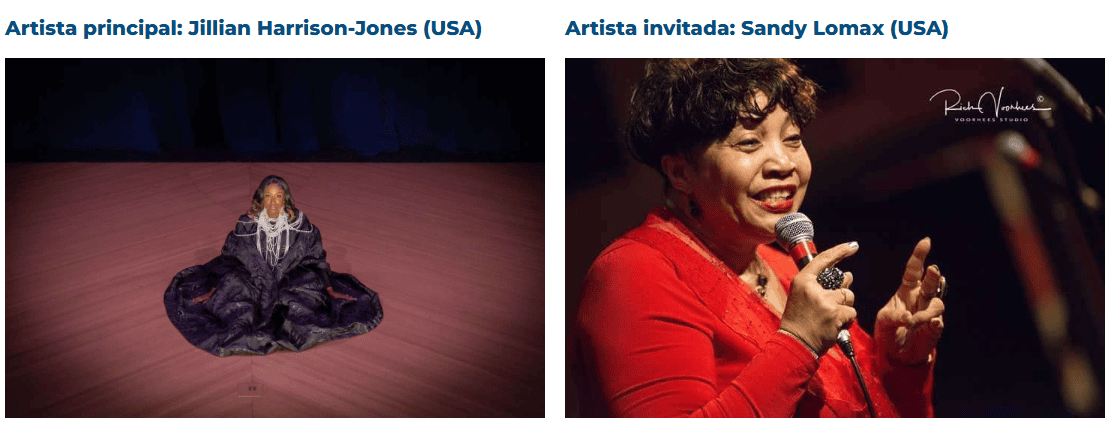
Jazz performers Jillian Harrison-Jones and Sandy Lomax
Headline photo: Noches de Blues y Soul poster.
A few years ago, I began asking myself a question that has only become more urgent with time: Who is financing the future?
Not the next quarter. Not the next election cycle. Not the next sustainability report. The future.
The kind of future where a young woman escaping violence can access dignified work. Where communities in remote regions can shape their own development. Where social mobility is not an exception but a possibility. Where prosperity is shared, not concentrated.

“My greatest motivation to lead the work at One is to witness value-generating projects whose results are sustainable over time and drive new initiatives” – Monica Gil Ryan
Throughout my career, I have worked at the intersection of public policy, private sector leadership, and social transformation. Those experiences taught me that lasting change does not happen by accident. It requires intention, resources, patience, and above all, trust.
That conviction is what led us at One Inversión Social to rethink a fundamental question: how can capital become a force for transformation?
At One, we believe social investment is not charity. It is one of the most strategic investments a society can make. We connect philanthropists, families, companies, and foundations with initiatives capable of generating measurable, sustainable, and systemic impact. Our work is based on a simple premise: resources create greater value when they are deployed with rigor, purpose, and a long-term vision.
Yet despite growing conversations around ESG, sustainability, and corporate citizenship, many important questions remain unanswered.
Why do we continue to finance short-term solutions for long-term problems? Why do we expect communities facing generations of exclusion to demonstrate transformational outcomes in six or twelve months? Why do we still measure social progress primarily through outputs rather than through lasting changes in people’s lives? And perhaps most importantly: Why do we trust financial markets to think in decades but expect social transformation to happen overnight?
One of the most common mistakes in philanthropy is impatience. We want immediate indicators. We want certainty. We want guarantees. But social change does not operate according to quarterly reporting cycles.
The most meaningful transformations often begin with something difficult to quantify: trust. Trust between organizations and communities. Trust between funders and local leaders. Trust that allows experimentation, learning, adaptation, and growth.
My two experiences at Harvard Business School reinforced the importance of technical rigor, evidence-based decision-making, policy design, and measurement. These tools matter deeply. Data matters. Evaluation matters.
But the field taught me something equally important. No framework, however sophisticated, can replace listening.
The leaders who understand the challenges of a territory are often the people who live there every day. Community organizations, grassroots leaders, local entrepreneurs, and social innovators frequently possess knowledge that no external consultant can replicate.
The role of philanthropy is not to arrive with all the answers. Its role is to identify those already creating solutions, provide them with patient and flexible capital, and help them scale what is already working.
This is where the private sector has an extraordinary opportunity.
For decades, many companies approached social responsibility as an activity adjacent to business. A donation here. A project there. A photograph for the annual report. That model is no longer enough.
The companies shaping the future are integrating social impact into their core operations. They are strengthening local supply chains, diversifying procurement, investing in talent development, supporting entrepreneurship, and using their operational capabilities to address challenges within their ecosystems.
The question is no longer whether companies should contribute to social transformation. The question is how intentionally they are doing it.
Because every allocation of capital is ultimately a statement about the future we want to build. Every investment reflects a belief. Every philanthropic decision reveals a priority. Every partnership sends a signal about whose voices matter and whose solutions deserve support.
So I return to the question. Who is financing the future?
Governments cannot do it alone. Communities should not have to do it alone. And philanthropy, while powerful, will never be enough if it remains disconnected from the broader economic system.
The future will be financed by those willing to think beyond immediate returns. By leaders who understand that prosperity and social cohesion are inseparable. By companies that recognize impact as a strategic asset. By philanthropists who combine the discipline of analysis with the humility of listening.
Most importantly, it will be financed by those who understand that social transformation is not an expense. It is an investment.
The challenge before us is not whether resources exist. The challenge is whether we have the courage, the patience, and the vision to direct them where they matter most.
Because the future is already being financed. The real question is: are we investing in the right one?
If this conversation resonates with you, I’d love to continue it. Let’s rethink together how philanthropy, business, and long-term social investment can help finance the future we all want to build.
Follow the conversation:
LinkedIn: Mónica Gil Ryan (linkedin.com/in/monica-gil-coca-5bb08143)
Instagram: @monicagilryan
Relief pledges test Colombia’s disaster-finance framework
A magnitude 7.4 earthquake struck western Colombia at 7:34 a.m. local time on August 10, with an epicenter about 3 miles (5 kilometers) east of San José del Palmar in the department of Chocó, roughly 150 miles (241 kilometers) from Bogotá, according to the US Geological Survey and Colombia’s Servicio Geológico Colombiano (Colombian Geological Survey). The quake originated at a depth of more than 100 kilometers, classifying it as a deep intraslab event tied to the Nazca Plate’s subduction beneath the South American Plate. Tremors were felt as far away as Panama, Venezuela, Ecuador, and Peru.
As of August 12, Colombian authorities had confirmed more than 188 deaths, over 1,600 injuries, 222 people missing, and 260 people still trapped in debris, according to the Unidad Nacional de Gestión del Riesgo de Desastres (National Disaster Risk Management Unit, UNGRD) and figures reported by El Tiempo; earlier tallies from the UN Office for the Coordination of Humanitarian Affairs (OCHA) put damaged homes at close to 5,000, with 61 buildings collapsed and more than 550 schools and 24 health facilities affected across roughly 16 departments. Chocó, Valle del Cauca, Caldas, Risaralda, and Quindío sustained the heaviest damage. President Abelardo De La Espriella declared a national disaster, invoked an economic emergency, and decreed three days of national mourning.
Colombia’s Foreign Ministry, the Cancillería, installed an international cooperation command post led by Foreign Minister Omar Bula to field and coordinate offers of assistance from foreign governments and multilateral organizations. Vice President José Manuel Restrepo said more than 12 countries had formally pledged humanitarian aid or rescue personnel, and that multilateral institutions alone had presented cooperation proposals totaling $1.3 billion USD in assistance of various kinds. “We have already received proposals worth $1.3 billion USD in cooperation of various kinds from multilateral organizations in the midst of this tragedy,” Restrepo said.
“We have already received proposals worth $1.3 billion USD in cooperation of various kinds from multilateral organizations in the midst of this tragedy.” — José Manuel Restrepo, Vice President of Colombia
United States
The US Department of State said it mobilized an initial $15.5 million USD in emergency shelter, food, and protection assistance, along with post-earthquake structural assessments, according to an August 11 media note from the department’s Office of the Spokesperson. The funding is being channeled through five partner organizations: Catholic Relief Services (CRS), the International Organization for Migration (IOM), Miyamoto International, the UN World Food Programme, and World Vision. Of the total, $3 million USD routed through CRS draws on funding already committed under a separate, previously announced global assistance award to that organization, meaning it does not represent new incremental spending beyond what State had already budgeted for CRS programming.
The department also activated a Disaster Assistance Response Team (DART), a standing mechanism of humanitarian specialists drawn from across the State Department, with members arriving in Colombia the day of the earthquake to coordinate needs assessments and the broader US government response alongside embassy personnel in Bogotá.
Separately from the new $15.5 million USD package, the State Department noted that as part of its existing $3.8 billion USD contribution to OCHA, the United States had previously provided $200 million USD to the Colombia Pooled Fund, a standing mechanism OCHA can draw on for earthquake-related needs as well as humanitarian programming in Colombia that predates the earthquake. That $200 million USD figure reflects prior funding availability rather than a new pledge tied specifically to the August 10 disaster.
On consular matters, the US Embassy in Bogotá remained open and continued providing emergency and routine passport, notarial, and consular services; its consular agency in Barranquilla also remained open. The embassy advised American citizens in Colombia to enroll in the Smart Traveler Enrollment Program (STEP) at step.state.gov and to follow [@USEmbassyBogota](profile/USEmbassyBogota) and [@TravelGov](profile/TravelGov) on social media for security updates. US citizens seeking assistance can reach the Bureau of Consular Affairs at 888-407-4747 from within the United States, or +1-202-501-4444 from other locations.
Multilateral development banks
The World Bank disposed $200,000 USD in a non-reimbursable grant, without an associated credit line, to fund post-earthquake damage assessments. Susana Cordeiro Guerra, the World Bank’s vice president for Latin America and the Caribbean, offered technical expertise drawn from the institution’s experience responding to disasters elsewhere, in addition to the grant.
The Inter-American Development Bank (IDB) approved $500,000 USD in non-reimbursable technical cooperation funding, of which $350,000 USD was made immediately available to the Colombian Red Cross and $150,000 USD earmarked for technical support, Restrepo said. Separately, IDB Group President Ilan Goldfajn said the institution has up to $300 million USD in contingent emergency financing available to Colombia should the government request it; wire reports including CNBC and CBC cited a related figure of $50 million USD as immediately available for reconstruction support, reflecting different tranches or reporting of the same contingent facility.
CAF, the Banco de Desarrollo de América Latina y el Caribe (Development Bank of Latin America and the Caribbean), pledged $500,000 USD in humanitarian donations to be channeled through its Social and Human Development Funds, CAF executive president Sergio Díaz-Granados said.
European Union
European Commission President Ursula von der Leyen announced €2.1 million EUR in humanitarian funding for health, water, sanitation and hygiene, shelter, food, protection, and cash assistance in the hardest-hit areas, according to the European Civil Protection and Humanitarian Aid Operations department (ECHO). The European Union activated its Civil Protection Mechanism, which pools resources among the bloc’s 27 member states, and deployed its Copernicus satellite mapping service to support damage assessment. A further €100,000 EUR was reallocated from an existing EU-funded project implemented by the German Red Cross to meet immediate needs of roughly 2,500 families in Chocó and Valle del Cauca.
Switzerland
The Swiss government approved 1 million CHF (about $1.23 million USD) in aid, with half directed to the UN World Food Programme and local nongovernmental organizations for emergency assistance and the remainder allocated to restoring living conditions in destroyed areas, according to the Swiss Agency for Development and Cooperation. Swiss President Guy Parmelin offered solidarity with Colombia the day of the earthquake.
Spain
Spain’s Agencia Española de Cooperación Internacional para el Desarrollo (Spanish Agency for International Cooperation for Development, AECID) mobilized an initial €1 million EUR package covering shelter materials, water and sanitation kits, medication, and support for deployed health personnel, Foreign Minister José Manuel Albares said. Spain’s Ministry of Foreign Affairs reported no confirmed Spanish fatalities as of August 12, though it had not yet located 75 Spanish nationals believed to have been in the affected region.
El Salvador
El Salvador’s president, Nayib Bukele, dispatched two aircraft carrying 100 tons of humanitarian aid along with medical and rescue teams, according to the Presidencia de la República de El Salvador (Presidency of the Republic of El Salvador).
Ecuador
Ecuador’s Ministerio de Relaciones Exteriores y Movilidad Humana (Ministry of Foreign Affairs and Human Mobility) sent 47 rescuers with canine units and equipment provisioned for seven days of operations.
Mexico
Mexico deployed 255 specialized military search-and-rescue personnel, including canine handlers and medical staff, along with 4 tons of medications, 8.4 tons of food, satellite phones, radios, generators, and tents, according to Mexico’s Secretaría de Relaciones Exteriores (Ministry of Foreign Affairs).
Peru
Peru sent a plane carrying 12.5 tons of supplies and 62 rescuers through its Ministerio de Relaciones Exteriores (Ministry of Foreign Affairs).
Chile
Chilean President José Antonio Kast offered his government’s civil and technical resources through Chile’s Ministerio de Relaciones Exteriores (Ministry of Foreign Affairs), without publicly specifying the scope.
Venezuela
Venezuela’s government, through Vice President and Foreign Minister Delcy Rodríguez and the Ministerio del Poder Popular para Relaciones Exteriores (Ministry of People’s Power for Foreign Affairs), said it would send rescue brigades, an announcement that drew domestic criticism within Colombia given the state of bilateral relations.
Brazil
Brazilian President Luiz Inácio Lula da Silva pledged solidarity and said logistical and technical teams were on standby through Brazil’s Ministério das Relações Exteriores (Ministry of Foreign Affairs).
Argentina
Argentina’s Ministerio de Relaciones Exteriores, Comercio Internacional y Culto (Ministry of Foreign Affairs, International Trade and Worship) offered material assistance, civil protection assets, and logistics support.
Additional Latin American and Caribbean support
Several other countries in the region conveyed solidarity or more limited offers of support:
- Panama — President José Raúl Mulino offered collaboration “within our capacity” through the Ministerio de Relaciones Exteriores de Panamá (Ministry of Foreign Affairs of Panama).
- Costa Rica — The government conveyed solidarity through its Ministerio de Relaciones Exteriores y Culto (Ministry of Foreign Affairs and Worship).
- Dominican Republic — President Luis Abinader said his country stood ready to provide assistance, coordinated through the Ministerio de Relaciones Exteriores de República Dominicana (Ministry of Foreign Affairs of the Dominican Republic).
- Guatemala — The disaster-response agency, the Coordinadora Nacional para la Reducción de Desastres (National Coordinator for Disaster Reduction, Conred), remained in contact with Colombian counterparts to determine whether a formal request for assistance would follow, President Bernardo Arévalo de León’s government said.
- Cuba — Expressed willingness to help without publicly detailing specific commitments.
- Bolivia — Expressed willingness to help without publicly detailing specific commitments.
Other countries
Vice President Restrepo named Japan, Sweden, and Turkey among the more than 12 governments that formally offered humanitarian aid or rescue support, though itemized figures for their pledges were not publicly available as of this writing. Israel, France, Germany, Italy, and Ukraine also expressed readiness to coordinate assistance, according to Colombian media reporting, without confirmed dollar figures attached to those offers.
Red Cross and Red Crescent movement
The International Federation of Red Cross and Red Crescent Societies (IFRC) launched an emergency appeal for 11.7 million CHF to support the Colombian Red Cross, which activated its National Crisis Room and deployed a 30-member urban search-and-rescue team from its Antioquia branch to Chocó, alongside volunteers from its Quindío and Caldas branches. The Colombian Red Cross also activated its Restoring Family Links service to help reunite people separated from missing relatives.
Private sector
Among corporate contributions, Spanish bank BBVA (BME: BBVA) (NYSE: BBVA) said it would provide 3,500 food and hygiene kits, including nonperishable staples and personal care items, distributed through Colombia’s regional food bank network.
How to contribute
Colombian donors and members of the international community seeking a vetted local channel for contributions can direct support through somosone.com.co, the Colombian strategic-philanthropy platform operated by ONE Inversión Social. The organization has partnered with Sankofa Danzafro, La Pascasia, and Presentes Corporación on a Chocó-focused relief campaign, with a donation page linked from the platform’s homepage.
Sale location, not flight origin, sets commission duty in Colombia
Colombia’s civil aviation regulator (Aeronáutica Civil) has fined American Airlines (NASDAQ: AAL) COP $65.3 million for failing to pay commissions owed to travel agencies on international tickets sold in the country, resolving a dispute over whether commission obligations apply when flights originate outside Colombia.
The sanction was issued through Resolution 02124 of July 3, 2026 by the Unidad Administrativa Especial de Aeronáutica Civil (Aerocivil), which determined that American Airlines had breached Resolution 3596 of 2006, the regulation establishing minimum commissions payable to travel agencies that commercialize air transport services in Colombia.
The case centered on the interpretation of when the commission obligation applies. American Airlines argued that commissions should not be payable for tickets involving flights departing from destinations outside Colombia, including the United States and Canada.
Aerocivil rejected that interpretation, finding that the determining factor under Colombian regulation is where the ticket sale takes place, rather than the flight’s point of origin or destination.
“The rule introduces no distinction whatsoever based on route origin or destination,” – Aerocivil, Resolution 02124.
The regulator added that the commission framework does not exclude tickets based on whether the itinerary begins in another country, meaning international routes remain subject to the rule when commercialized through Colombian travel agencies.
The proceedings originated from a 2023 complaint filed by the Asociación Colombiana de Agencias de Viajes y Turismo (Anato), the Colombian association representing travel agencies and tourism companies.
The complaint requested Aerocivil’s intervention after Best Travel, a Colombian travel agency, issued a ticket on March 31, 2023 and later invoiced American Airlines for a COP $27,095 commission payment on June 18 of that year. The airline declined to pay, citing the itinerary’s origin outside Colombia.
Aerocivil’s Grupo de Investigaciones y Sanciones a las Infracciones (GISI) opened a formal investigation on March 24, 2024. During the process, American Airlines requested that the case be closed, arguing that its due process rights had been affected because no preliminary inquiry had been conducted before the sanctioning procedure began.
The regulator dismissed those arguments and proceeded with the penalty. American Airlines may still submit a recurso de reposición (motion for reconsideration) challenging the decision.
The resolution provides further guidance on how Colombia applies its travel agency commission rules to international airlines selling tickets through Colombian distribution channels, an issue relevant to carriers operating in the country’s aviation market.
American Airlines, part of American Airlines Group, operates international routes connecting Colombia with the United States and other destinations through its global network.
Headline image: American Airlines aircraft with the Aeronautica Civil logo. (Photos sourced from Canva)
Economic emergency declared after deadly earthquake
Colombian President Abelardo de la Espriella announced the declaration of a state of economic, social and ecological emergency to accelerate the response and reconstruction following the magnitude 7.4 earthquake that struck August 10, leaving more than 265 people dead, nearly 3,500 injured and 495 still missing.
The extraordinary measure will temporarily allow the executive branch to issue decrees with the force of law directly related to the emergency, mobilize resources and expedite procedures that, under normal circumstances, require lengthier administrative or legislative processes.
“I am informing the country that I have decided to make use of the economic emergency, a mechanism provided for in our Constitution that will allow us to address this crisis as required,” De la Espriella said during a televised news conference.
According to figures from the Unidad Nacional para la Gestión del Riesgo de Desastres, UNGRD (National Unit for Disaster Risk Management), released by the Presidency, the earthquake also damaged the homes of about 25,800 families and affected critical infrastructure, including medical centers, pedestrian bridges, roads, aqueducts and airports.
Among the hardest-hit areas are cities such as Manizales, Pereira and Cali, as well as the department of Chocó, which was the epicenter of the earthquake. The scale of the damage now opens a reconstruction process that could extend well beyond the duration of the state of exception. But what exactly does this measure entail? Here we explain.
What is a state of economic emergency?
The state of economic, social and ecological emergency is one of three states of exception established under Colombia’s 1991 Constitution to address extraordinary circumstances.
The other two are a state of foreign war, regulated by Article 212 of the Constitution, and a state of internal disturbance for security reasons, established under Article 213. The mechanism now being used by De la Espriella is regulated by Article 215.
That article establishes that when events other than a foreign war or internal disturbance occur that “seriously and imminently disrupt or threaten to disrupt the country’s economic, social and ecological order” or constitute a “serious public calamity,” the president, with the signatures of all Cabinet ministers, may declare a state of emergency.
Each declaration may remain in effect for up to 30 days, and the different periods of emergency may not total more than 90 days within the same calendar year.
To use this mechanism, the government must demonstrate the existence of real and verifiable circumstances that represent a serious and imminent threat and explain why the state’s ordinary powers are insufficient to respond to the crisis.
In addition, measures adopted through emergency decrees must be directly related to the causes that prompted the declaration.
What can the president do during the emergency?
In practice, the mechanism temporarily expands the executive branch’s powers by allowing it to issue decrees with the force of law without initially following the ordinary legislative process in Congress.
Among the measures it can adopt are the reallocation of budget funds, creation of funds to respond to the emergency, authorization of direct contracting mechanisms, changes to tax calendars and, under applicable constitutional conditions, the establishment of temporary taxes.
Those taxes must cease to apply at the end of the following fiscal year unless Congress subsequently decides to make them permanent. Colombia has had several examples of this. In March 2026, amid heavy rains, the government of former President Gustavo Petro enacted Decree 0240, creating two temporary taxes. The first was a 16% consumption tax on gambling platforms, along with an expansion of the wealth tax.
The 30-day window will be particularly important for the immediate response. During that period, the government will be able to establish extraordinary mechanisms to assist victims, mobilize resources and launch the initial phases of reconstruction, including the potential channeling of international cooperation.
However, because the reconstruction of infrastructure and housing will likely extend for months or years, much of its implementation will subsequently have to continue through ordinary legislation and resources from the national budget.
Government announces the ‘Fondo Milagro’
De la Espriella also announced that the emergency will allow the creation of the so-called “Fondo Milagro,” a name connected to “Patria Milagro,” one of his government’s political slogans.
The president described the fund as “an entity that will channel national and international contributions, which will be allocated to the reconstruction of hospitals, educational centers, buildings, roads and airports that were damaged by the earthquake.”
The government also intends to use the extraordinary powers to promote economic recovery in the affected regions.
“The emergency must also include economic recovery measures that stimulate investment, reduce obstacles to project development and generate more jobs,” De la Espriella said.
Is it a blank check for the president?
The scope of the extraordinary powers explains why states of emergency often generate political and legal controversy in Colombia.
The ability to issue decrees with the force of law, temporarily modify certain fiscal and budgetary rules and accelerate contracting processes can be interpreted as a way to reduce the ordinary controls and procedures that normally constrain executive action.
However, the Constitution establishes specific limits.
The president cannot use the emergency to suspend fundamental rights, weaken workers’ social rights or interrupt the functioning of the other branches of government. Nor can the president use extraordinary powers to adopt decisions that are not directly aimed at addressing the causes and consequences of the emergency.
In addition, legislative decrees issued during the state of exception are automatically subject to review by the Constitutional Court.
Congress also retains its political oversight functions and may examine the reasons that led the government to declare the emergency and assess the appropriateness and timing of the measures adopted. Within its constitutional powers, it may also modify, add to or repeal certain provisions issued during the emergency.
Those checks have already had an impact in 2026: In April, 2026, the court struck down the emergency declared by Gustavo Petro in December 2025, while in June it upheld, with restrictions, another declaration issued in February.
An economic emergency and a national disaster are not the same
Before announcing the state of economic emergency, the government had declared a national disaster, a different legal mechanism.
The disaster declaration stems from Law 1523 of 2012 and is linked to the Sistema Nacional de Gestión del Riesgo de Desastres, SNGRD (National Disaster Risk Management System). Among other tools, it allows resources from that fund to be mobilized and expedites the contracting needed to provide humanitarian assistance.
The state of economic, social and ecological emergency, by contrast, is constitutionally grounded in Article 215 and grants the executive branch extraordinary and temporary legislative powers.
The two mechanisms can therefore operate in a complementary manner: One facilitates the administrative and operational management of the disaster response, while the other temporarily allows measures with the force of law to address a crisis that the government considers impossible to manage solely through ordinary mechanisms.
De la Espriella’s use of the mechanism now opens a new period of constitutional and political oversight. Although the executive branch will be able to act more quickly during the initial earthquake response, the measures it adopts must remain directly connected to the calamity and will be reviewed by both the Constitutional Court and Congress.
The death toll is certain to climb as rescue teams and citizen groups mobilize to find survivors.
A magnitude 7.4 earthquake struck western Colombia at 7:34 a.m. local time on Monday, August 10, 2026, killing at least 111 people and injuring 87 others, according to figures confirmed by President Abelardo de la Espriella and reported by Noticias Caracol. Twenty-nine of the deaths occurred in capital cities. The figures are expected to rise as search-and-rescue teams continue working through collapsed buildings in Cali, Chocó, and the Coffee Axis region.
“The same seismic systems and plate tectonics powering today’s earthquake are also behind recent volcanic activity at Volcán Puracé, but it would be a mistake without more evidence to infer any causality between the phenomena.” — Isabella Casasbuenas, mining engineer, Universidad Nacional de Colombia
The US Geological Survey (USGS) located the epicenter 5 kilometers south of San José del Palmar, a small municipality in the department of Chocó, at a depth of approximately 110 kilometers. The Servicio Geológico Colombiano (SGC, Colombian Geological Survey) described it as the strongest earthquake to hit Colombia in a decade. It was felt as far away as Bogotá, Medellín, and neighboring Venezuela, Ecuador, and Panama.
The national government declared a “situación de desastre nacional” (national disaster situation), and President de la Espriella, who was inaugurated just three days earlier, canceled his Monday agenda to lead the response personally. “He asumido directamente el liderazgo de la atención por la emergencia en San José del Palmar” (“I have taken direct leadership of the emergency response in San José del Palmar”), the president wrote, announcing a Puesto de Mando Unificado (Unified Command Post) at the Unidad Nacional para la Gestión del Riesgo de Desastres (UNGRD, National Unit for Disaster Risk Management). He later said he would travel to Bogotá to run the response from the UNGRD’s crisis room, with the vice president and cabinet ministers dispatched to Chocó, the Eje Cafetero (Coffee Axis), and other affected zones. “Lo primero es el rescate de las personas que están bajo los escombros, esa es la prioridad” (“The first priority is rescuing people under the rubble”), he said, according to Noticias Caracol.
The most dramatic footage I’ve ever seen of an earthquake as it was occurring … 🙏🏼🙁 pic.twitter.com/yg1BWUnhFc
— John (@market_sleuth) August 10, 2026
According to the president’s office, the earthquake damaged 1,575 homes and destroyed 37 others, collapsed 61 buildings, and damaged 18 health centers, 52 schools, 17 community centers, and 18 roads. Six airports, including those serving Pereira, Manizales, Quibdó, Armenia, Cartago, and Buenaventura, lost commercial operations, and a seventh sustained runway damage. In Cali, the mayor’s office reported more than 20 collapsed structures with people trapped inside; in Manizales, a tower of the city’s cathedral was damaged. The UNGRD said four urban search-and-rescue teams, from Bogotá, Envigado, Yopal, and Medellín, were deployed, with Bogotá and Antioquia contributing heavy equipment and aircraft. The agency also confirmed there is no tsunami threat to Colombia’s Pacific coast, and the SGC recorded two aftershocks, of magnitude 2.8 and 4.8, near the Chocó municipality of Nóvita.
Empresas Públicas de Medellín (EPM, Medellín’s public utility, which operates several of the country’s hydroelectric dams) said in a statement that its infrastructure was undamaged and no injuries were reported at its facilities. “Producto de nuestras operaciones no se han presentado personas o estructuras afectadas,” the utility said, adding that it continues operating normally while monitoring the situation. Read the full statement at epm.com.co.
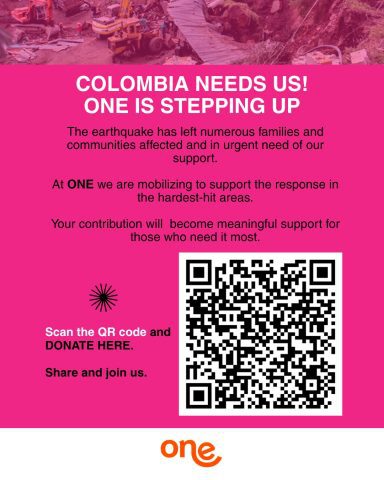
The One Foundation is mobilizing to support the response in the hardest hit areas. Click or scan the QR code.
How to help
Readers looking to support relief efforts can donate through the UNGRD‘s official channels , the One Foundation (One Inversión Social), or the Cruz Roja Colombiana (Colombian Red Cross), which coordinates emergency response nationally; its website was intermittently unreachable Monday amid the surge in traffic following the earthquake. In Medellín, the Fundación Banco Arquidiocesano de Alimentos de Medellín (Carrera 52 No. 30A-97) and Fundación Saciar (Carrera 50 No. 25-261) are collecting non-perishable food, water, rice, cooking oil, pasta, lentils, beans, canned goods, cornmeal, wheat flour, panela, powdered and UHT milk, hygiene products, diapers, and bedding for affected families. Noticias Caracol has additional donation points as they are confirmed.
Understanding the science: why a deep quake shook such a wide area
For readers unfamiliar with seismology, a few basics help explain why an earthquake this size caused damage across several cities at once, rather than concentrated destruction near a single epicenter.
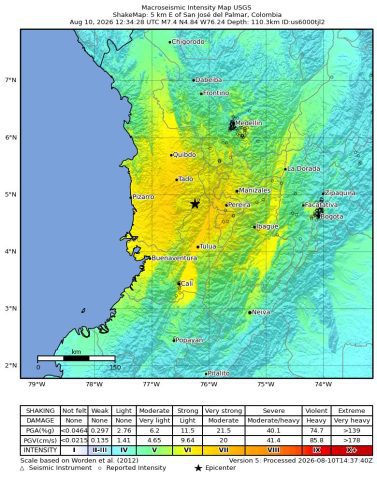
Estimated shaking intensity for the August 10, 2026, earthquake near San José del Palmar, Chocó. Image: US Geological Survey (USGS)
Earthquake magnitude measures the total energy released at the source; USGS calculated this event at 7.4 on the moment magnitude scale, the modern standard that replaced the older Richter scale for large earthquakes. Depth matters just as much as magnitude in determining what people on the surface actually feel. Most damaging earthquakes, like Ecuador’s 2016 Muisne quake or Haiti’s 2010 disaster, originate less than 20 kilometers below the surface, concentrating destructive shaking in a relatively small area near the epicenter. Monday’s earthquake originated roughly 110 kilometers down, a category seismologists call an “intermediate-depth” earthquake (any quake between 70 and 300 kilometers deep). Energy traveling that far to the surface loses some of its punch directly overhead, but it spreads shaking, typically more moderate but still potentially damaging, across a much broader region. That is why residents felt Monday’s earthquake as far as Bogotá and across three neighboring countries, even though the shaking was most intense closer to the Chocó-Valle del Cauca border.
The quake’s mechanism was primarily strike-slip faulting, meaning the two sides of the fault slid horizontally past each other, rather than one block thrusting up over the other, as happens in the shallow “megathrust” earthquakes more familiar along Chile’s or Japan’s coastlines. USGS’s analysis of the seismic waves (a “focal mechanism”) could not distinguish between two possible fault orientations, a steeply dipping fault with a mix of reverse and left-lateral motion, or a moderately dipping fault with largely right-lateral motion, but both are consistent with deformation occurring inside the Nazca plate itself as it descends beneath the South America plate along Colombia’s Pacific margin. Given the depth, USGS said the rupture likely occurred within the subducting plate rather than at the shallower boundary between the two plates.
Intermediate-depth earthquakes like this one are common along the length of the South America subduction zone and are generally attributed to bending stresses within the descending plate, distinct from the shallower interface earthquakes that produce tsunamis. Monday’s event occurred near the northernmost point where this type of intermediate-depth seismicity has historically been observed in Colombia. USGS noted that only two earthquakes of magnitude 7 or larger have occurred within 250 kilometers of Monday’s epicenter since 1950, and both were located near the coast; the region has more typically produced earthquakes below magnitude 7. USGS’s automated PAGER impact system, which generates preliminary loss estimates within hours of an earthquake to guide humanitarian response, issued an “orange” alert, its second-highest level, indicating significant casualties and widespread damage were likely; the system’s early statistical model, not a confirmed count, pointed toward hundreds of fatalities and roughly $649 million USD in economic losses, broadly in line with the toll now being confirmed on the ground.
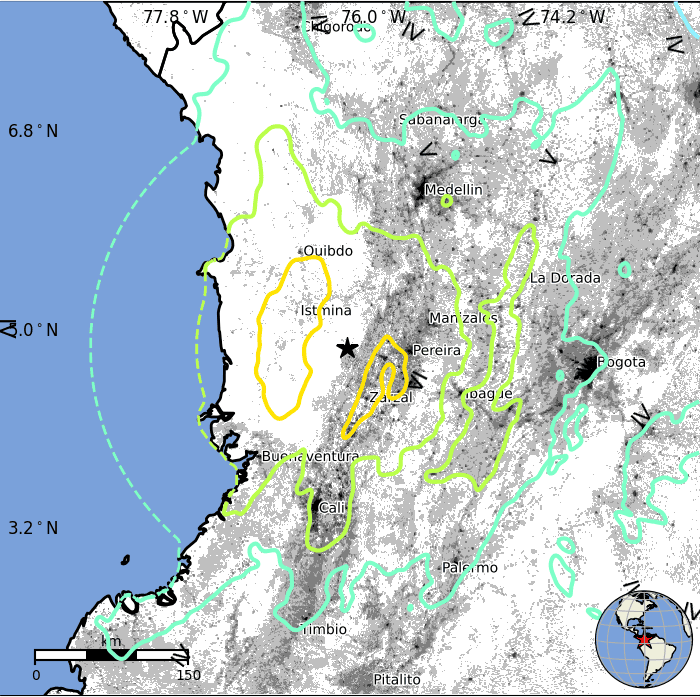
Estimated population exposed to each level of shaking intensity. Image: US Geological Survey (USGS)
A volcano already on alert nearby
The earthquake struck as Colombian authorities were already managing a separate, unrelated emergency: an orange alert at Volcán Puracé (Puracé Volcano) in the department of Cauca, roughly 150 kilometers south of Monday’s epicenter. The SGC has kept the Coconucos volcanic chain, which includes Puracé, Piocollo, and Curiquinga, under its second-highest alert level since a sharp rise in seismicity and gas emissions began around July 20, with instrumental readings in early August reaching the highest levels recorded since continuous monitoring began in 1993.
The volcano has produced six ash emissions since the afternoon of Friday, August 7, including two significant plumes, documented by residents and the SGC’s monitoring cameras, on Friday at 5:57 p.m. and Saturday at 9:12 a.m. Sulfur dioxide flux from the crater has measured around 2,100 tons per day, well above the volcano’s historical average, while ground-based carbon dioxide readings have also climbed. Natalia Contreras, the SGC official who oversees geohazard information, said the seismic activity driving the alert is dominated by fluid movement in shallow volcanic conduits, tremor and long-period earthquakes located less than a kilometer beneath the crater, rather than by rock-fracturing earthquakes, which have stayed comparatively rare and weak. It is the second time in less than eight months that Puracé has reached orange alert. The UNGRD has begun trucking water to roughly 3,000 residents in nearby communities after ash and acidic gases affected local water sources and pasture, and has prepared, but not activated, evacuation routes for the area.
Finance Colombia asked Isabella Casasbuenas, a mining engineer from Colombia’s Universidad Nacional (National University), whether Monday’s earthquake and Puracé’s unrest are connected. She explained that the same regional seismic systems and plate tectonics, ultimately driven by the Nazca plate’s subduction beneath South America, underlie both phenomena, but cautioned against inferring any direct causal link between the two without further evidence. Seismologists broadly share that caution: Monday’s rupture occurred roughly 110 kilometers underground, within the subducting Nazca plate, while the seismicity driving Puracé’s alert is occurring less than 2 kilometers beneath the volcano’s crater, in the shallow magmatic and hydrothermal system that feeds it. The two processes sit within the same broad tectonic framework but are not, on current evidence, mechanically linked events.
This is a developing story. Casualty and damage figures are preliminary and likely to change as search-and-rescue operations continue.

USGS’s ShakeMap system, which models expected shaking intensity using the Modified Mercalli Intensity (MMI) scale, estimated that roughly 1.6 million people experienced “very strong” shaking (MMI VII), nearly 8.9 million experienced “strong” shaking (MMI VI), and another 17 million experienced “moderate” shaking (MMI V) across Colombia, Ecuador, and Panama.
 Empleobilingue.com

- Director/a de operaciones para hotel, restaurante y discoteca 1626320364.60 - Medellín, Medellin, Antioquia, Colombia
- Coordinador/a de calidad para La Unión 1626483143.1 - La Unión, Antioquia, Colombia
- Desarrollador fullstack - Bogotá, Bogota, Colombia
- Technical Analyst - Remote
- PIM Administrator - Ecommerce - Remote (Bogotá, Bogota, Colombia)
- Auxiliar de gestión humana y bienestar para Girardota 1626060072.28 - Girardota, Antioquia, Colombia
- Marketing Strategist
- Trainer Manager - Bogotá, Bogota, Colombia
- Tolemaida UH- 60 Inspector - Bogotá, Bogota, Colombia
- Virtual Assistant - Team Lead - Remote
Contact Us

