















Fitch Ratings has released several key reports of late regarding areas of interest across Colombia and Latin America. The following is a summary breakdown from the New York-based rating agency of what each report finds about local and regional governments of Colombia after last year’s elections; the improving real estate sector across Latin America; and a neutral outlook for the cement section in the region.
Colombian Governments
Fitch Ratings Outlook 2024: Local and Regional Governments of Colombia
Fitch Ratings expects the assessment of risk profiles, together with key risk factors (KHRs), to remain unchanged, but will maintain special attention on those linked to the sustainability and adaptability of spending, both due to the macroeconomic environment and the ability to mitigate its growth.
However, low economic growth would have an impact on the dynamics of consumption-related tax revenues and could have a negative effect on territorial operating balances to the extent that local and regional governments (LRGs) are unable to implement effective expenditure control.
The new territorial administrations that will take office from January 2024 will present their development plans by mid-2024. Fitch expects capital investments to be made from the second half of the year, so no additional new debt needs are expected to finance infrastructure projects.
There is a wide list of projects with regional impact, which may require co-financing from the National Government. Dialogue between these territorial entities and the Nation will be fundamental for the advancement of such investment initiatives.
Real Estate Sector
Latin American Real Estate Outlook 2024
Fitch Ratings expects the Latin American real estate sector’s fundamentals to continue improving in 2024, according to its new outlook report.
Nearshoring is supporting strong occupancy rates and rent growth for industrial properties in Mexico. In addition, Fitch expects issuers in the industrial subsector to post high-single-digit revenue and EBITDA growth in 2024, supported by high demand.
Fitch expects the region’s shopping malls to maintain strong cash flow generation capacity and sound liquidity. This segment should benefit from inflation-adjusted rents, high collections and limited occupancy rate volatility throughout cycles. Fitch believes the LatAm office market will experience a slow but steady recovery in occupancy rates and rents, but should remain limited by oversupply and hybrid work.
LatAm real estate credit profiles experienced limited credit risk and rating deterioration over the past few years, aided by strong beginning balance sheets, healthy access to capital, and stable operating metrics. Sector leverage is manageable, liquidity is strong, near-term debt maturities are low, and portfolios hold high levels of unencumbered assets.
High-yield issuers rated in the sector are mostly limited by scale and/or operating environment. A potential slowdown in the U.S economy, electoral cycles, inflation, and persistently tight financial conditions remain the potential risks.
Cement Sector
Latin American Cement Outlook 2024
The outlook for the Latin American cement sector is neutral, according to Fitch Ratings latest Latin American Cement Outlook report. Fitch expects volumes to stage a recovery throughout the year after closing 2023 at subdued levels. Pricing was a bright spot in 2023, with record price increases at double digits, but it is likely to lose traction given declining inflation trends and lower energy prices.
Capital allocation strategies are expected to set the tone for rating changes during 2024. Most issuers currently present strong capital structures within their respective rating levels. Management decisions to invest in business growth, diversification (M&A), in ESG, or even in portfolio rebalancing seeking more value-added products or services/solutions will be key factors driving credit metrics in 2024. In terms of refinancing, we expect most issuers to remain proactive with their liability management strategies to avoid refinancing risks in the medium term.
A judge in Bogotá sentenced Andres Felipe Cardoso Alvarez, alias Orgon and purportedly part of the group Anonymous Colombia, to more than 3 years and 5 months in prison for the crimes of abusive access to a computer system, computer damage, and illegitimate hindering of a computer system.
According to the prosecutors office, Cardoso illicitly entered several private and public websites, including the official site of the Colombian president’s office (presidencia.gov.co), 12 mayoral offices, various municipal agencies, and the Regional Autonomous Corporations of Tolima, Huila and Norte de Santander, a departmental entity that regulates environmental activities and land use.
He also is now obligated to pay a fine of $28,000 USD.
Major Adrian Vega Hernandez, the head of the Police Cyber Center that contributed to the investigation, told Semana magazine that in there is no leadership structure within Anonymus Colombia and members work independently within hacking operations
“They, within the organization, do not have a defined hierarchy because it is not a pyramidal structure, it is a linear structure,” he told Semana. “They all contribute with the same capabilities to attack the targets and no one commands over the other.”
Cordoso was initially arrested in Aguazul, Casanare.
“Analysts from the Police Cybernetic Center established that Cardoso Álvarez was a participant in the cyber attacks called OP_Colombia and False Independence, which targeted the websites of the Ministry of Defense, the Attorney General’s Office, the National Army and the National Police,” said Olga Salazar, director general of Dijín, to Semana.
(Photo credit: Fiscalía)
This article, written by Sergio Saffon and Sara Garcia, was originally published by Insight Crime, a Medellín-based foundation dedicated to the investigation and analysis of crime and security in Colombia and Latin America.
President Gustavo Petro’s “Total Peace” policy had a difficult 2023. Not only did it fail to persuade the country’s most important armed groups to lay down their arms, but it also led to a reshaping of Colombia‘s criminal landscape.
The Total Peace policy is Petro’s bold bid to bring the criminal activities of Colombia’s main armed groups to an end. Since its inception in late 2022, it has sought to negotiate with more than 20 armed and criminal groups, ranging from the National Liberation Army (Ejército de Liberación Nacional – ELN) guerrillas to paramilitary offshoots such as the Gaitanist Self-Defense Forces of Colombia (Autodefensas Gaitanistas de Colombia – AGC), also known as the Gaitanistas, and smaller urban criminal gangs.
In 2023, the government has managed to engage only five groups in negotiations. Talks with the ELN and the Central General Staff (Estado Mayor Central – EMC) of the ex-FARC mafia — a confederation of dissident groups of the former Revolutionary Armed Forces of Colombia (Fuerzas Armadas Revolucionarias de Colombia – FARC) guerrillas — are the most advanced. The talks have led to multiple ceasefires with the government, significantly reducing clashes with state security forces across the country.
The state of the other negotiations, however, is uncertain. One of the most difficult challenges in advancing negotiations lies in the fact that the criminal groups are unwilling to submit themselves to the country’s judicial processes after the government’s proposed bill failed to pass in Congress. Public support for Total Peace has been crumbling in the last year.

The obstacles facing Total Peace are significant. While the state appears as far as ever from achieving a military, political, or financial victory over any of the country’s armed groups, some of those armed groups appear to be growing stronger.
The policy is facing its toughest test yet after the ELN recently kidnapped the father of an internationally famous soccer player, Luis Díaz, in the country’s northeastern department of La Guajira. Around the same time, tensions increased between the army and the EMC in the southwestern department of Cauca. Following these events, Petro removed Danilo Rueda from his post as Peace Commissioner and appointed Otty Patiño, who had until that point been the government’s delegate in negotiations with the ELN.
Below, InSight Crime looks at Total Peace’s impact on the restructuring of Colombia’s criminal groups in 2023.
Effect on Major Criminal Economies
Total Peace has had a deeply undesired effect: it has given new impetus to the fight to control Colombia’s strategic criminal economies, including coca cultivation. Abandoning these incomes is not a necessary condition to negotiate with the government, and the state cannot use the military against any group with which it has agreed to a ceasefire.
Some groups, such as the EMC, have managed to consolidate strategic corridors in Cauca and other regions in the south of the country. But this has also led to clashes. In some coca-growing areas, for example, violence has deepened the coca crisis caused by the fall in coca prices, although the drug trafficking business remains profitable.
In the departments of Cauca, Nariño, Norte de Santander, and Putumayo, disputes between criminal groups over sections of the drug trafficking chain appear to have driven away national and international buyers of coca paste and cocaine, keeping coca prices low and increasing oversupply in production areas.
“In places like Cauca, where there are many actors, there is a lot of insecurity. That doesn’t attract international actors, who need stability,” Luis Fernando Trejos, professor of political science and international relations at the Universidad del Norte, told InSight Crime.
As a result, some of these groups have sought to expand their sources of illicit income with other criminal economies such as gold mining, extortion, and kidnapping. The ELN has continued kidnapping and refused to give it up, despite it being prohibited under the ceasefire. This has been yet another source of tension with the government.
Coca prices appear to have fallen less in areas where there is one dominant criminal actor. In Bajo Cauca, Antioquia, a key area for the AGC, the price per kilo of coca paste has dipped slightly from $880 to $780, according to Carlos Zapata, president of the Popular Training Institute (Instituto Popular de Capacitación – IPC), a civil society organization specializing in human rights.
The group has also sought to profit from other illegal economies, such as illegal mining in Bajo Cauca, northeastern Antioquia, and southern Bolivar, as well as migrant smuggling through the Darién Gap.
Incentivizing Crime
The Total Peace policy was also one of the major contributing factors to the rapid evolution of crime in Colombia.
Ceasefires have been crucial to the change in criminal dynamics in the country, giving respite to armed groups from military operations against them. This pause has allowed them to concentrate on fighting rival organizations for control of strategic territories.
“Total Peace generated perverse incentives for the groups,” said Trejos, who explained that the ceasefires were “an unplanned truce [with the state] that left them a free battle front to move towards a more horizontal war with other armed groups without the state participating.”
In fact, according to data from the Ideas for Peace Foundation (Fundación Ideas Para la Paz), confrontations between armed groups increased by 85% and expanded to other areas under Total Peace.
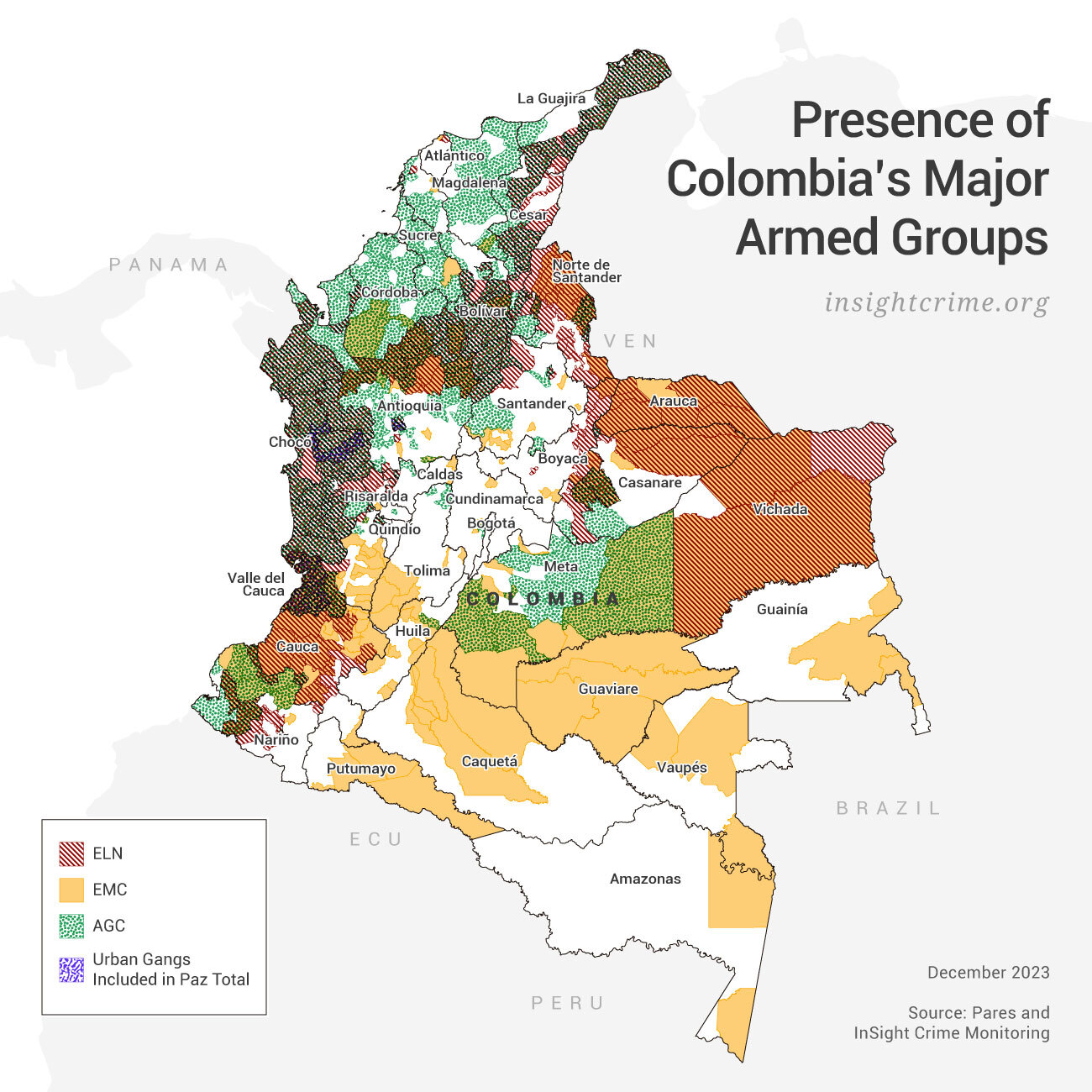
These clashes continue in places where criminal economies, including illegal mining, extortion, and drug trafficking, proliferate. Some of these territories, like Chocó, Antioquia, Nariño, Arauca, Putumayo, southern Bolívar, and Cauca, were FARC strongholds. The group’s demobilization in 2016 left a power vacuum that triggered battles for control.
In some of these territories — such as southern Bolívar and Chocó — it has become clear that criminal groups that do not have ongoing negotiations with the government, such as the AGC, are expanding and fueling an upsurge in violence.
There have been some positive developments in security, including a slight decrease in murders of social leaders and lower numbers of displacement and confinement. However, taken as a whole, Total Peace has failed to prevent the strengthening of the main criminal groups or curb their territorial expansion, recruitment, or the diversification of their income. All of this has led to increased violence between armed groups.
Bureaucratic Challenges
The lack of support for Total Peace within Congress has been one of the Petro administration’s greatest obstacles.
In March, the president presented the bill laying out the legal framework that would enable the government to negotiate with non-political criminal structures, such as urban criminal gangs, the AGC, and the Conquering Self-Defense Forces of the Sierra (Autodefensas Conquistadoras de la Sierra Nevada – ACSN), also known as the Pachenca.
In June, the bill collapsed due to a lack of support, leaving the government without the legal structure it needed to move forward with negotiations it had already begun, such as those with urban gangs in Medellín and Buenaventura.
During the year, tensions between the government’s Total Peace approach and the aims of key government ministries, including the defense and justice ministries, also became apparent.
Disagreements between the Colombian military and the Peace Commissioner over negotiations with the ELN and the EMC were particularly apparent during regional elections, which took place on October 29.
For example, the army did not enter or provide electoral materials to the town of El Plateado, a township in the municipality of Argelia, Cauca, and a key stronghold for EMC factions in the Cañón del Micay, until two days before the elections. This was to avoid a confrontation with the EMC, General Helder Giraldo Bonilla, commander of the military forces, told El Tiempo.
Then, the army hung about following the elections, increasing tensions in the area. The army was eventually pushed out of the town by the community — but the delay led to the EMC suspending peace negotiations for 10 days, arguing non-compliance by the government and complaining about the drawn-out presence of the army, according to a communiqué issued by the group on November 5.
This situation also highlighted the difficulty in reconciling Total Peace and the implementation of the government’s drug policy. The policy seeks to attack the main criminal structures dedicated to drug trafficking and the infrastructure of both drug production and trafficking, while also bringing opportunities to the communities most affected by this illegal economy’s dynamics.
But in key drug trafficking territories where groups such as the ELN and the EMC are the dominant actors, the ceasefires decreed under Total Peace may hinder the actions of the security forces against drug trafficking and the dismantling of the infrastructure that supports it. In the Cañón del Micay, the army was forced to halt a major anti-drug operation due to the ceasefire in mid-October, a setback in the fight against drug trafficking in this strategic enclave.
Considering these contradictory policies and disagreements within the government, the outlook for Total Peace looks bleak.
This article, written by Sergio Saffon and Sara Garcia, was originally published by Insight Crime, a Medellín-based foundation dedicated to the investigation and analysis of crime and security in Colombia and Latin America.
Big three credit rating agency Fitch Ratings has issued a B rating for Colombian airline Avianca’s long-term foreign currency issuer default ratings and long-term local currency issuer default ratings (IDR). It also assigned a rating of ‘B’/’RR4’ to Avianca’s senior secured exit notes Tranche A-1 and Tranche A-2, total amount of $1.7 billion USD due 2028, issued by Avianca MidCo2 Limited.
“Avianca’s ‘B’ rating reflects the industry’s high cyclicality risks, the company’s solid market position in the Latin American airline passenger industry, lean cost structure, moderate leverage, with net debt/adjusted EBITDA remaining in the range of 3.0x-4.0x within the rating horizon, and good liquidity position, yet limited financial flexibility,” said the New York-based agency in its note to investors.
On the risk side, Fitch pointed to the nation’s largest carrier’s uncertain trajectory and “above-average industry risks” as it continues to regain its footing following bankruptcy.
“Medium-term uncertainties include Avianca’s ability to maintain its strong operating margins while resuming its business growth post Chapter 11 process in U.S. and under a more challenging business environment and rising fuel prices,” stated Fitch.
“Ongoing execution risks related to its new business strategy moving towards a low-cost carrier are also embedded into the analysis, but recent quarters performance have shown good progress and favorable dynamics.”
Similarly, the future of Avianca will also require high-level execution of its new business model within this challenging macroeconomic and fuel price environment.
“Avianca has been working to shift to a low-cost carrier model, focusing on a simplified and cost-efficient narrow-body operation, with limited exceptions,” stated Fitch. “Increasing aircraft utilization to around 12 hours a day, and fleet densification, with around 20% increase in seats per aircraft, have been a key pillar of the company’s goal of achieving Cask ex-fuel of 3.4 cents.”
“Due to foreign exchange valuations, inflationary pressures, changes in network and higher costs of leases,” added Fitch, “the company has already reviewed this initial guidance now to a range of 3.7-3.8 cents by end of 2023. As of Sept. 30 2023, 100% of Avianca’s narrowbody were already reconfigured and aircraft utilization was between 11h-12h/day, and Cask ex-fuel was 3.9 cents.”
Fitch Ratings also issued a B rating to LifeMiles Ltd, the loyalty program subsidiary of Avianca.
(Photo credit: Avianca)
The sustainable finance market in Latin America “has diverged from the rest of the world by emphasizing the importance of social factors,” according to a recent report from Fitch Ratings offshoot Sustainable Fitch.
“We attribute the divergence to the region’s pressing social needs due to high poverty and inequality rates, and the intrinsic connection between environmental and social factors in the region’s crucial agribusiness sector,” stated Sustainable Fitch in a summary of the findings.
A result, or parallel outcome, is that while green bonds reign across the globe, the largest portion of total US dollar issuance in Latin America comes in the form of sustainability bonds. This is followed by sustainability-linked bonds and social bonds, as Fitch details in its report, “Latin America Sustainable Finance Snapshot: Merging Social Considerations and Novel Financial Instruments in Decarbonization Plans”
“Sustainable Fitch believes the strength of sovereign sustainability-linked bonds in the region lies in anchoring countries’ public debt with climate-related targets and the Nationally Determined Contributions in the long term, widening the potential investor base while tackling persistent liquidity challenges,” stated the environmental arm of the New York-based ratings agency.
It added that: “ESG regulations in the region, although relatively new, are becoming mandatory in several jurisdictions, boosting ESG integration and disclosure. Regional and national sustainable taxonomies are swiftly growing, reflecting global patterns. These taxonomies aim to align with international standards, while also addressing unique local conditions and challenges.”
A now-infamous incident of poor customer service by Avianca in the Colombian capital could lead to a new law intended to protect passenger rights and prevent similar infractions in the future.
The situation reportedly began when Jesús Orlando Jerez’s flight from Bogotá to Bucaramanga was canceled attributed to bad weather conditions in November. In the video posted to social media, an Avianca employee did not offer him a solution, and instead responded by saying, “if you were my dad or someone important to me, I could help you.”
After the video went viral, Senator Sandra Jaimes, coordinator of the Air Transport Monitoring Commission in the Colombian congress, shared her thoughts on the matter and announced that for the next period of the legislature, she is committed to file a bill that would seek to protect all air transport users in the face of these abuses. In her opinion, the Avianca violated the Consumer Statute regulation regarding their protection from discriminatory or unequal treatment.
Colombian regulator Superintendence of Industry and Commerce (SIC) has also demanded an investigation.
“We see with concern the constant complaints that are publicly known regarding the lack of quality of the services provided by Avianca,” said agency head Andrés Barreto González in a statement.
He added that the entity reviewed 4,138 lawsuits against air transport service providers during 2020 and 2021 alone, and highlighted 12 specific complaints known via Twitter, including incidents related to delays, cost overruns, flight cancellations, migration processes, or lost luggage.
For its part, the Colombian airline acknowledged the poor treatment, noting in a press release that “expressions were used that do not reflect our commitment to service, and we regret it.”
In a second public statement, Aviancia stated: “We currently have 453 people in training to attend to the high season and the growth of the operation, including the person in the case. We know that this is no excuse, and we regret the wrong handling you had with our client. We are aware that your communication does not reflect our promise of service and that it also does not represent our more than 14,000 employees who get up every day to connect this country.”
(Photo credit: Avianca)
The main event of the week was the 25 basis point cut in interest rates to 13% by Banco de la República. The move was so far overdue — and was so small — that it has been forgotten already. It is of course a welcome message, but isn’t big enough to shock the economy into life.
Photo: Banco de la República, the central bank of Colombia, in Bogotá. (Photo credit: Camilo Sanchez)
Two other questions arose. Firstly, as it was a 5-2 vote, which pair of directors are not capable of reading economic data and need removing? Secondly, how fast will rates now fall as we enter 2024?
Inflation has been stubborn in coming down. While food prices have started to ease, against expectation, there are concerns around both gasoline and energy prices, which continue to rise. On top of that, El Niño has now arrived and the country is beginning to dry out. The committee alluded to this in their press release.
Moreover, real sector data from the National Administrative Department of Statistics (DANE) (which is beyond the reading age of two directors) suggests the central bank has been sluggish in cutting rates. Most expected a first reduction in September, but the committee’s conservative nature meant they waited as long as possible. They did at least refer to October’s economic activity number (-0.4%).
Next up is the December inflation number, due out in early 2024. In the meantime, we at least have a signal from five of the central bank committee that they understand that rates need to come down.
In other news …
- Fitch Ratings are predicting a tough 2024 for the corporate sector in Colombia due to the continued restrictive conditions of the economy, which lead them to estimate a 2024 GDP growth of 1.2% — a number that does appear overtly conservative but, given the delay in cutting rates, perhaps wholly possible.
- The minimum wage discussions broke up again with no agreement. The workers are asking 18%, plus extras, while the employers have offered no proposal, as it’s impossible to calculate a figure given the theoretical increased costs that will come with the Labor Reform. The figure has to be higher than inflation, which is expected to close 2023 at ~10%m so the expectation is growing for a 12% number.
- October imports fell again by 12.3% to $5.37 billion USD. While it was one of the better numbers over recent months, it was dragged down in the main by manufacturing (and in particular vehicles). The $960 million USD deficit was down from $1.5 billion USD a year ago — but remains of high concern. Touching on this, the ANDI – Asociación Nacional de Empresarios de Colombia is expecting car sales of 180,000 this year — well below the 262,000 in 2022.
- The other number from DANE was economic activity for October, which dropped 0.4% YoY.
- The Colombian peso remains solidly below 4,000 to $1 USD in the main due to US macro data — but no doubt by the fact that the authorities are expecting record $10 billion USD in remittances in 2023.
Never miss Rupert’s latest commentary
Follow him now on LinkedIn to see What Jumps Out
Two African children from Guinea were abandoned at Bogota’s El Dorado International Airport. The first case, that of a 9-year-old, set off alarm bells for the authorities and Migration Colombia on December 18 officials assisted the minor, who had been hiding at the airport for 10 days.
Photo: Migracion Colombia
A few hours later, another 13-year-old boy from Guinea was found.
“When interviewed to verify his migratory situation, he indicated that he had arrived on December 7 in the company of two adults and that he had a connecting ticket to continue to El Salvador,” said Migration in a public statement. “It is important to specify that, according to the information available, this minor has no link with a similar case that occurred a few days ago with a girl of the same nationality and that both situations are cases that had not been registered until now.”
According to what has been ascertained, a number of African migrants were at the El Dorado airport waiting for an immigration solution. The authorities confirmed that the parents of both minors made a stopover in Bogota and continued on to El Salvador.
Both children arrived from Turkey and were found in malnourished conditions.
For now, the African children are in the custody of the Colombian Institute of Family Welfare (ICBF). “We are looking for diplomatic channels to restore their rights, we are looking for their families,” said Adriana Velázquez, ICBF deputy director, in public comments.
The reason for this massive arrival of Africans, according to experts, has to do with a modification in the country’s immigration legislation, which has facilitated the transit of these people through Bogota. Specifically, the modification of Article 8 of Resolution 5488 of July 22, 2022, which was updated in May 2023 with Resolution 3717, reduced the number of nationalities requiring airport transit visas to 42 countries.
“As a result of a visit requested by Colombian Migration to the international lounges of El Dorado Airport and carried out in coordination with the Airport concessionaire, Opaín, the Childhood and Adolescence Police, ICBF and the airlines Turkish Airlines and Avianca, it was agreed to create a new protocol to protect the rights of migrant minors in transit through our country,” said the agency in a s statement.
“The new protocol will include interviews to determine whether minors are accompanied and will be applied with emphasis on family cases, in order to establish a more rigorous verification process and ensure the protection of children and adolescents,” said the deputy director of migration control of Migration Colombia, Martha Hernandez.
Among the nationalities that do not require a visa are: Afghanistan, Algeria, Angola, Bangladesh, Burkina Faso, Cameroon, Cape Verde, Ivory Coast, Cuba, Egypt, Ethiopia, Eritrea, Gambia, Guinea, Tajikistan, Tanzania, Togo, Uganda, Uzbekistan, Yemen, Haiti, Iraq, Iran, Jordan, Lebanon, Libya, Pakistan, Palestine, Syria, and Sudan.
After completing another milestone in its certification process, Chilean low-cost airline JetSmart is now projecting that it will begin operating domestic flights in Colombia in March 2024.
So far, it has now cleared three of the five required certification phases and submitted the necessary documentation to operate domestically from airports in Bogotá, Barranquilla, Bucaramanga, Cali, Cartagena, Medellín, Cúcuta, Monteria, Pereira, Pasto, San Andrés and Santa Marta, according to the company.
The Santiago-based carrier, which already offers seven international routes to connect Colombia with other nations, also stated that it is working with the national aviation authority Aerocivil to secure landing and takeoff slots at Bogotá’s El Dorado International Airport
“We are now in the final stretch to complete all regulatory requirements and be able to offer domestic flights, with new aircraft, ultra-low prices throughout the country,” said JetSmart President and CEO Estuardo Ortiz,
Currently, JetSmart operates flights from Santiago to Bogotá, Medellin, and Cali; Lima to Cartagena, Medellín, and Cúcuta; and Antofagasta, Chile to Cali.
The Colombian Ministry of Commerce, Industry and Tourism (MinCIT) and the U.S. Agency for International Development (USAID) recently signed a memorandum of understanding that seeks to support the development of nature tourism and the implementation of public policies that strengthen the sustainability and competitiveness of the tourism sector.
Photo: As home to the most bird species on earth, birding is a key area of tourism that Colombia will be working to promote in the years to come. (Credit: ProColombia)
According to MinCIT, this agreement “formalizes and promotes a cooperation framework” between the two organizations and includes special emphasis on so-called “Development Programs with Territorial Focus” in municipalities focused on biodiversity conservation and ecosystem restoration.
For its part, USAID is expected to “complement infrastructure or promotion projects executed by MinCIT through Fontur, in order to maximize the expected impact in terms of community development, demand generation, strengthening of destinations, and offering sustainable and meaningful travel experiences for travelers.”
“Nature tourism in Colombia has great potential, but it also presents challenges in terms of environmental conservation,” said Commerce Minister Germán Umaña Mendoza. “With this memorandum, we will address these challenges together, working on initiatives that promote the protection of biodiversity, respect for local communities, and the generation of sustainable economic opportunities through tourism.”
Specifically, the agreement, which will be in force for one year, “represents a new mechanism for the promotion and efficient monitoring of goals and budget agreements for the priority policies” within the nation’s Tourism Sector Plan 2022-2026.
“The main tourism activities that are being carried out in the country’s emerging destinations are associated with bird tourism, hiking, adventure sports, among other typologies associated with nature tourism,” said Deputy Minister of Tourism Arturo Bravo.
 Empleobilingue.com

- Director/a de operaciones para hotel, restaurante y discoteca 1626320364.60 - Medellín, Medellin, Antioquia, Colombia
- Coordinador/a de calidad para La Unión 1626483143.1 - La Unión, Antioquia, Colombia
- Desarrollador fullstack - Bogotá, Bogota, Colombia
- Technical Analyst - Remote
- PIM Administrator - Ecommerce - Remote (Bogotá, Bogota, Colombia)
- Auxiliar de gestión humana y bienestar para Girardota 1626060072.28 - Girardota, Antioquia, Colombia
- Marketing Strategist
- Trainer Manager - Bogotá, Bogota, Colombia
- Tolemaida UH- 60 Inspector - Bogotá, Bogota, Colombia
- Virtual Assistant - Team Lead - Remote
Contact Us

