

















The United States Social Security Administration recently released the following notice for those living in Colombia and receiving Social Security or other federal benefits. Finance Colombia is posting the notice in full to help ensure affected readers see this important information.
The U.S. Embassy in Colombia is pleased to announce that representatives from the Regional Federal Benefits Unit will visit Bogotá, Cali, Medellín, and Pereira to offer services for U.S. Social Security and other federal benefits.
Cali
Location
Centro Colombo Americano
Calle 13 Norte No. 8-45
Barrio Granada
Cali, Colombia
Dates
April 18
8:30 am to 12:00 pm | 1:00 pm to 4:00 pm
April 19
8:30 am to 12:00 pm | 1:00 pm to 4:00 pm
Medellín
Location
Centro Colombo Americano
Carrera 45 #53-24
Medellín, Colombia
Dates
April 15
8:30 am to 12:00 pm | 1:00 pm to 4:00 pm
April 16
8:30 am to 12:00 pm | 1:00 pm to 4:00 pm
April 17
8:30 am to 12:00 pm
Bogotá
Location
Centro Colombo Americano
Calle 98 No. 17-32
Bogotá, Colombia
Dates
April 15
8:30 am to 12:00 pm | 1:00 pm to 4:00 pm
April 16
8:30 am to 12:00 pm | 1:00 pm to 4:00 pm
April 17
8:30 am to 12:00 pm
Pereira
Location
Centro Colombo Americano
Carrera 6 #23-58
Biblioteca, Piso 5
Pereira, Colombia
Dates
April 18
8:30 am to 12:00 pm | 1:00 pm to 4:00 pm
April 19
8:30 am to 12:00 pm | 1:00 pm to 4:00 pm
How to Schedule an Appointment
If you wish to submit your Foreign Enforcement Questionnaire SSA 7162/7161 form for 2023, no appointment is required. You may drop the form during service hours at the above locations.
Please schedule an appointment by sending an email to [email protected] with the subject line: “APPOINTMENT SSA – COLOMBIA”. Please include your full name, telephone number, the service required, and the last four digits of your social security number (if you have one) in the body of the message. You must bring original documents as well as a photocopy of each document required, as listed below.
If you wish to submit your Foreign Enforcement Questionnaire SSA 7162/7161 form, no appointment is required. You may drop-off the form during service hours at the above locations.
How to prepare for your appointment
Foreign Enforcement Questionnaire (FEQ)
FEQs are colloquially known as “proof of life” forms; these were mailed to individuals with a mailing address in Colombia with Social Security numbers ending in 50 through 99. Complete the FEQ SSA-7162 form if you receive payments in your own name. Complete the FEQ SSA-7161 form if you receive payments through a representative payee. Do not bring a duplicate Foreign Enforcement Questionnaire if you already mailed one in the second half of 2023. The Federal Benefits Unit cannot confirm if your previously submitted questionnaire was received and will not respond to inquiries requesting confirmation. You will need to verify the status of delivery with the tracking number provided by your shipping company.
Application for Social Security Benefits
For each applicant, bring an original and a copy of the birth certificate and U.S. passport. If applying for auxiliary benefits or survivor’s benefits as the spouse of a deceased beneficiary, bring the original and copy of the marriage and death certificate.
Application for Social Security Number Card
For each applicant, bring an original and a copy of the birth certificate and U.S. passport, and completed form SS-5FS.
To learn more about the services offered by the Regional Federal Benefits Unit visit: https://do.usembassy.gov/social-security/
Colombian airline Avianca will start flying from Bogotá to Paris on July 3 with a new route that will include five flights per week.
The flight will be operated by a Boeing 787 Dreamliner and depart Bogotá at 1:25 pm, landing at 6:40 am at Charles de Gaulle International Airport, every Monday, Wednesday, Thursday, Friday, and Sunday.
The return trip will leave Paris at 8:40 am, arriving at 12:40 pm back to El Dorado International Airport in the Colombian capital, on Monday, Tuesday, Thursday, Friday, and Saturday.
“Thanks to the work articulated with governments, authorities, and airports in Colombia and France, we are very proud to bring Latin America closer again with one of the main tourist destinations in Europe, which joins the cities we have already reached: Madrid, Barcelona, and London,” said Frederico Pedreira, CEO and president of Avianca in the company’s announcement.
“In addition, this route allows European tourists to visit our continent since, from the Colombian capital, they will be able to connect with more than 50 national and international destinations offered by Avianca.”
As noted by the executive, this marks Avianca’s fourth destination in Europe with direct service from Colombia.
Overall, the Bogotá-based airline will now fly to 26 countries, with Paris marking the carrier’s 76th destination.
In this week’s Colombia Business News Recap for April 4, 2024:
Click above to watch and listen!
- Petro’s health reform buried in the Colombian senate
- Geopark (NYSE: GPRK) launches a stock buyback
- Avianca launches flights to Montreal & Paris, but gets fined for unfair competition
- New Colombian Public Debt ETF launched
- Antioquia’s governor asks for public donations to complete highways
- Improvements in the road connecting Medellín to its international airport
- Economic uncertainty affecting foreign investment
- Corrupt prosecutor sent to jail
- Luis Carlos Sarmiento retires from Grupo Aval (NYSE: AVAL)
- Chickens being sacrificed and their blood spattered over Bogotá’s Metro Construction project. See: https://x.com/andreanimalidad/status/1770142966411317525?s=20
- Medellín is fighting back against perverts like Dominick DiVincenzo and Timothy Alan Livingston
Construction workers torture chickens on Bogotá Metro project:
#Denuncia🚨 Violencia contra animales (¿santería?) en obra del @MetroBogota @Bogota ‼️
El hecho atroz ocurrió en la Av Boyacá con 1a de mayo. Quién nos envió el video, dice que trabajadores hacen esto cada vez que terminan una etapa de la obra.
Sres @AnimalesBOG @FiscaliaCol… pic.twitter.com/haUm9bNE8A
— Andrea Padilla Villarraga (@andreanimalidad) March 19, 2024
Read more at Finance Colombia https://www.financecolombia.com/
Need to hire bilingual talent? Try EmpleoBilingüe! https://empleobilingue.com/
Date and Place: July 24th and 25th, 2024.Bogota, Colombia
Organizer: Vostock Capital
For the sixth consecutive year, Colombia Oil and Gas 2024 will attract c- level attendees, flagship oil and gas companies from Latin America, world suppliers for the industry, mines & energy ministries members and journalists to continue networking, share ideas and experience, together develop contingency plans and work towards a more ecofriendly and equal profitable industry.
Request more information for free
Congress Highlights:
- + 200 decision makers attend to Colombia Oil & Gas each year.
- + 20 investment projects related to production, exploration, transport, and energy transition in Colombia´s Oil and Gas Industry.
- + 40 industry leaders and experts will present and discuss the key topics influencing the development of the industry in Colombia and Latin America.
- Networking: 1 to 1 business meetings.
- Strategic Opening Session: The Role of the Hydrocarbon Sector in the Energy Transition Era.
- Newest Technologies for Oil and Gas Projects.
- Status of the Most Auspicious Oil and Gas Refining Projects of Colombia.
- Progress and Challenges in the LNG and Hydrogen Industry.
- Recent Gas Reserve Discoveries and Future Explorations.
- Towards a Profitable Greener Industry.
Best,
Catalina Velasco
LatAm Marketing Manager
Organizing Committee
Email: cvelasco@vostockcapital.com
To broaden its tech portfolio in Latin America, US-based digital services firm EPAM Systems, Inc. (NYSE: EPAM) has acquired Vates S.A., a software development company with offices in Argentina and Chile.
Founded in 1991, Vates has continued to expand and increase the services it delivers to clients, including software development, application testing, digital consulting, system integrations, big data analysis, and IT maintenance and support, according to EPAM. Its clients include news and information provider Thomson Reuters, regional telecom Claro, and financial services provider Bancor.
“Vates shares our engineering DNA and integrated consulting approach for accelerating digital transformation and enhancing business value, empowering the world’s leading brands to become more agile and adaptive enterprises,” said Hugo Gomez, vice president of Latin America at EPAM. “With the addition of hundreds of skilled engineers across LATAM, we’re excited to leverage Vates’ strong engineering capabilities, including cloud, testing, and Atlassian platform knowledge.”
The acquisition continues a push by EPAM to expand in Latin America.
In recent years, it has launched offices in both Bogotá and Medellín in addition to acquiring Colombia-based provider S4N to “help build a more agile, diverse global delivery organization,” according to the company.
EPAM says it will be gaining more than 500 engineers with the acquisition. The current “leadership team” of Vates is expected to stay in place, according to Bernardo Barra, CEO of Vates.
“With the addition of Vates, our team continues to grow as a leader in advanced digital services in LATAM with 3,000+ employees in the region,” said Ethan Matyas, senior vice president and head of delivery for North America at EPAM. “We look forward to enhancing global delivery for clients and bringing new opportunities for local technical talent, while reinvesting in their communities.”
Photo: Workers gathering in EPAM’s office in Colombia. (Photo credit: EPAM)
After the Easter week, when few were to be found at their desks, this week should see a return to normal. Or, at least, whatever that looks like in Colombia.
Many of the headlines will be reserved for Friday when National Administrative Department of Statistics (DANE) reveals the inflation number for March. The expectation is that it will have dropped again. According to the Fedesarrollo survey, it is estimated to come it at 7.34%, down from the current 7.74%. Meanwhile, the same survey is now expecting a 5.51% year-end inflation rate to close 2024.
If the analysts are correct, that will comfortably give Banco de la República room to cut another 50bps (to 11.75%) when they sit down in a few week’s time.
That conversation will no doubt be helped the weather experts appearing to be spot on with their El Niño estimate, which suggested it would break last week. There was certainly lots of rain, but XM is still suggesting people need to be careful with energy (which has been impacted by the drop in hydroelectric reservoirs) given that demand rose 8.31% year-over-year in March. Nonetheless, overall, it looks like Colombia will soon be into a normal weather pattern, having had a narrow escape from the dry period.
Hopefully, the central bank will also have taken note of the national unemployment data for February, which stood at 11.7% versus 11.3% a year ago. That is the first year-over-year increase in a very long time — and that backslide sits firmly at the door of a Banco de la República committee that has stubbornly refused to lower rates.
The International Monetary Fund (IMF), in its latest report, highlighted the authorities work in getting the economy back on track after an unbalanced 2021 and 2022. Some of that is the aforementioned central bank raising overnight rates, albeit too far, but also captures the work on the external deficit.
Colombian President Gustavo Petro may take a lot of flak, but the economy has far from come off the rails since August 2022, despite the new head of state inheriting a number of problems from the administration of former President Iván Duque.
If the IMF and ratings agency are generally happy, perhaps the press should take another look. Of course, there is work to do still. But one step at a time.
Finally, the spat in Antioquia over 4G, etc., and ‘Vaca (Piggy Bank)’ continues.
This is effectively local politicians (and some other entities that should know better) stirring up the press in order to gain a few points ahead of the 2026 elections. The government has already stated the original money will be delivered for the infrastructure projects by the July deadline.
The issue is the overspend, which is considerable, and you can’t just print $100 of millions of dollars — not in Colombia anyway. The budget is tight — and being handled carefully — and the money has to come from somewhere. But doubt it will appear before the ‘Vaca’ is filled, which is currently projected to be in June 2025.
Never miss Rupert’s latest commentary
Follow him now on LinkedIn to see What Jumps Out
After being elected to a second, non-consecutive term as mayor, defeating the unpopular incumbent’s cousin-in-law by a whopping 71%, Federico “Fico” Gutierrez is taking rapid steps to reduce the vice and sex tourism that grew rapidly during the previous mayoral administration.
While prostitution without intermediaries is legal in otherwise socially conservative Colombia, Medellín in particular has seen a rise in sex tourism, angering many locals. On the other hand, engaging in sexual activity with a minor is a serious crime in Colombia.
Monday, Mayor Gutierrez used his emergency powers to outlaw prostitution effective immediately in Medellín’s El Poblado sector, including the Parque Lleras and Provenza neighborhood popular with tourists. Emergency measures are effective for six months. The mayor also restricted bars, restaurants, and nightclubs to a 1 am closing time.
This move comes after a curfew measure for minors, still in effect, that the mayor enacted at the end of January in several commercial districts of the city where nightlife is a major component.
“We have to recover these spaces that crime has been taking over, ‘deconfusing’ these areas of the city and putting our women and especially our girls, boys, and adolescents at risk. The work of our mayor’s office will continue there, every day, 24 hours a day, and with all our support,” said Gutiérrez, who explained that this sex trafficking is controlled by the La Terraza, La Raya, and Robledo mafias active in Medellín.

Dominick Divencenzo is facing charges of sexually exploiting minors.
“Here, we need everyone’s commitment, understanding that this is a situation that has hit rock bottom. We did not come here to hide problems. We came to recognize them. There is a serious, difficult situation. I said it from my first day in office. Some measures have been taken and these are other exceptional ones,” said Gutierrez.
Earlier last month, two American citizens were arrested in Medellin in operations coordinated between Colombian police and the US Department of Homeland Security, both for the sexual exploitation of minors. Then, last week, due to a tip from a concerned neighbor, 36-year-old Timothy Alan Livingston was detained when he was caught in a luxury guest house with two girls, aged 12 and 13.

36-year-old Timothy Alan Livingston was detained when he was caught in a luxury guest house with two girls, aged 12 and 13.
Sources explain to Finance Colombia that Livingston was released after initial detention because there was not enough evidence to immediately charge him with a crime (Habeas Corpus), in other words, they were not able to immediately establish that he had engaged in sex acts with the children, who had been taken into custody after the incident by the child welfare authorities. Though still under criminal investigation, Livingston immediately fled to Florida, though Colombia has an extradition treaty with the United States, and the United States has demonstrated willingness to extradite US citizens to Colombia to face justice.
The Colombian police temporarily sealed the luxury guest house, called “Gotham” and located in Medellín’s upscale Poblado area in the Parque Lleras neighborhood. The closure lasts for 10 days pending additional legal sanctions. The mayor has called for “Extinción de Dominio” (similar to asset forfeiture in the United States), which is when the government seizes property used or paid for by criminal activity.
Gotham is not a hotel but a guest residence with five units, marketed through Airbnb. When contacted by Finance Colombia, the management company that actually owns the building shared this statement (translated by Finance Colombia):
We categorically repudiate any form of sexual exploitation of boys, girls and teenagers. We do this not only as responsible tourism actors in the city of Medellín, but also in our condition as fathers, mothers, daughters and sons. The exploitation of minors is aberrant and since the beginning of our company we have been committed to combating and preventing it. Our team is made up of 17 women, administrators of properties, that we have worked for the protection of the rights of women, children and adolescents from Colombia.
In recent years we have met with authorities on countless occasions, including the National Police and the Mayor’s Office of Medellín, to address traffic prevention strategies, sexual violence, drug trafficking and other phenomena that affect the safety of visitors and citizens and the integrity of our children. We have actively participated in the Intersectoral Roundtable and Interinstitutional Prostitution of the Mayor’s Office of Medellín to contribute to combating exploitation of minors in accommodation and lodging establishments.
All reservations in this tourist home are made through Airbnb. On this platform We require that users, whose identity is previously verified, expressly accept our policies against sex tourism, child exploitation and drug consumption before reserving the property. In addition to the above, as hotel operators, we have implemented policies and even more robust practices to guarantee security in tourist housing. In all the public spaces of the building we have installed security cameras, we keep strict records of guests, we implemented security procedures at the reception desk and even train periodically and in a documented manner, all our staff against child exploitation.
We are committed to implementing stronger security measures than usual in properties that are reserved through digital platforms. Despite our best efforts, a foreigner, who has been identified by the authorities, Timothy Alan Livingston, circumvented and violated our security schemes.
On the night of March 27, 2024, Mr. Livingston tried to enter with two companions who were carrying identification as adults. However, the security guard prohibited their entry suspecting that they could be minors. The building’s security cameras show that Livingston would have returned to the building and entered illegally in the early morning of March 28, when the night security guard’s shift had already ended.
Thanks to the complaint of a neighbor, the National Police was alerted to the situation and since then our entire team has been actively collaborating with the ongoing investigation. We are currently collaborating, and will continue to actively collaborate with the authorities, including the National Police and the Attorney General’s Office, to facilitate and expedite their investigations with the aim of prosecuting those responsible for this aberrant event.
We join the calls for justice to be done and we will continue to work closely with the local and foreign authorities to provide all information that allows identification, arrest and prosecute those responsible. As responsible tourism actors we are also affected by this case that harms many hotel properties and forces us not to neglect security for even a minute.
Our country has deep social problems. Just between January and August 2023, there were 8,295 sexual crimes against minors, according to data provided by the Attorney General’s Office. Our commitment is to promote quality tourism and that is why we have actively participated with the authorities, and with industry associations such as Fenalco and Cotelco, for many years to combat the scourge of child exploitation. We are horrified by the events that occurred, and in light of this phenomenon, given that we are also mothers and fathers with small children. We are concerned citizens who want justice to be done and a sustainable long-term tourism strategy implemented in the city of Medellín for the benefit of society and without crime or immorality.
We are with all Medellin and Colombian [citizens] during this painful process.
In January, Cristina Zambrano took over as new executive director of ACI Medellín, the city’s investment promotion agency.
As the acronym suggests, the Agency of Cooperation and Investment seeks to not just bring more revenue to the city — but to build bridges and encourage meaningful, lasting private/public partnerships that can help Colombia’s second largest city achieve a wide range of goals economic, social, development, business, and cultural goals.
To find out more about the agency’s objectives over the next four years, Finance Colombia Executive Editor Loren Moss got the chance to sit down with Zambrano.
Watch the full video conversation above or enjoy the English transcript below to learn more.
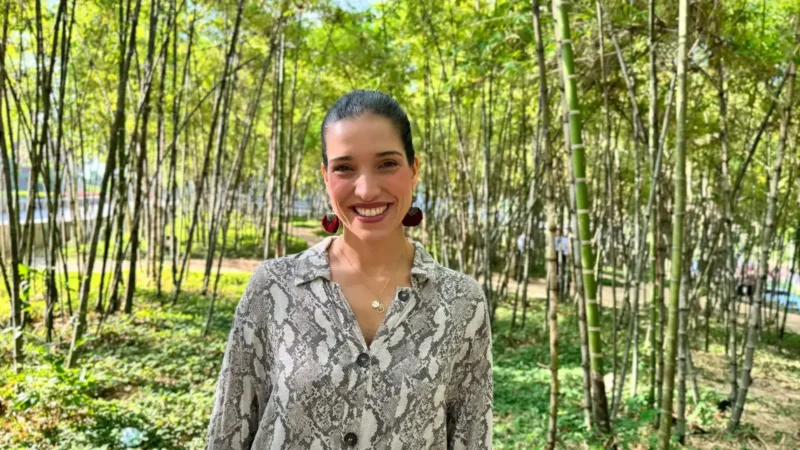
Cristina Zambrano, executive director of ACI Medellín. (Credit: ACI Medellín)
Loren Moss: You’re the new director of ACI Medellín, but you haven’t just begun. I mean, you’re very experienced already in the administration of the municipality of Medellín. Tell me a bit about the history, because, if I’m not mistaken, you started as ‘edil’ [public servant] of El Poblado in Communa 14, right?
Cristina Zambrano: That’s right. That’s right, Loren. Well, first of all, I want to thank you immensely for being here. Just like you said, I think this has already turned into a space that is very yours. And we truly thank you, from ACI, from the entity, from the district. Because it’s absolutely key and important for us to maintain a very close relationship with those great allies of the history and heart of this entity.
So, well, I’ll tell you a bit about myself. Indeed, “Paisa,” very “Paisa.” I was born, raised, and have lived almost my whole life here in this city. I say “almost my whole life” because I was abroad for a year and a half, living in London and Edinburgh. But for the rest, I have almost always worked for this city. I started my career path as a lawyer. I graduated from law school and began working at Bancolombia.
I think I was very focused at that time on the private sector, and it was the clearest path for me to follow my profession. However, while I was working at Bancolombia, my heart started beating harder for the public sector.
I remember one of the first conversations I had. My mom really belonged to the public sector. She was super, super close to the public sector, and she worked at the Compensation Fund, at public companies in Medellín, at SENA. So I believe she has always instilled in me a great love for what’s public. And the first conversation, with me working at Bancolombia, was with a person who was at the time the private secretary of the mayor at that time, David Escobar.
David Escobar was, at that time, like I mentioned, a private secretary, and the head of COMFAMA. He told me that he had also begun as an ‘edil’ in Communa 14, and asked why I wasn’t diving into public and political practices. And I said, “Hey, that’s interesting. I can continue working at Bancolombia, but I could complement a bit my work in the productive sector, with the public side.”
So that’s how I got started, and at that time I reached out and they introduced me to Mayor Federico. Federico was going into the Council of Medellín, and I accompanied him from Communa 14 as an ‘edil.’ So let’s say I started a journey that went from the public to the private, then went back to the public. But I’ve always said that my heart is very focused on the public world. And it’s been a wonderful trajectory, because I’ve had the best of both worlds, and I believe that throughout my whole professional career, I’ve come to realize how valuable it is to work with both sectors hand in hand. I’ve never been to the academy. But I think the other conversation that I’m missing is one to really understand the transformation process that this city has, which are the three players in addition to civil society.
Loren Moss: For me, with the eyes of a foreigner, something I’ve always seen as Medellín’s success was, First of all, the civil spirit that the ‘paisa’ pride has, the pride that the citizens have. Also, Medellín’s got a secret sauce. There’s been some hiccups recently, but historically the private sector has worked hand in hand with the public sector.
Here in Medellín, we’ve got some great powerhouses. You already mentioned Bancolombia. Obviously SURA, obviously Nutresa, Grupo Argos. And those are the great powerhouses of not just Medellín, but Colombia. But aside from that, aside from simply having this kind of source of income, and salaries, and taxes, businesses have had a sense of belonging, which has always supported the public sector. And
Something that fascinates me about Medellín is that ‑- not only in Colombia, but I have experience in many countries in Latin America, the Caribbean — and normally there’s a ‘Don,’ or a ‘patrón’ or a powerful family, or two.
As are the Garces of Monterrey, Mexico. Its not that they’re bad guys, bu it fascinates me that, in Medellín, that doesn’t exist. There are no ‘caudillos,’ no chiefs. It’s like, there are no families that have more than 1% of Bancolombia’s shares, of SURA’s, and that fascinates me.
So, tell me about the importance, for you who have gone through it, of bringing back that tradition of cooperation, including here as an Agency of Cooperation and Investment (ACI). In Cali, it’s West Pacific. In Bogotá, it’s Invest in Bogotá. But here it’s an Agency of Cooperation and Investment. Tell me about its importance and your goals for the next 4 years, or 3 and a half.
Cristina Zambrano: 3 and 10 months [Laughs.]
Loren Moss: Exactly! Returning to that topic, and besides that, what your main objectives and goals are in this position
Cristina Zambrano: Alright, great, Loren. So, just like you said, Medellín has had a big charm, because, well, let’s not forget that not many years ago I was here ‑- I believe all of us were — when Medellín was the most dangerous city in the world. And by most dangerous in the world I mean in the highest indexes of the most terrifying cities it would reach around 160 deaths per every 100,000 inhabitants. Medellín reached 380 deaths per every 100,000 inhabitants. I mean, it was a city that, in the words of many people from that time, they would basically say, “It’s a failed state. It’s a failed city.”
How did we manage to recover in what seems to me such a short amount of time? Because this was a very drastic transformation that Medellín has undergone, like I said, in what seems to me like a short time. And the only way we made it to where we are today is the teamwork, absolutely determined, of all the actors, right? I believe we were all struggling with such great difficulties. We couldn’t go any lower. We definitely had to look up. We came together and started working hand in hand. And let’s say in this entity, as such, that’s completely clear and it shows on the day to day and through our tasks, in how we manage all the projects the district of Medellín has, or its metropolitan area, which, as you know, CITRA works for its associates, and its associates are the district.
As a central entity, various public companies from Medellín, and the metropolitan area, which are all the other municipalities from the area. So, that’s how we, in our day-to-day lives, always have to work in favor of those strategic projects, which impacts all of us as an area — because I’m going a bit outside of Medellín — and it’s how we look for strategic allies, capable of carrying out those strategic projects that we have, right? That’s what we do. And we indeed, this entity is already 22 years old. I had the opportunity when we were in Federico’s previous administration, to become a part of his board of directors. So I hold it very close to my heart. At that time I was working as the director of public-private alliances.
And at this moment let’s say that it’s on a different field, since this is a much more international matter, right? The other one is work with the local or national productive sector on some specific infrastructure projects and other matters. But in this sense, it’s working with international allies, and it’s been absolutely wonderful what we’ve come across in the less than 2 months that I’ve been here. That’s how those networks, so well established, based on trust, have been very close to us for many years. Each time there are more networks that want in, and all the networks want to strengthen again some bonds of trust that perhaps were starting to deteriorate. But everyone is still here, and they still believe in this city and its development.
So we work with all those allies. We keep attracting investments.
As for real investment, I believe at the beginning this entity was set up when Medellín needed to change the face it had for the world. To change its image. And that job was so wonderfully done. So much so that now the investment comes on its own, yeah? I believe that’s a magnificent reality that we need to understand, and it’s that back then we had to go to convince and bring in these investors, sell them this city, tell them how great we were. But at the moment the reality is that investment comes more so on its own.
Now the world’s got its eyes set on Medellín. And I’ve been to a marvelous event with ProColombia, which is our natural ally in everything related to the attraction of investments. I was in Bogotá last week for two days of a super strategic work, with each one of the hosts they’ve got around the world, and everyone was telling me, “Sell to Colombia,” or “Colombia needs Medellín to be able to sell itself.”
It’s amazing how in the portfolio of how we sell Colombia, some regions have to appear in that map no matter what, because people immediately open their eyes and understand it. And that’s our job as ACI, as an entity. It’s about highlighting all those things we’ve been doing right, showing them and handing them over to all those allies, because they’re our ambassadors around the world. They help us attract investment, and I believe this city is now very well-established and clear on the fronts on which they’ve been working, doing good work. It’s been bearing fruit wonderfully, so we need to keep strengthening that. I’ll point out, for example, the Industry 4.0. No doubt, Medellín is already a district of science, technology and innovation.
Loren Moss: It’s known worldwide for that. And something you said fascinates me: last night I was having dinner with a US Embassy officer, and he was telling me that the embassy is based in Bogotá. But that all of them, if they could, would leave the embassy empty and move out to Medellín. Don’t you agree?
Cristina Zambrano: Yes. [Laughs.] That’s how they are…
Loren Moss: And there is no consulate here. There is one in Barranquilla, I think. Or on the coast. I’m not sure where, but what’s certain is that everyone wants to run away and move to Medellín.
Cristina Zambrano: That’s right.
Loren Moss: And it has its fame, but even then it’s very important to keep selling the city. It’s key because there’s a lot of competition.
Because there are other agencies that promote investments, there are other places. There are others like Costa Rica, which is also really well-established in the IT field. For example, there are already countries in the Caribbean, such as Jamaica, which is famous for its call centers, and Trinidad, in finances.
So, what is the importance of continuing to sell Medellín? Or continuing to attract, or to have incentive programs? Or, aside from that, simply to tell the story, because even though Medellín has already got fame, it’s not like everyone in the world knows. Some people are living under a rock or something.
Cristina Zambrano: Totally.
Loren Moss: But there are people thinking, “Yeah, OK, we know about Medellín. But we need to do our due diligence, we need to analyze. So, tell me about the role, the part ACI Medellín plays in that, and your vision regarding what you want to achieve by, I don’t know, in 2028. If we look back, in retrospect, to you, to define that this has been a success, what are the things you want to achieve?
Cristina Zambrano: Great. Well, indeed I think what you’re saying is true. There are so many cities in the world. Like I’m saying, each one of us has a different calling, and undoubtedly, each one has to continue strengthening, or pushing forward that name and that number of strategies that Medellín has. Medellín has a huge competitive advantage, and that is its institutionalism. Medellín as such is the second biggest public conglomerate in Colombia, after Ecopetrol.
Right? This means that when a company, an investor, a cooperator comes to us, they’re coming to the second biggest public conglomerate. We have a series of companies, because we’re talking about, I think, we’re over 35 companies taking part in the conglomerate. Each one with a role, each one with some kind of support that could be provided to that investor or that cooperator, each one with different opportunities. So, without a doubt, that’s an advantage we have. More so from the private standpoint, obviously, the work with the chambers of commerce.
The work with, for instance, compensation funds. Which is a figure that doesn’t exist in the world. An investor doesn’t yet understand so clearly why they have to provide that 4%.
Loren Moss: I can’t translate it! They are like well, “What’s ‘Caja de Compensación’?” “How do I explain it?
Cristina Zambrano: Compensation [Laughs.]
Loren Moss: What’s worse is that I’ve never seen this concept outside of Colombia. It’s like, I’m affiliated with COMFAMA. And they are like, “It’s not a syndicate?””No, it’s not a syndicate.” When I try to explain it to foreigners. “Well, it has like an amusement park, with a roller coaster, and it helps you buy a house,” and people are like, “What?”
Cristina Zambrano: [Laughs] And healthcare, and education, and they provide courses…
Loren Moss: And the hardest one is ‘cesantías’.
Cristina Zambrano: Yes.
Loren Moss: There’s no word, and it’s not translatable.
Cristina Zambrano: Yes.
Loren Moss: “And okay, what is ‘cesantías’?” It’s like a pension, but it’s not a pension…you use it like, when… [Laughs.]
Cristina Zambrano: Yes, yes, it’s complex. But see, that’s important, it’s interesting, because that private sector is several organizations, like I’m telling you, each one with a strategic role, and we are all absolutely interconnected with each other. And that’s very appealing to a future investor. And the investor knows they’re settling in a territory that’s not inventing many things. That is improving some with certainty, and that has many challenges to improve. But it is not making things up. And here each of us presents this ecosystem, and in one way or another people feel more at ease, like “Oh, these people are like, prepared.”
Well, as for what you were saying, I believe that here, understanding that we’re going to have some indicators in the development plan is key. Indicators that throughout many years of this entity have been very standard. Each time we need to increase them more, right? We start from a baseline and the idea is, obviously, to improve and surpass them. So, we have an amount of attraction of investment, which, right now is about $1,250 million USD, which is still under discussion, because you know that until we get the development plan approved, we still have two months left to discuss it, well, we’re not sure how the indicators are going to turn out.
We have an amount of attraction of cooperation, right? So we have no choice but to work for those purposes. But I think, answering your question: By going a bit beyond the indicators of a plan. As I was saying, this entity has been accomplishing them for many years, and let’s hope of course that we will be capable of accomplishing and surpassing them. But I believe here we have some really big goals, and it’s how we’re capable of, well, let’s say this entity when it was founded 22 years ago, like I told you it’s about to be, it was formed over a set period of time of 25 years. Therefore in the year 2027, this entity is to be reassessed, no matter what. Right? It’s obligated to be reconsidered, to take a look at what it’s been doing right, what could be improved, what needs to change. And it seems to me that this has been an entity that’s been absolutely key, counting with a very strong corporate government, because it is in charge of two really complex matters related to allies that are very much based on trust. It’s just that one-
Loren Moss: True.
Cristina Zambrano: It doesn’t draw in a cooperator overnight. Cooperation is a long-lasting affair. Cooperation is, just to give you an example, today we signed an agreement with public companies from Medellín. And the government of Copenhagen. This cooperation that was materialized today in the signing of an agreement, had been discussed for three years. So these very long-term relationships, or relationships with investors, which we’re already discussing; if they don’t count with an ecosystem, from the institutional point of view, with legal security, tax security, stability in many aspects, well, they’re simply not going to be settling here.
Those are two matters which are so key that the corporate government becomes way too relevant. This entity must be protected, right? So, because we have that goal or challenge, so big that it’s already been established for 2027, of revising this entity, I believe we need to start thinking about that starting today, right? About what we will become. About what Medellín needs. Over the course of 22 years, it has truly changed some things. Like I’m telling you, this entity was born with a purpose. It kept changing. Some additional matters started to be included according to how the world has been moving. So, at the moment we’re dealing with a very complex topic, and I don’t know how is it going to end, because I think we’re just starting to think which legal form this entity should have in order to continue being stable in its corporate government through the years. What strategic projects does it need to be focusing on to not be thinking of the city every four years, but instead long, long-term?
I’m telling you, both matters are very long-lasting. This number of matters turns us all into a work team. And I believe that as a district, as a conglomerate and as a metropolitan area, it makes us think of this entity as absolutely open to having whatever discussions are needed. With the private sector, national and international; with national and international cooperación; with everything regarding the Council of Medellín.
This is a public entity that will have to go through the Council of Medellín and through 21 councilors that have to approve whatever we propose should happen here. Of course, with the whole district, and the whole conglomerate, and each one of the entities. And because we can strengthen it each time, let’s say I realize more and more that at least in this administration, we are completely interconnected with one another; each one of us plays a role and is very clear on what we’ll be focusing on. All of us, and I mean all of us, from the secretaries’ point of view, even many of the directors of decentralized entities call me, very interested in getting ACI Medellín to provide them support in the execution of their strategic projects. So I believe we have to think big.
Loren Moss: You touched on a very important topic: trust. It’s important when the people trust the government, the agencies. It’s also important for foreigners. One thing when I talk to investors, to executives, they are afraid of going where there’s uncertainty, where there are scandals; where there’s drama.
When an experienced administration restores this trust, the investors think long-term: “Ah, is it safe to invest in Medellín?” Not in the sense that I’m going to get mugged or something like that. But safe in that I know for sure that our investment will be protected, will be stable, there won’t be a storm of scandals and stuff to the point our shareholders or our clients will ask us ‘Why are you there?”
It’s an extreme case, but look at what happened in Nicaragua. Nicaragua was kind of attracting many outsourcing companies, the BPOs. And then it all collapsed. And there were some companies, I remember talking with the executives, “What are you going to do?” And the executives were conflicted, “Look, I know that’s bad for us, but we don’t want to abandon our loyal employees either. Because if we go, they won’t have anything.”
Cristina Zambrano: That’s right.
Loren Moss: It’s an extreme case. But the thing is, people go “Look, we don’t need that drama, let’s go to another city in Colombia,” whenever things are rough here.
Cristina Zambrano: Definitely.
Loren Moss: But when there’s an administration with trustworthy people. When you see all the books with all the expenses. When you see that there’s a cooperative governance. When you can say,”What did ACI Medellín spend resources on? What did City Hall spend on?” And it’s not on, like, pet care. Not on, like, the sky. But on the things that the city needs. And believe me! Because our readers, our audience, are the foreign executives. Here in Colombia we already have analytic values, we have a portfolio.
But we and our readers are from abroad, who have assets in Colombia, who have investments in Colombia, and they wonder, and sometimes they ask us, “Hey, what’s going on with that?” It really matters to them. Companies think, “We don’t want to get involved in long-term projects, because later on…I don’t know, some crazy thing, or whatever, happens.”
And it’s something I discussed once, for instance, with some investors. “Why do you not take part in the tenders of, like, tunnels and stuff?” He replied, “Look at what’s happening now with the concessions with the tolls.”
Cristina Zambrano: Stalled.
Loren Moss: So what you’re saying is so important, to go to the conventions and to the conferences, the trips and all that. But as important as all of that is to have that governance and trust.
Cristina Zambrano: That’s right. That’s right, Lore. And, let’s say there is a very key, a very complex matter there. This trust is not easily acquired. This trust is relationships that take a lot, and it’s taken us a lot of effort as a city to work for them. The current mayor is a mayor who has earned trust over a trajectory.
I’m not just talking about the four years he had been mayor of this city already. I’m also talking about the other years as a councilor. I’m talking about his whole personal and family history, and a lot of other things. Thanks to all that today he has the trust of many. Obviously, us citizens who voted for him, we trust him.
As a national productive company that supports him, which is present to work hand in hand on international matters. I’ve realized personally how I see all the embassies are absolutely active, and I always ask the team, “Hey, is this normal? All the embassies want to be here?” “And all the councils want to have a meeting?”
Now everyone wants to. They tell me, “That’s not so easy, it’s not like that.” Ah…I’m overwhelmed because definitely everyone wants to have a spot with the mayor now. And that’s why I’m saying, that’s not something you accomplish on only four years.
Loren Moss: It’s the truth.
Cristina Zambrano: That has been achieved over a long period of time. That’s how it is with investment, and I believe that we as a city have known how to do it, and how to maintain it. Yesterday I was in a meeting, with the mayor, and he mentioned — I’m not sure anymore whether it was the ambassador of Denmark or of Israel — because we had four meetings in a row! But he told the ambassador, “there’s one thing of Medellín that’s really key: It’s the talent.”
Loren Moss: True.
Cristina Zambrano: “It’s the talent.” Right? So we started a discussion around this subject that is talent, and indeed, the people from this territory are talented and have proven it. And we had to live such a complex life story, so much so that now we are resilient, we are innovative, we are always running around. But we don’t give up so easily in the face of obstacles. This is something the private investment itself has realized, and they come looking for the talent, right?
Beyond the pretty mountains, the pretty landscape, and the marvelous weather, there are so many things here. And investors come looking for talent!
Loren Moss: And ‘berracos’ (talented people) I think is the Word.
Cristina Zambrano: Yeah!
Loren Moss: Because people here want to work. People here aren’t looking for free food, they’re looking for opportunities.
Cristina Zambrano: That’s right.
Loren Moss: They search for opportunities. “Which is the new company?” “Where can we work?” “Where are there opportunities?”
Cristina Zambrano: Indeed. And notice that the society itself is so nice because it’s when they see value in the things that both the private and the public sectors do. Right? Because both of us have to show ourselves to society, and show them the value of what we do in our day to day. And it’s the same society that in the future will demand the most from us, and the one that demands from us when we’re in the wrong too, right?
Loren Moss: Right.
Cristina Zambrano: Somehow, what you’ve been saying, which is related to the national government and everything that’s currently going on, and to the reforms, and the lack of resources and support for Antioquia, as such, has been a pretty, pretty complex matter.
Look how society itself starts demanding from the national government: “Why are you not looking at Antioquia?” “Why are you not going to finish the 4Gs?” “Let’s see where is the support for the tram on the 80, which you had already committed to?”
The whole society starts mobilizing in favor of a matter that, as you say, very ‘berracos.’ “We like working, and we like thriving and we like earning every one of the pesos we get with the sweat of our labor.
So I think that’s also reflected in the investment. It’s exactly the same. Let’s say those investors come, hire local talent, and realize that indeed there are some really interesting dynamics here, thanks to which we can work hand in hand. Surely some pretty complex challenges, but here we are in our day-by-day.
In an effort to promote responsible tourism development in Cartagena’s historic center and surrounding areas, the iconic Colombian coastal city has opened a new tourism center.
Known as the Casa del Consumidor Turista, and newly opened in March, this hub will serve as a center for various stakeholders to provide information to tourists, promote fair trade, and protect vulnerable populations who may be negatively affected by tourism, among other services.
The new location grew out of the combined efforts from Colombian Ministry of Commerce, Industry, and Tourism (MinCIT), the Superintendence of Industry and Commerce (SIC), and the Cartagena Tourism Corporation (Corpoturismo), which chose March as the time to open in the lead-up to the high-traffic Semana Santa week in the largely Catholic nation.
The new initiative is “part of a comprehensive strategy to promote responsible tourism in the city, where visitors have access to quality experiences and local communities find pathways to dignify their work,” said Commerce Minister Germán Umaña Mendoz when announcing the initiative.
The Casa del Consumidor Turista, which is located on the first floor of the district mayor’s office within the historic Walled City, will also work toward similar goals carried out by Cartagena’s existing Visitor Service Centers and devote resources to help resolve disputes and infractions related to tourism.
Arturo Bravo, Colombia’s deputy minister of tourism, added that they will continue to work to “attract events that promote the city with ethical tourism and the protect the cultural and natural heritage.”
(Photo credit: MinCIT)
This article, written by Gavin Voss, was originally published by InSight Crime, a Medellín-based foundation dedicated to the investigation and analysis of crime and security in Colombia and Latin America.
While security crackdowns are targeting Ecuador’s gangs in the streets, recent cases show that high-level government corruption has also become a massive obstacle in the fight against organized crime.
On March 15, Ecuador’s Attorney General’s Office presented evidence against 13 suspects in the so-called Metastasis Case (Caso Metástasis), which Attorney General Diana Salazar has described as “the largest in [Ecuador’s] history against corruption and drug trafficking.”
Suspects in the case include a former member of the National Assembly and a lead prosecutor for the province of Guayas, whose capital, Guayaquil, is central to the country’s drug trafficking economy.
The sweeping anti-corruption investigation is targeting a drug trafficking network once headed by Leandro Norero, a top ally of the Lobos gang before his murder in 2022. It was first announced to the public with raids of Ecuador’s Judicial Council, a body with the power to suspend and remove judges, in December 2023. Prosecutors initially targeted 30 people linked to Norero’s network, but the number of defendants has now reached 52.
Prosecutors allege that officials from Ecuador’s judiciary, legislature, and security forces received bribes through Norero via his lawyers and other intermediaries in exchange for helping him maintain his criminal empire while behind bars.
In addition, corrupt judges allegedly delayed money laundering cases against Norero’s siblings after receiving bribes, while police and prosecutors on Norero’s payroll passed him information about law enforcement crackdowns both inside and outside prison.
Norero also had links as high as the former president of the Judicial Council, who “planned to buy the decisions of the national magistrates” to achieve a favorable decision in a money laundering case against Norero’s brother, according to the Attorney General’s Office.
Metastasis’ findings have spawned other investigations. On March 5, the attorney general’s office announced Caso Purga (Purge Case), based on texts seized from the phone of a Metastasis suspect. Prosecutors are investigating a dozen judicial officials and lawyers associated with the judicial system in the province of Guayas, for links to organized crime and drug trafficking.
The counter-corruption offensive comes as President Daniel Noboa’s war on gangs moves into its third month. Noboa’s militarized response is widely popular and has resulted in a countrywide reduction in homicides. Still, concerns persist about criminality, especially in Guayaquil, where reports of extortion and kidnappings have dramatically increased this year, according to police statistics accessed by Ecuavisa.
InSight Crime Analysis
While most eyes remain on the fight on the streets, the Ecuadorian government’s real battle may be for control of the state.
Corruption has always existed in Ecuador, but recent cases signal an alarming escalation in its prominence, according to Melania Carrión, a security consultant and former government official specializing in prisons.
“Before, there were officials linked to the drug issue,” she told InSight Crime.
“But there was still respect for state institutions.”
In recent years, elements of the navy, police, and prisons authority have been accused of helping gangs move drugs, access arms, and maintain their criminal enterprises from behind bars. Corruption has also limited the impact of homicide investigations, while killings in the country have jumped from 5.7 per 100,000 in 2018 to 44.5 in 2023.
As part of an attempt to address corruption, Noboa announced the creation of a joint financial crime investigation unit on March 7. The measure will increase collaboration within Ecuador’s government to fight money laundering and other white-collar crimes. He also proposed a constitutional amendment that seeks to close a prominent legal loophole, which allows criminals to stall their trials. Ecuadorians will vote on the amendment at a referendum on April 21.
But even with these measures, government corruption in Ecuador remains a formidable obstacle to reversing the advances of criminal groups. Record quantities of cocaine are flowing through Ecuador, and InSight Crime estimates that just the Colombian cocaine entering the country may be worth nearly one billion dollars to criminal groups helping to store and transport it through the country. Lucrative extortion, kidnapping, and drug dealing markets further bolster gang coffers, providing criminal groups with the means to bribe officials and sometimes even bring them into their fold.
(Photo credit: Xavier Granja Cedeño – Cancillería Ecuador)
This article, written by Gavin Voss, was originally published by InSight Crime, a Medellín-based foundation dedicated to the investigation and analysis of crime and security in Colombia and Latin America.
 Empleobilingue.com

- Director/a de operaciones para hotel, restaurante y discoteca 1626320364.60 - Medellín, Medellin, Antioquia, Colombia
- Coordinador/a de calidad para La Unión 1626483143.1 - La Unión, Antioquia, Colombia
- Desarrollador fullstack - Bogotá, Bogota, Colombia
- Technical Analyst - Remote
- PIM Administrator - Ecommerce - Remote (Bogotá, Bogota, Colombia)
- Auxiliar de gestión humana y bienestar para Girardota 1626060072.28 - Girardota, Antioquia, Colombia
- Marketing Strategist
- Trainer Manager - Bogotá, Bogota, Colombia
- Tolemaida UH- 60 Inspector - Bogotá, Bogota, Colombia
- Virtual Assistant - Team Lead - Remote
Contact Us

