

















New York-based credit ratings agency Fitch Ratings downgraded key ratings of Colombia Telecomunicaciones S.A. E.S.P.’s (ColTel), citing the telecom’s strained credit metrics, negative free cash flow generation, and intense competition.
Specifically, Fitch Ratings set the following ratings for ColTel
- Long-Term Foreign Currency Issuer Default Ratings: BB+ (down from BBB-)
- Long-Term Local Currency Issuer Default Ratings: BB+ (down from BBB-)
- National Scale Rating: AA+(col) (down from AAA(col))
The big three ratings agency also downgraded ColTel’s $500 million USD notes (due 2030) to BB+ from BBB- as well as its local issuances of bonos ordinarios to AA+(col) from AAA(col).
Though controlled by Telefonica S.A. of Spain, the Colombian government owns roughly a one-third stake in the telecom, which provides mobile, broadband, television, and other services to consumers and enterprises.
“Although the Colombian government holds a 32.5% stake in ColTel,” stated Fitch in its ratings announcement, “it does not influence the company’s management, so the government’s involvement does not directly impact the ratings.”
ColTel’s net leverage hit 3.2x last year, per Fitch, which noted that it expects this figure to stay relatively steady over the next two years and close at around 3x by the end of 2025. While the firm also projects adjusted EBITDA to “improve modestly” this year to around COP 1.2 trillion (from COP 1.1 trillion), Fitch says it “anticipates that free cash flow will remain negative and be constrained by significant capital expenditures, including the renewal of spectrum anticipated for 2024 and 2025.”
This article, written by Juliana Manjarrés and Salvador Lescano, was originally published by InSight Crime, a Medellín-based foundation dedicated to the investigation and analysis of crime and security in Colombia and Latin America. (Photo credit: DEA)
A decline in drug trafficking in northern Colombia has led to a rise in extortion as increasingly fragmented criminal groups seek new sources of funding.
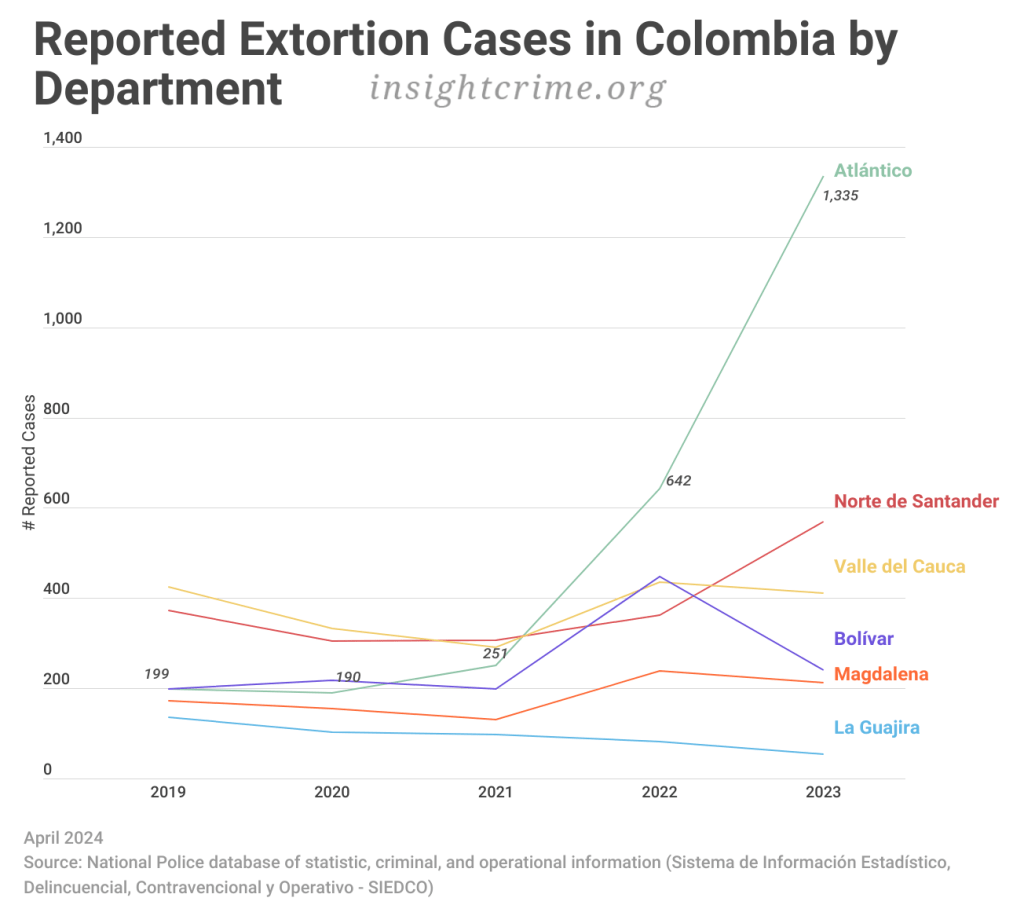
Reports of extortion in the department of Atlántico, Colombia, rose from 199 in 2019 to 1,335 in 2023 — a 570% increase — according to the national police database (Sistema de Información Estadístico, Delincuencial, Contravencional y Operativo – SIEDCO). The cases are concentrated in the metropolitan area of its capital, Barranquilla. The national police has sent hundreds of officers to help Barranquilla’s forces confront this issue.
The rise in extortion “primarily affects merchants, shopkeepers and transport workers,” said a report by the Peace and Reconciliation Foundation. According to the investigation, the criminal groups involved include the Gaitanistas – also known as the Gulf Clan, one of Colombia’s dominant drug trafficking groups – as well as smaller organizations such as the Costeños, the Pepes, and the Rastrojos Costeños.
Atlántico was the department with the highest increase in extortion complaints in the country over the last four years. Meanwhile, in other departments in northern Colombia, such as Bolivar, La Guajira, and Magdalena, as well as departments elsewhere with a significant criminal presence, such as Norte de Santander and Valle del Cauca, extortion complaints remained relatively stable.
InSight Crime Analysis
The increase in extortion in Atlántico is primarily the result of two factors: a reduction in cocaine trafficking during the COVID-19 pandemic and the fragmentation of criminal groups.
When cocaine trafficking decreased during the pandemic, smaller local criminal groups that acted as logistical operators for the Gulf Clan lost a significant portion of their revenues.
“They needed to replace those national revenues with local revenues,” Luis Fernando Trejos, a professor in the Political Science and International Relations department at the University of the North, told InSight Crime.
“When the quarantines were relaxed … local criminal organizations began to compete for the economies that were left standing,” he added.
Meanwhile, these local criminal groups also began to fragment.
“From the Costeños, come the Rastrojos Costeños, and then the Pepes. It’s no longer just one organization extorting, now others are competing for control of that income,” said Trejos.
Unlike large-scale drug trafficking, which requires an extensive network, smaller criminal groups can easily carry out extortion schemes, often using technology to reach and rob their victims.
“You don’t need huge numbers and territorial control. Just a small group — even two people on a motorcycle — who can pressure [victims] for the extortion payment, shoot at a business, or simply leave a note,” said Trejos.
This article, written by Juliana Manjarrés and Salvador Lescano, was originally published by InSight Crime, a Medellín-based foundation dedicated to the investigation and analysis of crime and security in Colombia and Latin America.
When President Gustavo Petro won the presidency, I suggested that Venezuela might prove an economic Black Swan for Colombia. Even though, so far, only a Grey Cygnet has been sighted — there is still time.
Photo: Colombian President Gustavo Petro speaking at the World Economic Forum Annual Meeting in 2023. (Credit: WEF / Boris Baldinger)
This week, Petro was in Venezuela with Nicolás Maduro — and oil and gas topped the agenda.
The gas pipeline from Venezuela has been out of action since 2014 and therefore needs extensive repairs. The cost has been slated at $7.8 billion USD, but Maduro says he is prepared to pay the price in order to re-initiate exports to Colombia. It seems a big price tag but, at face value, positive noises from Caracas are talking about a one-year timetable for the project once the finances are in place.
This is a little on the long end of the timing from the perspective of Colombia, which is short on gas with Ecopetrol and other companies facing up to the reality that there are no massive reserves that can be easily recovered. Nonetheless, Ecopetrol CEO Ricardo Roa announced that $360 million USD would be invested to increase production.
In the same sector, there was talk of Ecopetrol exploring for oil along the Venezuelan border in return for Colombia exporting energy to its neighbors.
Regarding overall trade between the two nations, according to Petro, figures are heading toward $1.2 billion USD in exports and $200-$300 million USD of imports. If true, those export figures would be up 78% on 2023 and fully 600% higher than the $196 million USD lows seen during the administration of former President Iván Duque years.
There are those who find it distasteful to do business with Caracas, but the height of cross-border trade ($6 billion USD in exports) occurred back in 2008, when Álvaro Uribe and Hugo Chavez were the respective president of Colombia and Venezuela, respectively — and they were hardly political bedfellows.
Neither Colombia or Venezuela has the luxury of ignoring one another when it comes to trade. If no one across the globe dealt with political foes, the world economy would grind to a halt very quickly.
In other news…
- Fedesarrollo reported another drop in consumer confidence for March to -13% (from -9.4% most recently). There was a difference in the sub-categories, with a decline in consumer outlook but a more optimistic view of the economy. As ever, Medellín (home of those ideologically opposed to Petro) was the least optimistic (at -45.6%).
- The World Bank lowered their GDP estimate for 2024 from 1.8% to 1.3%, after that they expect as snap back for 2025 (3.2%) and 2026 (3.1%).
- Water rationing has begun in Bogotá, with Mayor Carlos Fernando Galán suggesting it may last for a year. Me thinks this statement is more about getting usage under control than a sincere expectation.
- The Colombian peso has weakened marginally this week to reach the levels of around 3,800 to $1 USD (due to US inflation data).
- The health system remains a political football and we appear no closer to a resolution.
- As for the other reforms: Nothing to report, but a Natixis Investment Managers/GRI survey of 44 countries ranked Colombia’s archaic system at number 41. Still, there are those — currently sunning themselves and drinking cocktails at Asofondos de Colombia in Cartagena — suggesting it doesn’t need changing!
Never miss Rupert’s latest commentary
Follow him now on LinkedIn to see What Jumps Out
In this week’s Colombia Business News Recap for April 13, 2024:
Click above to watch the video
- Gringos gone wild! “Cannabis Jimmy,” Californian pot producer caught near Medellín.
- Colombian economic growth stalls, 277,000 jobs lost in January & February alone.
- Former President Alvaro Uribe’s prosecution moving forward under new attorney general.
- From 2018: Former Colombian President Álvaro Uribe Submits Resignation from Senate Amid Investigation
- From 2020: Breaking News: Former Colombian President Alvaro Uribe Under House Arrest
- Water rationing comes to major cities in Colombia due to serious drought conditions.
- Collective Mining (TSX: CNL) is finding more gold, copper & silver in its Apollo porphyry.
- US Ambassador Palmieri meets with Medellín’s Mayor Gutierrez & pledges full support against sexual predators and human traffickers.
- The Feria 2 Ruedas motorcycle convention returns to Medellín May 2-5, bringing commerce, fun & learning opportunities.
Subscribe free at https://fcsubscribe.com
Need to hire bilingual talent? Try EmpleoBilingüe! https://empleobilingue.com/
Update: James Landis responds.
We promised to provide an update if we hear from Mr. Landis and he provided us with the following statement:
I am innocent of the charges filed against me. I was and am not selling cannabis and was only doing educational tours to mostly Americans who visited our house. The charges against me are serious and I was set up by a bad person living in our house and he went to the police and made up all these lies about me being a drug trafficker , etc. None of that is true.
Medellín’s Mayor Federico “Fico” Gutierrez met this week with US Ambassador to Colombia Francisco Palmieri in Bogotá to discuss joint efforts against sexual predators and human trafficking. Ambassador Palmieri pledged the total cooperation of the US government and its resources to support Colombian law enforcement, and to bring any American perpetrators to justice, including extradition of American citizens to Colombia. Translation by Finance Colombia:
Click above to watch video
Ambassador Palmieri
Thank you Mr. Mayor for accompanying us today In this work, a work group that we have established, and I believe that we have advanced in many fields, in this effort against sexual exploitation and human trafficking. We are very thankful that we can work with your team.
Mayor Gutierrez
Many thanks Mr. Ambassador. This has been a very positive meeting. Protecting childhood has to be the most important. This alliance permits us to put forward maximum effort against sexual exploitation of children and adolescents. Against the human trafficking networks, and definitely we can combine forces. This will bring grand results, and as I say, this has a component of struggle, of control, but also of prevention, in which we are going to work as a team, and this is a fine message that we are sending together.
Ambassador Palmieri
We have listened very clearly that there is zero tolerance for these types of crimes, and count on us here in Colombia, working with your public forces, but also on our side in the United States to ensure that nobody can escape responsibility.
Mayor Gutierrez
I want that Medellín is converted into the example, not only for Colombia, and not only for Latin America, but for the world in the struggle against sexual exploitation of boys, girls, and teenagers. And I know that with your accompaniment, and that of your government, the US government and all those agencies, we are going to consolidate a good example of this collaboration for the entire world.
A great time was had by all, and the event, held on the rooftop lounge of Medellín, Colombia’s Marquée Hotel was full to legal capacity with entrepreneurs, investors, executives and enthusiasts eager to network and fellowship around the common themes of generative artificial intelligence and related technologies.
Click above to view the video highlights and performance!
Produced by
- Ben Yurcisin https://www.linkedin.com/in/benyurcisin/
- Frank Casale https://www.linkedin.com/in/fcasale/
Sponsored by
- Intu Global https://intu.global/
- Finance Colombia https://www.financecolombia.com/
Co-Chairs:
- Loren Moss https://www.linkedin.com/in/lorenmoss/
- Elkin Echeverri Garcia https://www.linkedin.com/in/elkin-echeverri-garcia-bb81505/
Musical guest: Spirokor https://chelistian.wixsite.com/website
Venue: Marquée Hotel https://marqueemedellin.com/


Photos: Liliana Padierna
The Simón Bolivar Foundation, a nonprofit foundation of US oil giant Citgo Petroleum Corporation, has extended its grant-sponsored partnership with the Texas Children’s Hospital and the Baylor College of Medicine Children’s Foundation Colombia to continue working together to support Colombians and Venezuelans in the department of La Guajira, one of the Andean nation’s poorest and least developed regions.
With this formal extension of their working relationship, the two organizations noted that they will continue to give special special attention to Venezuelan children and mothers as they work toward their larger mission to improve the health of vulnerable individuals affected by disaster, conflict, and poverty.

Micheal Mizwa of Texas Children’s Hospital (third from left), Mariela Poleo of the Simón Bolívar Foundation (in red on right), and others celebrate a funding milestone. (Photo: Simón Bolívar Foundation)
Overall, according to the organizations, they have impacted an estimated 7,766 migrants, mainly pregnant women and children, in this area of Colombia since 2022. Of the estimated 7.7 million Venezuelans who have migrated out of their home country during the past decade or so, nearly 3 million have hosted in Colombia, according to the UN Refugee Agency.
For 2024, the initiative will continue to focus on improving health and nutrition services, strengthening psychosocial support, increasing the capacity of health professionals and health workers, and meeting unmet basic needs, according to Ana Maria Galvis, executive director of Baylor College of Medicine Children’s Foundation Colombia.
The agencies say that extending and expanding the initiative will benefit nearly 10,000 more people, including around 1,600 children.
Michael Mizwa, director of Texas Children’s Global and CEO of Baylor College of Medicine Global Health, noted that this extension comes just as the organization marks its 10th anniversary of partnering with Baylor College of Medicine Children’s Foundation Colombia.
“This grant agreement…ensures the continuation of quality health care for these communities in La Guajira that are living in distress,” he said in a statement. “We can ensure the children, women, and communities served receive health care and nutritional services, capacity building for health workers and their basic needs are met.”
Mariela Poleo, president of the Simón Bolívar Foundation, added that continuing the work will help “address the complex humanitarian crisis in Venezuela” and expand “initiatives that improve access to medicine, nutrition, and healthcare for vulnerable populations in and from Venezuela.”
This article, produced by Henry Shuldiner, was originally published by InSight Crime, a Medellín-based foundation dedicated to the investigation and analysis of crime and security in Colombia and Latin America.
Photo: “El Mocho” of the AGC is one high-profile arrest by the Colombian police. (Credit: Policía Nacional de Colombia)
One of Colombia’s biggest criminal groups is expanding its reach, threatening to disrupt the government’s peace processes with other armed groups, a recent report found.
The report published by the International Crisis Group in March describes how the Gaitanist Self-Defense Forces of Colombia (Autodefensas Gaitanistas de Colombia – AGC) has become the largest armed group not currently involved in formal negotiations under the banner of President Gustavo Petro’s Total Peace (Paz Total) initiative. The report expressed concern that the AGC could interfere with and even sabotage other groups’ peace dialogues as they expand and fight for strategically valuable territory.
With about 9,000 members, the AGC is the largest group involved in drug trafficking in the country, earning additional income through arms trafficking, illegal mining, migrant smuggling, and extortion in many municipalities throughout Colombia’s Caribbean coast.
Petro has managed to start talks with some of the country’s other main criminal groups, including the National Liberation Army (Ejército de Liberación Nacional – ELN) and the Central General Staff (Estado Mayor Central – EMC) of the ex-FARC mafia. Recently, Petro announced negotiations with the Second Marquetalia (Segunda Marquetalia), another group of FARC dissidents.
Shortly after the report was published, Petro opened the door for a “legal negotiation” with the AGC, which the group publicly accepted under the condition that negotiations are a political process, similar to other groups involved in Paz Total, as opposed to a “sometimiento a la justicia” (submission to justice), which would potentially involve harsher criminal penalties.
InSight Crime spoke with the report’s author, Elizabeth Dickinson, about the potential for peace talks with the AGC as well as some of the report’s main findings:
InSight Crime (IC): Do you think the AGC is genuinely interested in participating in these dialogues?
Elizabeth Dickinson: Yes. The AGC has a disadvantage compared to other groups, as they remain outside ceasefire agreements. For example, in Sur de Bolívar, where the EMC, ELN, and AGC are fighting one another, the military is only targeting the AGC. This strategic constraint on the battlefield is probably their greatest short-term incentive to come to the table.
Two longer-term objectives are also driving the group’s willingness to enter talks. First, there’s a strong desire for legitimacy, which comes with having a seat at the negotiating table with the government. This group fundamentally does not understand why it is the only major armed group in Colombia outside the peace process. And considering the level of control and sophistication they’ve obtained in recent years, the leadership has a chip on its shoulder for not being included in these talks.
The second objective is judicial leniency. Successful peace talks could involve potentially reduced sentences in exchange for providing truthful testimony. Congress will need to establish the specific terms of this arrangement, but this proposition holds particular interest for members of the organization who are interested in finding a way out of this situation of perpetual violence.
The lower-level fighters within the group — young guys aged 18 to 24, who often joined seeking job opportunities — feel that the reality they’ve encountered is not what they anticipated. It is not necessarily a very happy life to live in the ranks of this group, exposed to violence, in difficult environments, and away from home.
That said, some level of noncompliance or criminal interests will continue among the “mandos medios,” the mid-level commanders, who may not have the same incentives to participate in the peace process.

IC: The AGC has perfected the practice of “monetizing territorial control” by profiting off all economic activity, licit and illicit, in areas where they are the dominant actor. Where is the group trying to expand its control and why?
Elizabeth Dickinson: If you look at a map, you can understand precisely why they’re expanding where they’re expanding. I would point to three areas.
The first one is the Pacific coast. This group is ambitious to control both coastlines because if one drug trafficking route is down, the other route is open, and there are many different international markets accessible from various routes. They also think this will dramatically increase their political leverage. From their stronghold in Urabá, Antioquia, they have expanded south through Chocó. They are now in Bajo Calima, across the bay from Buenaventura, and they will likely continue into Valle de Cauca, where their expansion is motivated by control of fluvial routes and access to extortion revenues from a very lucrative industrial economy outside of Cali, in Tulua and Buga.
The second focus is mining areas in Bolívar, Antioquia, and Cesar. These are very obviously linked to gold mining, a very attractive product for all armed groups in Colombia, particularly with the market for coca a little bit out of whack. They are systematically pushing the ELN out of its strongholds in mining areas in these places.
The last area of expansion, based on their strategic positioning, seems to be Catatumbo, Norte de Santander, home to the highest concentrations of coca crops, coal mining, palm oil production, and the vast numbers of crossings on the Colombia/Venezuela border. If they were to achieve that, they would dominate the corridor from the Venezuelan border, across the entire Atlantic coast, all the way down to the Pacific coast, an enormous strategic prize.
IC: In the report, you quote one AGC commander saying he envisioned the organization “maintaining its structure and illicit business activities, but just making them less violent.” How is that reconcilable with what the government wants in the long term?
Elizabeth Dickinson: In the short term, all armed groups in Colombia want to continue their armed control and their businesses while reducing violence. Under the previous peace commissioner, the government’s priority was reducing violence and dealing with the territorial control aspect at a later stage.
But if we’re demobilizing a group with as much territorial control as the AGC and as many roots in the economy, the state must be prepared to address the vacuums left behind. And today, that’s simply not possible. In negotiations with the various criminal groups, the planning must start now — from a military perspective, from an institutional perspective, and a services perspective.
IC: The AGC is one of several groups that split off from the United Self-Defense Forces of Colombia (Autodefensas Unidas de Colombia – AUC) when the coalition demobilized in 2006. What has made the AGC stronger and more resilient than other groups that emerged from that process, such as the Rastrojos?
Elizabeth Dickinson: To understand their expansion model, it is crucial to comprehend the organization’s structure. It comprises three branches: military, economic, and political. This structure goes down to the street level. In every town in AGC areas, the community can point to the guy who is the political head, the economic head, and so on. Their expansion involves building a social base, where they have a role in community organizations like the Community Action Boards (Juntas de Acción Comunal – JAC), and they control every aspect of the economy, with the threat of violence lingering in the background in case anyone doesn’t comply.
Another important factor was their relationship with the landowners. A portion of the political and economic classes prefer to live with this group rather than risk exposure to unknown actors, like the ELN, the EMC, or criminal organizations. Those landowner networks have been fundamental for this group’s survival because, in moments of economic scarcity, the landowners would step in and front AGC members’ salaries for a month or two while they got back on their feet.
The other thing that is quite different from groups like the Rastrojos or some urban gangs is that the AGC is not urban. This is a fundamentally rural organization. They have strategically chosen not to make cities their priority. This is not an organization inside Barranquilla. They’re sitting on the perimeter, letting the gangs in the city fight it out while they wait for a winner to decide who to work with. Existing mainly in the countryside has helped them avoid scrutiny and security operations.
IC: After the capture of Dairo Antonio Úsuga, alias “Otoniel,” in 2021, the group’s new leader, Jobanis de Jesús Ávila Villadiego, alias “Chiquito Malo,” has tightened his grip on the organization, according to the report. How has the group’s structure changed with this change of leadership?
Elizabeth Dickinson: One way this group expanded was through a franchising model, which is still part of the organization’s DNA. At a local level, commanders have autonomy over extortion and low-revenue criminal economies, bringing in money for their specific bloc or front. But the big games like drug trafficking and mining are run by the Estado Mayor (central command).
When Otoniel was captured, there were some questions about whether this organization would even stay together. So Chiquito Malo took an aggressive stance towards consolidation, sending several envoys across the region to negotiate with the different fronts and bring them all on board. He’s also replaced local and mid-level commanders across the region in cases where the envoys were not enough to get them on board with the structure.
IC: The market for coca leaves remains inconsistent throughout Colombia, with prices varying considerably by region. However, the report found prices in AGC territory remained stable. How has the AGC achieved this despite falling prices in areas controlled by other groups?
Elizabeth Dickinson: There are a few hypotheses. The buyer relationship is the most powerful explanation of what’s happening in the market. The AGC has a consistent buyer relationship with international cartels, principally the Sinaloa Cartel on the Atlantic coast, but also with European organized crime. In a situation of oversupply, like we now have in Colombia, where there is too much coca, it’s a buyer’s market, and the buyers get to choose who they work with. And the AGC has essentially won that buyer’s market.
The AGC has a few advantages that make it the obvious candidate. First, its territories are consolidated. They are the only ones participating in drug trafficking in areas they control. So, when traffickers enter an AGC area to buy coca or organize a shipment, they’re not worried, for example, about which group controls the exit routes that specific day. By contrast, in Nariño, one trafficker might have to pay four different extortion fees because there are so many groups present.
The second advantage they have is transportation. The infrastructure on the Atlantic coast is vastly superior to that in southern Colombia. The Atlantic coast has the Troncal del Caribe highway, significant ports in Barranquilla and Cartagena, and developed fluvial routes.
Third, the AGC has been able to penetrate security forces at a local level — and it’s very much at the local level, not systematic. We are talking about an organization that can buy off specific police and military officials, making them very consistent suppliers.
Fourth, because they’re so successful in the cocaine business, they have tons of capital. If a shipment gets lost, the AGC will guarantee payment to the buyer. This also helps explain why coca prices have been stable because even if the market price has dropped, the AGC has the money to say, we’ll just pay our coca growers slightly more because it will keep us popular in these areas.
This interview has been edited for clarity and fluidity.
This article, produced by Henry Shuldiner, was originally published by InSight Crime, a Medellín-based foundation dedicated to the investigation and analysis of crime and security in Colombia and Latin America.
New York-based ratings agency Fitch Ratings recently affirmed its key ratings of Colombian utility Interconexión Eléctrica S.A. E.S.P. (ISA) due to a low business risk profile, manageable regulatory risk, and indebtedness that matches expectations, among other factors.
Specifically, the big three ratings agency affirmed the following ratings for ISA:
- long-term national rating at AAA(col) with a stable outlook
- short-term national rating at F1+(col)
- bond program rating at AAA(col)
- commercial paper program rating F1+(col)
- issuer default rating (IDR) in both foreign and local currencies
Fitch noted in its accompanying statement that the IDR ratings, in particular, “reflect the company’s low business risk profile, which is characteristic of the power transmission business.” All the current ratings, the agency says, “take into account the strong geographic and business diversification of its revenue stream which, together with the high predictability of its operating cash flow.”
The company’s outlook is also aided by a strong credit profile, adequate liquidity and aggressive growth strategy, according to Fitch.
Fitch Ratings added that it “considers ISA’s business and financial profile to be strong enough to rate it two notches above its owner, Ecopetrol S.A.,” while noting that “ISA’s ratings to preserve the two-notch spread” would be impacted if Ecopetrol faces a negative ratings move.
“The ratings reflect ISA’s low business risk profile, derived from its stable and predictable cash flow generation, a characteristic of electric transmission companies, where approximately 80% of the company’s EBITDA generation comes from the electric transmission business over the rating horizon,” stated Fitch Ratings.
“The rest of the EBITDA generation is mainly concentrated in concession roads, with operations in Colombia and three in Chile, which include a compensation mechanism that extends the concession period or offers a minimum revenue guarantee in case the concessions register low traffic volumes. The agency estimates that the telecommunications business accounts for less than 3% of the company’s consolidated EBITDA.”
Fitch Ratings has upgraded Cementos Argos, S.A.’s long-term national ratings to ‘AA+(col)’ from ‘AA(col)’, following the resolution of the Positive Watch. This upgrade applies to the following:
- Issuance of Ordinary Bonds for COP $640,000 million
- Program for the Issuance of Ordinary Bonds and Commercial Papers for up to COP $3.0 trillion
- Program for the Issuance of Ordinary Bonds and Commercial Papers for up to COP $2.0 trillion
The Long-Term Rating Outlook is Stable. The short-term national rating for the Ordinary Bond and Commercial Paper Issuance Programs was affirmed at ‘F1+(col)’.
The upgrade reflects the anticipated strengthening of Cementos Argos’ capital structure and enhanced financial flexibility due to the use of USD1.2 billion from a transaction with Summit Materials for debt repayment. Fitch projects the company’s gross and net leverage to approach 2x by 2024. Despite reduced geographic diversification from deconsolidating its U.S. operations, Cementos Argos’ profitability, reduced financial expenses, and reallocation of capital to more profitable operations are expected to support operating cash flow generation. The company’s non-controlling investment in Summit Materials provides exposure to the U.S. market, contributing to its financial flexibility.
Key Rating Factors:
Strengthened Capital Structure: Cementos Argos received approximately USD$1.2 billion from its transaction with Summit Materials (NYSE: SUM), earmarked for debt repayment. By 2024, debt payments are expected to total COP4.7 trillion, reducing the company’s debt from COP6.9 trillion at the end of 2023. The reduction in debt is expected to lower short-term debt maturities, spread out long-term amortizations, and maintain leverage near 2x.
Lower Leverage: Cementos Argos’ net leverage was 2.4x at the end of 2023, supported by favorable operating results. The transaction with Summit Materials allowed for U.S. asset monetization and debt repayment. Fitch forecasts that leverage will remain close to 2x through 2024, supported by stable EBITDA and moderate debt requirements.
Geographic Concentration: The deconsolidation of U.S. operations has reduced the company’s geographic diversification, concentrating operations in Colombia and Central America and the Caribbean (CAC). These regions are expected to account for approximately 58% and 42% of EBITDA, respectively. While this increases exposure to regional economic cycles, the expected improvement in profitability, stable EBITDA, and stronger capital structure should offset the risks.
Financial Flexibility: The non-controlling 31% stake in Summit Materials provides exposure to the U.S. market and supports financial flexibility. Cementos Argos has implemented cost and productivity efficiency programs, which are expected to improve its cost structure and profitability.
Negative Free Cash Flow: Fitch projects that operating cash flow (FCO) will remain stable, averaging COP730,000 million annually from 2025. However, due to demanding dividend payments and share buybacks, free cash flow (FFL) is expected to remain negative, with a margin of approximately -4%.
Competitive Position: Cementos Argos remains a leading producer of cement and concrete in Colombia and Central America. The company holds significant market shares in Colombia, the Dominican Republic, Panama, and Honduras.
Rating Derivation:
Cementos Argos has a more robust business and credit profile compared to Ultracem, S.A.S. (rated A(col) with a Negative Outlook) due to its broader geographic presence and lower leverage. However, compared to Colombina S.A. (rated AA+(col) with a Positive Outlook), Cementos Argos’ business profile is more vulnerable to economic cycles, although this is partially offset by its stronger capital structure.
Key Assumptions:
- Deconsolidation of the U.S. operation in 2024 and investment registration via the equity method.
- Debt repayment totaling USD1.2 trillion, with USD700 million for U.S. debt and USD500 million for Colombia.
- Annual cement sales volume growth in the low single digits between 2024 and 2027.
- EBITDA margin near 22%.
- Average exchange rate of COP4,152 per USD1 for the projection period.
- Capex and dividend distribution aligned with management projections.
- Share buybacks between 2024 and 2026 totaling approximately COP450,000 million.
Rating Sensitivity:
Negative/Downgrade Factors:
- Net debt-to-EBITDA leverage exceeding 2.5x on a sustained basis.
- Liquidity levels below 1x.
- Equity investments or debt-financed acquisitions that weaken the credit profile.
- Dividend distributions or value extraction mechanisms that increase leverage and pressure FFL.
Positive/Upgrade Factors:
- Greater geographic diversification of EBITDA generation.
- Sustained net debt-to-EBITDA leverage below 2x.
- Liquidity consistently above 1.5x.
- Interest coverage above 6.5x.
- Positive FFL generation throughout the cycle.
Liquidity:
The transaction with Summit Materials has improved Cementos Argos’ liquidity by reducing short-term debt concentrations. The remaining debt is primarily in long-term bonds with amortizations spread over time. The company’s stake in Summit Materials, a New York Stock Exchange-listed company, also supports financial flexibility. Cementos Argos maintains uncommitted credit quotas of COP2.5 trillion.
Issuer Profile:
Cementos Argos is a nearly 90-year-old company specializing in cement, concrete, and aggregates production in Colombia and CAC. Following the integration with Summit Materials in 2024, the company deconsolidated its U.S. operations, which accounted for 55% of EBITDA in 2023.
Criteria Applied:
- Corporate Finance Rating Methodology (December 22, 2023)
- National Scale Grading Methodology (December 22, 2020)
- Parent-Subsidiary Rating Link Methodology (July 13, 2023)
 Empleobilingue.com

- Director/a de operaciones para hotel, restaurante y discoteca 1626320364.60 - Medellín, Medellin, Antioquia, Colombia
- Coordinador/a de calidad para La Unión 1626483143.1 - La Unión, Antioquia, Colombia
- Desarrollador fullstack - Bogotá, Bogota, Colombia
- Technical Analyst - Remote
- PIM Administrator - Ecommerce - Remote (Bogotá, Bogota, Colombia)
- Auxiliar de gestión humana y bienestar para Girardota 1626060072.28 - Girardota, Antioquia, Colombia
- Marketing Strategist
- Trainer Manager - Bogotá, Bogota, Colombia
- Tolemaida UH- 60 Inspector - Bogotá, Bogota, Colombia
- Virtual Assistant - Team Lead - Remote
Contact Us

