Previous Story

Bancolombia: Colombia Inflation Rises to 5.3% Under Indexation Pressures
Posted On February 14, 2026
Comment: Off
The bank’s analysts say that the increase still doesn’t include the effects of Gustavo Petro’s 23% decreed increase in the country’s legal minimum wage.
According to a report by the Economic, Industry & Market Research Area of Bancolombia (BVC: BCOLOMBIA, NYSE: CIB), annual inflation in Colombia rose by 25 basis points to 5.35% in January 2026. This monthly increase of 1.18% represents the highest inflation level since October 2025.
The data, originally prepared by the National Administrative Department of Statistics (DANE), indicates that 70% of the January inflation print was concentrated in the services and regulated components. These two sectors contributed 83 basis points of the total 118-point monthly increase, largely driven by the initial stages of annual cost pass-throughs associated with high indexation.
Businesses should prepare for more intense inflationary pressures in February and March 2026 as the full impact of the minimum wage increase and renegotiated supplier contracts take effect.
Sectoral Impacts and Service Acceleration
Annual inflation in the services category accelerated by 40 basis points to reach 6.33% in January, its highest level since April 2025. The monthly variation of 1.18% in this sector was nearly double the historical January average of 0.63%.
Bancolombia analysts attribute this acceleration to early adjustments linked to the 23% minimum wage increase for 2026 and indexation to previous years’ inflation. Notable increases were observed in:
- Full-service restaurant meals: 3.36%
- Prepared meals consumed outside the home: 2.38%
- Domestic services: 5.16%
- Imputed rent: 0.43%
The regulated group also saw an acceleration, with annual inflation rising to 5.47% from 5.40%. This was primarily explained by adjustments in urban transportation, vehicle fuels, natural gas, and tolls.
Food and Goods Price Momentum
Annual food inflation edged up slightly to 5.10% from 5.06%. Perishable foods saw an acceleration to 4.69% due to seasonal and supply factors affecting products such as tomatoes, potatoes, and plantains. Processed foods, including beef, milk, and poultry, reflected early-year cost pass-throughs, though annual inflation in this sub-group eased to 5.23%.
The goods category reached its highest level since March 2024, at 2.93%. Price hikes in this segment were driven by new taxes on alcoholic beverages enacted under the economic emergency, as well as pharmaceutical products. Conversely, price declines were noted in personal hygiene products, vehicles, and appliances, benefiting from the recent appreciation of the exchange rate.
Monetary Policy Implications and Forecasts
The Central Bank of Colombia (Banco de la República) faces continued challenges in converging toward its 2% to 4% target range. Core inflation, excluding food and regulated items, reached its highest level since November 2024, indicating persistent upward pressure.
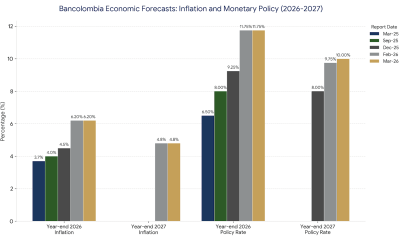
Bancolombia forecasts that year-end inflation will reach 6.4%. The analysts suggest that the full impact of the minimum wage increase has not yet been reflected in consumer prices, as many firms are still operating with inventories purchased at previous cost levels.
Consequently, the Central Bank is expected to continue raising its monetary policy rate to anchor inflation expectations. Bancolombia anticipates the policy rate could rise to 11%, noting that the challenging outlook introduces a hawkish bias to future decisions.
Photo courtesy Bancolombia