Previous Story
Frontera’s Cartagena LNG Terminal Reaches 71% Completion as Continuing-Operations Profit Falls By a Third
Posted On November 17, 2026
Comment: 0
Tag: adjusted EBITDA, Arabian Gulf, barú, Bay of Cartagena, bolivar, break bulk, calgary, cartagena, colombia, Containers, crude oil pipeline, ecopetrol, el niño, Excelerate Energy, Frontera Energy, FSRU Express, gas rationing, liquefied natural gas, liquefied petroleum gas, llanos basin, lng, lpg, María Nohemí Arboleda Arango, Ministerio de Minas y Energía, natural gas deficit, natural gas imports, ODL, Oleoducto de los Llanos Orientales, Orlando cabrales segovia, Parex Resources, Petromil, port infrastructure, Primax, Promigas, puerto bahia, regasification, roll-on/roll-off, roro, Royal Vopak, Sociedad Portuaria El Cayao, Sociedad Portuaria Puerto Bahía, SPEC LNG, Strait of Hormuz, take-or-pay, thermal power generation, third quarter 2026 earnings, Trafigura, Unocorp, UPME
A Second Cartagena Gas Import Terminal Nears Start-up
Frontera Energy Corporation (TSX: FEC) (OTCQX: FECCF) reported on November 11, 2026, that the liquefied natural gas (LNG) regasification terminal it is building at its Cartagena port is 71% complete and remains on schedule to begin operating in February 2027. Adjusted EBITDA for the third quarter reached $34.8 million USD, a 16% increase over the same quarter of 2025, and the Calgary company recorded net income attributable to equity holders of $11.7 million USD, or $0.17 USD per diluted share.
That profit is 33% below the $17.6 million USD the same continuing operations generated a year earlier, and 54% below the $25.4 million USD Frontera reported for the third quarter of 2025 including the businesses it has since sold. Adjusted EBITDA margin narrowed to 62% from 66%, and general and administrative expense rose 70% year over year, to $4.0 million USD from $2.36 million USD.
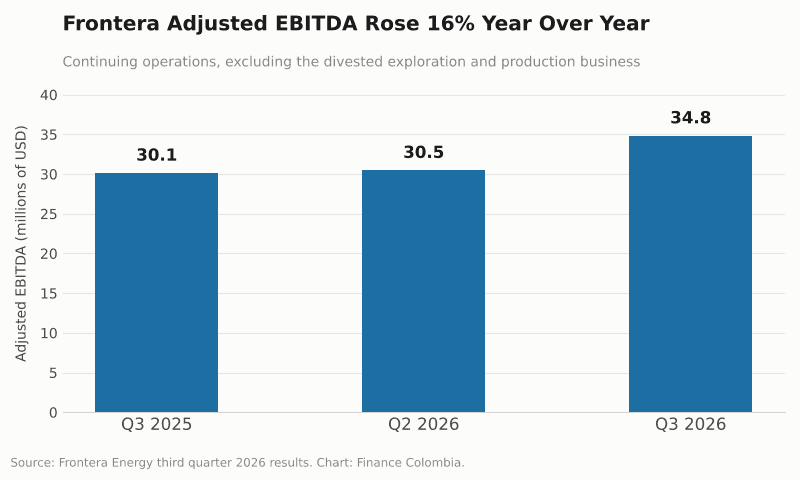
Adjusted EBITDA reached $34.8 million USD in the third quarter of 2026, up from $30.1 million USD a year earlier. (Chart: Finance Colombia, data from Frontera Energy)
Frontera Kept the Pipeline Stake and the Port
Shareholders approved the sale of Frontera’s Colombian exploration and production portfolio to Parex Resources Inc. (TSX: PXT) (OTC: PARXF) on April 30, 2026. The transaction closed on June 1, 2026, at an implied value of $750 million USD. Frontera returned $8.34 CAD per common share, roughly $430 million USD in aggregate, and retained $64 million USD, of which $39 million USD was allocated to growth projects at the port.
Frontera retained two assets: a 99.97% interest in Sociedad Portuaria Puerto Bahía, a multi-purpose marine terminal in the Bay of Cartagena, and a 35% equity interest in Oleoducto de los Llanos Orientales S.A., the crude pipeline known as ODL. The quarter carried no income from discontinued operations.
ODL Equity Income Tops Port Revenue
ODL contributed $17.2 million USD of equity income, slightly more than half of Frontera’s $33.0 million USD in total revenues and other income for the quarter. Volumes averaged 242,078 barrels per day, essentially flat against the 241,958 barrels per day of a year earlier, and the average transportation tariff edged up to $4.90 USD per barrel from $4.83 USD. On a 100% basis ODL revenue rose 20%, to $115.4 million USD, with pipeline transportation services up 8%, to $94.2 million USD, and the line Frontera reports as other revenues rising to $21.1 million USD from $8.3 million USD. Frontera attributed ODL’s net income contribution to higher pipeline transportation revenues and to variances in the mark to market of risk management contracts.
ODL declared $69.9 million USD of distributions to Frontera during 2026, against $61.5 million USD for all of 2025, of which $52.4 million USD had been received by September 30, 2026.
Roll-On/Roll-Off Units Rise as Liquids and Containers Fall
Puerto Bahía produced $15.6 million USD of Colombian port revenue, up 30% year over year. General cargo accounted for all of the increase, bringing in $9.84 million USD against $6.17 million USD, a 60% rise, after handling 49,575 roll-on/roll-off units, 37% more than the 36,303 units of the third quarter of 2025. Break bulk volumes rose 62%, to 15,303 tons or cubic meters, though over nine months they are down 11%, to 51,718 from 58,162.
Liquids revenue was flat year over year at $5.75 million USD against $5.79 million USD, and down from $6.48 million USD in the second quarter, as throughput fell 17% year over year and 18% quarter over quarter, to 32,724 barrels per day. Nine-month liquids throughput is down 24%, at 36,501 barrels per day against 48,096. Container traffic dropped 58% year over year, to 2,576 twenty-foot equivalent units. Frontera describes container traffic as one of the general cargo terminal’s largest growth opportunities and puts existing handling capacity at roughly 42,000 TEUs a year.
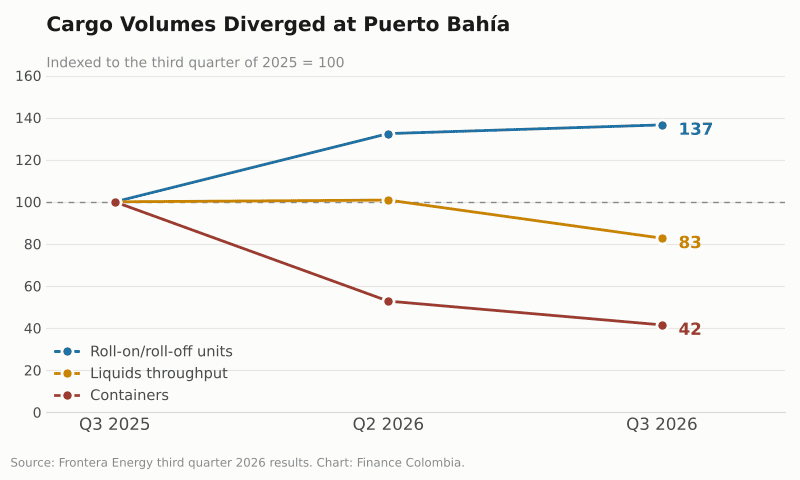
Roll-on/roll-off units rose 37% against the third quarter of 2025 while liquids throughput fell 17% and container volumes fell 58%. (Chart: Finance Colombia, data from Frontera Energy)
Four of the terminal’s eight storage tanks went under take-or-pay during the quarter, initially for fuel oil and other fuels. So did roughly 10,000 barrels per day of additional diesel and fuel oil imports, under short-term agreements with Primax, Unocorp, Trafigura and Petromil that Frontera attributes to heavier thermal power generation under El Niño.
The Vessel for Cartagena Has Not Been Named
Capital expenditures reached $19.5 million USD in the quarter, five times the year-earlier figure, and $17.7 million USD of that went to the LNG project. Frontera listed jetty modifications, including the civil works tying the jetty into the gas pipeline system, access platforms, mooring and balcony systems, and other equipment supporting the floating unit’s operations among the quarter’s spending. It puts total project cost at $80 million USD to $100 million USD, and says the build benefits from repurposing the existing connection to the Cartagena refinery for natural gas.
“Additionally, we will soon launch an open process to identify incremental third-party LNG volumes.” — Orlando Cabrales Segovia, chief executive officer, Frontera Energy Corporation
The commercial structure rests on a two-phase take-or-pay agreement with Ecopetrol S.A. (BVC: ECOPETROL) (NYSE: EC) for 126 million cubic feet per day from February 2027, rising to 300 million cubic feet per day after the first two years. The agreement Puerto Bahía signed with Excelerate Energy, Inc. (NYSE: EE) gives it access to a floating storage and regasification unit with capacity of about 500 million cubic feet per day, roughly four times the first-phase commitment, on an initial seven-year term extendable by a further five to eight years. Frontera ties the open process to that spare capacity and to Colombia’s widening supply deficit.
Neither company has named the unit that will serve the terminal at start-up. The contract contemplates redeploying the FSRU Express, but Excelerate said in its own third-quarter results, published November 5, 2026, that the conflict in the Arabian Gulf has led it to expect to use other units in its portfolio located outside the Gulf in the near term, eliminating the need for a vessel to transit the Strait of Hormuz. Frontera’s risk disclosures name the possibility that Excelerate does not deliver within the anticipated timelines, or that the unit provided in the near term does not meet the appropriate technical specification.
LPG Moves to a Second Phase and a Power Plant Enters Evaluation
Liquefied petroleum gas (LPG) handling, which began in March 2026 with capacity of up to 10,000 tons a month, more than tripled quarter over quarter to 13,792 tons. A 29,500-ton refrigerated storage facility has gone to engineering, procurement and construction contract, with Frontera targeting 2028 operations for the second phase. The company is separately evaluating a thermal power plant of 150 to 300 megawatts anchored by the LNG terminal, which it says would need firm energy obligations, environmental permits, regulatory approvals including from the Unidad de Planeación Minero Energética (Mining and Energy Planning Unit, UPME), and take-or-pay commitments sufficient to support a final investment decision.
Colombian Gas Production and Reserves Have Fallen
Imports covered 41% of Colombian gas demand at the close of October, Minister of Mines and Energy María Nohemí Arboleda Arango said in remarks La República reported on November 6, 2026. Roughly 75% of that imported volume goes to power generation, the minister said. Portafolio, reporting her diagnostic of the sector, put proven gas reserves at the equivalent of 5.9 years and national gas production down an estimated 34% between 2019 and 2026, against a 17% decline in oil. Finance Colombia reported in July that proven reserves have fallen 54% since 2018.
The country’s only regasification terminal in operation is Sociedad Portuaria El Cayao, known as SPEC LNG, at Barú in the Bay of Cartagena, owned 51% by Promigas (BVC: PROMIGAS) and 49% by Royal Vopak (Euronext Amsterdam: VPK). Its capacity had risen from 475 to 533 million cubic feet per day days before a fault in one of its four regasification trains cut it back to 400 million, El Universal reported. The Ministerio de Minas y Energía (Ministry of Mines and Energy) declared scheduled gas rationing in Resolution 40585 of October 26, 2026, and Portafolio reported full capacity restored on October 31, 2026. The ministry had also declared rationing in late September, after an earlier contingency at the same terminal, Forbes Colombia reported.
Frontera held $83.9 million USD of cash and $191.1 million USD of total debt and lease liabilities at September 30, 2026. Net debt fell to $107.2 million USD from $159.8 million USD a year earlier, taking leverage to 0.88 times trailing adjusted EBITDA from 1.43 times, and last twelve-month infrastructure distributable cash flow reached $87.0 million USD. Nine-month adjusted EBITDA stands at $93.8 million USD, within $16.2 million USD of the top of the $110 million USD to $120 million USD full-year range Frontera guided to in its June closing release, before either of the two quarters it has reported since.
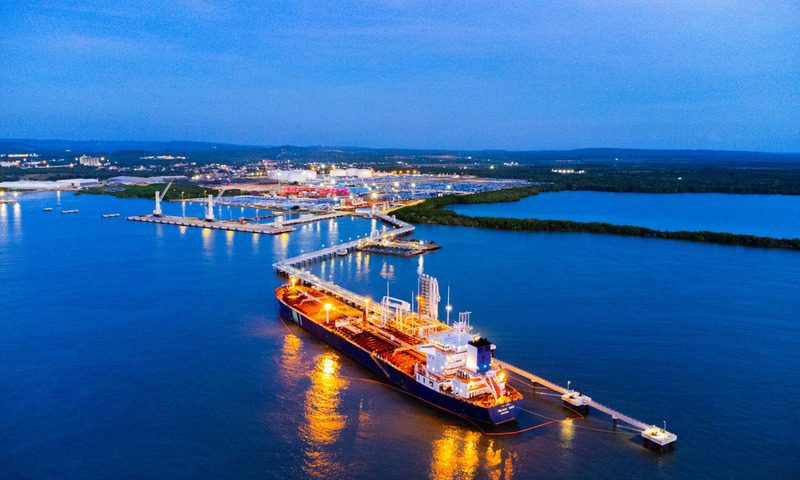
Headline photo: A tanker lies alongside Puerto Bahía’s liquid jetty in the Bay of Cartagena at dusk, with the general cargo terminal and storage tanks behind it. (Photo courtesy Puerto Bahía)