Previous Story
Colombian Senate Committee Advances Emirates Trade Pact as Senators Question Gold Traceability
Posted On November 17, 2026
Comment: 0
Tag: abelardo de la espriella, abu dhabi, agro-industry, air services agreement, Analdex, beef exports, Bill 266 of 2026, bogotá, Brasilia, Centro Democratico, CEPA, Chamber of Representatives, chile, Chile UAE CEPA, coffee exports, colombia, Colombia UAE trade agreement, Colombian Congress, Colombian Exports, Comisión Segunda, Comprehensive Economic Partnership Agreement, Constitutional Court, dane, double taxation convention, Dubai, Emirates airline, fiscal impact analysis, flower exports, Foreign Investment., free trade agreement, germán umaña mendoza, gold, gold traceability, Gustavo Petro, Honorio Henríquez, illegal mining, Iván Duque, Law 2246 of 2022, Law 819 of 2003, Manufacturing, Mauricio Gómez Amin, Middle East trade, MinCIT, Ministry of Commerce Industry and Tourism, non-monetary gold, páramos, price band mechanism, rules of origin, Sandra Carvajal Sáenz, Senate of Colombia, Sentencia C-126 de 2023, Sentencia C-170 de 2021, Sentencia C-175 de 2023, Servicio Nacional de Aduanas, Tariffs, Thani bin Ahmed Al Zeyoudi, Tourism, trade surplus, united arab emirates
Duty-free access hinges on Congress, the president and the Court
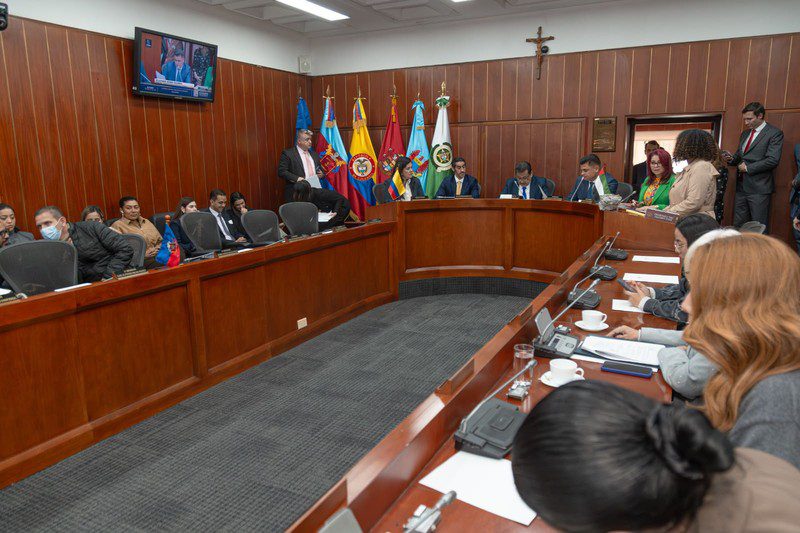
A committee of Colombia’s Senate of the Republic has taken the first of the four congressional votes required on the Comprehensive Economic Partnership Agreement, or CEPA, between Colombia and the United Arab Emirates. The Comisión Segunda (Second Committee), which handles foreign relations and foreign trade, approved the ratifying bill in first debate on November 4, 2026, in a 9-2 vote, and the measure now goes to the full Senate for a second debate. Once the agreement is in force, 85% of Colombian products would enter the Emirati market duty-free immediately, according to the Ministerio de Comercio, Industria y Turismo (Ministry of Commerce, Industry and Tourism).
Two Colombian government offices date the vote differently. The Senate’s press office put it at November 4, while the ministry’s release, published on November 5, described the committee as having approved the agreement on November 5. Neither office accounts for the difference. El Nuevo Siglo, which identified the measure as Bill 266 of 2026, reported the approval in a story dated November 4.
Three debates remain: a second in the Senate plenary, a third in the Chamber of Representatives‘ own Second Committee and a fourth in the Chamber plenary. Article 157 of Colombia’s Constitution requires all four. The sequence started in the Senate because Article 154 requires bills on international relations to begin in that chamber. The approving law then goes to the president for signature and to the Corte Constitucional (Constitutional Court) for review. The ministry said the agreement cannot take effect until Congress has approved it and the Court has signed off. Ratification of the treaty by the president comes last.
The tariff schedules front-load food and light manufacturing
Between them, the immediate and five-year schedules cover 98% of Colombian products: the 85% that enters duty-free on the first day, plus another 13% phased in over five years. The November 5 release does not say what happens to the remaining 2%. The immediate list runs from coffee, fruit, flowers, beef, poultry, dairy and cocoa through apparel, footwear, leather goods, paper and wood products, fertilizers, soaps, precious stones, watches and medical devices. Sweet biscuits, waffles, pharmaceuticals, ceramics, machinery and household appliances sit on the five-year schedule instead.
Emirati products face a different timetable. The ministry said 63% would enter Colombia duty-free on the day the agreement takes effect, and that the remaining 37% would be phased in over as long as 12 years, with the price band mechanism staying in place mainly for oils and sugar. The agreement runs to 19 chapters. Those the ministry has named across its announcements include market access for goods, rules of origin, sanitary and phytosanitary measures, trade remedies, services, digital trade, government procurement, dispute settlement, investment and intellectual property, and environment, sustainable development and responsible tourism.
Gold is most of what Colombia already ships
Colombia exported $864.3 million USD to the Emirates in 2025, up 68.3% from $513.7 million USD in 2024, according to the Departamento Administrativo Nacional de Estadística (National Administrative Department of Statistics, DANE). Of that total, $759.1 million USD, or 87.8%, was non-monetary gold, the classification that excludes gold ores and concentrates. The agency puts everything else Colombia sold the Emirates that year at $105.3 million USD in its export bulletin for December 2025, which carries the full-year totals, marks the series provisional and notes that its figures may not sum exactly because of rounding.
The ministry measures the trade the agreement is designed to open under a separate heading, non-mining, non-energy goods. Colombia shipped $35.1 million USD of those goods to the Emirates between January and August 2026, the ministry said. When the agreement was signed, the same ministry reported $34.3 million USD for all of 2023, though under the broader heading of non-mining goods, so the two baskets are not identical. Trade in both directions reached $929 million USD in 2025, with a Colombian surplus of $799 million USD, the ministry said.
Senators questioned the agreement’s gold traceability
Senators whom El Nuevo Siglo did not name questioned the agreement’s traceability mechanisms and the risk that trade under it could be used by networks that extract and sell gold illegally. Honorio Miguel Henríquez Pinedo, the Centro Democrático senator who is president of the Senate and carried the bill as its ponente (rapporteur), responded that the agreement’s text and annexes keep origin controls, customs oversight and international due diligence standards in place, and that Colombian authorities retain their regulatory and inspection powers to block the movement of resources from unauthorized mining. Colombia has operated a registry for gold sales aimed at combating money laundering and illicit mining since 2015.
In remarks released by the Senate’s press office, Henríquez also told the committee the bill would protect the environment and natural resources and would permit no mining in Colombia’s páramos (high-altitude wetlands). He said Colombia exported about $864 million USD to the Emirates in 2025 and that those sales could triple under the agreement, called the Emirates one of the Middle East’s markets with the greatest purchasing power, and said the treaty would also promote tourism. Colombia authorized a Bogotá–Dubai route for the airline Emirates in March 2024.
“The aim is to expand Colombian exports and bring in foreign investment.” — Honorio Miguel Henríquez Pinedo, president of the Senate of Colombia
The government makes its case
Vice Minister of Foreign Trade Sandra Carvajal Sáenz appeared before the committee on behalf of Commerce, Industry and Tourism Minister Mauricio Gómez Amín. She described the CEPA as the first agreement Colombia has signed with Arab countries, which she characterized as high-income, fast-growing markets. The foreign ministry’s register of bilateral instruments lists several earlier Colombia–Emirates agreements, among them visa exemptions signed in 2014 and 2019 that are in force, and an investment promotion and protection agreement and a double taxation convention, both signed on November 12, 2017, that are not. That register dates the CEPA itself to December 5, 2023, the day negotiations closed, rather than to the signing the following April.
The ministry identified manufacturing and agro-industry as the sectors with the largest opportunities. The Emirates, a market of 11.5 million people with an estimated gross domestic product per capita of about $50,200 USD, imports an annual average of $19 billion USD in agricultural and food products, according to the ministry. Its December 2023 statement put Emirati food imports at roughly $5 billion USD a year against total imports above $350 billion USD. That food figure covers a narrower basket than the agriculture-and-food average, and the releases do not reconcile them.
Carvajal took office in August 2026 and was previously Caribbean regional manager at Analdex, the Colombian foreign trade association.
An earlier Colombia–Emirates treaty law failed constitutional review
In Sentencia C-175 de 2023 (Judgment C-175 of 2023), issued on May 24, 2023, the Constitutional Court struck down Law 2246 of 2022, which approved the air services agreement the two countries signed in Brasilia in November 2012. Article 7 of Law 819 of 2003 requires a fiscal impact analysis of any bill that orders spending or grants a tax benefit. The Court has held that the requirement reaches bills approving treaties and, in Sentencia C-126 de 2023, limited it to those filed after the Court served notice of Sentencia C-170 de 2021, which it did on July 30, 2021.
The air services bill was filed on August 12, 2021, after that date, so the requirement applied to it. The Court found that two of the treaty’s articles granted tax benefits and that no analysis of their fiscal cost was presented, either in the government’s statement of motives or during the legislative process, with the Ministerio de Hacienda y Crédito Público (Ministry of Finance and Public Credit) filing no opinion of its own. Because the bill was a government initiative, the Court treated the omission as an incurable defect and struck the law down without examining the treaty’s substance. Two justices dissented, arguing first that applying the timing rule to a bill filed before the Court settled it was retroactive, and second that the two articles granted no tax benefit. The Court noted that the government may submit a fresh approving bill if it sees fit, provided it complies strictly with every procedural requirement and with Article 7 in particular. The foreign ministry lists that air services agreement as not in force for Colombia.
The agreement has waited since 2024 for ratification
Colombia and the Emirates opened negotiations in December 2021, according to the ministry, and closed them in December 2023, although the ministry’s own announcement of the signing dates the start to November 2021. Then-Commerce Minister Germán Umaña Mendoza and Thani bin Ahmed Al Zeyoudi, then the Emirati minister of state for foreign trade, signed the agreement on April 18, 2024. More than two and a half years passed between that signing and the committee’s vote. The process has spanned three administrations: negotiations opened under President Iván Duque, the signing took place under President Gustavo Petro, and the bill is moving under President Abelardo De La Espriella, who took office in August 2026.
Chile signed its own CEPA with the Emirates in Abu Dhabi on July 29, 2024, a little over three months after Colombia signed, and brought it into force internationally on November 24, 2025, and domestically on December 22, 2025, according to Chile’s Servicio Nacional de Aduanas (National Customs Service). Colombia’s agreement remains three congressional votes, a presidential signature, a constitutional review and ratification away from the same status.
Headline photo: The Colombian Senate’s Second Committee meets on the bill ratifying the Comprehensive Economic Partnership Agreement with the United Arab Emirates. (Photo courtesy MinCIT)