Previous Story
Colombian Court Denies Cepeda’s Bid to Restore Peace Radio Programming
Posted On September 8, 2026
Comment: Off
Tag: 2016 Final Peace Agreement, abelardo de la espriella, Alexandra Falla, Ángela María Mora, ascamcat, bogotá, Catatumbo, censorship, colombia, Corporación Étnica Ambiental del Pacífico Sostenible, Emisoras de Paz, farc, freedom of expression, Inravisión, ituango, ivan cepeda, mintic, Radio Nacional de Colombia, RTVC, tutela
A Bogotá court has denied a tutela — an expedited constitutional action for the protection of fundamental rights — that Senator Iván Cepeda Castro filed against Colombia’s Ministry of Information and Communications Technology (Ministerio de Tecnologías de la Información y las Comunicaciones, or MinTIC) and the state broadcaster Inravisión over the suspension of local news and opinion programming on the country’s 20 Emisoras de Paz, or Peace Radio Stations.
Bogotá’s 32nd Court for the Execution of Sentences and Security Measures (Juzgado 32 de Ejecución de Penas y Medidas de Seguridad de Bogotá) ruled that Cepeda, along with Holmer Pérez Balmaceda of the Catatumbo Farmers’ Association (Ascamcat) and Clímaco Carmelo Landazuri Preciado of the Corporación Étnica Ambiental del Pacífico Sostenible (Capacs), had not shown a current violation of their rights or irreparable harm attributable to MinTIC or Inravisión. The court found the stations had not been shut down and their frequencies had continued operating.
“Inravisión has not issued any administrative act or directive aimed at suppressing, closing or eliminating the Peace Radio Stations, canceling their frequencies or permanently ending their operation.”
— Bogotá’s 32nd Court for the Execution of Sentences and Security Measures
The dispute traces to August 17, 2026, when Inravisión — the name the public broadcasting system readopted earlier this year after two decades as RTVC — instructed the directors of the 20 stations by WhatsApp message to halt their regular programming, according to reporting by El Armadillo. The order also reached 11 decentralized stations in the Radio Nacional de Colombia network, covering more than 70 frequencies in total. Since then, the affected signals have carried only music from Bogotá in place of locally produced news, culture and community programming. One of the 20, in Ituango, Antioquia, was among the first two Peace Radio Stations to go on air, in 2019, alongside a sister station in Chaparral, Tolima, and is the only one of the network’s stations in Antioquia department, according to Las2orillas.
Cepeda, who lost the presidency to Abelardo de la Espriella in the June 21 runoff, announced on August 21 that he would sue, writing on X that the suspension “disregards that these stations were created under Section 6.5 of the Final Peace Agreement and the duty of state authorities to comply in good faith with what was agreed,” according to El País (Cali). The Fundación para la Libertad de Prensa (FLIP), the Misión de Observación Electoral and the Asociación Mundial de Radios Comunitarias (AMARC) all publicly rejected the suspension, and separately argued it affected more than 463,000 listeners, mostly in rural, Indigenous, Afro-Colombian and peasant communities.
The Peace Radio Stations were created under the 2016 accord between the Colombian government and the demobilized FARC guerrilla group to produce content on peacebuilding and the accord’s implementation in municipalities hit hardest by the armed conflict; roughly 90 percent of their programming has consisted of locally produced content rather than national feeds, according to Inravisión staff cited by Infobae Colombia. The network had previously been cited as the one commitment of the 2016 accord to reach full implementation.
The suspension followed the August 7 inauguration of de la Espriella and the August 12 appointment of Ángela María Mora as Inravisión’s new manager. On August 16, MinTIC issued a statement declaring the end of what it called “the propaganda apparatus in Colombia’s Public Media System,” announcing an “immediate action plan” with Minister Alexandra Falla to overhaul programming, review contracting and eliminate the news and opinion slots across the system’s radio and television offerings, according to Semana. Mora and Falla said the review covers more than 1,051 contracts worth over $100 billion COP signed in 2026, including roughly $7,255 million COP in advertising, planning and digital-content services under separate scrutiny, according to Las2orillas. Findings are set to go to Colombia’s Inspector General’s Office (Procuraduría General de la Nación) and Comptroller General’s Office (Contraloría General de la República). The former Inravisión manager, Hollman Morris, had faced a Procuraduría disciplinary investigation opened in June over allegations that the outlet was used to favor the previous Petro government’s political agenda. Senator Enrique Gómez, of the Salvación Nacional movement that backed de la Espriella’s campaign, said on August 21 that the stations were “the official megaphones of the FARC for indoctrinating regions” and a “nest of propaganda,” a characterization FLIP rejected, warning that stigmatizing the stations’ journalists could increase their risk of attack, per Las2orillas.
In its ruling, the court also rejected the censorship claim, finding the programming change applied uniformly across all 20 stations without singling out particular content, programs or people, and that the plaintiffs had not specified what information had gone unreported or what concrete impact the centralization had caused. On the stations’ role under the peace accord, the court acknowledged they serve as “an instrument intended for pedagogy and reconciliation in territories affected by the conflict” but found the shutdown did not rise to an actual, current violation of the right to peace, since the infrastructure, frequencies and underlying contracts had all remained in force. The government has described the change as a temporary programming scheme adopted while a review and reorganization of the schedule is carried out, rather than a final decision to end the service.
Although it denied the tutela, the court urged Inravisión — without making it binding — to define and publish a timetable for reactivating the stations’ local news programming. Cepeda has said he will appeal the ruling to a higher court, according to Cablenoticias. Colombia’s Congress has already taken up the underlying dispute: Representative Alejandro Toro, of the opposition Pacto Histórico, filed a control-hearing request, joined by 18 other representatives, to question Falla and Mora over the decision.
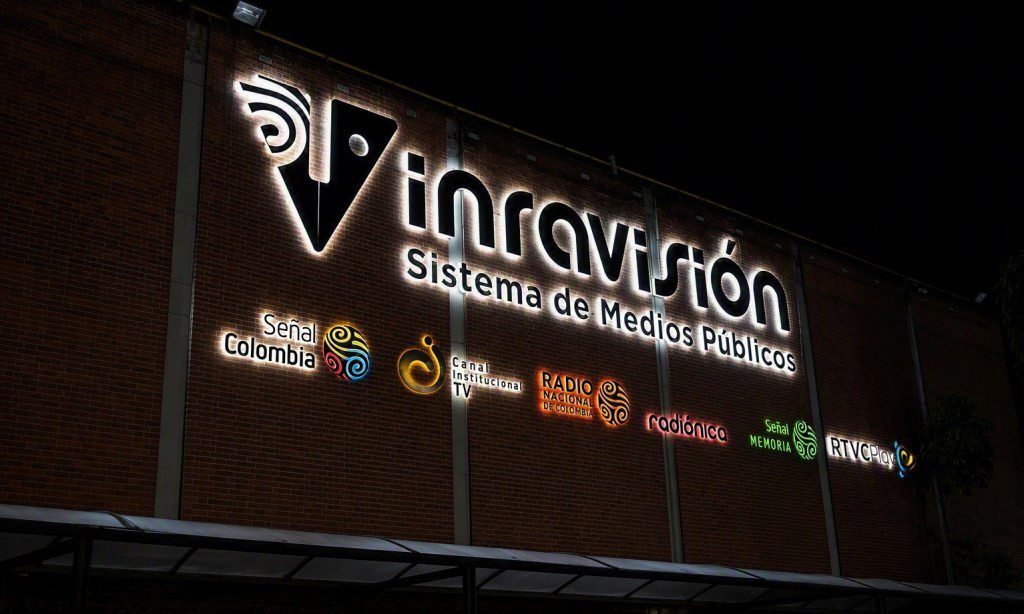
Headline photo: Illuminated signage on the Inravisión — Sistema de Medios Públicos headquarters in Bogotá.