Previous Story
After Four Years: Petro’s Legacy
Posted On August 9, 2026
Comment: Off
Tag: abelardo de la espriella, banco de la republica, Casa de Nariño, Clan del Golfo, Congress of Colombia, Constitutional Court, dane, Departamento Administrativo Nacional de Estadística, Ejército de Liberación Nacional (ELN), francia márquez, Gobierno del Cambio, Government of Change, Gustavo Petro, Miguel Uribe, Ministry of Agriculture, peace agreement, Petro´s Legacy, Presidency of Colombia, superintendencia nacional de salud, total peace
What remains after four years of Colombia’s first left-wing government?
Four years after Gustavo Petro took office, Colombia is a different country from the one he inherited in August 2022, but it continues to face some of its deepest historical problems: inequality, violence, drug trafficking, illegal economies, corruption and the state’s limited ability to exercise control over large parts of the country.
Petro came to power with an ambitious promise: to transform the country. His election represented a historic change in itself. For the first time, a leader from the left reached the presidency, and social sectors traditionally distant from power gained direct representation in the executive branch.
Four years later, just as the self-described “Gobierno del Cambio” (Government of Change) comes to an end, the record is mixed. Petro leaves behind measurable social progress, a broader political spectrum capable of competing for power and significant reforms in labor and politics. But he also leaves unfinished projects, a peace policy that failed to achieve its objectives, a persistent crisis in the health care system, corruption scandals, and an administration marked by high ministerial turnover.
Perhaps his deepest legacy lies not in any specific reform, but in demonstrating that Colombian democracy could incorporate sectors that had remained on the margins of power for decades without altering the system of checks and balances that underpins the country’s democratic processes.
The main achievement: A broader democracy
Petro’s election in 2022 was the culmination of a political process Colombia had been experiencing for decades: the gradual expansion of the ideological spectrum with a realistic chance of reaching the presidency.
Francia Márquez‘s rise to the vice presidency carried equally profound significance. A Black woman from a region historically affected by poverty and conflict, her election became a symbol of political mobility and representation in a country where economic and social elites have traditionally dominated the main centers of power.
Márquez built part of her political discourse around the “nadies” (nobodies), an expression intended to champion historically excluded communities. Petro incorporated that narrative during his term and embraced political and social inclusion as one of the defining elements of his administration.
From that perspective, regardless of how its public policies are evaluated, the Petro administration leaves behind a broader democracy: after 2022, Colombia demonstrated that ideological, social, ethnic and regional groups previously distant from presidential power could also reach the Casa de Nariño. It was a necessary message for a country whose guerrilla movements emerged partly in response to the traditional two-party system of the last century.
Paradoxically, that expansion coexisted with an often-conflictive relationship between the president and some of the institutions designed precisely to limit the exercise of power.
At various points, Petro challenged Congress, the courts, the Banco de la República, the media and sectors of the opposition when their decisions stood in the way of parts of his agenda. Those checks, however, are not an anomaly in Colombia’s political system but one of its structural components: the system of checks and balances.
Incoming President Abelardo de la Espriella will likely face a similar reality. Without his own majorities in Congress, his ability to govern will also depend on negotiations, judicial oversight and institutional limits that no president can eliminate simply by winning an election.
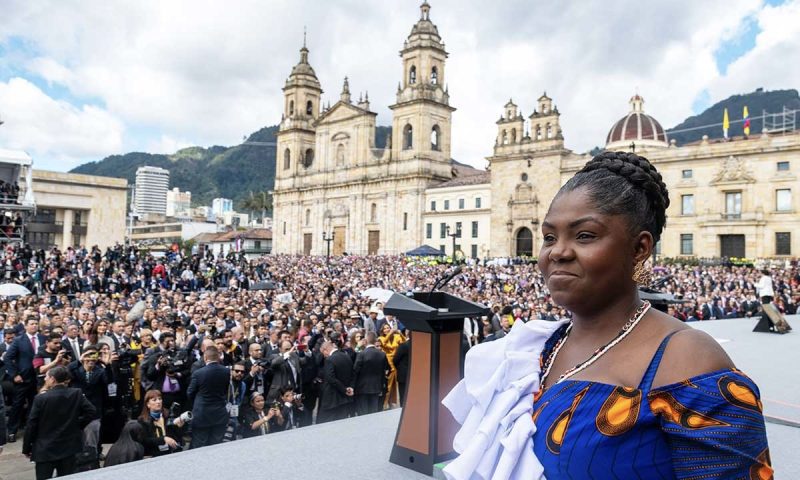
Francia Márquez during her inauguration as vice president of Colombia at Plaza de Bolívar in Bogotá on August 7, 2022. Photo courtesy of the Presidency of Colombia.
Less poverty, more employment and higher wages
On social issues, several indicators improved during the Petro administration.
In 2025, according to figures from the Departamento Administrativo Nacional de Estadística, or DANE, monetary poverty fell to 28%, the lowest level recorded in the country up to that point. Petro had taken office in 2022, when the rate stood at 36.6% following the sharp increase caused by the pandemic.
During the first three years of his administration, about 3.8 million people moved out of monetary poverty and nearly 1 million escaped extreme poverty, according to official DANE figures.
The labor market also improved. Unemployment, which stood at around 11.3% in 2022, fell to about 8% during the first months of 2026.
Petro also ended his term with a 23% increase in the minimum wage for 2026, far above inflation, which closed 2025 at 5.1%. The measure directly benefited about 2.5 million workers and their families and reflected one of the president’s most consistent political priorities: improving workers’ incomes and conditions.
The labor reform moved in the same direction, increasing the amount employers must pay for nighttime, Sunday and holiday work: one of the country’s long-standing labor policy shortcomings.
Those results allow the outgoing government to argue that part of its redistributive agenda produced tangible effects, even though Colombia remains a deeply unequal society.
Reforms that advanced and those left halfway
The record of Petro’s major structural reforms is considerably more complex.
Agrarian reform, one of his central campaign promises, fell far short of its goals. Petro had proposed purchasing 1.5 million hectares of land for distribution to farmers and advancing the formalization of 7 million hectares envisioned under the Peace Agreement.
According to figures from the Ministry of Agriculture, more than 462,000 hectares had been purchased by mid-2026, less than one-third of the announced target.
On pensions, the government succeeded in getting Congress to approve an overhaul of the system that replaced competition between public and private regimes with a system based on a public foundation and additional savings mechanisms administered by private entities. To secure its passage, the executive branch had to compromise on some of its original objectives. The reform was subsequently challenged in court, and its implementation was suspended while the Constitutional Court reviewed the legislative process, which remains unresolved in the absence of a final ruling from the court.
Colombia’s institutional system thus once again demonstrated the limits any president faces when attempting to implement structural transformations without sufficiently broad political consensus.
“Total Peace”, one of the administration’s biggest defeats
If there was one area where results fell particularly far short of initial expectations, it was security policy and the so-called “Total Peace” initiative.
Petro came to power proposing simultaneous negotiations with different armed organizations to reduce violence and move toward resolving the conflicts that persisted after the 2016 agreement with the FARC.
Four years later, his government ended without reaching a final agreement with the main armed groups with which it had opened negotiations.
During that period, organizations such as the Ejército de Liberación Nacional (ELN), and the Clan del Golfo maintained or expanded their operational capacity in different territories, while the country continued to record kidnappings, recruitment of minors, attacks and killings of social and political leaders.
Political violence reached one of its most serious moments with the killing of presidential hopeful Miguel Uribe, an event that reminded the country of the dangers of political violence that Colombia had believed it had left behind.
The failure of Total Peace to produce sustainable agreements will likely be one of the most difficult aspects of the outgoing president’s legacy to defend.
A health care transformation that never came
Petro also failed to transform the health care system on the terms he had proposed during the campaign.
The reform became one of the main battlegrounds among the executive branch, Congress, insurers, health care providers and different political sectors.
As that dispute continued, patient petitions, complaints and claims increased from about 915,000 in 2021 to 2.1 million in 2025, according to figures from the Superintendencia Nacional de Salud.
By the end of the administration, many patients continued to report difficulties obtaining medications and receiving timely care at hospitals and clinics, while household out-of-pocket spending on health care increased.
Petro profoundly altered the debate over Colombia’s health care model, but he failed to replace it with the system he had promised.
Corruption undermined one of Petro’s central promises
Perhaps one of the government’s most politically costly contradictions was corruption.
Petro had built much of his political career denouncing links among corruption, public contracting, and traditional power structures. His arrival at the presidency came with a promise to govern differently.
His administration, however, ended up being affected by several scandals.
The most significant involved the Unidad Nacional para la Gestión del Riesgo de Desastres (UNGRD), in which investigations pointed to the alleged use of public resources and contracts to benefit members of Congress in exchange for support for government initiatives.
The instability caused by the legal troubles surrounding Ricardo Roa, who headed the country’s most important oil and gas company, also had a profound economic impact, eroding both the company’s market value and the governance of one of the institutions underpinning the national economy.
Those controversies were compounded by investigations and disputes involving members of the president’s political and family circle. His son, Nicolás Petro, faced criminal proceedings related to funds received during the campaign, while Verónica Alcocer, then the president’s wife, remains at the center of questions over the use of public funds.
Determining individual responsibility is a matter for judicial and oversight authorities, but politically, the cases eroded one of the central elements of the message that had brought Petro to power.
More than 60 ministers in four years
Administrative instability also became a defining feature of the government. Over four years, more than 60 people served across 18 ministries, equivalent to an average of more than three officeholders per ministry.
The changes reflected political crises, disagreements within the governing coalition, differences between ministers and the president, shifts in the executive branch’s priorities and, at various points, difficulties maintaining a stable administrative course.
The result was a government with considerable rhetorical ability to place issues on the public agenda, but greater difficulty turning some of those debates into sustained policies over its four years in office.
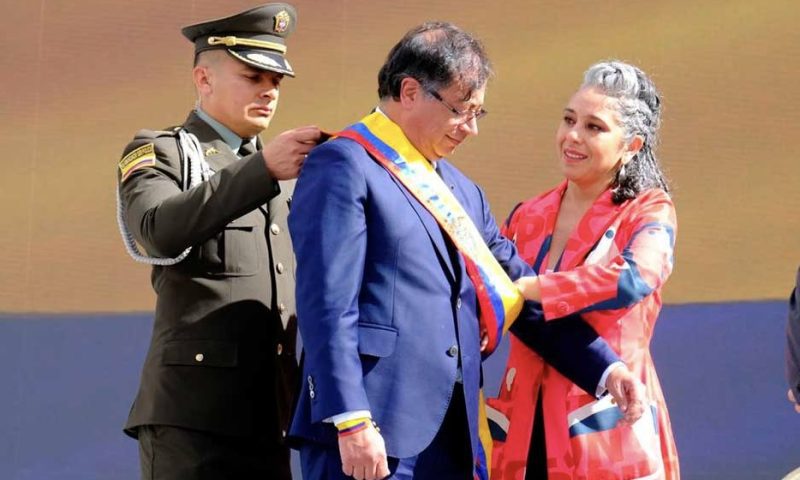
Congresswoman María José Pizarro places the presidential sash on Gustavo Petro during his inauguration at Plaza de Bolívar in Bogotá on August 7, 2022. Photo courtesy of the Presidency of Colombia.
Petro changed who can govern, but not the rules of power
Gustavo Petro’s legacy can hardly be reduced to a simple choice between success and failure.
His administration produced tangible social results and expanded the boundaries of political representation in Colombia. It also put issues on the agenda that will likely remain part of the debate under future governments: inequality, the energy transition, agrarian reform, the functioning of the health care system, and representation for historically excluded populations.
But the promise of structural transformation was far broader than the results ultimately achieved.
Petro discovered, as his predecessors did and as De la Espriella probably will, that winning the presidency does not mean controlling the Colombian state. Congress, the courts, oversight agencies, the Banco de la República, regional governments, the media and a deeply polarized civil society impose limits on any political project.
Petro discovered, as his predecessors did and as De la Espriella probably will, that winning the presidency does not mean controlling the Colombian state. Congress, the courts, oversight agencies, the Banco de la República, regional governments, the media and a deeply polarized civil society impose limits on any political project.
In that sense, the main transformation of these four years may have been less institutional than democratic: Petro did not completely change the way Colombia works, but he did help change the idea of who can govern it.
De la Espriella’s arrival at the presidency from the opposite end of the ideological spectrum is, paradoxically, another manifestation of that expansion.
Colombia thus ends four years of its first left-wing government and begins its first far-right government. What remains between the two is a democracy with more diverse political alternatives, but one that is also deeply polarized, with institutions under intense strain and many of the country’s historical problems still unresolved.