Previous Story
Colombia and Ecuador Escalate Trade Tensions with Tariffs Raised to 100%
Posted On April 13, 2026
Comment: Off
President Gustavo Petro recalls Colombia’s ambassador and signals a potential withdrawal from the Andean Community of Nations (CAN)
Ecuador’s government announced an increase in the so-called “security tariff” applied to imports from Colombia, raising it from 50% to 100%, a move that has intensified trade tensions between the two countries.
In response, the Colombian government, through its Ministry of Commerce, Industry and Tourism, said it will match Ecuador’s measure by adjusting its tariffs to the same level, arguing the need to “maintain balance in bilateral trade conditions.”
The Ecuadorian decision was formalized through a resolution issued by the National Customs Service of Ecuador (Servicio Nacional de Aduana del Ecuador), which establishes that the new tariff will take effect on May 1, 2026.
According to Ecuador’s government, led by President Daniel Noboa, the measure is driven by concerns over border security. In an official statement, authorities said that “after confirming the lack of implementation of concrete and effective border security measures by Colombia, Ecuador is obliged to adopt sovereign actions.”
Colombia’s response and diplomatic measures
Amid the escalation, President Gustavo Petro announced immediate diplomatic actions, including recalling Colombia’s ambassador to Ecuador, María Antonia Velasco, whom he said “must return immediately” to Colombia. He also stated that “the next cabinet meeting will be held at a location along the border with Ecuador,” in a message posted on X.
Petro also criticized statements from Ecuador’s government, saying that “the president of Ecuador insults the Colombian government, which has seized more cocaine than at any point in world history.”
For her part, Minister of Commerce, Industry and Tourism, Diana Marcela Morales Rojas said Colombia “had maintained open diplomatic channels prior to Ecuador’s decision.”
“We have exhausted all diplomatic efforts and kept dialogue channels open with the Government of Ecuador, seeking a solution that benefits both countries, businesses, and above all, communities on both sides of the border. However, we have not received a positive response,” she said in a statement.
Economic impact and trade response
Colombia’s government, led by the Ministry of Commerce, Industry and Tourism, also announced it will amend Decree 170 to raise tariffs to 100%, in line with Ecuador’s measure. The proposal will be submitted to the Committee on Customs, Tariff and Foreign Trade Affairs (Triple A) for review, meaning that details and the effective date of the increase have yet to be determined.
According to the statement, Ecuador’s tariff hike distorts competitive conditions in the Andean market, negatively affecting Colombian producers competing with Ecuadorian goods.
The government also announced relief measures aimed at mitigating the impact on the productive sector, including favorable credit lines, expanded access to financing, and mechanisms to preserve employment.
Political escalation and questions over the Andean system
Amid the growing trade dispute, President Petro also signaled a potential shift in Colombia’s economic foreign policy, stating that Ecuador’s actions “mark the end of the Andean Pact for Colombia.”
“We have nothing left to do there. The foreign minister must begin the process of joining Mercosur as a full member and redirect our efforts toward the Caribbean and Central America,” he said.
The Andean Pact, also known as the Andean Community of Nations (CAN), established in 1969 by Colombia, Ecuador, Peru and Bolivia, has historically been a cornerstone of regional economic integration.
Both governments have filed formal complaints with the CAN, which will assess the admissibility of the claims and may mediate the dispute.
More information on the trade dispute between Colombia and Ecuador? Read Trade War Between Colombia And Ecuador Escalates, With 50% Tariffs Threatened by Finance Colombia.
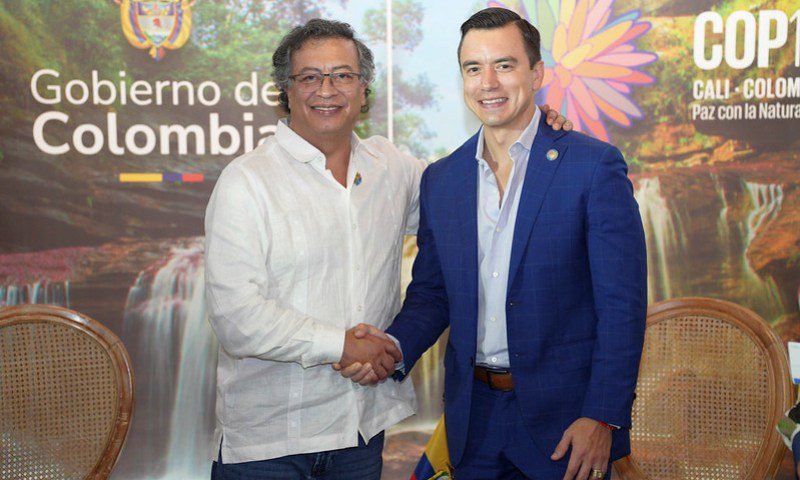
Above photo: President Gustavo Petro of Colombia with President Daniel Noboa of Ecuador (photo courtesy Presidencia of Ecuador)